

















How to connect to the internet in Vietnam in 2026: eSIM or SIM card
Without mobile internet, a trip to Vietnam gets harder. You can't call a Grab, open a map, or translate a hotel address. The good news is that connectivity here is among the cheapest in Asia.
You have one choice to make. Buy an eSIM online before your flight or get a local SIM card at the airport. The second option is cheaper, but adds registration hassle. Starting April 15, 2026, Vietnam requires mandatory biometric verification when activating a new card (Circular 08/2026, Vietnam Ministry of Science and Technology).
Below we break down the carriers, plans, and how to avoid being left without connectivity on your very first day.
Ad: this article contains affiliate links. We earn a commission if you book through them, at no extra cost to you.
The essentials on SIM cards and eSIMs in Vietnam
💡 In short:
- For trips up to three weeks, get an eSIM: buy it in advance, turn it on when you land.
- Get a local card at a carrier store, not at the first airport kiosk.
- Viettel leads in coverage, followed by Vinaphone and MobiFone.
- Unlimited plans always have a daily speed cap, check it before you pay.
- Carrier prices and registration rules: 09/2026, verified on the Vietnam Ministry of Science and Technology website
Vietnam is covered by 4G and 5G networks almost everywhere tourists go. Networks differ in speed, but the paperwork side is the same. The card is tied to the owner's passport, and this is done right at purchase. It's registration, not coverage, that most often ruins travelers' first day.
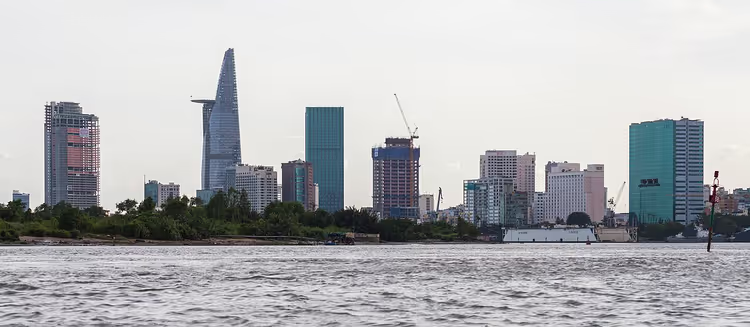 © Diego Delso · CC BY-SAPhoto: Diego Delso, CC BY-SA (https://creativecommons.org/licenses/by-sa/3.0), Wikimedia Commons
Do you need a SIM card or eSIM in Vietnam
Free Wi-Fi awaits you in hotels, cafes, and train stations, but it doesn't solve three tasks: calling a Grab, building a route in Google Maps, and translating a menu or address. Mobile internet handles them in a couple of seconds, and without it, getting around an unfamiliar city turns into a constant search for a hotspot. Offline maps work poorly, and finding a taxi without an app is hard.
A separate plus is that Vietnamese connectivity costs pennies by European standards, so you pay once and stay online for the whole trip. Even a short weekly package pays for itself in peace of mind.
SIM card or eSIM: which is better
Criterion | Local SIM card | eSIM |
|---|---|---|
Where to buy | airport, carrier store | online, before your flight |
Registration | passport and biometrics on site | not needed, the provider handles it |
Phone number for calls | yes | usually no |
Price | lower | slightly higher |
Your home card | you need to open the SIM tray | stays active |
Buying at the airport looks simple. However, it's precisely the kiosks in the arrivals area that most often sell used or poorly registered cards. You can't verify registration by looking at it, and the card stops working after a couple of days.
An eSIM eliminates this problem. You buy it online, install it at home via QR code, and turn it on upon arrival. The price difference is a few euros. In return, you don't stand in the arrivals hall and don't risk losing connectivity mid-trip.
How much data do you need for a trip
Mobile data runs out faster than it seems, because maps, Grab, messengers, and stories add up to a noticeable amount. Carriers consider about 1 GB per day a comfortable norm (Vinaphone tourist plans).

The hungriest item on this list: video. An hour of high-quality viewing consumes more data than maps, email, and messaging over an entire day, so don't go by the number of messages, but by how much you watch and how much you tether to other devices.
If you shoot video or work from cafes, plan for twice as much (provider data usage estimates). For a long trip, get a package with headroom or an unlimited plan with a high daily cap. Otherwise, by day four you'll be buying extra gigabytes at an inflated price.

How an eSIM for Vietnam works
An eSIM is a digital SIM card inside your phone. No physical card is needed, and you don't open the SIM tray either. You buy a plan online, receive a QR code, and confirm installation. Upon arrival, you just enable the profile in settings.
The main benefit shows up in the first hour. You step off the plane and immediately order a Grab, without hunting for a card kiosk. Your home card stays in the phone, and SMS verification codes from your bank arrive as usual.
There are limitations too. With most providers, an eSIM doesn't give you a local number, so calls and SMS go through WhatsApp or Telegram. For tourist needs, that's enough. Plans with a number do exist, but they're less common and cost more.
Some packages work in several Asian countries. That's convenient if you're heading to Cambodia or Thailand after Vietnam. You can top up the plan remotely if you run out of data early.
Before buying, check your phone's compatibility. Each provider publishes a list of supported models. From our experience traveling around Southeast Asia: install the profile at home, not in the arrivals hall, where the network is unstable.
How to install an eSIM: step by step
The purchase takes a few minutes, but the order of steps matters, and it's worth remembering in advance. First, you choose a plan on the provider's website and pay by card, after which an email arrives with a QR code and short instructions. Install the profile at home, connected to your home Wi-Fi, because airport networks can be overloaded and the email with the code may not open. The phone saves the profile as inactive, and it won't consume anything until you land. Upon arrival, you go into settings, enable the profile, and allow data, while keeping your home card for calls and SMS. If internet doesn't appear right away, wait a couple of minutes or select the network manually (Sim Local activation guide).
Best eSIM providers for Vietnam (2026)
eSIM prices change every week, and providers use different networks. Below are four services travelers mention most often. The easiest way to check current rates for your trip is to browse the catalog, for example compare eSIM plans for Vietnam.
Provider | Data | Validity | Price guide |
|---|---|---|---|
Holafly | unlimited only | 1-90 days | daily rate, the provider shows the price only at checkout (official site, as of 09/2026) |
Nomad | 1-50 GB and two unlimited plans | up to 30 days | from $4 for 1 GB for 7 days (official site, as of 09/2026) |
SIMLOCAL | from 1 GB to unlimited with 10 GB per day | 3-30 days | 10 GB for 30 days around $18 (official site, as of 09/2026) |
Klook | 1-10 GB | 1-30 days | the platform shows the price only on the plan page (official site) |
Holafly
Holafly sells only unlimited plans for Vietnam. You choose the duration yourself: from 1 to 90 days (Holafly plans). The longer the trip, the lower the daily rate, so a two-week package works out noticeably cheaper than a one-week one.
The service is considered one of the most expensive on the market, and that's true. In return, you get internet without counting gigabytes and 24/7 support. The provider allocates 500 MB per day for hotspot use.
- Who it's for: trips with streaming, video calls, and all-day navigation.
- The catch: the highest price among the four services.
Nomad
Nomad is an all-rounder. For Vietnam, it offers plans with fixed data allowances plus two unlimited options for heavy users (Nomad plans).
The key feature: top-ups. If you run out of data or your trip gets extended, you buy more gigabytes in the app without changing your eSIM. The plan also works in neighboring Asian countries.
- Who it's for: trips of three weeks or longer, when having a buffer matters.
SIMLOCAL
SIMLOCAL bets on unlimited plans with a high daily threshold. Unlimited packages include 5 or 10 GB per day at full speed (Sim Local plans). Many competitors cap the threshold at 3-5 GB, after which speeds drop.
Fixed plans are available too: from 1 GB for 3 days to 20 GB for 30 days. Some packages run on the Mobifone network, while others connect to local carriers' networks.
- Who it's for: those who tether internet to a laptop and watch videos in the evening.
Klook
Klook sells eSIM as part of its platform, and price-wise it's usually one of the cheapest options on the list. The range of plans goes from short 1-7 day packages to 10 GB with a 30-day validity, and the platform only reveals the price on the plan page, so check it before buying (Klook eSIM for Vietnam).
In Vietnam, Klook traffic runs on the Viettel network, meaning the operator with the best coverage in the country. The weak point: support. Reviews of customer service are mixed.
- Who it's for: short trips and small amounts of data.
- The catch: customer support responds more slowly than competitors.
SIM card plans in Vietnam in 2026
Prices for local SIM cards barely differ between operators. There's no point comparing down to the last cent, because everyone's pricing is roughly the same. Two parameters affect the plan: validity period and whether you need a number for calls.

Here's the choice. A regular prepaid card is cheaper, but requires top-ups and doesn't include a data package. A tourist SIM card costs more, but comes with internet for 7, 15, or 30 days right away (tourist package terms).
A good benchmark: the official Vinaphone plan. It gives you 15 days, 1 GB of internet per day, 50 minutes of calls, and 50 SMS for 199,000 dong, about €8 (as of 09/2026, Vinaphone tourist plan). At the store they'll charge extra for the physical card itself, usually 10,000-20,000 dong.
Unlimited packages are more common than fixed ones. Don't look at the word "unlimited", look at the daily speed threshold. The fair usage policy is what the operator calls the amount after which your internet becomes slow. For you, that means one simple thing: plan ahead for evening streaming and tethering to your laptop.
Check the terms while you're still at home. Prices at airport counters are a couple of euros worse than in the city.
Where to buy a SIM card and how to register it
At Vietnam's airports, counters are right by the baggage carousel. In Da Nang, you'll find them right at the exit from the arrivals area. Everyone's selection is roughly the same, and so are the prices, so there's little point in choosing based on price.

You can pay by card at the counter, which is convenient if you haven't gotten local cash yet. The counters work quickly and efficiently, so you're unlikely to be stuck in line for long.
Then comes the important part. Every SIM card is linked to the owner's passport, and at the operator's store they'll ask for your passport and take a photo. Starting April 15, 2026, a biometric facial check was added to this (new rules for mobile subscribers). The rule applies to tourists too, so you'll need your passport in any case.
You can check the registration yourself. Send a message with the text TTTB to 1414. In a few minutes you'll get an SMS with your name, date of birth, and passport number (card registration rules). If there's no data, the card isn't registered and can be disconnected at any time.
There are four operators in the country: Viettel, Vinaphone, MobiFone, and Vietnamobile. Viettel leads in coverage and speed, with the best 4G and 5G network (Viettel on tourist plans). Vinaphone and MobiFone are close behind. Vietnamobile is weaker outside major cities, so it's only worth getting for a short trip to Hanoi or Ho Chi Minh City.
It's more reliable to buy a card at an official operator store in the city: they'll also help with activation and explain the plan terms.
In the city, the selection is wider. At Viettel and Vinaphone stores, you'll be offered not only tourist plans but also regular prepaid plans with top-ups. For a trip longer than a month, that's a better deal.

Prepaid SIM card with home delivery
If your phone doesn't support eSIM, a prepaid card ordered to your home is the remaining option. These offers are sold online, and the plastic arrives by mail before you leave. All three formats are available: mini, micro, and nano.

The option is convenient in one way. You arrive with service already activated and don't waste time at counters. There are two catches: the price is higher than local rates, and the data is often limited to internet only, with no calls or SMS.
Check two things before ordering. First: whether your carrier's network is supported in Vietnam. Second: how the card will be registered. If it isn't linked to a passport under current rules, it may be disconnected (subscriber registration procedure).
For most trips, eSIM remains simpler. A prepaid card makes sense when your phone is more than five years old or when you specifically need a Vietnamese number.

⁉️🤔 Frequently asked questions
Does eSIM work in Vietnam on my phone?
Every provider publishes a list of compatible models, and it's worth checking before you pay. Most modern smartphones support eSIM. The exception is some devices made for the Chinese market, where the manufacturer has disabled the eSIM module. Checking takes a minute and eliminates the main purchase risk.
How much does a SIM card cost in Vietnam?
A price reference for a tourist card using Vinaphone as an example is given above, in the section on SIM card plans (Vinaphone plan). A regular prepaid card costs less, but you have to top it up separately. For the same plan, an airport counter usually charges noticeably more than a carrier's city store, so it's better to go into the city for a card.
Which network is best in Vietnam?
Viettel has the best coverage (Viettel data). A comparison of all four carriers is given above, in the section on buying and registering a SIM card.
Can you make calls with an eSIM?
With most providers, an eSIM gives you data only, so calls and texts go through WhatsApp, Telegram, or another messenger. Plans with a local number do exist, but they're less common and cost more. If you need a number for bank codes, keep your home SIM active in the phone.
What should I do if my SIM card stops working?
First check your registration using the SMS query described above in the section on buying and registering a SIM card (registration rules). If there's no data, the card isn't linked to your passport, and it will be disconnected again. In that case, go to a carrier store with your passport or switch to an eSIM.
In short: what to set up before your trip to Vietnam
If you're going for a week or two, get an eSIM with a fixed data package: it can be installed in advance and doesn't require registration. For a month-long trip with hotspot use, an unlimited plan with a high daily threshold is a better deal. If your phone doesn't support eSIM, your options are a prepaid card from home or a local SIM at a Viettel store.
The main rule is simple: sort out your connectivity before you fly. That way you step off the plane online, not in line at a counter.
You can order an eSIM for Vietnam in advance in a couple of minutes, and it's worth comparing insurance terms for your trip from home.

A small editorial team writing guides for independent travel. We travel ourselves, but we haven’t been everywhere, so we check prices, opening hours and how to get there against official sources.