
















Lebanon: Beirut, Byblos and Baalbek with safety warnings in mind
By 2026, Lebanon can no longer be called a calm destination. Part of its territory is closed to tourists, and in the remaining areas you should check the situation before you fly.
As of 09/2026, the Auswärtiges Amt has a partial travel advisory for Lebanon (as of: Auswärtiges Amt). You cannot ignore it: some regions are outright closed, while others are strongly advised against.
At the same time, Baalbek, Byblos, and Beirut remain some of the most history-rich places in the Mediterranean. Below you will find a route through these cities, transportation, prices, and a safety section that is best to start with.
Ad: this article contains affiliate links, we earn a commission if you book through them, at no extra cost to you.
Lebanon today: safety and entry
💡 In short:
- Before you fly, check the advisories: southern Lebanon, the Bekaa Valley, and the Baalbek-Hermel Governorate are closed to tourists.
- Visas on arrival are issued to citizens of many countries, with a stay usually up to 30 days.
- Between cities, it is more convenient to travel by car with a driver rather than on local buses.
- Safety and entry: 09/2026, verified on the official Auswärtiges Amt website.
Official advisories now matter more than any guidebook. The Auswärtiges Amt warns against travel to the southern part of the country, the Bekaa Valley, the Baalbek-Hermel Governorate, the southern suburbs of Beirut, the border with Syria, and Palestinian refugee camps. It also recommends avoiding visits to the remaining regions (as of: 09/2026, Auswärtiges Amt website).
Tripoli is singled out separately: the city has an elevated risk of violence and crime. Keep that in mind if you plan to head north.
Entry itself is straightforward. Visas are issued on arrival to citizens of many countries, and you are usually allowed to stay in Lebanon for up to 30 days (as of: 09/2026, Auswärtiges Amt entry rules). One nuance: an Israeli entry stamp in your passport will almost certainly get you denied entry to Lebanon.
Before the trip, register with your country's consular services and follow the news. The situation in the region changes quickly, and advice becomes outdated within days.
How Lebanon works
Lebanon was long a French mandate territory, and traces of that are still visible. French is still widely used in education.
Tourists should know one distinctive feature. The country's top positions are allocated by confession: the president is a Maronite Christian, the prime minister is a Sunni, and the speaker of parliament is a Shia. Parliament operates under a strict 50/50 quota between Christians and Muslims.
This structure exists nowhere else. It helps maintain a fragile balance between communities, but it also means the country has spent years unable to agree on key issues.
The scars of the civil war have not gone anywhere. Bullet marks on facades, unfinished buildings, and military vehicles on the streets can be seen across the country. Take it in stride: tourists in Lebanon are welcomed warmly, and history literally lies underfoot.
Why go to Lebanon
A logical question after the safety section. Lebanon is unlike either Egypt or Turkey. There is no polished resort infrastructure, but a small area packs in Phoenician ports, Roman temples, Crusader fortresses, and underground rivers.
Christian churches sit next to mosques here, and on a single street you will hear both French and Arabic.
Many people come back for the Lebanese themselves. People here are loud, emotional, and open: at the market they will strike up a conversation first, and a driver will consider it a point of honor to tell you where to eat. If you are tired of sterile resorts and identical beaches, you will appreciate the contrast.
Lebanon is not spoiled by tourists, and that is its advantage. At the main sights you will not find lines of tour buses. Instead, you will meet talkative locals.
 © Choinowski · CC BY-SAPhoto: Choinowski, CC BY-SA (https://creativecommons.org/licenses/by-sa/4.0), Wikimedia Commons
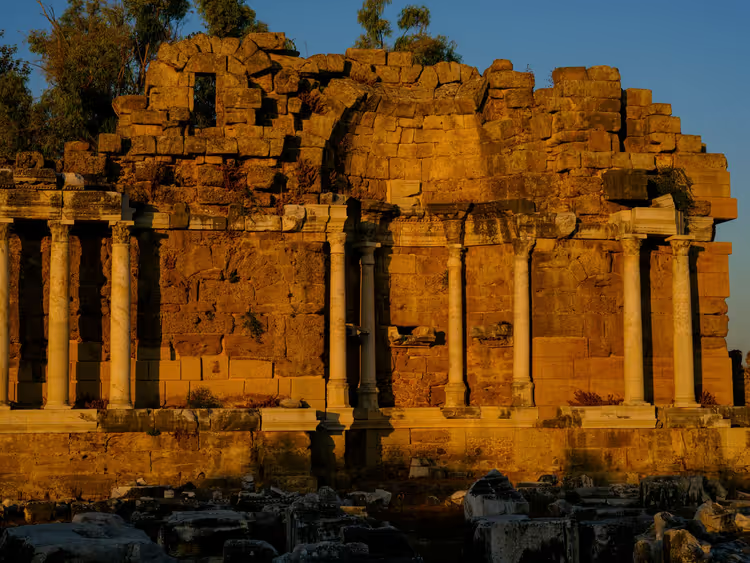
Another argument: the density of sites. Biblical Byblos and the capital Beirut lie within a couple of hours' drive of each other. Ancient Baalbek is also not far, but it is currently in a travel advisory zone.
And do not forget the food. Shawarma and kebab are made on almost every corner, and local pastry shops offer sweets you will not find in Europe.
How to get around the country
Public transportation in Lebanon is complicated. Buses and minibuses depart from the Beirut bus station, but the schedule depends on the driver: he waits until enough passengers have gathered.
There are plenty of taxis in the country, and they are persistent. Drivers honk to get your attention and are ready to intercept a passenger right at the curb. Prices are moderate, and bargaining is appropriate.
Beirut is easy to explore on foot, but for trips to other cities you need a car. The best option: arrange a driver for the day through your hotel. For a group of three or four, this is cheaper than taking a taxi for every trip.
Two sounds will stay with you for a long time. The first: the muezzin's call to prayer, which sounds five times a day and starts around five in the morning. The second: the hum of local taxi horns.
Public transportation comes with another complication: catching a return bus is difficult even for locals.
Option | When it works | The catch |
|---|---|---|
On foot | central Beirut | you will not get far beyond it |
Taxi | short trips | bargaining and pushiness |
Bus | budget outings | waits for the bus to fill up |
Car with driver | trips around the country | more expensive than other options |
The driver will come to your hotel in the morning and drive you around the country all day. Book such a trip in advance.
Baalbek
Baalbek is considered the country's main ancient site and a UNESCO World Heritage Site. It stands in the Bekaa Valley, and the Auswärtiges Amt currently explicitly warns against traveling there. Plan a visit only if the advisory is lifted.
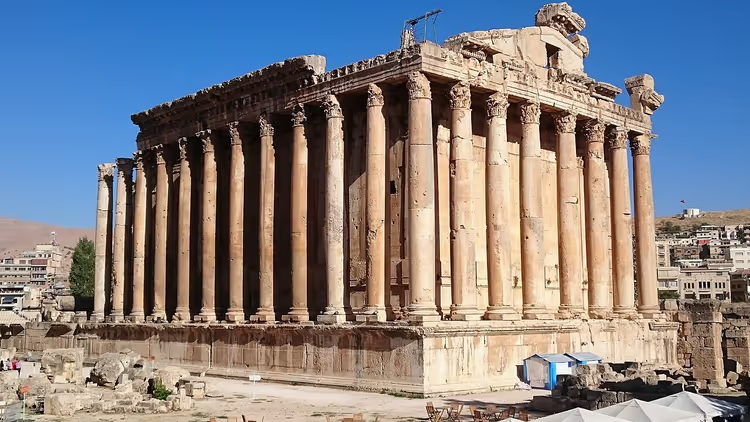
The history of the place begins long before the Romans, but it was the ancient ensemble that brought the city its fame. The largest temple is dedicated to Jupiter, with the temples of Bacchus and Venus standing nearby. Layered on top of the ancient remains are traces of a medieval fortress and a mosque.
The main structures are gathered on a single site, so the visit will not take a whole day. By the weight of individual stone blocks, Baalbek in some ways surpasses even the Pyramid of Cheops, and that is not an exaggeration.
 © Saadedine AL SAIDI · CC BY-SAPhoto: Saadedine AL SAIDI, CC BY-SA (https://creativecommons.org/licenses/by-sa/4.0), Wikimedia Commons
The local monoliths impress just as much as the temples. Individual blocks weigh hundreds of tons, and the largest one still lies in the quarry: it was never hauled to the construction site.
Entry costs about $10-15. If the advisory is lifted, it is convenient to book a tour in advance: Baalbek tours on GetYourGuide.
Near the ruins there is a tavern away from the main entrance. The cuisine is typical for the East. But the local anise spirit arak is worth trying here. It is diluted with water, which makes the drink turn cloudy, and the taste resembles licorice.
The visit takes at least two hours, and with photos even longer. Bring water: there is little shade on the site, and in summer the stones heat up so much that walking is hard. Morning is more comfortable than midday, and there are fewer groups right at opening.
What to see | Why it is interesting |
|---|---|
Temple of Jupiter | the largest in the ensemble |
Temple of Bacchus | better preserved than the others |
Temple of Venus | compact, stands separately |
Fortress and mosque | layers from different eras |
Quarry | the abandoned monolith |
Byblos (Jbeil)
Byblos, also known as Jbeil, is considered one of the oldest cities in the world. It was the main port and shipyard of the Phoenicians, but its best days are long gone: today it is a small seaside town.
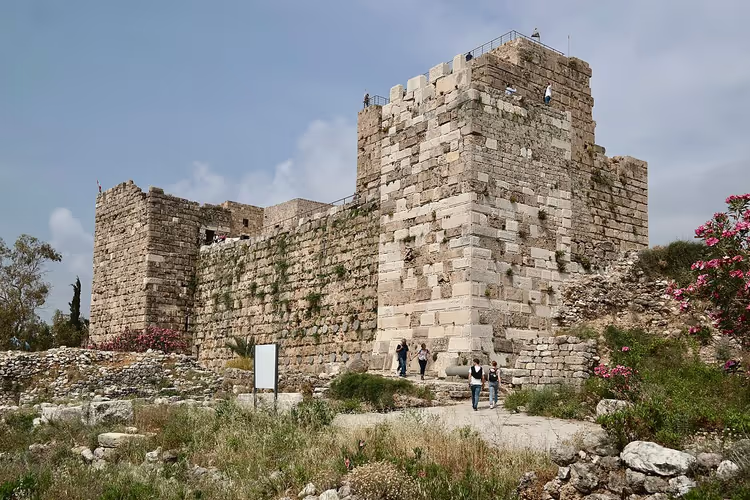
The city has preserved a 12th-century Crusader fortress, a Roman amphitheater, and an ancient necropolis of local rulers. Byblos is Christian, and you can feel it: after the Arab bustle, it looks like an island of Mediterranean Europe.
By the number of sites packed into a small area, Byblos outdoes many capitals. The fortress, the ancient theater, and the necropolis stand side by side, and the hill offers a view of the sea.
 © Orient at de.wikipedia · CC BY-SAPhoto: Orient at de.wikipedia, CC BY-SA (https://creativecommons.org/licenses/by-sa/2.0/de/deed.en), Wikimedia Commons
A separate topic: the sea. The beaches in Byblos are open and accessible, but the Lebanese themselves do not like swimming in the sea and consider it dirty.
Instead, locals dig pits in the sand, fill them with water, and splash around there, a few meters from the actual sea.
The water in Byblos is actually clean, and the beach is sandy and uncrowded. If you want a beach vacation in Lebanon, this is the place to start.
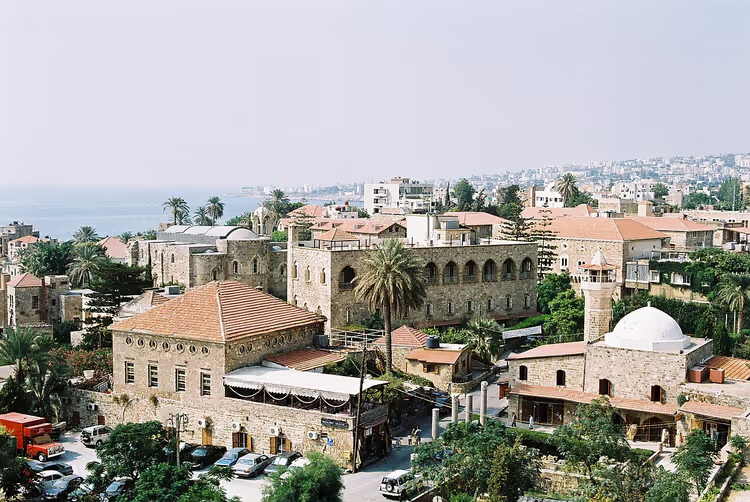
Besides the fortress, it is worth walking down to the old port. Narrow streets, stone quays, and a restored center create an almost European picture. You can walk around the city in an hour, and along the way someone will definitely offer you coffee.
Tripoli
Tripoli is called a city of sharp contrasts. Restored houses here sit next to ruined ones, and the Crusader fortress is guarded by armored personnel carriers.
The main site: the Crusader citadel, one of their last strongholds in the region. The city was taken by the Mamluks in the late 13th century, and since then the fortress has been guarded by other owners.
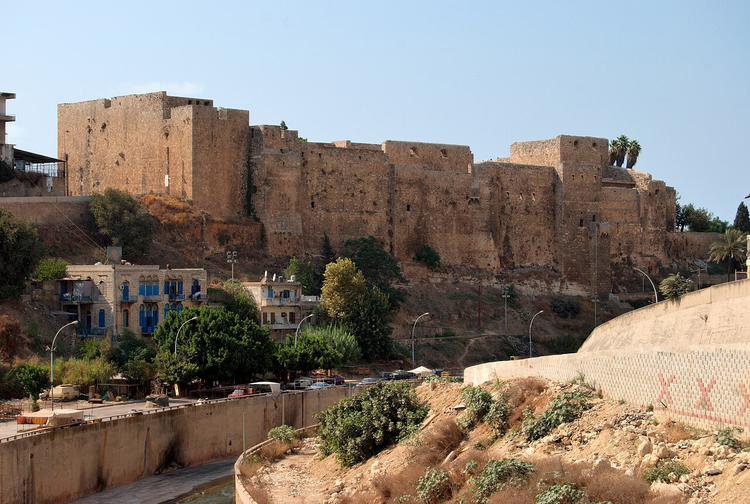 © Peripitus · CC BY-SAPhoto: Peripitus, CC BY-SA (https://creativecommons.org/licenses/by-sa/3.0), Wikimedia Commons
It is not only the walls that make an impression. In the center, by the river, locals dump mountains of unwanted clothes, and these piles are easily mistaken for a clothing market.
By Lebanese standards the city is young, but it has plenty of sites. Besides the citadel, it is worth walking through the old center and stopping by the local market.
If the citadel is closed, do not be disappointed. The old town with its markets and mosques is worth a separate walk, and the craft shops here are among the most affordable in the country.
One final reminder: the Auswärtiges Amt singles out Tripoli due to an elevated crime risk. Plan a trip there only when the situation is calm. Do not walk around here alone or after dark.
Jeita grotto, Harissa, and Jounieh
The country's natural wonder is the Jeita Grotto. An underground river emerges here through a tunnel and feeds the Dog River.
The visit starts with a boat ride through the lower level. Then you go up and walk among stalactites and stalagmites.
 © Vyacheslav Argenberg · CC BYPhoto: Vyacheslav Argenberg, CC BY (https://creativecommons.org/licenses/by/4.0), Wikimedia Commons
Photography is forbidden inside, so it is better to put the camera away and just look.
Site | Admission | Hours | Closed |
|---|---|---|---|
Jeita Grotto | about $15 (as of 09/2026, official website) | 9:00-16:00 (official website) | Monday |
An hour is enough to see both levels. Go at opening time: by noon tour groups arrive, and a line forms at the boat. Bring warm clothes, because it is cool underground even on a hot day.
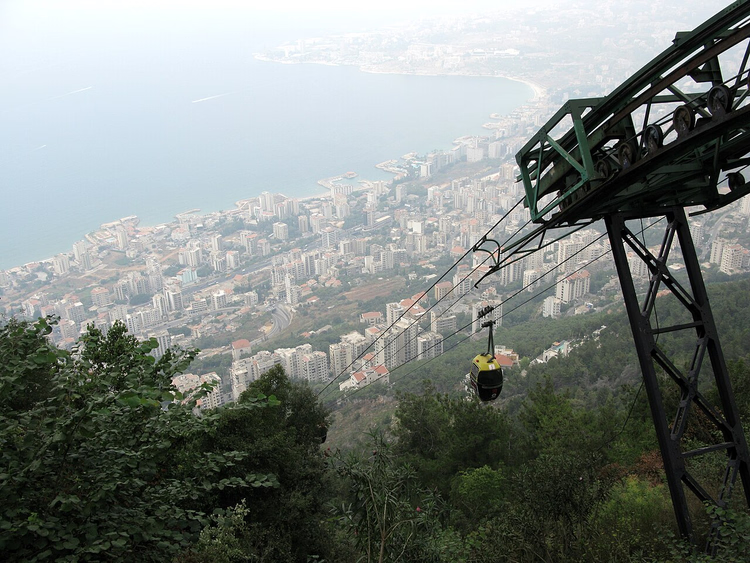
Nearby stands Harissa, the statue of the Virgin Mary, patroness of Lebanon. Inside the pedestal there is an observation deck and a chapel, and the figure itself is visible from the surrounding hills.
In the evening, the view opens onto the lights of Jounieh, the capital of Lebanese Christians. Souvenirs are sold right there, and the best one is something made of Lebanese cedar. The hill has been visited by popes more than once.
On the same hill stands the Cathedral of Saint Paul, belonging to the Melkite Greek Catholic Church. The interior here combines a Roman model with Byzantine decoration.
Harissa is especially good in the evening: the sea breeze, the lights of Jounieh, and the coolness after a hot day.
Beirut
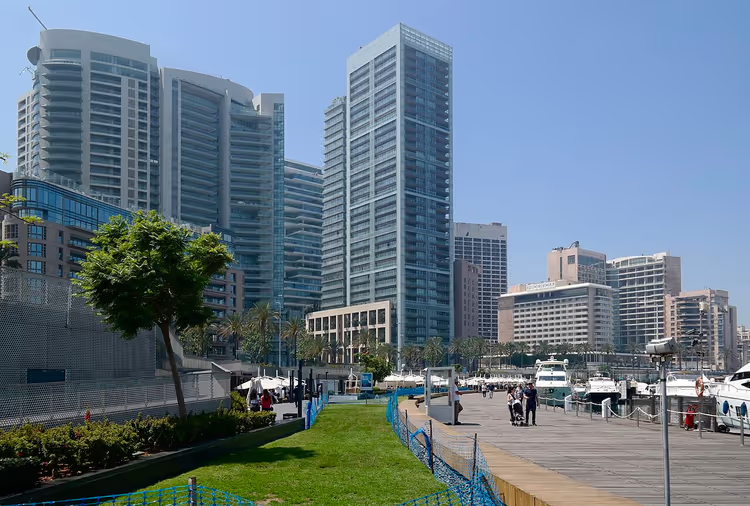
Beirut serves as the country's main air gateway: all flights to Lebanon arrive here. The city is old and rich in religious architecture.
Among the Christian churches, the Greek Orthodox Cathedral of Saint George, the Church of Saint Elias, and the Church of Saint Maron with its slender towers resembling minarets are well known.
The Muslim side is no less impressive. The Mohammad Al-Amin Mosque, also called the Hariri Mosque, stands next to Martyrs' Square. It opened relatively recently but has already become one of the city's symbols.
 © Choinowski · CC BY-SAPhoto: Choinowski, CC BY-SA (https://creativecommons.org/licenses/by-sa/4.0), Wikimedia Commons
Another must-see is the Al-Omari Mosque, one of the oldest buildings in the city. A Roman temple of Jupiter once stood on this site, then a Byzantine church. Today you will see an azure dome and massive bronze chandeliers.
If architecture can wait, Beirut has other things to do:
- Walk along the corniche and decide for yourself whether swimming in the Mediterranean is worth it.
- Try a hookah: for locals it is as much a symbol of the country as the Lebanese cedar.
- Stop by a pastry shop: Eastern sweets are understood differently here than in Europe.
- In the evening, try a glass of local Lebanese wine.
The center is worth walking. Martyrs' Square, the mosques, and the churches stand close to one another, and between them you will find cafes with sea views. You will only need a taxi for distant points.
After the capital, add a couple of addresses beyond it to your itinerary. The Horsh Ehden and Chouf nature reserves will appeal to nature lovers. The ancient Sidon (Saida) and Tyre (Sour) are interesting for history buffs, but both lie in the south of the country. This region is part of the warning zone, so it is better not to go there now.
Lebanon is small overall, so in one trip you can easily combine mountains, sea, and antiquities. The main thing is to plan your route in advance and leave extra time for the road.
Tours and tickets in Beirut
Guided tours, skip-the-line tickets and activities — most offers can be cancelled free of charge.
See offers on GetYourGuideThe widget loads once you give your consent.
⁉️🤔 Frequently asked questions
Do I need a visa to travel to Lebanon?
Citizens of many countries, including EU states, get a visa on arrival, and the length of stay usually does not exceed 30 days (as of 09/2026, Auswärtiges Amt: entry and customs). Before departure, check the current rules on the agency's website and with your carrier.
Is it safe to travel to Lebanon right now?
The country cannot be called completely safe. The Auswärtiges Amt has a partial travel advisory in effect: travel to the south of the country, the Bekaa Valley, and the Baalbek-Hermel Governorate is explicitly warned against, and visits to all other regions are strongly advised against (as of 09/2026, Auswärtiges Amt advisories). Make your decision based on the latest news.
How much do tickets to Baalbek and the Jeita Grotto cost?
A ticket to Baalbek costs about $10-15, and the Jeita Grotto complex costs about $15 (as of 09/2026, official website). The grotto is open Tue-Sun from 9:00 AM to 4:00 PM, closed on Mondays. Check prices on site.
How do I get from Beirut to Byblos and Baalbek?
Buses and minibuses depart from the Beirut bus station, but departure depends on how full the vehicle is. A more reliable option is to arrange a car with a driver for the day through your hotel: for a group of three or four people this is more convenient and often cheaper. The drive to Byblos takes under an hour.
When is the best time to visit Lebanon?
The most comfortable time is spring and autumn, when there is no summer heat. But the main factor right now is not the weather, it is the situation in the country. Check the advisories and plan your trip only for a calm period.
In short: what to book
Lebanon requires less booking and more planning. Safety first, then the itinerary.
- If you are coming for antiquity: Byblos, and Baalbek only after the advisory is lifted.
- If this is your first time in the country: base yourself in Beirut and take day trips.
- If you are short on time: Beirut, the Jeita Grotto, and Harissa.
- If you are traveling with children: the Jeita Grotto makes a stronger impression than the ruins.
Book hotels in advance: hotels in Beirut on Trip.com. For tours around the country, see tours on GetYourGuide. And before you fly, take care of connectivity: eSIM for Lebanon.

A small editorial team writing guides for independent travel. We travel ourselves, but we haven’t been everywhere, so we check prices, opening hours and how to get there against official sources.