






Meltemi: where in Greece it blows strongest and when to go
From mid-May to mid-September, the Aegean Sea runs on a schedule. The meltemi blows almost every day, and in July and August it holds at 4-7 on the Beaufort scale (Wikipedia data). For kitesurfers, windsurfers, and wing foilers, this is Europe's most reliable wind guarantee. But the wind doesn't work the same everywhere: it accelerates between islands and nearly dies down in sheltered bays. Below you'll find the mechanics of the meltemi, month-by-month statistics, and four spots that pull harder than the rest.
Ad: this article contains affiliate links, we earn a commission if you book through them, at no extra cost to you.
What the meltemi is
💡 In short:
- The meltemi blows from mid-May to mid-September, peaking in July and August.
- In high season, the wind holds at 4-7 on the Beaufort scale almost every day.
- For windsurfing and wing foiling, head to Karpathos; for kitesurfing with flat water, choose Prasonisi.
- Season and wind strength: 09/2026, verified against Wikipedia reference.
The meltemi is the name for the steady northerly wind of the Aegean Sea. The ancient Greeks called it the "etesians," meaning annual winds, because it returned every summer. It doesn't blow like a typical sea breeze but as a large-scale weather system over the entire eastern Mediterranean. That's its defining feature: the wind holds for days and depends little on local heat.
Dry air from the north brings clear skies and excellent visibility. On the water, it provides the coolness without which summer heat on the islands is hard to bear. For surfers, something else matters more: the meltemi has a high recurrence rate. From mid-May to mid-September it blows consistently, and during the peak weeks of July and August almost without interruption (description of the wind regime).
A strong meltemi can keep blowing even at night. A typical shore breeze shuts off completely by evening, but this wind holds most of its strength until morning. Anyone planning long sessions feels the difference: you won't lose a day of riding just because of a calm.
Who this matters to in practice. A beginner needs light morning wind and a wide, shallow shore. An experienced rider wants maximum power and open water. Both needs are met on the same islands, but at different times of day and in different bays. That's why the same spot can work for both a family with kids and an athlete with their own gear.
What the meltemi is not. It's not a thunderstorm or a storm front. It doesn't arrive with rain or turn the weather overcast. The danger here is different: the wind blows steadily and strongly for many days in a row, so the people who get into trouble are exactly those who underestimated its persistence.
Why the meltemi blows every summer
It comes down to a simple pair: a high-pressure area sits over the Balkans, and a low-pressure area over Anatolia and the Middle East. In summer, the land of Asia Minor heats up, the pressure gradient grows, and dry air flows from the north across the Aegean Sea to the south. This pattern is described as the seasonal trade wind of the eastern Mediterranean (trade wind description).
Direction depends on terrain. In the northern Aegean, the wind comes from the northeast; in the central part, from the north; and near Crete and Karpathos it turns toward the northwest (on wind direction). So "the meltemi always blows from the north" is only roughly true. At any given spot, you'll feel your own angle.
During the day, the contrast intensifies. Land heats up more than water, the pressure gradient grows, and the northerly flow accelerates. That's why afternoon hours at the spots are the strongest, and by evening the wind eases slightly (daily dynamics). We'll break down the hour-by-hour details below.
The Venturi effect: why it's stronger between islands
Mountainous islands act like a nozzle. Air compresses in narrow straits and accelerates, so the wind in a channel between two islands is stronger than in open water. The gain reaches two Beaufort points (Venturi principle).
On the leeward side, the pattern is reversed. A steep slope produces gusty, fading flows, but right at the shore the water stays smooth. That's how flat-water zones appear: strong wind and flat water in the same bay. This is the best option for beginners and for anyone working on turns.
Here's the practical takeaway. If you want predictable flat water, look at channels and leeward bays. If you want waves, take the windward side, where the wind comes off the sea.
Check the forecast for a specific bay, not for the island as a whole. The difference between two beaches on the same island can be a full Beaufort point. That's exactly why Paros and Naxos have a calm lagoon and strong chop sitting side by side.
The narrower the passage, the stronger the acceleration (channel between islands).
That's why the same forecast reads differently depending on where you're going. For open water, use the general picture; for a specific bay, use a local model. In the Aegean, straits and ridges change the picture every day, and it's worth budgeting a day for travel because of that.
Wind strength by month
The main season runs from mid-May to mid-September, with short wind windows remaining in October. The peak falls in July and August: during these months the wind blows at the right strength almost every day. Below are month-by-month reference points, as described by windsurf stations and spot reviews (seasonal data).
Month | Wind probability (≥ 4 Beaufort) | Typical strength | Who it's for |
|---|---|---|---|
May and June | 40-60% | 3-5 Beaufort | Beginners and those getting back into shape |
July and August | around 70% | 4-7 Beaufort | Experienced riders, strong steady wind |
September | 50-65% | 4-6 Beaufort | Those who want warm water and fewer people |
October | 30-45% | 3-5 Beaufort | Short wind windows at the end of the season |
Treat the probability figures as a reference point, not a guarantee. On Karpathos, station statistics show the highest values in Greece (wind map). In the main riding areas the meltemi stays in the strong range, and individual spots with the Venturi effect deliver noticeably more.
What this means for your trip. If you're going for strong wind, plan for July or August. If you want warm water and fewer people, choose September. For your first steps on the water, the start of the season, May and June, works best.
Remember the gusts. The average wind in the forecast won't tell you about gusts in the channel. At strong spots a gust can be several Beaufort above the baseline, so bring gear with some margin.
Daily cycle: morning, midday, evening
Morning at the spot is the calmest. The wind is light, the water is smooth, and there are few people at the launch. If you're just learning, this is your time. Experienced riders often take a big kite or sail during this window and work on technique without overload.
By midday the wind picks up. Heating of the land strengthens the pressure gradient, and the flow builds hour by hour. The maximum comes between 2:00 PM and 5:00 PM, when strong spots blow 5-7 Beaufort (daily profile). Chop appears on open water, while flat water holds near the shore.
In the evening the wind gradually eases. By sunset it's noticeably weaker than the daytime peak, but it doesn't shut off completely. On Karpathos the channeling in the strait works even at night, so late sessions there are common (Karpathos spot data).
How to structure your day. An early start gets you the calm morning, and the evening is better left for rest. If you need strong wind and don't care about flat water, plan your riding for the afternoon.
Meltemi and sea breeze: what's the difference
A sea breeze is familiar to anyone who has spent time by the sea. It kicks in during the day, when the land heats up faster than the water, and dies down after sunset. Its strength is modest, and it doesn't extend beyond a narrow coastal strip.
The meltemi is dozens of times larger. It's a system over an entire region, not a local flow. It blows for days without nighttime pauses and at its peak reaches 7-8 Beaufort (reference on the etesians). A regular breeze never produces those values.
The practical difference for you. Riding on a sea breeze is scheduled for the second half of the day. With the meltemi the forecast is more stable: if the system has set in, the wind will hold for several days in a row, and you're almost guaranteed to get your planned sessions in.
There's a flip side too. A light breeze is nearly harmless, while a strong meltemi demands discipline. Keep a reserve of energy and don't go out without a rescue boat if the wind is pushing offshore.
Best spots for kitesurfing and windsurfing
The Aegean Sea offers some of the most reliable riding areas in Europe. But the islands differ from each other a lot: in some places a strait makes all the difference, in others it's the shape of the coastline. Below are the four spots people choose most often (overview of riding areas).
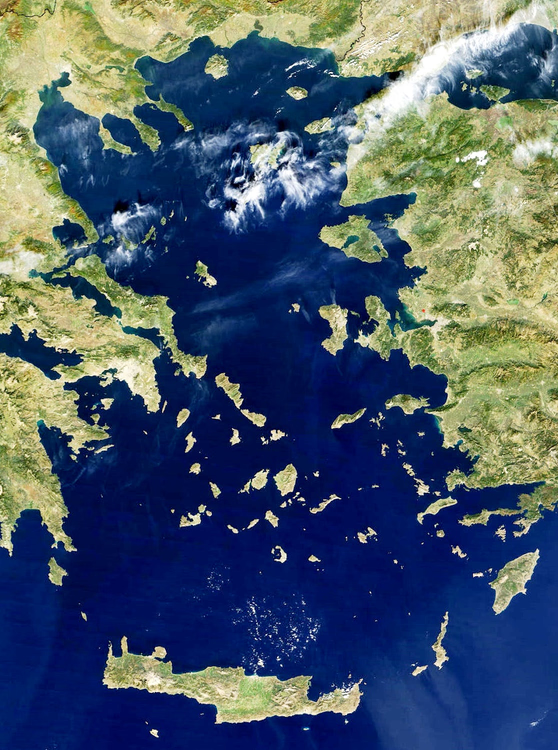
From there, the choice depends on what you're after. For fast progression you need steady crosswind and a shallow shore. For speed and jumps you need a strong flow and flat water. All four spots below cover different scenarios, but they require different skill levels (Naxos spot conditions).
Karpathos: Devil's bay and chicken bay
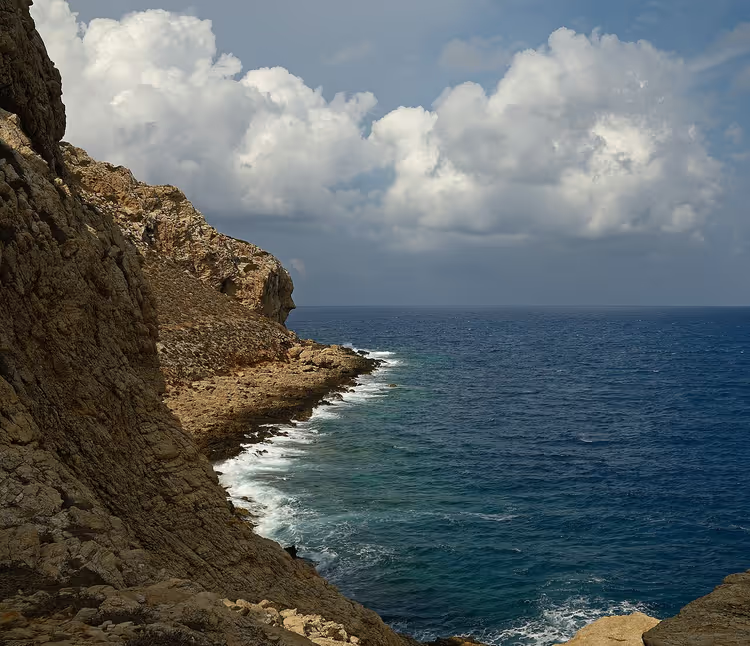
Karpathos is the windiest island in Greece. In Devil's Bay, the channeling between the mountains accelerates the flow to 5-7 Beaufort on average, and on some days up to 9 (overview of Karpathos spots). Nearby, there are stations with rental gear and instructors.
 © Ввласенко · CC BY-SAPhoto: Ввласенко, CC BY-SA (https://creativecommons.org/licenses/by-sa/3.0), Wikimedia Commons
The water in the bay is flat, with no waves. For windsurfing and wing foiling these are almost ideal conditions: long tacks and high speed. The wind here is offshore and cross-shore, so kitesurfing on Karpathos is left to experts only (spot data).
- How to get there: Karpathos airport, then drive to Afiartis (about 15 km on the map).
- Who it's for: experienced windsurfers and wing foilers.
- The catch: offshore wind, only pros should kitesurf here.
- Hotels on Karpathos on Trip.com
Rhodes: two sides of Prasonisi
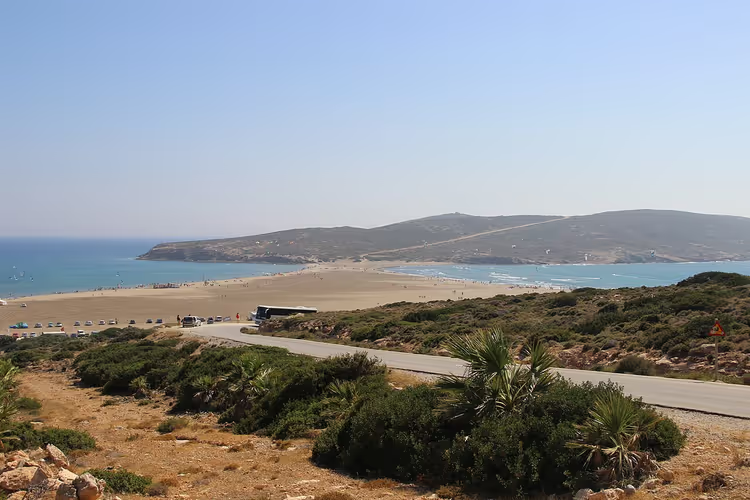
Prasonisi is a narrow sand spit in the south of Rhodes. The sandy strip connects a small island to the mainland, and the wind accelerates in this narrow spot (spot description). Two different bodies of water sit right next to each other here.
 © Vadim Indeikin · CC BY-SAPhoto: Vadim Indeikin, CC BY-SA (https://creativecommons.org/licenses/by-sa/3.0), Wikimedia Commons
On the western side there is a calm, shallow lagoon. It's flat water for kiting, freestyle, and first steps. The eastern side is open to the Aegean Sea: there you get waves and wind from the sea, so advanced riders choose it (spot guide).
Prasonisi is convenient because both areas are right next to each other. You can learn on the lagoon in the morning and move to the wave side after lunch. You progress without relocating to another island, and schools operate on both shores.
- How to get there: the southern tip of Rhodes, about 1.5 hours by car from the airport (on the map).
- Who it's for: beginners on the western side, experienced riders on the eastern side.
- The catch: in high season the lagoon fills up with school students during the day.
- Hotels in Rhodes on Trip.com
Paros: the channel and Pounda
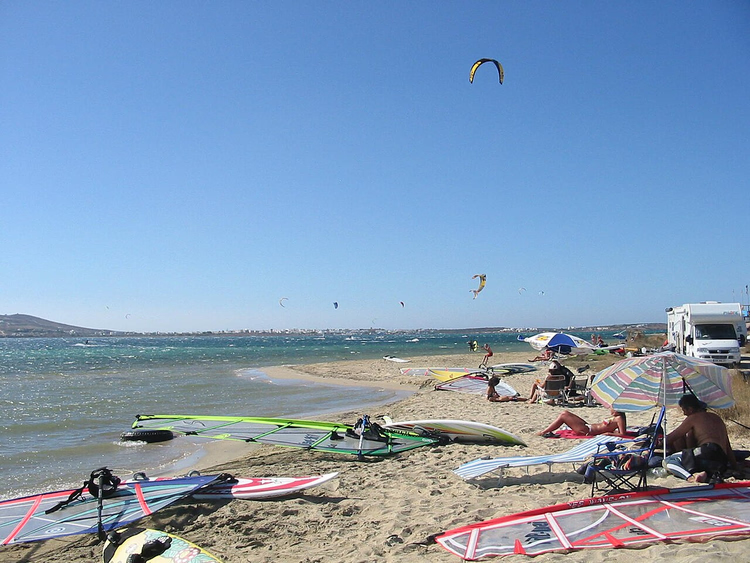
Pounda sits on the southwestern shore of Paros. The same compression effect works here: air enters a narrow channel and accelerates. As a result, the wind holds at 20-30 knots almost all summer (Paros overview). Paros has hosted World Cup windsurfing events more than once.
 © brunobarbato · CC BYPhoto: brunobarbato, CC BY (https://creativecommons.org/licenses/by/3.0), Wikimedia Commons
The water at Pounda is a mix of flat sections and moderate chop. That's convenient: you pick a smooth stretch for speed or a choppy lane for jumps. The spot suits both kitesurfers and wing foilers (channel conditions).
- How to get there: southwestern Paros, about 15 minutes by car from the port of Parikia (on the map).
- Who it's for: intermediate and advanced kiters and wing foilers.
- Hotels in Paros on Trip.com
Naxos: Mikri Vigla
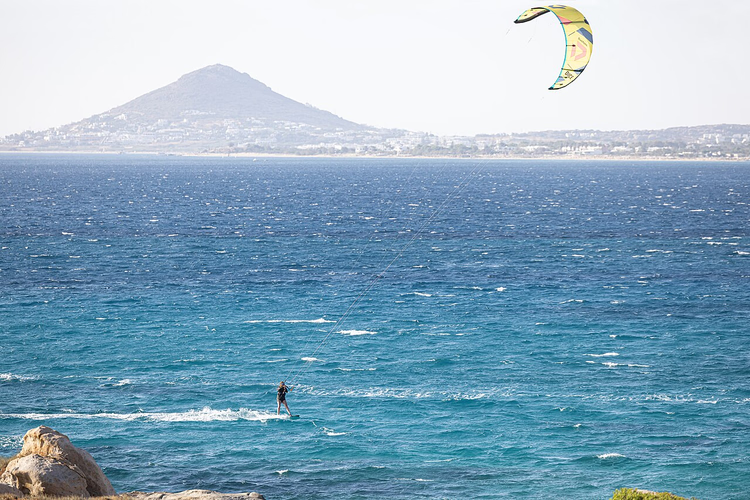
Mikri Vigla lies on the southwestern shore of Naxos. The strait between Naxos and Paros adds 5-10 knots to the overall flow, which is why the island is considered the windsurfing capital of the Cyclades (Naxos spot data).
 © Tsui · CC BY-SAPhoto: Tsui, CC BY-SA (https://creativecommons.org/licenses/by-sa/4.0), Wikimedia Commons
The wind here is side and side-onshore, and it builds gradually through the day. The bottom is sandy, and the entry is gentle. That makes Mikri Vigla a good fit for people taking their first steps on a kite or wing foil (Naxos overview).
Near Mikri Vigla there is accommodation right by the water, and the sea entry is sandy and gradual. After a session you don't need to drive anywhere, and a beginner walks into the water without rocks or reef (Mikri Vigla overview).
- Getting there: southwest Naxos, about 20 minutes by car from the port of Naxos (on the map).
- Who it's for: beginners and progressing riders.
- Hotels on Naxos on Trip.com
Which spot suits your level
Your level matters more than the weather. In strong offshore wind, misjudging your abilities quickly leads to an emergency. That's why spots are classified not by scenery, but by wind conditions and depth (safety overview).
Level | Wind | What you need on the water | Spot |
|---|---|---|---|
Beginner | 3-4 Beaufort | wide shallow shore, onshore wind | Rhodes and Kos lagoons |
Progressing | 15-22 knots | steady crosswind, moderate chop | Naxos, Paros |
Experienced | over 30 knots in gusts | flat water, full gear control | Karpathos, Prasonisi |
Beginners need a large shallow area and wind that pushes them toward shore. That way a fall doesn't turn into a long swim. Kos and Rhodes have plenty of such spots, which is why schools operate there all summer (school data).
Progressing riders need steady crosswind. That's how they lock in turns and first jumps at 15-22 knots. Naxos and Paros deliver this almost without interruption.
Experienced riders want the maximum. Karpathos and Prasonisi offer strong wind and flat water for speed, but demand full gear control. Here gusts easily exceed 30 knots (strong spots overview).
Gear for the meltemi: kites and sails
At summer spots, the wind ranges from 15 to over 30 knots in a single day (wind data). So gear is chosen not only by rider weight, but also by gustiness and water state. Below are typical ranges for Aegean spots.
Sport | Wind | Gear | Spot type |
|---|---|---|---|
Kitesurfing | 20-35 knots and above | 6-9 m² kite, sturdy 4-line bar | strong wind with chop |
Windsurfing | 18-32 knots | 3.7-5.3 m² sail, 75-95 L board | flat water in channels or chop |
Wingfoil | 15-28 knots | 3.0-4.5 m² wing, 800-1200 cm² front foil | sheltered bays with standing depth |
Go small. A big kite or sail in the meltemi gives no advantage, but punishes mistakes. Schools at the spots usually refresh their rental gear every season, so on site you can pick the size that matches the actual wind (spot conditions).
A separate topic for wingfoilers. On the open Aegean, there's a steep short chop, and the foil easily breaches the crest. That's why experienced riders choose a front foil under 1000 cm² and a longer 85-90 cm mast (foil data). A short mast in that chop knocks you out of flight more often.
If you're unsure about size, take two setups for the first days. One for light mornings, another for strong days. That way you won't lose a session because of one wrong choice.
Best time to go
The main season runs from mid-May to mid-September, peaking in July and August with about 70% consistency (season statistics). In those months, air temperatures on land regularly exceed 30 °C, while on the water you get cooling from the wind.
June is a compromise. The wind hasn't reached its maximum yet, but schools and beaches are less crowded. For beginners and wingfoil courses, this is a good window (Naxos wind pattern).
July and August give the strongest, most consistent wind. The catch: at popular spots like Rhodes and Karpathos there are a lot of people, and you have to share the water (seasonal overview).
September is often called the best month. The sea is at its warmest, the wind is still reliable, and the crowds are leaving. For athletic performance and a relaxed vacation, it's a great choice.
Plan with a buffer. In high season, accommodation near the spot gets booked up early, so reserve something close to the shore and to the rental center. Otherwise you'll have to drive to the beach every day.
Wetsuit and wind protection
Strong wind quickly cools your muscles even in hot weather. In air above 30 °C, evaporation from wet skin works like air conditioning, and without protection a long session ends in cramps (season data).
Bring a short 2-3 mm wetsuit or a neoprene top (gear recommendations). For morning sessions, a thin long-sleeve top works well; during the day, a shorty is enough. Extra neoprene in the wind only gets in the way.
Don't forget the small things. High-SPF sunscreen, sunglasses on the water, and an extra layer of clothing after riding. A wet rider in the wind gets cold even on a warm day.
⁉️🤔 Frequently asked questions
When does the meltemi blow strongest?
The peak comes in July and August. During these months the wind blows at force 4-7 almost without breaks, and frequency reaches 70% (station data). From mid-May to mid-September it's also steady but weaker. In October, wind windows become short.
Where does the meltemi wind come from?
It's born from pressure differences. A high-pressure area sits over the Balkans, while a thermal low forms over Anatolia in summer. Dry air moves south across the Aegean Sea, and the islands and straits further accelerate the flow (data on the etesians).
On which Greek islands is the wind strongest?
Karpathos has the highest frequency, especially at Devil's Bay and Chicken Bay. Strong meltemi also hits Rhodes at Prasonisi, Paros near Pounda, and Naxos at Mikri Vigla. In the straits between islands, the Venturi effect adds up to two force points (wind regime overview).
Is the meltemi suitable for beginners?
Yes, if you choose mornings and a sheltered lagoon. During the day the wind strengthens and shifts offshore, and then a beginner needs a rescue boat and an instructor. The best starting options are the shallow bays on Rhodes and Kos (Prasonisi spot overview).
What wetsuit do you need in summer?
A short 2-3 mm wetsuit or a neoprene top is enough (season reference).
How is the meltemi different from a regular sea breeze?
A sea breeze is local and dies down by evening, while the meltemi blows across the whole region for days without nighttime pauses (description of the etesians).
In short: what to book
The meltemi is predictable, but spots vary a lot. Choose a destination that matches your level in advance so you don't waste your vacation traveling between islands.
- If you're a beginner: go for the lagoons of Rhodes and Kos, ride in the morning.
- If you're progressing: go for Naxos or Paros, you need steady cross-shore wind.
- If you're an experienced rider: go for Karpathos or Prasonisi, where you get maximum power and flat water.
In high season, accommodation near the spot gets booked first, so reserve early. Find a hotel on Trip.com

A small editorial team writing guides for independent travel. We travel ourselves, but we haven’t been everywhere, so we check prices, opening hours and how to get there against official sources.