
















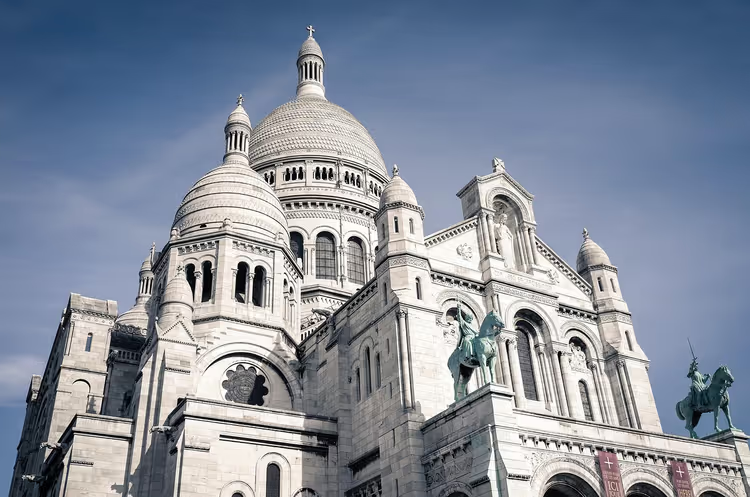
Montmartre on foot: Sacre-Coeur, Wall of Love and Moulin Rouge
Montmartre sits on a hill, and that shapes the entire route. A wide staircase and a funicular lead up to the top. Down below you leave noisy Paris behind; up above, a different city begins: studios, cabarets, and a square where people paint portraits.
The main challenge here is not the climb. The hill has more places than you can cover in a day. We put together eight Montmartre sights into one walking route: from the Sacré-Cœur Basilica to the Moulin Rouge cabaret.
Plan for half a day on foot. The hill is small, but climbs and lines eat up time, and the densest stretch lies between Sacré-Cœur and Place du Tertre. Wear flat shoes: the cobblestones on the slopes are old and uneven.
Ad: this article contains affiliate links, we earn a commission if you book through them, at no extra cost to you.
Sacré-Cœur Basilica
💡 In short:
- Head up to the basilica in the morning, before tour groups gather at the steps.
- Go inside to see the apse mosaic and stained glass.
- Prices and opening hours: 09/2026, verified on the basilica's official website.
The white basilica occupies the highest point of the hill and is visible from many parts of the city. Entry to the church itself is free; you only pay to climb the dome. Verified on 09/03/2026 on the Sacré-Cœur Basilica website.
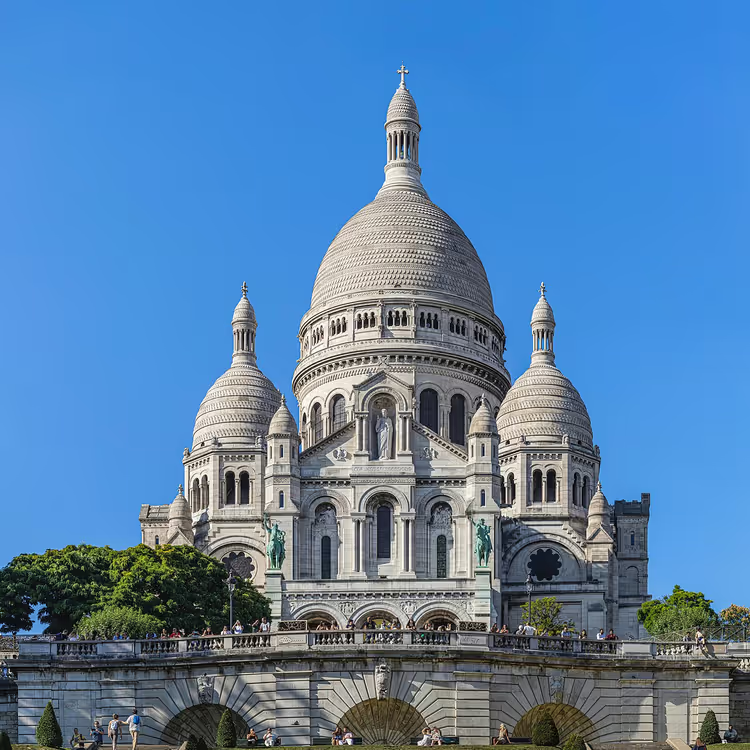 © Terragio67 · CC BY-SAPhoto: Terragio67, CC BY-SA (https://creativecommons.org/licenses/by-sa/4.0), Wikimedia Commons
Inside, you are greeted by the apse mosaic and stained glass. Many visitors linger at the image of the Sacred Heart, where pilgrims and couples come to pray.
There are two ways up. On foot via the wide staircase, or by funicular from the foot of the hill. The staircase is free; the funicular saves energy if you are traveling with children or bags.
By midday, tour groups gather on the viewing terrace in front of the basilica. If you want a shot without other people's heads in it, come at opening time or after sunset. In hot weather, bring water: there is almost no shade on the climb.
Place du Tertre and street artists
Place du Tertre was the center of the village of Montmartre when the hill stood outside the Paris city limits. The old parish church and the former town hall building in the middle of the square are reminders of that village past.
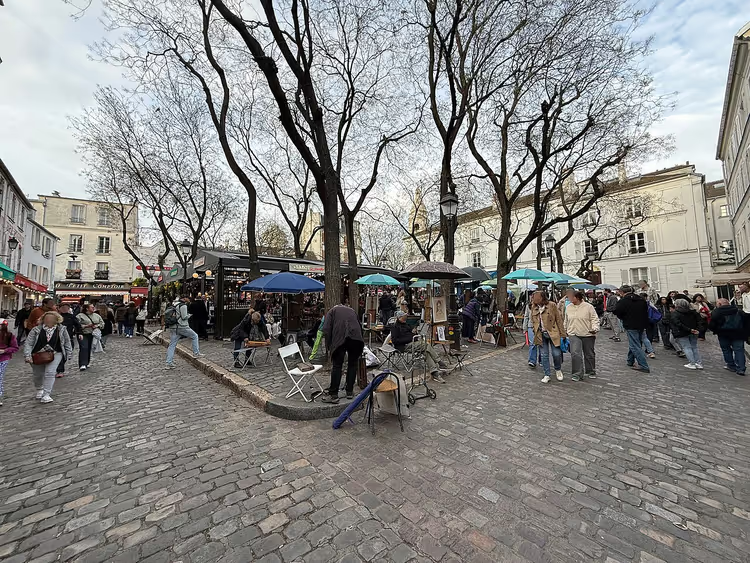 © Chabe01 · CC BY-SAPhoto: Chabe01, CC BY-SA (https://creativecommons.org/licenses/by-sa/4.0), Wikimedia Commons
From Sacré-Cœur Basilica it is about 250 meters, a 3-4 minute walk (per the map). In the early 20th century, Pablo Picasso and Maurice Utrillo worked on the square, and the neighborhood's modern art scene later grew out of this spot.
Today the square belongs to artists and caricaturists. For a modest fee, you can commission a portrait right on the street and take it home with you. Look at the samples on the easels and agree on a price before the work begins.
Who it's for: if you want a souvenir from your trip, not a fridge magnet. Not for: if you need a quick route to the basilica, the square is packed with onlookers. With a guide you will see the same places but hear the neighborhood's stories: Montmartre tours on GetYourGuide.
Bateau-Lavoir: the artists' house
Poor and not yet recognized artists lived in the Bateau-Lavoir residence, which translates as "laundry boat." The building resembled the laundry barges that were common on the Seine. Conditions there remained grim: weak heating and cramped rooms.
But at various times Bateau-Lavoir was home to Marie Laurencin, Juan Gris, Kees van Dongen, Amedeo Modigliani, and Pablo Picasso. The residents often did not even have enough money for food.
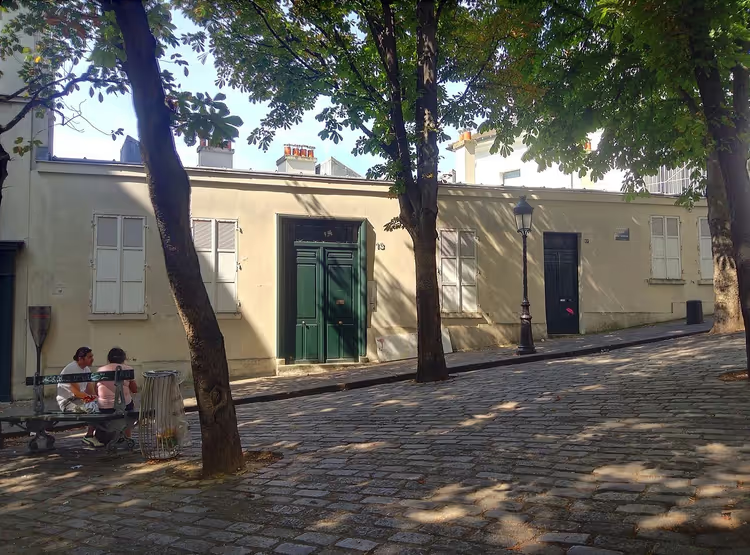 © Kalashni · CC BY-SAPhoto: Kalashni, CC BY-SA (https://creativecommons.org/licenses/by-sa/4.0), Wikimedia Commons
From Place du Tertre to Bateau-Lavoir is about 400 meters, a 5-6 minute walk (per the map). The spot is marked with a plaque, and the building itself stands in a quiet dead-end street away from the tourist flow.
Au Lapin Agile cabaret
The Au Lapin Agile cabaret, translated as "The Agile Rabbit," is no less famous than the Moulin Rouge. The venue was first called "The Thieves' Meeting" and later "The Assassins' Cabaret." The second name is linked to images of famous murderers on the walls.
The current name came from a painting by André Gill: a rabbit jumps out of a pot on the canvas. In the early 20th century, poor artists and writers gathered here; today the room draws tourists.
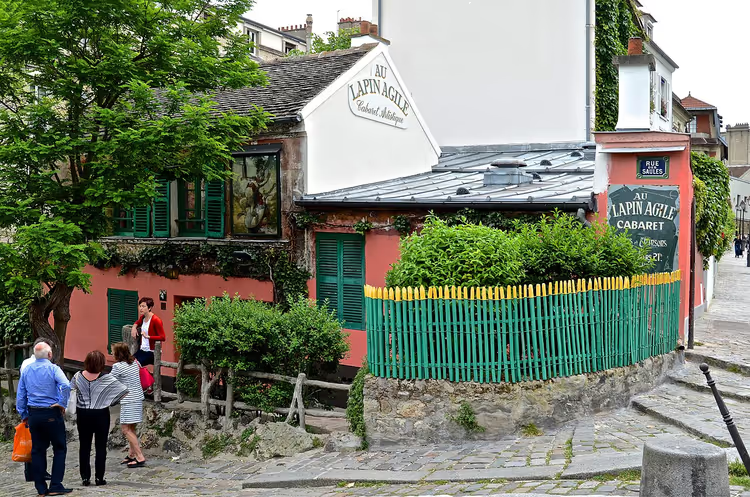 © David McSpadden from Daly City, United States · CC BYPhoto: David McSpadden from Daly City, United States, CC BY (https://creativecommons.org/licenses/by/2.0), Wikimedia Commons
Shows run Tuesday through Sunday from 9:00 PM to 2:00 AM, closed on Mondays. A ticket with the show and first drink costs €24, or €17 for students and visitors under 26 (as of 09/2026, L'Officiel des spectacles).
From Bateau-Lavoir to the cabaret is about 500 meters (on the map). It's best to book evening tickets in advance, as weekend seats sell out quickly.
Musée de Montmartre and the vineyard
The Musée de Montmartre tells the story of the hill from the 12th century to the present day, and its walls once housed Auguste Renoir's studio. An old vineyard survives nearby: its harvest produces a small amount of wine, and in mid-October the area hosts a young wine festival with tastings.
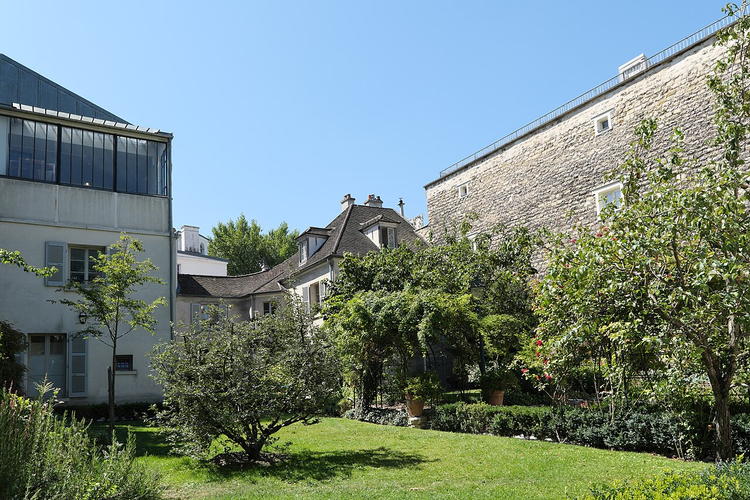 © GFreihalter · CC BY-SAPhoto: GFreihalter, CC BY-SA (https://creativecommons.org/licenses/by-sa/4.0), Wikimedia Commons
The museum is open daily from 10:00 AM to 7:00 PM, with last entry 45 minutes before closing. Tickets cost €16 during exhibition periods and €14 at other times, children under 10 enter free, and the gardens alone cost €6 (as of 09/2026, official museum website).
The address is easy for a GPS: 12, rue Cortot, 75018 Paris. The most convenient approach is from Métro Lamarck-Caulaincourt (line 12) or from Anvers (line 2) with a funicular ride up (according to the museum, 09/2026).
From Au Lapin Agile cabaret to the museum is about a 3-minute walk (on the map). If you're planning several museums during your trip, Paris museum tickets on Tiqets can help you compare options in advance.
Wall of love on place des Abbesses
In the early 21st century, the Wall of Love appeared in Montmartre, a mosaic panel with the phrase "I love you" in dozens of languages. The panel was created by artists working in graffiti techniques, and it quickly became a meeting spot for couples and newlyweds.
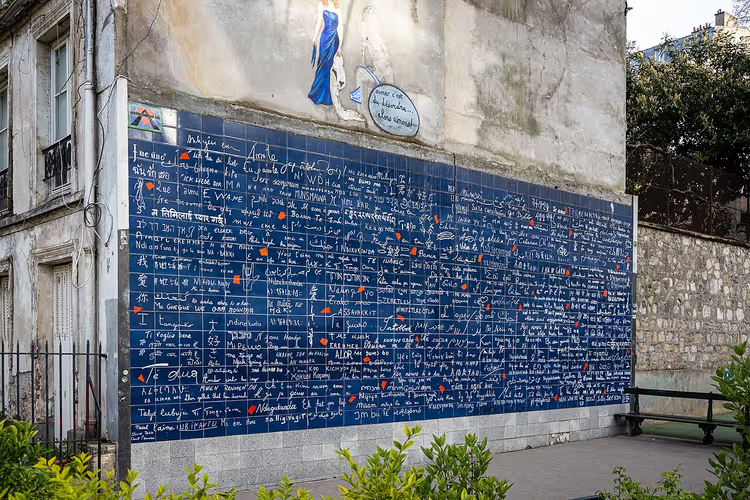 © Superbass · CC BY-SAPhoto: Superbass, CC BY-SA (https://creativecommons.org/licenses/by-sa/4.0), Wikimedia Commons
The wall stands in a small square on Place des Abbesses, next to Métro Abbesses station (line 12). You can find the inscription in your own language on the tiles.
From the Musée de Montmartre to the Wall of Love is about 350 meters, a 4-5 minute walk (on the map). Come early in the morning if you want a photo without a group in front of the panel.
Place Pigalle and Paris at night
Place Pigalle in earlier times was where artists found models. Today it's a nightlife hub: sex shops, bars, and strip shows stay open well past midnight. By day the area looks calmer than in photographs.
This was the location of Henri de Toulouse-Lautrec's studio, the artist who made the Moulin Rouge famous with his posters. It was his posters that made the square recognizable far beyond France.
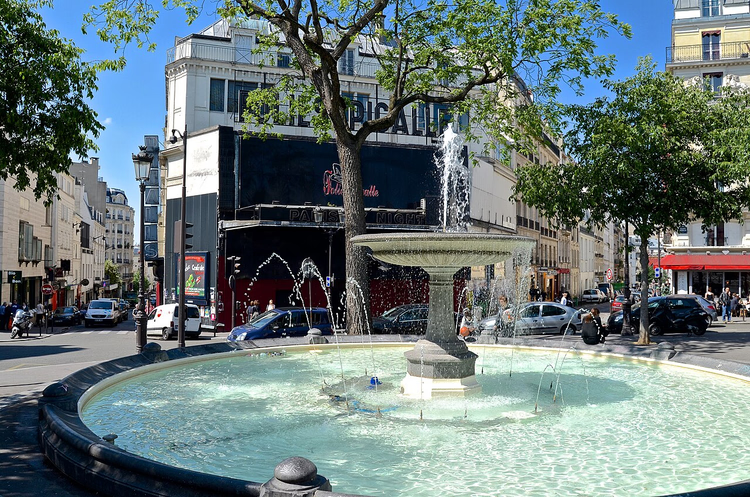 © David McSpadden from Daly City, United States · CC BYPhoto: David McSpadden from Daly City, United States, CC BY (https://creativecommons.org/licenses/by/2.0), Wikimedia Commons
From the Wall of Love to Place Pigalle is about 600 meters, a 7-8 minute walk downhill (on the map). In the evening it's crowded here, while by day the square looks almost ordinary.
Moulin Rouge cabaret
The Moulin Rouge has operated since 1889 and remains the most recognizable cabaret in Paris (as of 09/2026, official website). Here the cancan evolved from a vulgar dance into a polished show with music, costumes, and feathers.
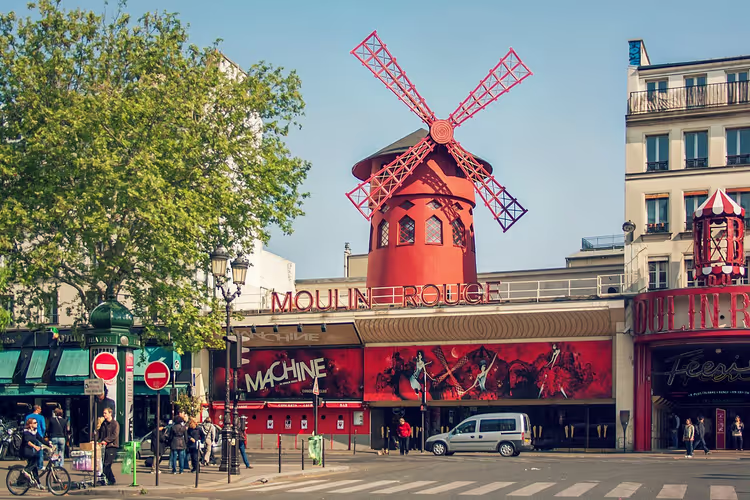 © Juanedc from Zaragoza, España · CC BYPhoto: Juanedc from Zaragoza, España, CC BY (https://creativecommons.org/licenses/by/2.0), Wikimedia Commons
Today the venue runs evening programs: a show and a dinner show. The dinner show starts at 7:00 PM and costs from €263 per person (as of 09/2026, booking on the official website). Tickets for the show without dinner are cheaper.
Available weekend seats sell out quickly, so it is better to book your date in advance: tickets for the Moulin Rouge show with champagne can be purchased ahead of time so you do not depend on the box office.
From Place Pigalle to the cabaret is about 450 meters, a 5-6 minute walk (according to the map). Boulevard de Clichy runs nearby with heavy traffic, so cross at the traffic light.
Montmartre on the map and how to get there
The easiest way is to take the Métro. Anvers station (line 2) is at the foot of the hill, where the climb to the Sacré-Cœur Basilica begins. Abbesses and Lamarck-Caulaincourt stations (both line 12) bring you out on the slopes of Montmartre (according to the Musée de Montmartre, 09/2026).
With luggage, it is more convenient to take a taxi to the upper part of the hill rather than walking up the stairs. If you want to stay near the hill, hotels in Paris on Trip.com can be filtered by district.
Route through Montmartre
Places on the map
- Montmartre A hill with artists' studios and cabarets above northern Paris
- Sacré-Cœur Basilica The hill's highest point, free entry, only the dome climb is paid
- Place du Tertre Former centre of the old village, today a square of street painters
- Bateau-Lavoir Artists' tenement where Picasso and Modigliani once lived
- Au Lapin Agile Old cabaret, evenings Tuesday to Sunday, ticket €24
- Musée de Montmartre History of the hill and Renoir's studio, an old vineyard nearby
- Wall of Love Mosaic panel with 'I love you' in dozens of languages near Place des Abbesses
- Place Pigalle Centre of nightlife, once the site of Toulouse-Lautrec's studio
- Moulin Rouge Cabaret running since 1889, dinner show at 19:00
The map includes the entire route: the basilica, Place du Tertre, Bateau-Lavoir, Au Lapin Agile cabaret, Musée de Montmartre, the Wall of Love, Place Pigalle, and Moulin Rouge. You can change the order, but it is better to leave the climb to the basilica for the morning.
Tours and tickets in Paris
Guided tours, skip-the-line tickets and activities — most offers can be cancelled free of charge.
See offers on GetYourGuideThe widget loads once you give your consent.
⁉️🤔 Frequently asked questions
How much time do you need for Montmartre?
The route through all eight spots takes half a day, with stops and photos. If you only have a couple of hours, keep the basilica, Place du Tertre, and the Wall of Love, and move the rest to another day. That way you're not rushing up the hill, but taking your time to see the neighborhood.
When is the best time to visit the Sacré-Cœur Basilica?
In the morning, right when it opens, or after sunset. At midday, tour groups gather at the steps and the viewing platform gets crowded. In the evening you get soft light, open shots, and a short line for the dome.
How much does it cost to enter the Sacré-Cœur Basilica?
Entry to the basilica itself is free for everyone; you only pay to climb the dome (as of 09/2026, official website). Both tourists and pilgrims go inside. Wear comfortable shoes for the climb: the staircase is narrow and the viewing platform is exposed to the wind.
Do you need to book the Moulin Rouge show in advance?
Yes, it's best to book your date in advance. Prices and dinner-show times are listed in the Moulin Rouge section above.
What can you see in Montmartre for free?
The Sacré-Cœur Basilica itself and the Paris panorama from its steps. You can walk around Place du Tertre for free, look at the artists' work, and find the Wall of Love. The paid options are the dome climb, the Musée de Montmartre, and evening cabaret shows. That way you can put together a route with almost no tickets.
How to get to Montmartre without a car?
By Métro: Anvers station (line 2) at the foot of the hill, Abbesses and Lamarck-Caulaincourt stations (line 12) on the slopes (according to the Musée de Montmartre, 09/2026). From there you walk up or take the funicular. A taxi is convenient if you've arrived with suitcases and don't want to carry them uphill.
In short: what's worth booking
If you have one evening in Paris: book the dinner show at Moulin Rouge.
If you're traveling with kids: plan Montmartre for the morning and save the evening cabaret for another day.
If you want to save money: walk up to the basilica and set aside one hour for the Musée de Montmartre.
You can book your date and check available options in advance: show tickets and tours on GetYourGuide.

A small editorial team writing guides for independent travel. We travel ourselves, but we haven’t been everywhere, so we check prices, opening hours and how to get there against official sources.