
















Bukhansan in Seoul: hiking to Baegundae and park entry without a ticket
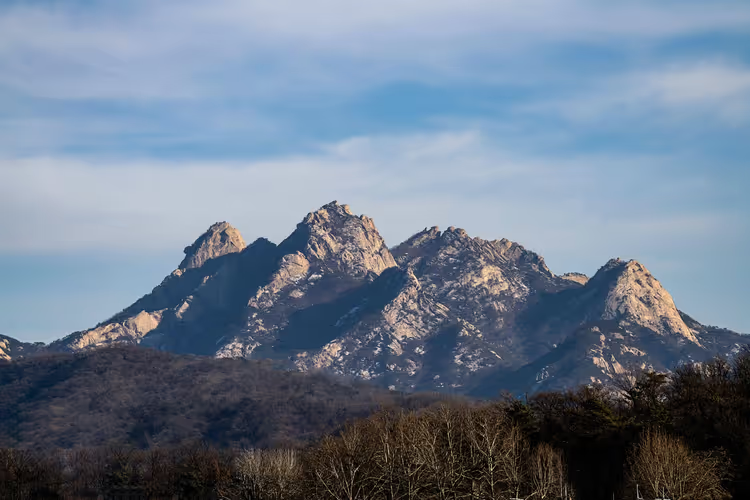
Bukhansan rises to 835.6 meters right within Seoul city limits (as of 09/2026, VisitKorea). It is the only national park inside a metropolitan area.
If you want to see Seoul from above in a single trip, half a day is enough. The main peak, Baegundae, is manageable for a beginner, while the Insubong cliffs require experience and gear. Most visitors make the same mistake: they hit the trail after lunch and end up turning back at a closed gate.
Below we show how to split your energy between the peaks, where to find the temples and the fortress wall, and how to get to the park entrance by subway and bus.
Ad: this article contains affiliate links: we earn a commission if you book through them, at no extra cost to you.
Pride of Seoul
💡 In short:
- peaks, temples, and a fortress wall sit right within Seoul city limits
- Prices and opening hours: 09/2026, verified on the official VisitKorea website
Seoul is surrounded by mountains on all sides, and Bukhansan holds a special place among them. The name translates as "mountain north of the Han." The Han River does in fact flow to the south, within the city. Residents of the capital call the park the "green lungs" and come here year-round to trade the noise of avenues for the quiet of granite slopes.
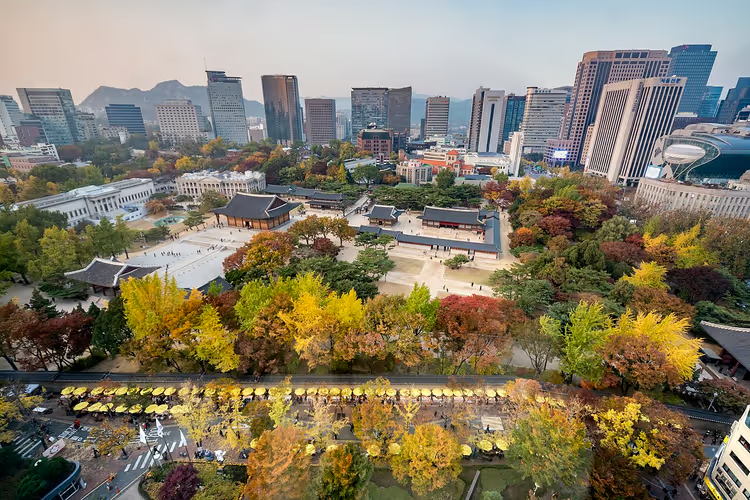
In Korean history, this mountain played the role of a natural wall. During the Joseon dynasty, it shielded the northern approaches to the capital. Today, defense has given way to a different purpose: the park has become a place of rest for city residents and visitors to the country.
The slopes of Bukhansan are made of granite, and three rocky peaks rise above the ridge. Hence the second name, Samgaksan, meaning "mountain of three horns." These peaks are clearly visible from city streets, and you can climb to them in a single day.
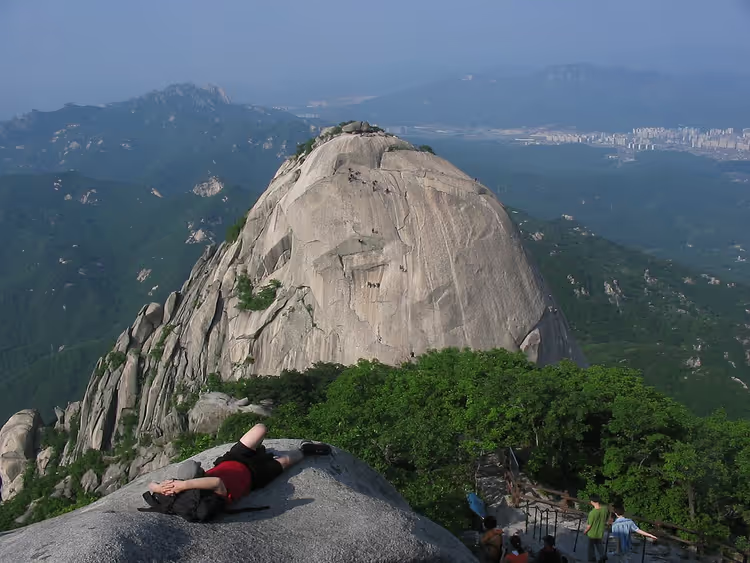
The city panorama opens up from the very first ascents. From the ridge you can see districts, the river, and neighboring mountains as if in the palm of your hand. Families with children and tourists with cameras come here for this view.
Untouched nature near a metropolis
What else draws people to Bukhansan besides the view? Nature that has been left almost untouched by the city. The temperate climate supports more than 1,300 species of plants and animals (as of 09/2026, official Korea tourism portal). On the trails you will hear dozens of birds, and in the mountain streams you will see fish.
In 1983, the mountain was officially declared a national park (as of 09/2026, Bukhansan National Park). Today, both Bukhansan and the neighboring Dobongsan mountain are under protection. The total park area reaches almost 80 square kilometers (as of 09/2026, Wikipedia).
 © 라성민 · CC BY-SAPhoto: 라성민, CC BY-SA (https://creativecommons.org/licenses/by-sa/3.0), Wikimedia Commons
Each season changes the picture beyond recognition. In summer, the slopes are fragrant with herbs and flowers. In autumn, the foliage bursts into red and yellow, and Buddhist temples look especially beautiful against this backdrop. In winter, snow-covered peaks await you, and in spring the slopes are covered with fresh greenery and pink azaleas.
Choose your season honestly: in summer the park is humid and crowded, and in autumn there is a line to the summit on weekends. The quietest time is a weekday early in the morning.
Baegundae Peak: the main goal of the climb
Baegundae is the highest point of the park and the most popular goal. The trail to the top is marked, and in places steps are carved into the rock with handrails installed. A beginner can handle this climb if you take your time and make stops.
 © Seongrae Kim · CC BYPhoto: Seongrae Kim, CC BY (https://creativecommons.org/licenses/by/3.0), Wikimedia Commons
The summit area offers a 360-degree view of Seoul. On a clear day you can see not only the city center but also the outlying districts. Bring water and a light jacket: it is always windy and noticeably cooler at the top.
More than one trail leads to the top, with several routes of different lengths. You can start your ascent in one place and descend in another. That way you won't have to retrace your steps over the same rocks.
Insubong and the rock route
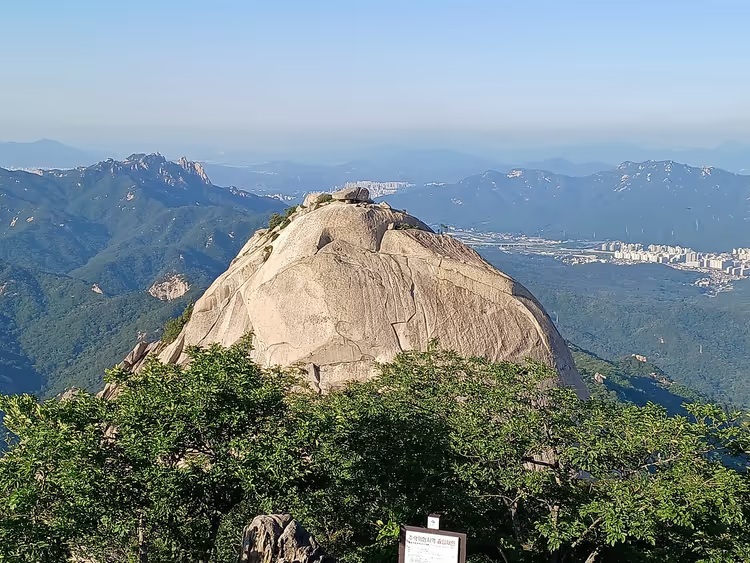
Insubong is lower than the main peak, at 810.5 meters (as of 09/2026, Korea national parks guide). But this peak is more serious in terms of difficulty. It requires climbing skills and gear. Local climbers love Insubong's smooth cone: you can train close to home.
 © Symtux · CC BY-SAPhoto: Symtux, CC BY-SA (https://creativecommons.org/licenses/by-sa/4.0), Wikimedia Commons
If you are heading into the mountains for the first time, choose the trails to Baegundae. Save Insubong for later. Experienced hikers value this route for its long rock ledges and exposed sections. Do not go here in the rain: the rocks become slippery.
Trails, villages and temples of Bukhansan
Hundreds of trails circle the mountain and wind between rocks and gorges. There are more than a dozen officially marked routes, so it is easy to put together a hike that matches your fitness level. One route passes through the Pyeongchang area, where Korean TV series are filmed. Others go past ordinary villages where chickens and ducks roam in the yards.
Locals call the most scenic route the "hidden wall." It runs between two peaks and is considered the second most difficult: part of the way you climb over rocks. The reward is views of ridges and gorges.
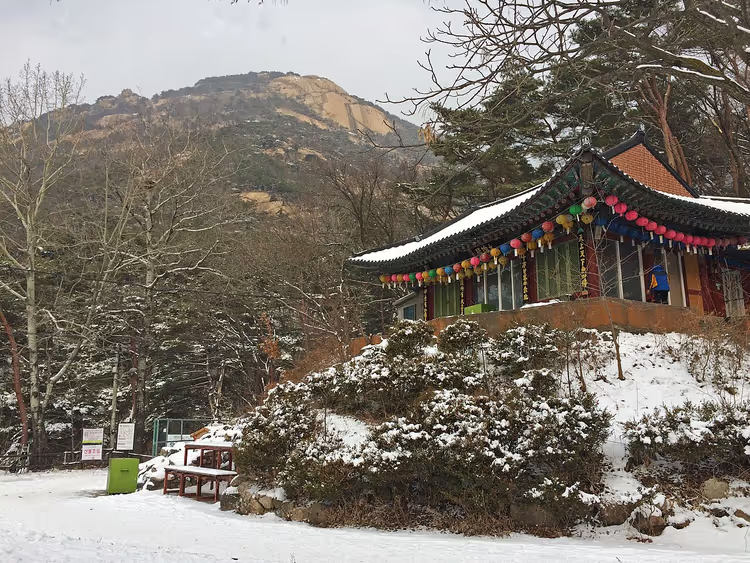 © Lcarrion88 · CC BY-SAPhoto: Lcarrion88, CC BY-SA (https://creativecommons.org/licenses/by-sa/4.0), Wikimedia Commons
There is also a loop route that covers both Bukhansan and Dobongsan. It is divided into short segments, and the difficulty varies from section to section. Some trails have evocative names: the meditation road, the pilgrims' road, the pine road. In summer the pine forest provides shade and relief from the heat.
The slopes are home to more than a hundred Buddhist temples and hermitages (as of 09/2026, Korea Tourism Organization data). They are built into the landscape and almost blend in with the rocks. There are also ancient fortresses here. Construction of Bukhansanseong Fortress began in the first centuries AD, and its walls took their current form in the 18th century. A walk along the defensive wall takes several hours.
Tours and tickets in Seoul
Guided tours, skip-the-line tickets and activities — most offers can be cancelled free of charge.
See offers on GetYourGuideThe widget loads once you give your consent.
Hours, admission and how to get there
According to the Korea Tourism Organization, it is a good idea to plan your visit to the park in advance. Admission is free, but the last ascent time is limited: until 4:00 PM in summer and until 3:00 PM in winter (as of 09/2026, official Korea tourism website). The park is open daily.
You can get there by subway and bus. One option: take line 5 to Gwanghwamun station, exit 2, then bus 1020 to the stop near the park entrance (as of 09/2026, Korea Tourism Organization website). The stop is only 132 meters from the gate. Another popular entrance is on the Bukhansan Ui station side.
There is a rental service at the entrance: if you did not bring gear, you can rent shoes and equipment on site. Wear comfortable sneakers or hiking boots. Regular canvas shoes are not suitable for granite steps.
Before starting difficult routes, sign in on the list and report your return. That way rescuers know you have come down. If you twist an ankle or get a scrape, help is available at the foot of the mountain.
A ritual for good luck
On the way to the summit, locals build small stone cairns. According to local belief, such a cairn speeds up the arrival of good fortune. Try it yourself: a few stones by the trail take only a second of work.
Bukhansan on the map
The map will help you plan your route and find the park entrances. Mark your starting point in advance so you don't wander around at the foot of the mountain.
⁉️🤔 Frequently asked questions
How much does it cost to enter Bukhansan?
Entry to the national park is free, no ticket purchase is needed. The only money you might spend is on renting shoes and gear at the entrance and on food at the roadside cafes.
How many hours does it take to climb Baegundae?
A beginner should allow half a day for the round trip, including stops and photos. The exact time depends on the route you choose and your fitness level. Start in the morning: the trail gets crowded during the day, and the last ascent time is limited.
Do I need special shoes and gear?
For the trails to Baegundae, trekking boots with good tread are enough. Regular sneakers slip on the granite steps. Climbing gear is only needed on Insubong, where going up without skills and protection is dangerous.
Can you get to the park without a car?
Yes, the park is connected to the city by subway and buses.
When is the best time to go to avoid the crowds?
Come on a weekday early in the morning. Fall weekends draw the biggest lines on the ridge. In summer the park is humid, but the shady pine trails are a plus. In winter you need warm layers and non-slip shoes.
Are there temples and a fortress on the mountain?
Yes. Many Buddhist temples sit right among the rocks. The Bukhansanseong fortress with its defensive wall is also here.
In short: what to book
Bukhansan suits almost everyone. Beginners will be fine with the trail to Baegundae, experienced hikers will enjoy the rocks of Insubong. Plan your trip for the morning, bring water and trekking shoes, and save the difficult routes for next time.
If you are short on time: climb only to Baegundae. If you are up for a full day: choose the loop route with temples and the fortress wall.
Want to add a Seoul tour to your hike? Check out tours on GetYourGuide.

A small editorial team writing guides for independent travel. We travel ourselves, but we haven’t been everywhere, so we check prices, opening hours and how to get there against official sources.