
















Muckross Abbey and Killarney National Park: what to see in one day
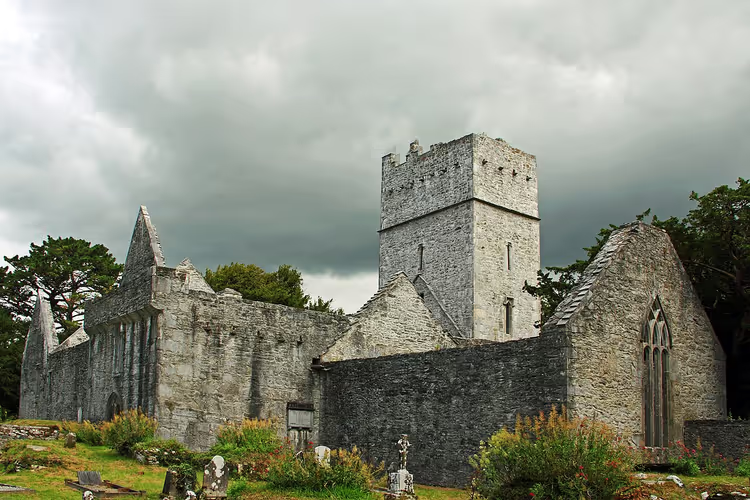
Muckross Abbey stands in the woods of Killarney National Park, off the N71 road. The Franciscan friary was founded here in 1448 (as of 09/2026, Arrivalguides guide). What remains of the monastery are its walls, cloister, and square tower.
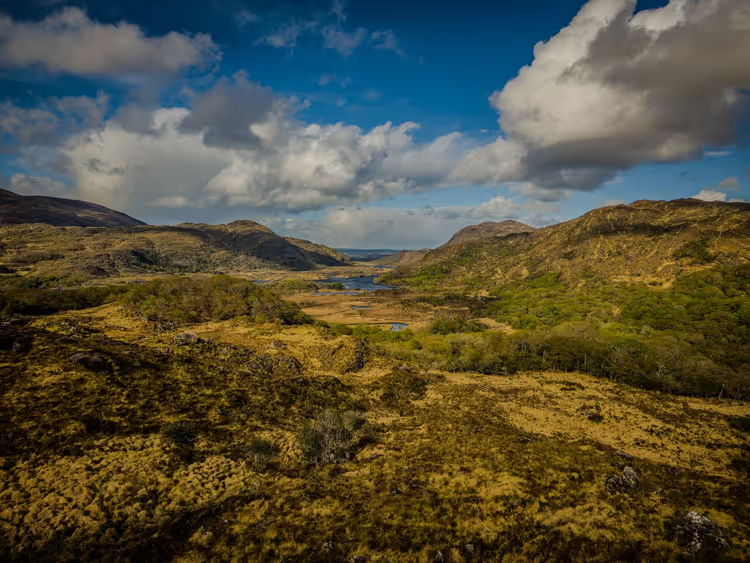
The surrounding park spreads out with lakes, yew groves, and the MacGillycuddy's Reeks mountains (as of 09/2026, official Killarney National Park website).
One day in Killarney comfortably covers the abbey, Torc Waterfall, and Muckross House. Below you'll find what to see inside, where to park, and how to fit it all in without rushing.
Ad: this article contains affiliate links. We earn a commission if you book through them, at no extra cost to you.
What to see at Muckross Abbey
💡 In short:
- The cloister with its arcades and the old yew tree in the center of the courtyard.
- The square tower: a climb up a narrow staircase and views over the lakes.
- Free entry, open during daylight hours (as of 09/2026, trips.ie directory).
The best-preserved part is the cloister with its arcades and inner courtyard. Wild grapevines wind around some of the arches, making the ruins feel alive rather than museum-like.
In the center of the courtyard grows a yew tree believed to be as old as the friary itself. According to legend, the tree witnessed both the monks and Cromwell's soldiers. Its crown is so dense that it stays shaded beneath even at midday.
Climb the square tower. The steps are narrow and worn, but from the top you get views over the lakes, the forest, and the MacGillycuddy's Reeks range. In the rain the stones get slippery, so hold onto the wall.
Inside you'll see niches, arrow loops, and rooms on two levels. The Franciscans lived simply: white walls with no carving or painting. Stone benches stand by the windows.
 © Daviddphotos · CC BY-SAPhoto: Daviddphotos, CC BY-SA (https://creativecommons.org/licenses/by-sa/4.0), Wikimedia Commons
The abbey cemetery
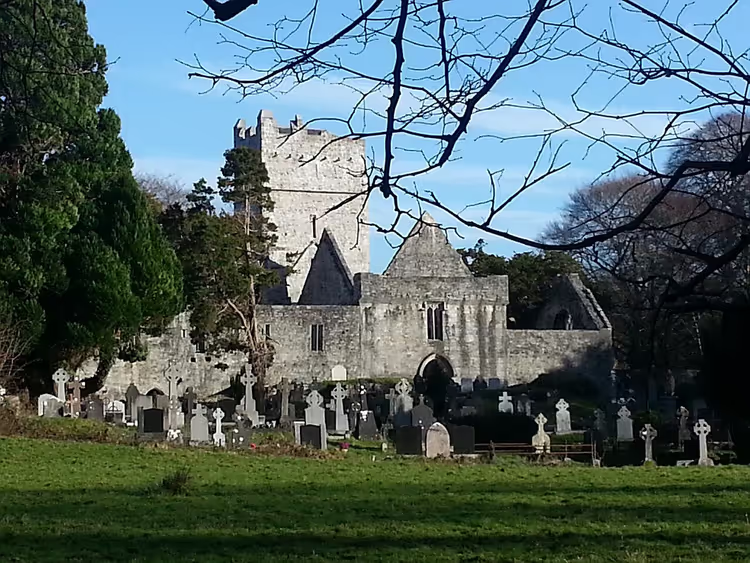
The cemetery by the south wall is still in use. The ground is rocky and space is limited, so family graves are the norm here, and new headstones stand right up against slabs from past centuries.
 © The Speckled Bird · CC BY-SAPhoto: The Speckled Bird, CC BY-SA (https://creativecommons.org/licenses/by-sa/4.0), Wikimedia Commons
Gaelic chieftains, poets, and farmers are buried here. The Irish choose only consecrated ground for burial, which is why the abbey cemetery remains open. Visit quietly and don't photograph people without permission.
History: 1448 and Cromwell's troops
According to legend, a church stood on this site as early as the early Middle Ages, destroyed by Viking raids. The documented history begins in 1448: chieftain Donal McCarthy Mor founded a Franciscan friary here (as of 09/2026, Arrivalguides abbey overview).
The friary took its name from Muckross Lake, beside which it stands. For two centuries the monks served, educated the surrounding villages, and ran the estate. The political strife of Ireland touched them too: the community left and returned.
In the mid-17th century, Cromwell's troops swept through Ireland and burned the monastery. The stone walls survived; the timber floors and roof did not. Since then the abbey has stood roofless, and it has never been restored.
For local Catholics the friary was a refuge, and people continued to come here after its closure. The masonry holds, but time takes its toll: part of the vaulting has collapsed, and it's best not to go inside in strong winds.
The walls are not all that remains of the monastery. Nearby, outbuildings survive, along with a stretch of the old path the monks used to walk to the lake. Trails around the abbey lead out to groves and the shoreline.
Gardens and Muckross House
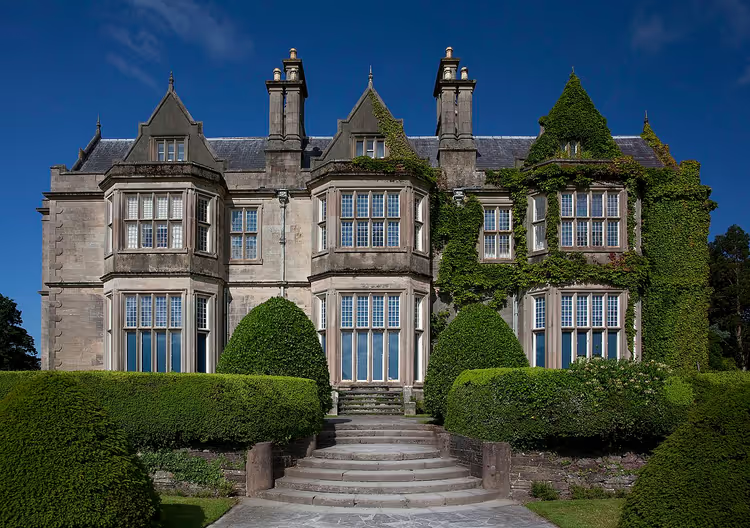
Muckross House stands in the center of the park, and the official website calls the complex Kerry's main attraction (as of 09/2026, muckross-house.ie). The Victorian mansion is surrounded by gardens with flowerbeds, avenues, and well-tended trees.
The gardens were spruced up for Queen Victoria's visit and have been kept in the same formal style ever since. House tickets are sold by timed entry: check the schedule and prices on the Muckross House tickets page, verified 14.09.2026.
Workshops operate nearby: the Mucros Weavers, a pottery, a bindery, and a book restoration studio. There's a restaurant in the garden, so you don't need to go into town for lunch.
For families there's Traditional Farms, a 1920s-style farm with machinery, furniture, and animals. The farm ticket is separate from the house ticket.
 © Emmett.Hume · CC BY-SAPhoto: Emmett.Hume, CC BY-SA (https://creativecommons.org/licenses/by-sa/3.0), Wikimedia Commons
The estate lands were transferred to the state in 1932 and became the core of the country's first national park (as of 09/2026, National Parks Service). Today it is the most visited part of the park, and tour groups come here.
Mountains, Torc Waterfall and the Lakes of Killarney
The park covers 10,000 hectares, or 25,425 acres (as of 09/2026, National Parks Service). It was created on the Muckross lands and became Ireland's first national park. UNESCO included it in its network of biosphere reserves, and chose Glacier National Park in the USA as its sister park.
 © Colin Park · CC BY-SAPhoto: Colin Park, CC BY-SA (https://creativecommons.org/licenses/by-sa/2.0), Wikimedia Commons
The MacGillycuddy's Reeks range, the highest in the country, rises above the lakes. Carrauntoohil stands here, attracting trekkers. The slope is loose scree, so without experience it is better to hire a guide.
Torc Waterfall hides in an oak grove, reached by a short staircase from the parking lot on the N71. The cascade is stepped, and it looks best after rain, when the water comes down in a wall.
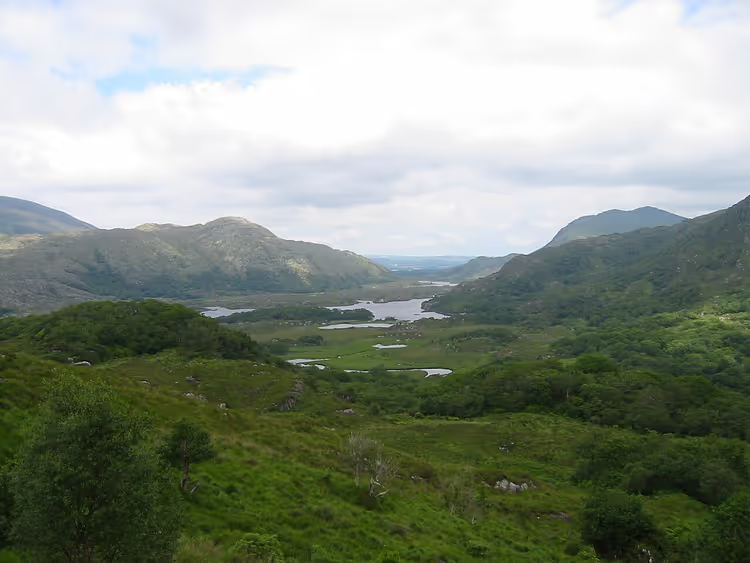
The lakes are fished for brown trout and salmon, and the forests are home to birds and deer. The native herd of red deer has lived here since Neolithic times, and it is the only such herd in the country: stags reach up to 220 kg (as of 09/2026, National Parks Service).
The ancient Reenadinna yew forest and the oak woods by the lakes are highlighted separately on the park's official website (as of 09/2026, Killarney National Park). Paths run along the shore of Lough Leane, and they are convenient for a morning walk.
What to see | What it is | Access |
|---|---|---|
Muckross Abbey | Franciscan monastery from 1448 | Free, year-round |
Muckross House | Victorian mansion with gardens | Timed tickets |
Traditional Farms | 1920s-style farm | Separate ticket |
Torc Waterfall | Stepped waterfall near the N71 | Free |
Lakes of Killarney | Lough Leane, Muckross Lake and Upper Lake | Free, along the shore |
Ross Castle | Castle on the shore of Lough Leane | Ticketed entry, check hours on site |
By minibus or car you can tour the park in a couple of hours. Horse-drawn carriages from Killarney go more slowly, but along old roads and with the driver's stories.
Hours and admission
The abbey is open year-round, with free access during daylight hours only (as of 09/2026, trips.ie guide). Tickets for the house and farm are sold separately; check the schedule on the Muckross House website, verified 09/14/2026.
Parking at the abbey gate is very small and fills up quickly. There is a large lot at Muckross House, about a kilometer away (as of 09/2026, trips.ie guide).
You cannot drive through the gardens or past the monuments, so leave your car in the lot (as of 09/2026, park visitor rules).
Bring a rain jacket: the Atlantic weather can change within an hour. Choose shoes with sturdy soles, as the park trails are wet after rain. Bring water and snacks too, since there is a cafe only near the estate.
Tours and tickets in Killarney
Guided tours, skip-the-line tickets and activities — most offers can be cancelled free of charge.
See offers on GetYourGuideThe widget loads once you give your consent.
How to get there and where to stay
You can reach the park by train, bus, and car, with the main entrance off the N71 road (as of 09/2026, official Killarney National Park website). Horse-drawn carriages run from Killarney to the abbey and the estate, and this is the most popular way to get there without a car.
If you are staying overnight, choose accommodation in Killarney itself. Hotels and campsites also operate inside the park, by the lakes.
Inside the park, stick to marked trails and do not feed the deer. The conservation rules here are strict, and violations result in fines.
⁉️🤔 Frequently asked questions
Do you need to buy a ticket to Muckross Abbey?
No. Entry to the grounds is free year-round. There are no ticket offices or guards at the gate, and inside you can stay exactly as long as you like. Check the tour times for the house in advance on the Muckross House website.
How much time should you allow for the abbey and the park?
An hour is enough for the abbey itself: the cloister, tower, and cemetery are compact. Allow half a day for the park with Torc Waterfall and the estate, or a full day if you're heading into the mountains. Don't treat the abbey as a quick stop "on the way" between two other sights.
How to get to the abbey without a car?
Buses and horse-drawn carriages run from Killarney to the park, with the main entrance off the N71 road. Walking from town is too far, so take a carriage or rent a bike. From the parking area at the gate, you'll reach the cloister in a couple of minutes.
What to see near the abbey?
Torc Waterfall, the Muckross House gardens, the Traditional Farms, Ross Castle on the shore of Lough Leane, and the lakes with their native deer herd. All of this is inside Killarney National Park. If you're short on time, start with the abbey and the waterfall.
Where is Muckross Abbey and how do you find it?
It stands in Killarney National Park, in County Kerry, just off the N71. Your sat nav will take you to a small parking area directly opposite the entrance. From there you walk along a path that follows the wall.
In short: what's worth booking
Muckross Abbey rounds out the main draw of this part of the park: ruins with no admission fee, a tower with views over the lakes, and the yew tree in the cloister. From there the route builds itself, because Torc Waterfall, the estate, and the lakes are all close by.
If you have one day and no car, book park and Ring of Kerry tours on GetYourGuide. If you're staying overnight, compare hotels in Killarney on Trip.com.
Arrive in the morning, bring a rain jacket, and don't plan more than an hour for the abbey.

A small editorial team writing guides for independent travel. We travel ourselves, but we haven’t been everywhere, so we check prices, opening hours and how to get there against official sources.