
















Night trains from Germany: which connections work in 2026 and how much a sleeping berth costs
Night train in Europe saves you a night in a hotel and a morning trip from the airport. But schedules and ticket sales are more complicated in practice than the marketing pictures suggest.
From September 1, 2026, the train from Berlin to Stockholm changed operators: Swedish SJ discontinued the service, and it is now run by RDC Deutschland as EN 344 and EN 345 (verified on 12.09.2026 on the official RDC Deutschland website). The train runs three times a week and takes about 15 hours.
Below we have compiled data from the ADAC review of 21 connections between German and European cities and updated it using the carriers' official websites. Further down you will find tables with prices and travel times, a breakdown of transfers, carriage categories, and the ticket search process.
Ad: this article contains affiliate links, we earn a commission if you book through them, at no extra cost to you.
Night trains in Europe: the essentials
💡 In short:
- Of 105 possible connections between seven German and 15 European cities, only 55 met the night train criteria.
- Seven connections were direct, and another seven required one transfer at a reasonable time. The rest took longer than 23 hours.
- Prices for a sleeping berth in the review ranged from 54 to 607.80 €, and the difference within the same train reached up to three times (as of 2024, ADAC review).
- We recommend booking four to six weeks in advance, and even earlier during holiday periods.
- Prices and schedules: 09/2026, verified on the official websites of RDC Deutschland and European Sleeper.
For a long time, the night train was transport for die-hard rail fans. Now it is a trend: routes are added almost every year, and interest grows along with them. 42 percent of Germans are generally willing to take a night train for a vacation, and among people aged 18 to 39 the figure is 52 percent (as of ADAC survey on night trains). Respondents give the same reasons: a calmer journey and arriving well rested.
But what does it look like in reality? How convenient are the connections, are the prices clear, and does online booking work? The ADAC review provides answers, with the team attempting to buy 21 trips through different portals.
How ADAC tested night trains
The test started in seven German metropolitan areas: Berlin, Hamburg, Munich, Cologne, Stuttgart, Dresden, and Hanover. The destinations were 15 popular European cities, from Paris and London to Florence and Budapest. For comparison, they only looked at one-way trips.
They searched for the cheapest offer with a sleeping berth: one place in a couchette or sleeping car, second class, with mandatory reservation. If that option was not available, the testers moved to the next one by price. Requests were made on May 2-7, 2024 for dates from May 27 to June 23, that is, four to seven weeks before the trip (as of ADAC research report). This detail matters to you: ADAC considers this booking window to be typical.
Map: 21 connections in the ADAC review
All 21 connections are plotted on the map in the ADAC report. It shows that the radius of direct night trains from Germany reaches Stockholm in the north and Rome in the south. Night trains most often depart from Berlin, Munich, and Dresden.
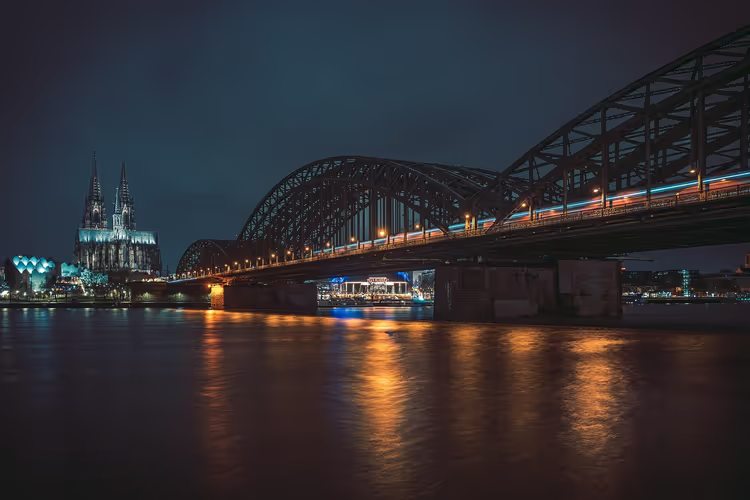
 © dronepicr · CC BYPhoto: dronepicr, CC BY (https://creativecommons.org/licenses/by/2.0), Wikimedia Commons
Good direct connections
Seven connections passed the review as good direct trains: no transfers needed, departure and arrival times are acceptable, and the journey takes no more than about 15 hours. The offer changes every season, and some of the trains from the test do not run year-round. So before buying, always check the current schedule with the carrier.
Prices in the table are the cheapest place with the option to lie down, second class, as found by the testers in May 2024; fares are different today, so check them with the carrier (as of 2024, ADAC price table).
Route | Train | Travel time | Price |
|---|---|---|---|
Berlin - Stockholm | EN 346 | 15:20 | 96.90 € |
Berlin - Vienna | NJ 457 | 11:21 | 144.90 € |
Munich - Rome | NJ 295 | 13:00 | 154.90 € |
Munich - Amsterdam | NJ 420 | 12:07 | 54.90 € |
Stuttgart - Budapest | EN 50237 | 12:50 | 54.00 € |
Dresden - Brussels | ES 452 | 12:57 | 69.00 € |
Hanover - Vienna | NJ 491 | 11:20 | 139.90 € |
Details of direct connections
EN 346, Berlin - Stockholm. Departure 18:37, arrival 9:57, travel time 15 hours 20 minutes. You can also board in Hamburg. From September 2026, the train runs three times a week and operates as EN 344 toward Stockholm (checked 12.09.2026, RDC Deutschland schedule).
NJ 457, Berlin - Vienna. Departure 19:39, arrival 7:00, travel time 11 hours 21 minutes. Additional boarding stops: Dresden-Neustadt, Dresden, Bad Schandau.
NJ 295, Munich - Rome. Departure 20:10, arrival 9:10, exactly 13 hours en route. You can join at München Ost and Rosenheim stations.
NJ 420, Munich - Amsterdam. Departure 22:52, arrival 10:59, travel time 12 hours 7 minutes. Boarding also in Rosenheim, Augsburg, Nürnberg, Würzburg, and Köln. By price, this is one of the two cheapest options on the list.
EN 50237, Stuttgart - Budapest. Departure 20:29, arrival 9:19, travel time 12 hours 50 minutes. Additional stops: Göppingen, Ulm, Augsburg, München Ost, Rosenheim.
ES 452, Dresden - Brussels. Departure 20:30, arrival 9:27, travel time 12 hours 57 minutes. This train is operated by European Sleeper. Boarding is possible in Bad Schandau, Dresden-Neustadt, Berlin-Ostbahnhof, Berlin, and Bad Bentheim.
NJ 491, Hanover - Vienna. Departure 21:57, arrival 9:17, travel time 11 hours 20 minutes. For you, this is the most flexible option in northern Germany: you can board the car in Hamburg-Altona, Hamburg-Harburg, Hannover, Göttingen, Würzburg, Nürnberg, Regensburg, and Passau.
Convenient connections with a transfer
Seven connections have a transfer, but it happens at a reasonable time: no earlier than 6:30 a.m., in most cases after eight or nine o'clock. You won't have to get up before dawn. The overnight portion of the trip takes more than eight hours, which is enough to get a good night's sleep before the transfer.
Prices in the table are the cheapest sleeping option, second class, as of May 2024 (as of: 2024, ADAC on connections with transfers).
Route | Train | Travel time | Price |
|---|---|---|---|
Berlin - London | ES 452 | 13:01 | 166.00 € |
Hamburg - Paris | NJ 471 | 11:28 | 250.90 € |
Stuttgart - Florence | NJ 237 | 14:10 | 213.80 € |
Munich - London | NJ 40468 | 11:45 | 207.90 € |
Cologne - Budapest | NJ 40421 | 13:52 | 120.90 € |
Stuttgart - Rome | NJ 237 | 15:31 | 175.80 € |
Dresden - Milan | EN 40458 | 15:40 | 247.00 € |
Details: connections with a transfer
ES 452, Berlin to London. The train departs at 22:56, you transfer in Brussels at 9:27, and arrive in London at 11:57. Total travel time is 13 hours 1 minute, of which 10 hours 31 minutes are on the night train. Boarding: Bad Schandau, Dresden, Dresden-Neustadt, Berlin-Ostbahnhof, Bad Bentheim.
NJ 471, Hamburg to Paris. Departs at 22:07, transfer in Offenburg at 6:37, arrival at 9:35. Total travel time is 11 hours 28 minutes, with 8 hours 30 minutes overnight. You can board in Hamburg-Altona, Hamburg-Dammtor, Hamburg-Harburg, Bremen, Verden (Aller), Hannover, and Karlsruhe.
NJ 237, Stuttgart to Florence. Departs at 20:29, transfer in Venice at 8:22, arrival at 10:39. Total travel time is 14 hours 10 minutes, of which 11 hours 53 minutes are overnight. Boarding: Göppingen, Ulm, Augsburg, München Ost, Rosenheim.
NJ 40468, Munich to London. Departs at 00:12, transfer in Brussels at 9:46, arrival at 11:57. Total travel time is 11 hours 45 minutes, with 9 hours 44 minutes overnight. Boarding: Rosenheim, Mainz, Koblenz, Bonn-Beuel, Aachen. The catch: a midnight departure means you either need a late transfer or an overnight stay before the trip.
NJ 40421, Cologne to Budapest. Departs at 22:27, transfer in Vienna at 9:17, arrival at 12:19. Total travel time is 13 hours 52 minutes, with 10 hours 50 minutes overnight. Boarding: Würzburg, Nürnberg, Regensburg, Passau.
NJ 237, Stuttgart to Rome. Departs at 20:29, transfer in Venice at 8:22, arrival at 12:00. Total travel time is 15 hours 31 minutes, with 11 hours 53 minutes overnight. Boarding is the same as on the Florence train: Göppingen, Ulm, Augsburg, München Ost, Rosenheim.
EN 40458, Dresden to Milan. Departs at 21:10, transfer in Zurich at 9:05, arrival at 12:50. Total travel time is 15 hours 40 minutes, of which 11 hours 55 minutes are overnight. Boarding: Bad Schandau, Dresden-Neustadt, Riesa, Leipzig, Frankfurt a. M., Mannheim, Karlsruhe, Baden-Baden, Offenburg, Freiburg i. B.
Poor connections with a transfer
The problems with night trains are visible in these seven examples. Some trips take more than 23 hours: from Berlin to Madrid or from Hamburg to Barcelona. You need three transfers, sometimes four, and one of them can be at six in the morning. The overnight portion on the connections from Cologne to Florence and Barcelona is only about six and a half hours. That is not enough to rest and get up before the transfer.
Some night trains depart after midnight. They are also noticeably more expensive: the Hamburg to Rome trip in the 2024 test cost more than 600 €.
The prices in the table are the cheapest sleeping option, second class, as of May 2024 (data: 2024, ADAC on poor connections).
Route | Train | Travel time | Transfers | Price |
|---|---|---|---|---|
Berlin to Madrid | ES 452 | 23:44 | 3 | 275.42 € |
Hamburg to Rome | NJ 471 | 19:33 | 2 | 607.80 € |
Hamburg to Barcelona | NJ 471 | 23:20 | 4 | 321.15 € |
Cologne to Florence | NJ 403 | 13:22 | 2 | 224.90 € |
Dresden to Paris | EN 40458 | 12:25 | 1 | 297.00 € |
Cologne to Barcelona | NJ 403 | 16:51 | 3 | 226.35 € |
Hannover to Florence | NJ 471 | 16:34 | 2 | 267.80 € |
Details: poor connections
ES 452, Berlin to Madrid. Departs at 22:56, transfer in Brussels at 9:27, arrival at 22:40. Total travel time is 23 hours 44 minutes, with 10 hours 31 minutes overnight. Boarding is also possible in Bad Bentheim.
NJ 471, Hamburg to Rome. Departs at 22:07, transfer in Zurich at 10:05, arrival at 17:40. Total travel time is 19 hours 33 minutes, of which 11 hours 58 minutes are overnight. Boarding: Bremen, Verden (Aller), Hannover, Karlsruhe, Offenburg. This is the most expensive trip in the test.
NJ 471, Hamburg to Barcelona. Departs at 22:07, transfer in Basel at 8:10, arrival at 21:27. Total travel time is 23 hours 20 minutes, with 10 hours 3 minutes overnight. Four transfers mean a high risk of missing a connection at every change. Boarding: Hamburg-Altona, Hamburg-Dammtor, Hamburg-Harburg, Bremen, Verden (Aller), Hannover, Karlsruhe, Offenburg, Freiburg i. B.
NJ 403, Cologne to Florence. Departs at 23:42, transfer in Basel at 6:20, arrival at 13:04. Total travel time is 13 hours 22 minutes, of which only 6 hours 38 minutes are overnight. You will have to get up at six in the morning to make the connection. Boarding: Bonn-Beuel, Offenburg, Freiburg i. B.
EN 40458, Dresden to Paris. Departs at 21:10, transfer in Offenburg at 5:45, arrival at 9:35. Total travel time is 12 hours 25 minutes, with 8 hours 35 minutes overnight. Boarding: Bad Schandau, Dresden-Neustadt, Riesa, Leipzig, Karlsruhe, Baden-Baden.
NJ 403, Cologne to Barcelona. Departs at 23:42, transfer in Basel at 6:20, arrival at 16:33. Total travel time is 16 hours 51 minutes, with only 6 hours 38 minutes overnight. The catch: a short overnight portion plus three transfers during the day. Boarding: Bonn-Beuel, Offenburg, Freiburg i. B.
NJ 471, Hannover to Florence. Departs at 0:30, transfer in Zurich at 10:05, arrival at 17:04. Total travel time is 16 hours 34 minutes, of which 9 hours 35 minutes are overnight. Boarding: Hamburg-Dammtor, Hamburg, Hamburg-Harburg, Bremen, Verden (Aller), Hannover, Karlsruhe, Offenburg, Freiburg i. B.
Overview: night trains from seven cities
Where can you actually go by night train from seven major German cities? In theory, there are 105 combinations: seven departure cities times 15 destinations. Only 55 of them met the night train criteria, and that is the main finding of the test (data: ADAC city-by-city test).
Start | Where night trains go |
|---|---|
Berlin | Amsterdam, Barcelona, Brussels, Budapest, Vienna, London, Madrid, Paris, Stockholm |
Hamburg | Barcelona, Budapest, Vienna, Milan, Paris, Prague, Rome, Stockholm, Florence |
Munich | Amsterdam, Brussels, Budapest, Vienna, Copenhagen, London, Milan, Paris, Rome, Stockholm, Florence |
Cologne | Barcelona, Budapest, Vienna, Milan, Paris, Rome, Florence |
Stuttgart | Budapest, Vienna, Rome, Florence |
Dresden | Amsterdam, Brussels, Budapest, Vienna, London, Milan, Paris, Rome, Florence |
Hannover | Budapest, Vienna, Milan, Prague, Rome, Florence |
Which European cities night trains go to
A second look at the same table shows the picture by destination. Of the 15 popular European cities, Vienna, Budapest, and Rome are the best connected. No suitable options were found for Lisbon at all, and Copenhagen and Prague were only on sale from one or two departure points at the time of the test. If your destination is further south or west, be prepared for a transfer.
Destination | Where night trains depart from |
|---|---|
Paris | Berlin, Dresden, Hamburg, Cologne, Munich |
London | Berlin, Dresden, Munich |
Madrid | Berlin |
Barcelona | Berlin, Hamburg, Cologne |
Rome | Hannover, Hamburg, Dresden, Cologne, Munich, Stuttgart |
Milan | Hannover, Hamburg, Dresden, Cologne, Munich |
Brussels | Berlin, Dresden, Munich |
Vienna | Berlin, Hannover, Hamburg, Dresden, Cologne, Munich, Stuttgart |
Budapest | Berlin, Hannover, Hamburg, Dresden, Cologne, Munich, Stuttgart |
Stockholm | Berlin, Hamburg, Munich |
Copenhagen | Munich |
Prague | Hamburg, Hannover |
Amsterdam | Berlin, Dresden, Munich |
Florence | Hannover, Hamburg, Dresden, Cologne, Munich, Stuttgart |
Lisbon | no options |
More connections are proposed by the Back on track initiative, which brings together railways and public organizations and promotes new night routes.
10 Tips: how to find and book night trains
- Book in advance. The optimal window is four to six weeks before the trip, earlier during school holidays and public holidays. Many trains run only three times a week, and available spots sell out quickly.
- Search on the Deutsche Bahn portal or in the DB Navigator app. In the ADAC test, this portal provided the most information about carriers and stops.
- Vary your search. Some night trains do not depart from the main station and do not run every day. Enter only the city, without selecting a station, and try several dates.
- Separate searching from buying. If a connection is not sold on the portal, buy the ticket on the national railway's website or at a staffed ticket counter at the station.
- Buy segments separately. A whole journey does not always come together as one ticket. In that case, buy each leg separately, but keep the connection risk in mind.
- Compare prices. You can check train schedules for a route on Trip.com. In the ADAC test, the best offer was not always found on the same site.
- Consider Interrail. Day and monthly passes pay off on very long routes with several transfers.
- Book a private compartment. On many night trains you can reserve a private compartment for women, for families, or for passengers with reduced mobility.
- Plan a buffer for delays. Transfer time should not be tight, otherwise one delay ruins the entire trip.
- Check passenger rights. Find out in advance whether your ticket remains valid if a connection is missed.
The problem: too few direct connections
If you are lucky enough to get a direct connection, the trip goes smoothly. 58 percent of passengers who have taken a night train in the past 12 months would likely recommend this way of traveling, and among people aged 18 to 39 the figure is 72 percent (as of: ADAC passenger survey).
But the test also revealed problems. Direct connections are still scarce, and searching for trains from Germany to attractive European cities is cumbersome. Half of the acceptable options require at least one transfer, and some transfers fall in the middle of the night. That is exactly why you should book the trip as a single order with a time buffer.
Booking a night train: not easy online
Night trains in Germany are operated by various state railways and private companies. There is no single portal for buying tickets across borders. Searching for travel times, prices, and comfort categories takes a lot of time and is often confusing.
The ADAC test used the Deutsche Bahn, Trainline, and Rail Europe portals, and they produced different results. DB found 19 of 21 test connections, Rail Europe found 15, Trainline only seven. Worst of all, the connections found were often not available for purchase: of the 21 options the team initially identified as sellable, five disappeared the next day. That is why ADAC advises booking quickly, and we would add: save the options you find with a screenshot.
According to the same survey, 53 percent of night train passengers prefer to buy their ticket at a ticket counter or a travel agency rather than online (as of: ADAC survey on ticket purchasing).
The most convenient portal turned out to be the Deutsche Bahn website. It provided the most information about carriers, the journey itself, intermediate stops, and onboard services. That is why the test data was collected there, while the two trips not available on DB were searched for via Rail Europe. If you are looking for a night train for the first time, start with DB Navigator and check the alternative on Trip.com.
Prices: differences by a factor of several
Prices on the portals are where things are worst. Even at Deutsche Bahn, prices for the 21 test connections were not always available. If a message appears saying the price cannot be determined, you are told to contact the international carrier directly or buy the ticket at a ticket counter.
On the other hand, for three quarters of the queries DB offered the cheapest solution, while Rail Europe returned the best price in roughly half of the cases. The price spread in the test was enormous: from €54 to €607.80 for a single trip (as of: 2024, ADAC on price spread).
The difference between categories within the same train is even more striking. A spot in a four- or six-person couchette car is inexpensive, while a night in a sleeping car easily runs into three figures. If you are traveling as a couple or a family, calculate both options in advance.
Sleeping car, couchette car, or seated car
In the ADAC test, they looked for the cheapest offer with a place to sleep: a single spot in a couchette car for four to six people or in a sleeping car. But what is the actual difference between a sleeping car, a couchette car, and a seated car? Below is an example from the two carriers that operate the most night trains from Germany.
Categories on ÖBB Nightjet
Austrian Federal Railways ÖBB offers its own Nightjet trains with NJ numbers. On some routes, new-generation cars are already in service, and a total of 33 trainsets are planned for this fleet (verified 09/12/2026 on the official Nightjet website). In addition, ÖBB operates EuroNight trains with EN letters together with partner railways. The services and cars there may differ from the Nightjet standard.
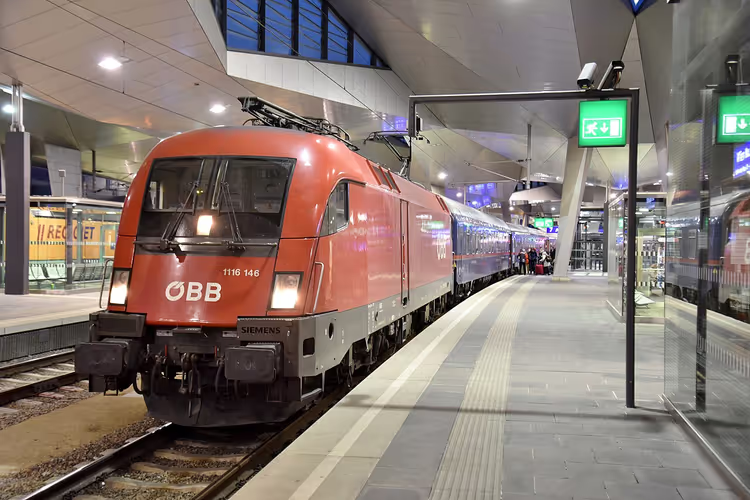 © Bahnfrend · CC BY-SAPhoto: Bahnfrend, CC BY-SA (https://creativecommons.org/licenses/by-sa/4.0), Wikimedia Commons
According to the same page, in the new-generation cars the windows allow mobile signals through, and the compartments have a control panel for lighting and calling the attendant. For you, this means a more stable connection on the road.
Categories on European Sleeper
The Belgian-Dutch company European Sleeper has been operating since 2021 and currently serves three night routes: Berlin - Paris, Prague - Brussels, and Brussels - Milan (verified 09/12/2026 on the carrier's website). Previously the company only ran between Brussels and Berlin; now there are more connections.
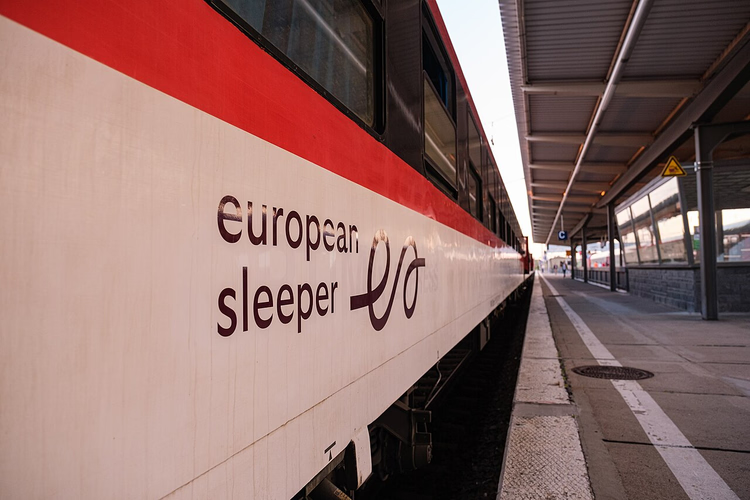
Advance-purchase fares for these trains start at €49.99 per seat, and to Paris from €79.99 (as of 09/2026, European Sleeper fares). The catch: in 2026, European Sleeper does not sell bicycle transport, and dogs or cats are only accepted in a private compartment with a €29.99 surcharge. Children under three travel free if they do not occupy a separate seat.
Breakfast on the night train: usually included
ADAC testers almost always found seats in second-class couchette without cancellation rights. They could freely choose travel dates within the period from May 27 to June 23, and that helped. Only in two cases did they have to take a more expensive comfort ticket because the cheap option was no longer on sale, and once the team took first class.
On most railways, breakfast is included in the price. On European Sleeper, you need to order it separately. If you are traveling with children, plan breakfast in advance: it is not always possible to buy it on board.
Travel time: night train instead of plane and car
Does the night train work as an alternative to flying and driving within Europe? According to the ADAC team's results, yes, if it is a direct train with a journey of ten to roughly 15 hours. For example, Berlin to Stockholm takes about 15 hours, and that is a reasonable price for skipping a night in a hotel.
On long routes with several transfers, the picture is the opposite. The Berlin to Madrid trip takes at least 23 hours 44 minutes, and Hamburg to Barcelona 23 hours 20 minutes. Overall, travel times in the test ranged between 11 hours 20 minutes and 23 hours 44 minutes, with eight of the 21 connections taking longer than 15 hours (as of ADAC on travel times). If you are comparing with flying, count not only the hours in the air, but also the trip to the airport and waiting time.
Passenger rights: the risk with connections
Every additional connection increases the risk of missing the next train. There is often no guaranteed connection if you bought tickets for different legs from different operators. Example: a seat on the Nightjet to Paris and a separate ticket on the private Eurostar to London.
There is an agreement among 16 European rail operators on journey continuation, under which a stranded passenger must be taken to their destination free of charge. But you have no legal right to demand this (as of ADAC on passenger rights). Allow generous buffer time between legs, and keep both tickets when making a connection: you will need them if you have to prove the journey was linked.
10 ADAC recommendations for operators and policymakers
- Create a single booking platform. It should bring together all operators and all connections and show the difference in price, class, amenities, and breakfast.
- Simplify online search. A separate button or filter for night trains is needed, with entry of cities only without pre-selecting a station, and date selection across several days.
- Extend the booking window. Tickets should be sold earlier than six months in advance, as airlines do, even with a caveat about possible schedule changes.
- Make prices clearer and more attractive. Larger quotas of cheap seats are needed, less price spread within a class, and a scale based on ticket flexibility and refundability.
- Add more sleeping accommodation. Operators are advised to increase the number of sleeper and couchette compartments and to use double-decker cars.
- Expand night service in Europe. More routes, more direct trains, and fewer connections make the trip more attractive.
- Factor night trains into network development. The need to expand the night network should be built into infrastructure planning for passenger and freight transport.
- Plan timetable slots better. Night trains should also be considered when allocating routes.
- Strengthen passenger rights. Consumer protection should also cover journeys made up of multiple legs with different operators, including missed connections and through tickets.
- Develop cross-border cooperation. European railways should continue to expand the Agreement on Journey Continuation (AJC).
How the testing was done
The test simulated a typical trip. They searched for an offer for one person aged 35 with light luggage, without a Bahncard or other discounts. The journey had to start with a night train, and a connection to a regular long-distance train was allowed.
The night train criteria were as follows: the journey lasts at least ten hours, with at least six of those hours on the night train, and no more than three connections. Since many trains run only on certain days, all options from Monday through Sunday were checked.
They always looked for the cheapest offer with a place to sleep: a single spot in a couchette or sleeper car, second class, economy fare with a reservation and no cancellation option. If that was not available, they took the next option by price, and if no sleeping accommodation was available, they chose a seated car.
Queries were sent on May 2-7, 2024, for dates between May 27 and June 23, 2024. That is four to seven weeks before the trip, which, according to ADAC's marketing department, matches typical passenger behavior.
Of 105 theoretically possible connections, only 55 met the criteria. No suitable offers were found for Lisbon, and Copenhagen and Prague were only sold from one or two starting points at the time of the test. For practical testing, 21 connections were selected: seven direct, seven convenient with one connection, and seven poor ones with multiple connections, late departure, or an early transfer. The three groups were needed to see the problems more precisely (as of ADAC methodology).
⁉️🤔 Frequently asked questions
How much does a place on a night train across Europe cost?
In the ADAC check, prices for a place where you can lie down ranged between €54 and €607.80 per journey, second class. The cheapest offer was found on the Munich - Amsterdam and Stuttgart - Budapest routes. A place in a couchette car is almost always cheaper than in a sleeper car, and the difference within the same train can be up to three times (as of ADAC on prices, 2024).
How many weeks in advance should you book a night train?
We recommend four to six weeks before the trip, and even earlier during vacations and holidays. Trains do not run every day, and there are few places in sleeper and couchette cars. In the check, five of the 21 connections disappeared from sale the very next day after they were found, so book as soon as you have settled on your dates.
What should you choose: sleeper, couchette, or seated car?
A sleeper car gives you a private compartment for one or two people, a couchette means four or six places in a section, and a seated car is the cheapest and least comfortable. For a night on the move, take a sleeper or couchette: the price of a night in a sleeper car often already runs into three figures, but you arrive rested.
Is breakfast included on a night train?
At most rail companies, breakfast is included in the price of a place in a sleeper or couchette car. There was one exception in the ADAC check: on European Sleeper, breakfast must be ordered and paid for separately. If you are traveling with children, check what the breakfast includes when booking.
What should I do if I miss a connection?
Contact the conductor or the operator's service point. There is an agreement among 16 European railways on journey continuation, but you have no legal right to demand free transport, especially if tickets for the legs were bought from different companies. Keep both tickets and do not agree to buy a new one at your own expense without going through the process.
Which German cities do night trains to Europe depart from?
Night trains in the ADAC check departed from Berlin, Hamburg, Munich, Cologne, Stuttgart, Dresden, and Hanover. Munich has the most connections, with trains going to 11 European cities, including Rome, Paris, and Stockholm. From Stuttgart the choice is smaller: Budapest, Vienna, Rome, and Florence.
In short: what is worth booking
If you need a short and predictable trip, take a direct connection from the seven tested: Berlin - Vienna, Munich - Amsterdam, or Hanover - Vienna. If your destination is farther and cannot be reached without a connection, plan one connection in the morning hours and avoid routes where the night portion is shorter than seven hours.
If you are short on time: check train tickets in Europe on Trip.com. If you arrive early and want to check in right away: look at hotels near the station in your destination city.
Compare both options in advance and book four to six weeks ahead, while the train still has places to sleep.

A small editorial team writing guides for independent travel. We travel ourselves, but we haven’t been everywhere, so we check prices, opening hours and how to get there against official sources.