
















Rome city passes: which one pays off for your itinerary in 2026
There are many city passes for Rome. It is easy to buy the wrong one on the first try. Rome City Pass, Rome Tourist Card, Roma Pass, and Omnia Card work differently and cost different amounts. We compared all four by what they include, how much you save, and how convenient they are for September 2026. One important detail: for most passes, the validity period starts from first activation, not from purchase. Below you will see which pass pays off for your itinerary and where you would be overpaying for the packaging.
Ad: this article contains affiliate links, we earn a commission if you book through them, at no extra cost to you.
What a Rome pass is and when you need one
💡 In short:
- Roma Pass is the cheapest and works well without the Vatican: first entry is free, transit is included.
- Omnia Card and Rome Tourist Card cover both the Colosseum and the Vatican Museums with skip-the-line access.
- Rome City Pass by Turbopass is the most flexible: you choose the inclusions and duration yourself.
- A pass pays off when you use it for an expensive entry (Colosseum, Vatican) plus transit.
- Pass prices and inclusions: checked 09/2026 on the Roma Pass operator site and the Vatican Museums site.
A city pass is a single ticket for several attractions and museums. You pay once, and within the validity period you visit the included sites. Some passes add public transit, a hop-on hop-off bus tour, and skip-the-line entry to the most popular places. The countdown usually starts from first activation. According to the Roma Pass rules, the clock starts when you first enter a museum or tap your card on transit.
What city passes are available for Rome
Below we briefly break down each of the four passes. The order is not a ranking: each has different strengths.
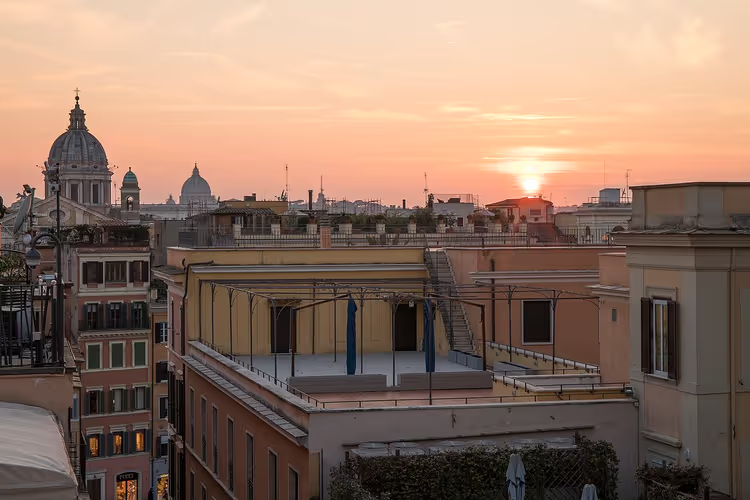 © Luigi Guerrieri4 · CC BY-SAPhoto: Luigi Guerrieri4, CC BY-SA (https://creativecommons.org/licenses/by-sa/4.0), Wikimedia Commons
1. Rome city pass by Turbopass
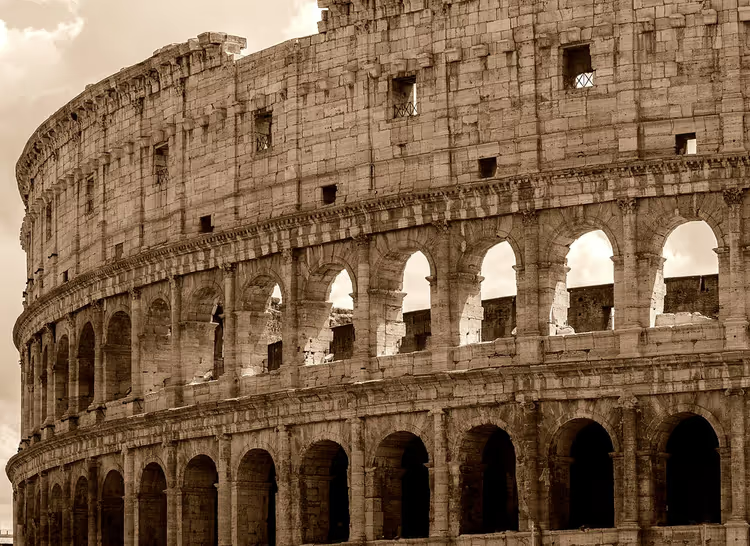 © Jon Gudorf Photography · CC BY-SAPhoto: Jon Gudorf Photography, CC BY-SA (https://creativecommons.org/licenses/by-sa/2.0), Wikimedia Commons
Rome City Pass is issued by Turbopass, a German operator of city passes in a dozen European cities. For Rome, it is the most flexible option. You choose the duration yourself, from 2 to 5 days, and decide whether you need the Colosseum, the Vatican Museums, both, or neither. The pass includes skip-the-line entry to the Vatican Museums and the Sistine Chapel, access to St. Peter's Basilica, a hop-on hop-off bus, and city transit. You can optionally add an airport transfer. The catch: the price depends on your selection, and a full package runs into the low three figures per adult. Check the current inclusions and pricing on the Turbopass website.
2. Rome Tourist Card
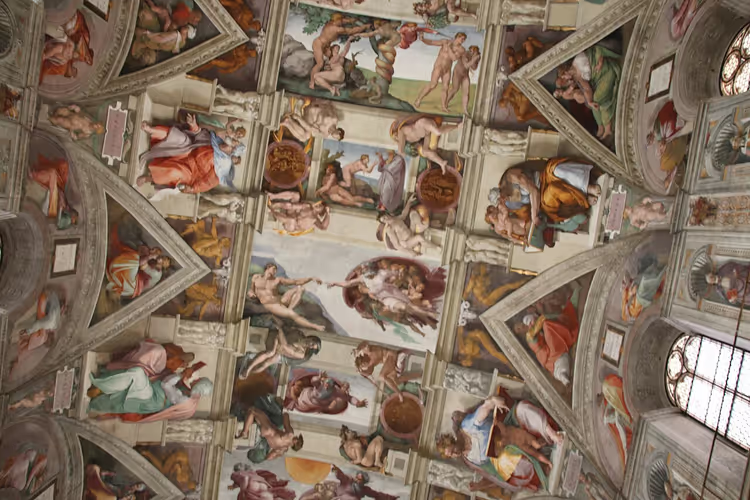
Rome Tourist Card is Tiqets' own "homegrown" pass, and you can only buy it there. The logic is simple: three major sights without lines and without hassle. It includes the Colosseum with the Roman Forum and Palatine Hill, the Vatican Museums and the Sistine Chapel, plus one attraction of your choice: St. Peter's Basilica, the Pantheon, or Castel Sant'Angelo. The pass comes with a city audio guide app and a discount coupon for other Tiqets tickets. There is no time limit, so you can spread your visits across days at your own pace. In terms of price, the card is roughly on par with separate Colosseum tickets and the Vatican combined, so the savings are modest, but there is less hassle. Check the Rome Tourist Card price on Tiqets.
3. Roma Pass
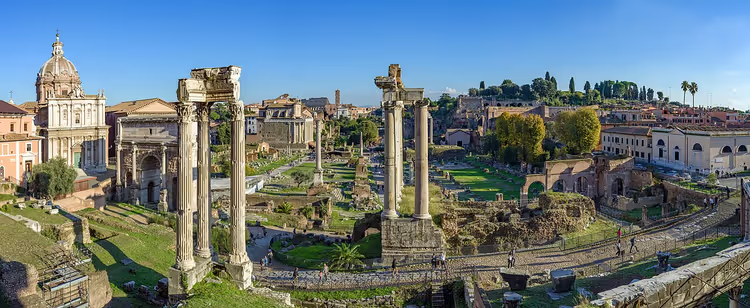 © This Photo was taken by Wolfgang Moroder . Feel free to use my photos, but please mention me as the author and send me a · CC BY-SAPhoto: This Photo was taken by Wolfgang Moroder . Feel free to use my photos, but please mention me as the author and send me a, CC BY-SA (https://creativecommons.org/licenses/by-sa/3.0), Wikimedia Commons
Roma Pass is the cheapest of the four passes, and it is backed by the city. There are two versions: 48-hour and 72-hour. With the 48-hour version, the first entry is free and the rest of the attractions are discounted. With the 72-hour version, the first two entries are free. Public transport is included for the entire duration. The Vatican Museums, however, are not included in Roma Pass at all, and there is no bus tour either. The 48-hour card costs 38 €, and the 72-hour card costs 62.90 € (as of 09/2026, Roma Pass website). It is an honest choice for those coming specifically for ancient Rome. See Roma Pass on GetYourGuide.
4. Omnia Card
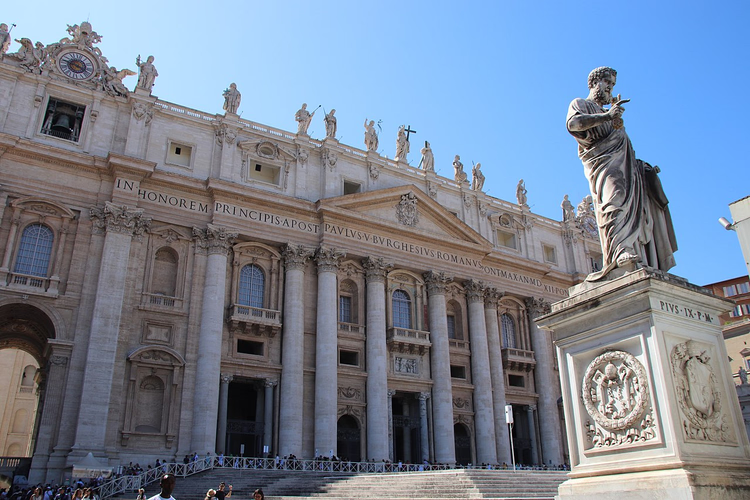
Omnia Card is available only as a 72-hour version. It is an expanded Roma Pass: it includes Roma Pass itself plus everything it lacks. With Omnia you skip the line at the Vatican Museums and St. Peter's Basilica, visit the Colosseum and the Roman Forum, and ride the hop-on hop-off bus and city transport for three days. You also get two free entries of your choice from the Roma Pass attractions. For the Colosseum and the Vatican Museums, you need to book a time slot in advance. The catch: the price is in the low three-digit range per adult, and on a packed itinerary it saves you only a little. But everything is bundled into one ticket. See Omnia Card on GetYourGuide.
Pros and cons of Rome city passes
Pros
The main advantage is that you pay once and then visit the attractions in the bundle without buying tickets individually. Some passes include skip-the-line entry to the Colosseum and the Vatican Museums. This saves you not money, but hours in the July heat. Transport is usually free within the validity period, which makes planning your day easier. You are buying peace of mind: the itinerary comes together in advance, and on the ground you do not need to stand at ticket offices. For a first trip to Rome, this removes half the logistics.
Cons
There is a catch too, and it is worth understanding before you buy. Not every pass offers a good price-to-value ratio: sometimes buying tickets separately works out slightly cheaper than the bundle. A pass nudges you to stick to the list of included attractions, otherwise the value melts away. In Rome this is less of a problem than in other cities: almost all the museums in the bundles are either free or discounted. Still, you will need to do the math for your own itinerary.
Rome pass comparison: table
We have gathered the main differences into one table. For exact individual ticket prices, check the links to the official websites.
Pass | Vatican Museums | Colosseum and Forum | Transport | Hop-on hop-off | Duration |
|---|---|---|---|---|---|
Rome City Pass (Turbopass) | optional, skip-the-line | optional | included | included | 2-5 days |
Rome Tourist Card | yes, skip-the-line | yes, skip-the-line | no | no | no limit |
Roma Pass | no | yes | included | no | 48 or 72 hours |
Omnia Card | yes, skip-the-line | yes | included | included | 72 hours |
For reference: a full 24h ticket to the Colosseum, Roman Forum, and Palatine Hill costs €18 for an adult (as of 09/2026, Parco archeologico del Colosseo). A ticket to the Vatican Museums costs €20 plus €5 booking fee on the official website, €25 total (as of 09/2026, Vatican Museums rates). The value of each pass is calculated against these figures.
Calculation examples: when a pass pays off
Important: the numbers below are a guide, not a guarantee. The result depends on how many sites you manage to visit and which ones you choose. We take confirmed entry prices and calculate using the cheapest ticket option for September 2026.
Roma Pass for 48 hours
The scenario is simple: two days of ancient Rome without the Vatican. On the first day you do the Colosseum, the Forum, and the Palatine, on the second one or two city museums. With Roma Pass, entry to the Colosseum is free. Add city transport for two days and discounts on the remaining museums. The card pays off if you take one expensive entry plus a couple of metro rides per day.
Roma Pass for 72 hours
Three days give you more room. Here the first two entries are free, not just one. The Colosseum plus, for example, the Borghese Gallery, that is already two paid sites that the pass covers. Transport is included for all 72 hours. The card is justified if your itinerary would have cost about the same in tickets and fares without the pass. The Vatican is not in Roma Pass, keep that in mind.
Omnia Card for 72 hours
Omnia works differently because it also covers the Vatican. Add up the individual tickets: the Vatican Museums, the Colosseum, the hop-on hop-off bus, transport for three days, and two entries of your choice. The total comes close to the price of the pass itself, so the net savings with Omnia are small. Its strength is elsewhere: one ticket covers both ancient Rome and the Vatican without separate bookings. If you do not want to piece the trip together from parts, the premium for convenience is justified.
Rome Tourist Card
Rome Tourist Card is convenient for those who want exactly three main sites without queuing. The savings are small, but there is no confusion. This is a choice for a short but packed itinerary.
Rome city pass from Turbopass
Turbopass pays off on a long trip with a full itinerary. The more expensive sites and the longer the duration, the more noticeable the savings compared with individual tickets. For 4-5 days with the Colosseum, the Vatican, transport, and the bus, the package usually pays off. For a short trip to one museum, on the contrary, it is an overpayment: you simply will not have time for that many sites. Calculate for your specific route on the Turbopass page.
Which pass to choose based on trip length
A 2-day trip
For two days, look first at Rome City Pass or Rome Tourist Card. Rome Tourist Card is simpler: three sites without queuing and without rushing. If you do not need the Vatican, take Roma Pass for 48 hours. It is the cheapest of all and covers the ancient part with transport. Roma Pass suits those who are going for the Colosseum and the forums and are not heading to the Vatican Museums.
A 3-day trip
For three days, three of the four passes work well. The only one that does not offer noticeable value is Omnia Card: it is about convenience, not savings. Rome City Pass pays off with a typical active itinerary including the Colosseum and the Vatican. Roma Pass for 72 hours pays off on an ancient Rome itinerary, the Vatican is not included. Rome Tourist Card saves a little, its plus is simplicity.
A 5-6 day trip
For almost a week in Rome, Turbopass is the best fit. Over a long period you can comfortably cover the whole set, and Rome City Pass pays off easily. Rome Tourist Card also works: it has no time limit, and you simply spread your visits across the days. Roma Pass is already too small for that length: 72 hours will run out in the middle of the trip.
Tours and tickets in Rome
Guided tours, skip-the-line tickets and activities — most offers can be cancelled free of charge.
See offers on TiqetsThe widget loads once you give your consent.
⁉️🤔 Frequently asked questions
Is it worth buying a city pass for Rome at all?
Yes, if you take at least one expensive skip-the-line entry and use transport. A pass saves both money and time in queues. Calculate for your own route in advance.
Are the Vatican Museums included in Roma Pass?
No. Roma Pass does not include the Vatican Museums and the Sistine Chapel. For the Vatican without queuing, take Omnia Card, Rome Tourist Card, or Rome city pass from Turbopass. According to Roma Pass, the card covers ancient Rome and city transport, but not the Vatican.
Which pass is the cheapest?
The cheapest is Roma Pass: 48 hours for 38 €, 72 hours for 62.90 € (as of 09/2026, Roma Pass website). It is city-backed and includes transport. But it does not include the Vatican or the hop-on hop-off bus, so cheapest does not mean best for everyone.
Do I need to book a time slot for the Colosseum and the Vatican with a pass?
Yes, for the Colosseum and the Vatican Museums you usually need a time slot in advance, even when entry is already included in the pass. This protects you from queues, but requires you to choose a date and time at activation. Check the booking terms of the pass itself.
When does a pass not pay off?
When you are going for one or two days, walk a lot, and visit one museum. Then individual tickets and single rides will cost less than a package. A pass pays off on a packed itinerary, not on a relaxed stroll.
In short: what is worth booking
The summary is short. Your choice depends on whether you are going to the Vatican and how many days you are coming for.
- If you are going without the Vatican: take Roma Pass, it is the cheapest and includes transport.
- If you need both the Colosseum and the Vatican without queuing: look at Rome Tourist Card or Omnia Card.
- If the trip is long and the itinerary is full: put together Rome city pass from Turbopass for your length of stay.
- If you want one ticket for everything and do not want to count every little thing: Omnia Card is worth its price for the convenience.
First calculate your route using confirmed entry prices, and only then buy a pass.

A small editorial team writing guides for independent travel. We travel ourselves, but we haven’t been everywhere, so we check prices, opening hours and how to get there against official sources.