
















Emergency exit row seats: who won't get them and what to choose instead
A seat on a plane is chosen for comfort, not for price. The most legroom in economy class comes from rows at the emergency exit. But not everyone can take those seats: strict safety rules apply here.
Aviation authorities require that a passenger at the exit be able to open the door themselves and help the crew during an evacuation. For this reason, exit-row seats are not sold to just anyone. Below, we break down which seats to choose for your needs and how to secure them in advance.
Ad: this article contains affiliate links, we earn a commission if you book through them, at no extra cost to you.
What makes emergency exit rows special
💡 In short:
- the emergency exit row has more legroom, but the seat is not always free;
- a window seat gives you a better view, an aisle seat gives you more freedom, an exit-row seat gives you more space;
- only passengers ready to help the crew during an evacuation can sit at the exit;
- requirements for exit-row passengers are set by aviation authorities (as of 09/2026, EASA).
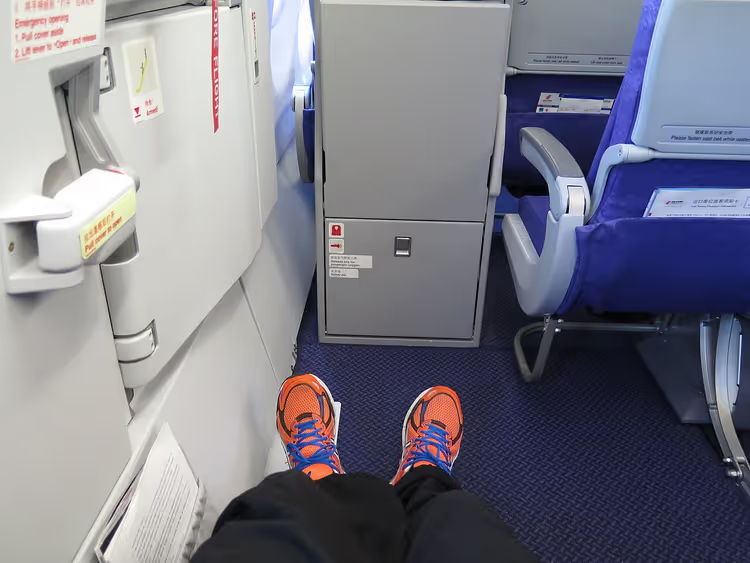
An exit-row seat is valued for its space. These seats usually offer several centimeters more pitch than a standard economy row. On a two-hour flight, that is a nice little bonus, and on a long-haul flight the advantage is obvious. If the exit row is located over the wing, turbulence feels weaker there than in the tail.
There is a flip side. In many cabins, the seat directly in front of the exit does not recline: otherwise the backrest would block the path to the door. That is why this seat is chosen noticeably less often. Keep this in mind if you are used to sleeping in a reclined position.
Some exits are located over the wing. These doors are not always covered by a flight attendant, and in an emergency passengers have to open them themselves. Full-size doors work differently: a crew member sits nearby on a jump seat, gives commands, and helps with evacuation.
In an exit row, the armrest between seats is often fixed, and the tray table pulls out directly from it. This saves space, but you cannot raise the armrest. On the other hand, you can actually stretch your legs forward here, which is not true of a standard row.
 © Douglas Perkins · CC BYPhoto: Douglas Perkins, CC BY (https://creativecommons.org/licenses/by/4.0), Wikimedia Commons
Pros and cons of seats in the cabin
Before choosing, it helps to compare options. Below is a typical picture for a narrow-body aircraft in a 3+3 configuration. Individual airlines change details, but the general logic stays the same.
Seat | Pros | The catch |
|---|---|---|
At the emergency exit | More legroom, first to the exit | Not available to everyone, sometimes for an extra fee |
In the row before the exit | Priced like a regular row | The seat often does not recline |
Window | View, you can lean against the wall and not bother neighbors | Harder to get up to the aisle |
Aisle | You can get up freely and take things from the overhead bin | Neighbors and crew bump your shoulder |
Behind a bulkhead | More legroom, nobody reclines into you | No space under the seat in front for your bag |
Last row | Near the rear bulkhead it is usually less crowded | Often does not recline, closer to the lavatories |
If sleep matters more, take a window seat in the middle of the cabin and away from the lavatories. If you get up often, choose an aisle seat. The middle seat in a block of three is squeezed from both sides, and it is taken last.
A bulkhead seat is convenient for families with infants: that is where bassinets are attached. However, you will have to keep your carry-on in the overhead bin, because there is no space under the seat in front. Rows directly over the wing are next to the engine, so you pay for the quiet there with a slight hum.
Who cannot sit at the emergency exit
Seating rules at the exit are set by aviation authorities and carriers. The reason is one: safety. Details vary by country and airline, but the meaning is the same.
A passenger sitting at the exit must be ready to help the crew. That is why these seats are not given to people with reduced mobility or to those who cannot act quickly on commands. The same applies to serious hearing and vision impairments: without understanding commands, help is impossible. You will also be refused if you are flying with someone who needs assistance during evacuation.
You cannot occupy these seats with small children, even if the child is flying with an adult. The ban also applies to passengers with animals, including service dogs. Elderly people and passengers of unsuitable physical size will also not be offered an exit-row seat.
There are also precise criteria. The passenger must be able to lift and hold the heavy exit cover themselves: for window exits, that is about 27 kg. The minimum age is also restricted: depending on the carrier, it ranges from 12 to 18 years. If a passenger cannot read the safety card or understand crew commands, they will not be given an exit-row seat.
Sometimes the carrier asks you to check in at the counter rather than online. A staff member verifies the passenger's readiness and only then issues the boarding pass. This condition is worth clarifying when you buy the ticket.
How to choose the best seat in advance
A good seat goes to whoever takes it first. The seat map appears in your booking right after you buy the ticket, and you can open it at any time. After that, it is simple.
- Open the seat map in your booking or in the airline's app.
- Decide on your priority: sleep, freedom, or a quick exit matters most for this particular flight.
- Choose a zone. The front of the cabin deplanes faster, the middle is smoother.
- Book your seat in advance if you are flying as a family or with a child.
Online check-in usually opens 24 hours before departure. By that time, exit-row seats are often already taken, and the passenger gets whatever is left. If you are flying with children, choose seats in the regular part of the cabin in advance.
For a long-haul flight, take a window seat in the middle section: it gives you support for sleeping and less turbulence. For a short flight, an aisle seat is enough to get out without rushing and be the first to grab your carry-on. Some carriers give exit-row seats to loyalty program members for free and sell them to everyone else for an extra fee.
⁉️🤔 Frequently asked questions
Who exactly cannot sit at the emergency exit?
The seat will not be given to those who cannot help the crew during an evacuation. The full list of restrictions is in the section "Who cannot sit at the emergency exit."
Are the best seats on a plane always at the emergency exit?
Not always. The exit row has more legroom, but the seat in front of it often does not recline, and the seat itself comes with an extra fee. For sleeping, a window seat in the middle of the cabin is sometimes more comfortable: there is less turbulence and neighbors do not bump your shoulder.
Why is the seat in front of the emergency exit cheaper but less comfortable?
The backrest of this seat often does not recline, otherwise it would block the path to the door. The carrier does not charge a premium for it, but the passenger sits with a straight backrest for the whole flight. If you are used to sleeping reclined, it is better to skip this row.
Can you pay extra for an emergency exit seat?
With some airlines, yes: the exit-row seat is sold as a paid option. But the extra fee does not cancel the safety rules for this row. The conditions are worth clarifying when you buy the ticket.
Where on a plane is there the least shaking?
The least turbulence is in the middle of the cabin, closer to the wings and the aircraft's center of gravity. The tail shakes the most. If you are sensitive to turbulence, ask for a seat over the wing or slightly ahead of it.
In short: what to book
If you need sleep, take a window seat in the middle of the cabin. If freedom matters more, choose an aisle seat. If you want more legroom and are ready to help the crew, ask for an emergency exit row.
Planning a new flight: compare airfare prices on Kiwi.com.

A small editorial team writing guides for independent travel. We travel ourselves, but we haven’t been everywhere, so we check prices, opening hours and how to get there against official sources.