
















Walking tour of Kuala Lumpur: 6 stops from Jamek Mosque to Chinatown
Kuala Lumpur is easier to see on foot. The historic center is compact, and the main sights are within a two-kilometer radius of each other.
In half a day you can cover six stops, and almost all of them are free. You'll only pay at the textile museum, where admission costs 2 to 5 ringgit (as of 09/2026, museum's official website).
Ad: this article contains affiliate links, we earn a commission if you book through them, at no extra cost to you.
Route: six stops in half a day
💡 In short:
- See the center in one line: Jamek Mosque, St. Mary's Cathedral, Merdeka Square, the textile museum, Central Market, and Chinatown.
- Start at the Masjid Jamek LRT station in the morning, when the square is still empty and not too hot.
- Bring water and an umbrella: the walks are short, but you'll be out in the open sun.
- Opening hours and admission checked in 09/2026 using museum data and the cathedral's official website.
Stop | Admission and rules |
|---|---|
Jamek Mosque | Free, outside prayer times; on Fridays non-Muslims are not admitted (mosque visit rules) |
St. Mary's Cathedral | Free, open outside services (parish website) |
Royal Selangor Golf Club (off route) | Private club far from the center: members and their guests only (private club charter) |
Merdeka Square | Free, open 24/7 (square guide) |
Muzium Tekstil Negara | 2 to 5 ringgit, daily 9:00-18:00 (museum's official website) |
Central Market and Chinatown | Free, bargaining is appropriate |
Jamek Mosque at the river confluence
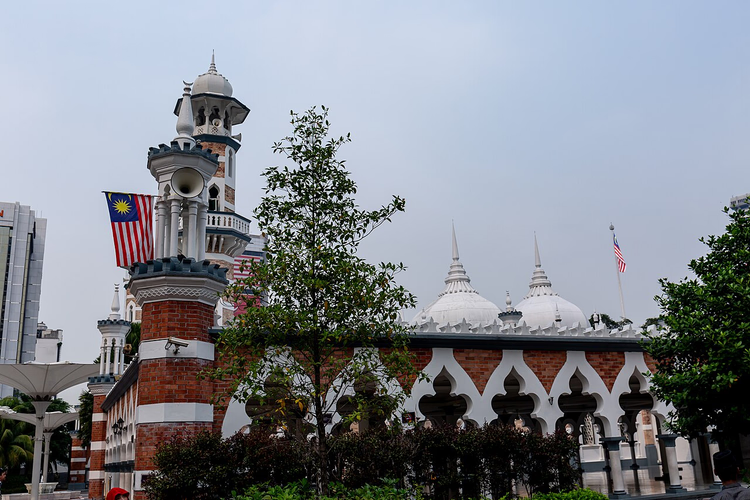
Start your walk at Masjid Jamek, the oldest mosque in the city. It was built in 1909 to a design by British architect Arthur Benison Hubback (as of 09/2026, Malaysia Traveller). The site was chosen for its symbolism: at the confluence of the Klang and Gombak rivers, where the first settlement of the future capital stood.
The building is done in Moorish style. The mosque has three white domes, minarets, and striped red-and-white walls. For a long time it was the country's main mosque, until Masjid Negara took over that role in 1965 (as of 09/2026, mosque page).
Today entry is open to everyone, regardless of faith. Non-Muslims are admitted outside prayer times, and on Fridays the doors are closed to them (as of 09/2026, Malaysia Traveller). Your shoulders and knees must be covered.
- How to get there: the Masjid Jamek LRT station is right at the entrance (see map).
- Who it's for: those who want to start the route with the oldest building in the center.
- The catch: on Fridays entry is closed to non-Muslims, and during prayer times tourists are not admitted.
St. Mary's Cathedral and the Henry Willis organ
 © Flaming Ferrari · CC BY-SAPhoto: Flaming Ferrari, CC BY-SA (https://creativecommons.org/licenses/by-sa/3.0), Wikimedia Commons
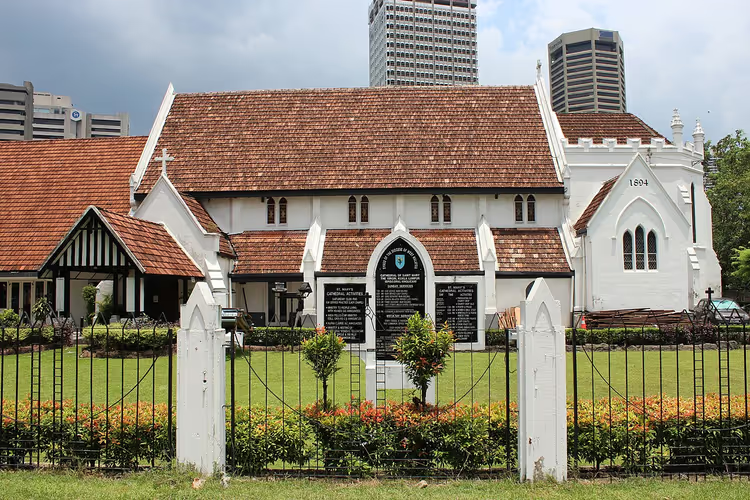
400 m from the mosque stands the Anglican St. Mary's Cathedral. It was consecrated in 1895, and the design was prepared by A.C. Norman, the architect of the Sultan Abdul Samad Building next door (as of 09/2026, cathedral's official website).
The cathedral is done in English Gothic style. White stone, pointed windows, and stained glass look austere, without unnecessary detail. The main treasure inside: an old organ by Henry Willis, the same master who built the organ for St Paul's Cathedral in London (as of 09/2026, cathedral history).
If you go in the morning, light through the stained glass falls in colored patches on the floor. Since 1970 the church has held the status of cathedral of the Diocese of West Malaysia. Services run on a schedule, so on Sundays go in between them.
- How to get there: 400 m from Masjid Jamek along Jalan Raja (see map).
- Tip: half an hour is enough for a visit; the stained glass is best viewed in sunlight.
Royal Selangor Golf Club: how golf began
 © Gryffindor 10:54, 23 December 2006 (UTC) · CC BYPhoto: Gryffindor 10:54, 23 December 2006 (UTC), CC BY (https://creativecommons.org/licenses/by/2.5), Wikimedia Commons
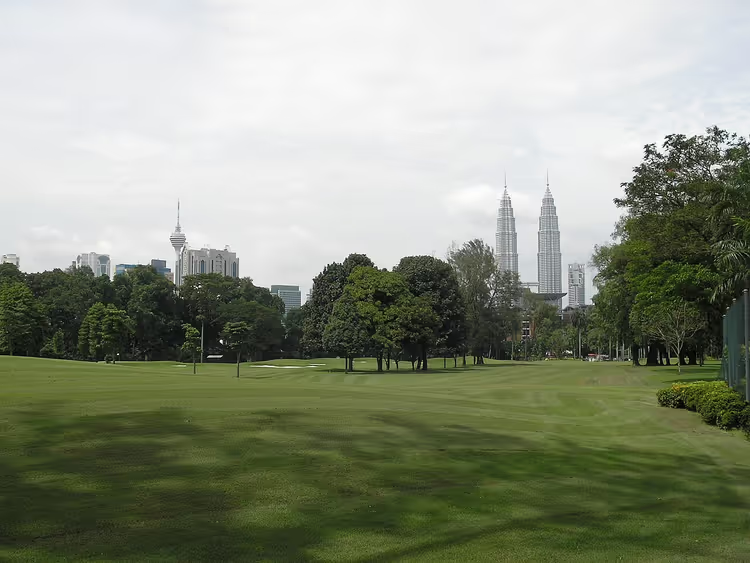
The golf club is far from the center and isn't part of the walking route. This section explains what the British did in Kuala Lumpur besides service and cricket. The Royal Selangor Golf Club was founded in 1893, and today it's one of the oldest golf clubs in Asia (as of 09/2026, Wikipedia).
It all started with an ad in the Selangor Journal newspaper. On January 13, 1893, several coffee planters called a meeting at the Selangor Club and proposed creating a golf club in the city. The first course was laid out on Petaling Hill, where the Merdeka and Negara stadiums now stand (as of 09/2026, club history).
In 1918, the government took the hill for a public park and offered the club a new site in the city center. It has operated there since 1921. In 1942, the clubhouse was occupied by the Japanese military (as of 09/2026, RSGC history section).
Today the grounds have two 18-hole courses and a short 9-hole Sulaiman course. In 1963, the club received royal status and changed its name to The Royal Selangor Golf Club (as of 09/2026, club website).
One important caveat for you here: you can't get onto the grounds. It's a private club that admits only members and their guests (as of 09/2026, club rules).
- Who it's for: those collecting the history of the colonial city rather than sporting impressions.
- Not for: those hoping to walk the course and photograph the holes from inside.
- The catch: outsiders aren't allowed on the grounds, so you'll have to look from the street.
Merdeka square and the sultan Abdul Samad building
 © Shesmax · CC BY-SAPhoto: Shesmax, CC BY-SA (https://creativecommons.org/licenses/by-sa/4.0), Wikimedia Commons
Merdeka Square (Dataran Merdeka) used to serve as the cricket field of the Selangor Club (as of 09/2026, Wikipedia). Don't confuse this club with the golf club from the previous section: today it's called the Royal Selangor Club and stands right on the square.
At midnight on August 31, 1957, the British flag was lowered here and the flag of independent Malaya was raised for the first time. The flagpole on the square has since grown to 95 m and ranks among the tallest in the world (as of 09/2026, Dataran Merdeka guide).
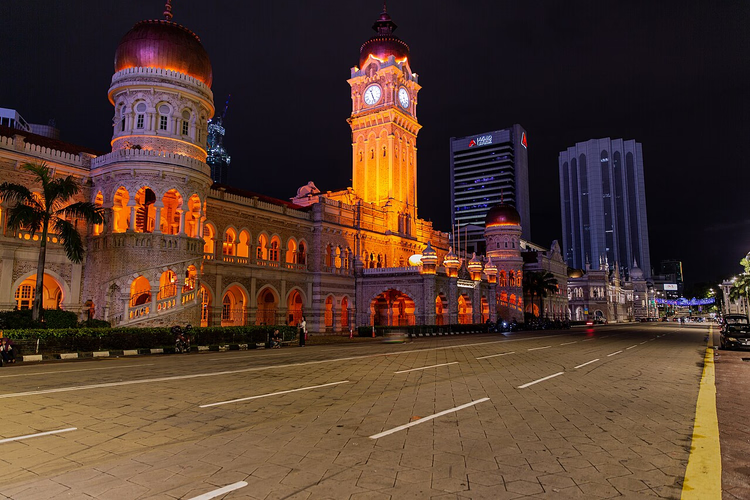
Across from the square stands the Sultan Abdul Samad Building. It was built in 1897 for the British colonial administration (as of 09/2026, Wikipedia). It's recognizable by its copper dome and clock tower, which locals call the city's Big Ben.
The facade is done in the Indo-Saracenic style: arches, onion domes, symmetrical towers. In the evening, the lighting comes on, and the largest crowd of photographers gathers at the facade.
- Getting there: about a five-minute walk from the Masjid Jamek LRT station (per the map).
- Who it's for: those who want to see the place where independent Malaysia was born.
- The catch: there's almost no shade on the lawn, and it's hot here during the day.
Muzium Tekstil Negara in the old building
 © Marcin Konsek · CC BY-SAPhoto: Marcin Konsek, CC BY-SA (https://creativecommons.org/licenses/by-sa/4.0), Wikimedia Commons
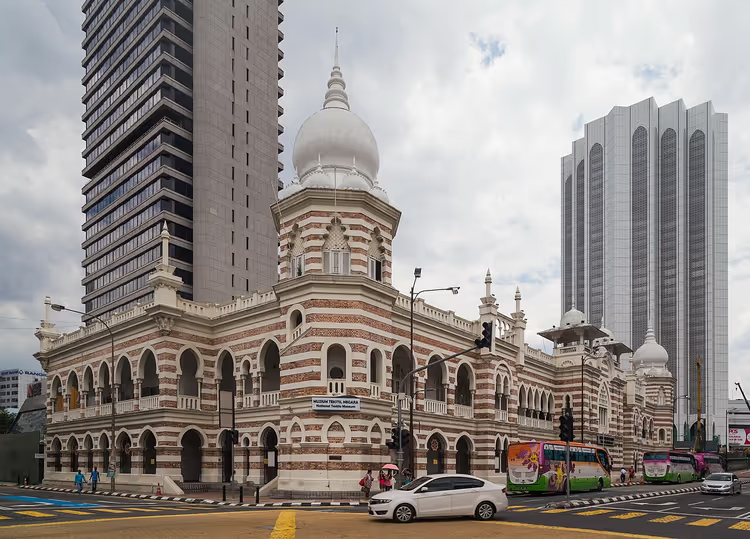
Muzium Tekstil Negara, or the National Textile Museum, sits right next to the square, adjacent to the Sultan Abdul Samad Building. The museum is open daily from 9:00 AM to 6:00 PM, and admission costs between 2 and 5 ringgit (as of 09/2026, official museum website).
The exhibition is divided into four galleries. Here you'll see batik, songket, national costumes, wedding attire, and a collection of jewelry, brooches, and hairpins from different regions of the country. Fabric patterns once indicated the wearer's status, so the designs on display don't repeat.
The museum building is interesting in its own right. The neo-Moorish facade with towers, carved arches, and tall spires looks like part of the square's palace ensemble. The museum and the square together take about an hour.
- How to get there: about 200 m from Merdeka Square (on the map).
- Who it's for: those interested not only in facades but also in crafts.
- Tip: if you prefer listening to a guide, check out tours of central Kuala Lumpur on GetYourGuide.
Central Market and Chinatown
 © Shesmax · CC BY-SAPhoto: Shesmax, CC BY-SA (https://creativecommons.org/licenses/by-sa/4.0), Wikimedia Commons
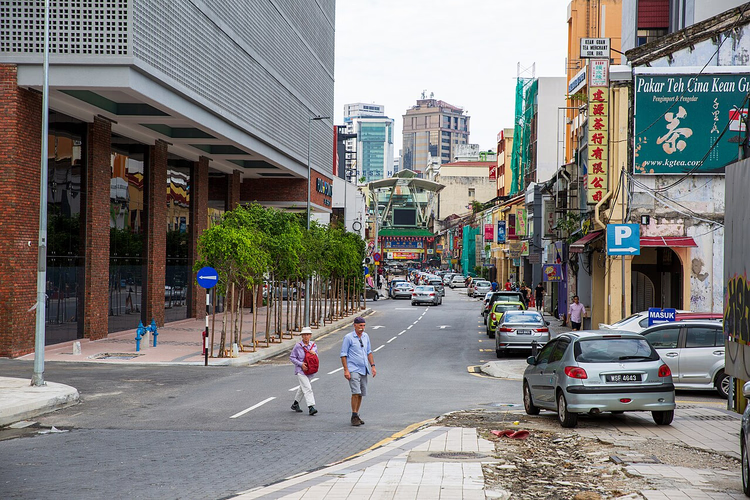
The market and Chinatown wrap up the route. Central Market started as an ordinary fish and spice market, and today it's a large air-conditioned pavilion with souvenirs and craft shops. Admission is free, and people come here primarily for gifts.
Chinatown begins right behind the market, with Petaling Street as its main thoroughfare. Vendors sell clothing, shoes, accessories, and brand-name replicas. Quality varies, so inspect any item in good light before buying.
- How to get there: Pasar Seni station is right by Central Market (see map).
- Who it's for: those who want to finish the walk with souvenirs and street food.
- The catch: Chinatown is noisy and crowded, and much of the merchandise is repetitive.
Tours and tickets in Kuala Lumpur
Guided tours, skip-the-line tickets and activities — most offers can be cancelled free of charge.
See offers on GetYourGuideThe widget loads once you give your consent.
⁉️🤔 Frequently asked questions
How long does the whole route take?
At a leisurely pace, the route takes about three hours including the museum. If you want to sit down at a cafe in Central Market, plan for half a day. It's only a ten-minute walk from the square to Chinatown, so you can split the route into two parts and come back to it in the evening.
What's the best time to start?
It's best to head to Jamek Mosque in the morning, in time for the museum's 9:00 opening. By midday the square gets hot, and there's almost no shade there. If you can't make it in the morning, start after 4:00 PM: the heat eases toward evening, and the Sultan Abdul Samad Building is illuminated. Keep in mind that the museum closes at 6:00 PM.
Can non-Muslims enter Jamek Mosque?
Yes, admission is free, but only outside prayer times. On Fridays, non-Muslims are not allowed in, so save Friday for other stops (as of 09/2026, Malaysia Traveller). Your shoulders and knees must be covered. Women should bring a headscarf.
What's free, and where do you have to pay?
You can visit the mosque, the cathedral, the square, Central Market, and Chinatown for free. You only have to pay at Muzium Tekstil Negara: from 2 to 5 ringgit (as of 09/2026, the museum's official website). You don't need a ticket for the Royal Selangor Golf Club for a different reason: outsiders are not allowed in.
How do you get to the start of the route?
The route starts at the Masjid Jamek LRT station: the exit leads straight to the mosque (see map). From the Bukit Bintang area, it's easier to take a taxi than to walk in the heat. At the end of the route, you'll find yourself at Pasar Seni station, from where it's easy to get to any part of the city.
In short: what's worth booking
The central Kuala Lumpur route requires almost no bookings. All stops are open to visitors, and you only have to pay at the textile museum. What you should plan is the day, your start time, and a supply of water.
- If you have half a day: do all six stops in a row, from Jamek Mosque to Chinatown.
- If you have less than three hours: save Chinatown for next time.
- If you want a guide: Kuala Lumpur tours on GetYourGuide.

A small editorial team writing guides for independent travel. We travel ourselves, but we haven’t been everywhere, so we check prices, opening hours and how to get there against official sources.