
















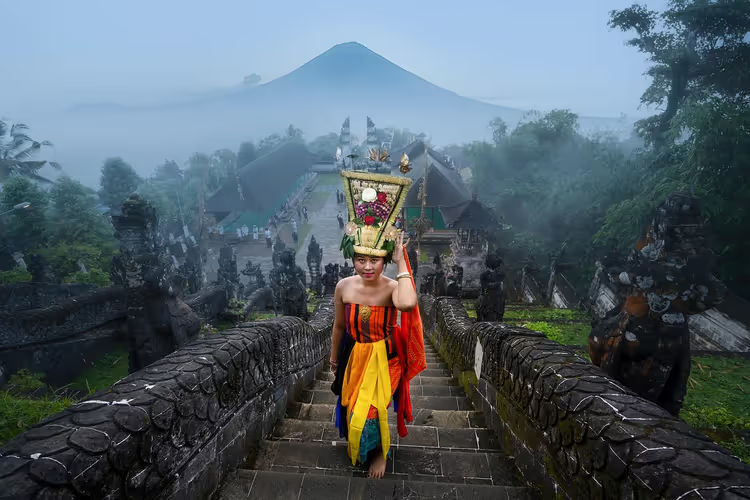
35 places in Bali: a practical guide to temples, waterfalls and parks
The list of Bali's attractions quickly turns into a muddle if you only look at the map. The island's roads are narrow, the switchbacks are slow, and the temples, waterfalls and parks are scattered across every district. In a single day you will cover the south coast and see two sights out of thirty-five.
We have gathered the main places into one route list and sorted them by part of the island: the south with its clifftop temples, the centre with Ubud, terraces and waterfalls, the east with the palaces of Karangasem, the north with volcanoes, lakes and the village of Trunyan, and the west with West Bali National Park. You can only walk across the sand spit to Tanah Lot Temple at low tide.
Below you will find a description of each sight, practical details on getting there and tickets, and the honest catches. We checked the facts against the sights' official websites and park guides, and turned any unconfirmed numbers into general wording. Decide where to go first based on your own schedule: the island is big, and you won't get around all of it in one trip.
Ad: this text contains affiliate links, we earn a commission through them, and the price for you stays the same.
How Bali is laid out and what to see
💡 In short:
- Five areas of the island: the south (Kuta, Bukit, Uluwatu, Tanah Lot), the centre (Ubud, waterfalls, terraces), the east (palaces and Karangasem), the north (volcanoes, lakes, Trunyan), the west (West Bali National Park).
- Allow anywhere from an hour to half a day per sight: temples and waterfalls are quick to see, while parks with shows take half a day.
- Tickets and opening hours: 09/2026, checked on the official Waterbom Bali website.
The logic of travelling around the island is simple. You stay either in the south, in Kuta, Seminyak or Nusa Dua, or in Ubud, and from that base you plan loop days without going back to the hotel. The drive between the south and the central part eats up a noticeable chunk of the day, so in one day people do either the southern route or the central one.
The south of the island is the most convenient for a short trip: in two days you cover Uluwatu, Tanah Lot, the Bukit beaches and Garuda Wisnu Kencana Park. Give the centre over to nature: the rice terraces, waterfalls, monkey forest and museum halls of Ubud sit close to one another. The east and the north each need a separate day, because the switchbacks between them take a lot of time.
Your situation | Where to go first |
|---|---|
First trip | Uluwatu, Tanah Lot, Ubud, Tirta Empul Temple |
You want mountains | Mount Batur, Lake Bratan, the village of Trunyan |
Travelling with children | Waterbom, the bird park, the safari park, the elephant park |
You love water | Tegenungan, Sekumpul, Munduk, Tibumana |
Looking for quiet | West Bali National Park, Jatiluwih |
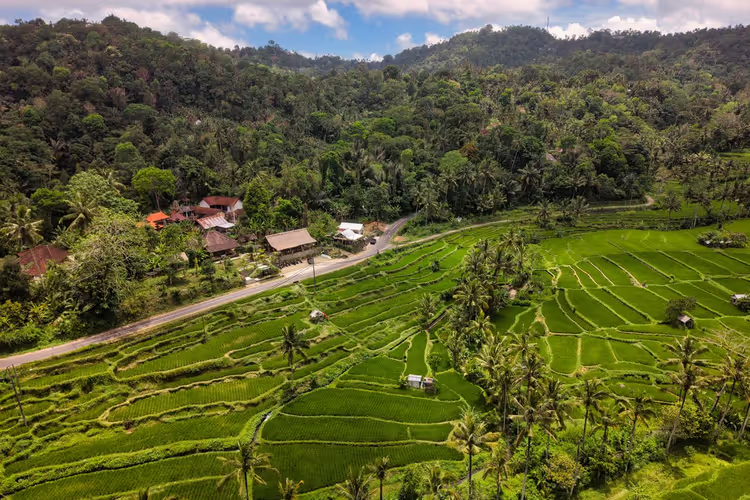
1. Mount Agung
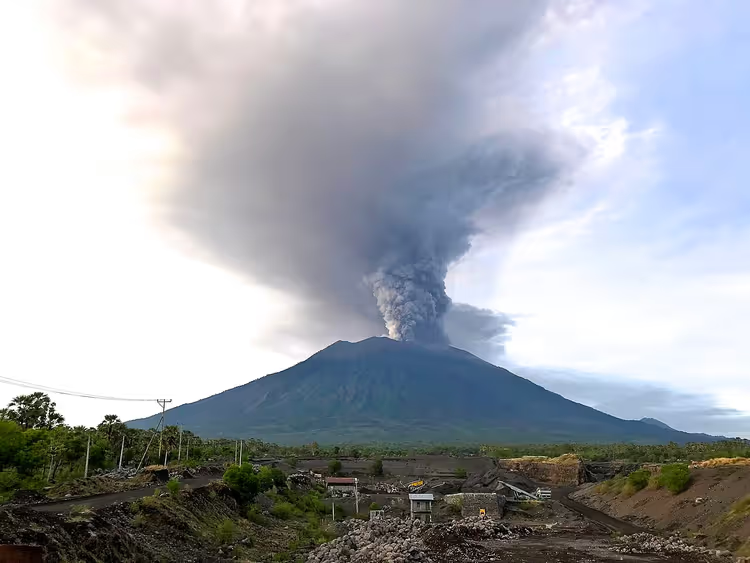 © Michael W. Ishak ( www.myreefsdiary.com ) · CC BY-SAPhoto: Michael W. Ishak ( www.myreefsdiary.com ), CC BY-SA (https://creativecommons.org/licenses/by-sa/4.0), Wikimedia Commons
Agung rises above every other peak on the island, and the Balinese regard it as the home of the gods. The volcano is active: there were eruptions in the last century too, so the upper slopes are almost bare of vegetation. The crater at the summit is wide, and the trail runs along a narrow ridge beside the drop.
Sunrise at the top is worth the night-time start. You will see the green island beneath the clouds and the neighbouring peaks, but only in clear weather. You need a guide not for the stories but for safety on the unlit trail.
- Getting there: a winding road leads from Ubud to the foot of the mountain through the Kintamani area, and the drive takes several hours.
- Cost: the route is paid, and you arrange the ticket on the spot with a guide or in the village.
- Who it's for / Not for: for you if you have mountain hiking experience. Not for those counting on an easy walk with children.
- The catch: the climb is tough, and there are few handrails on the trail.
2. Mount Batur
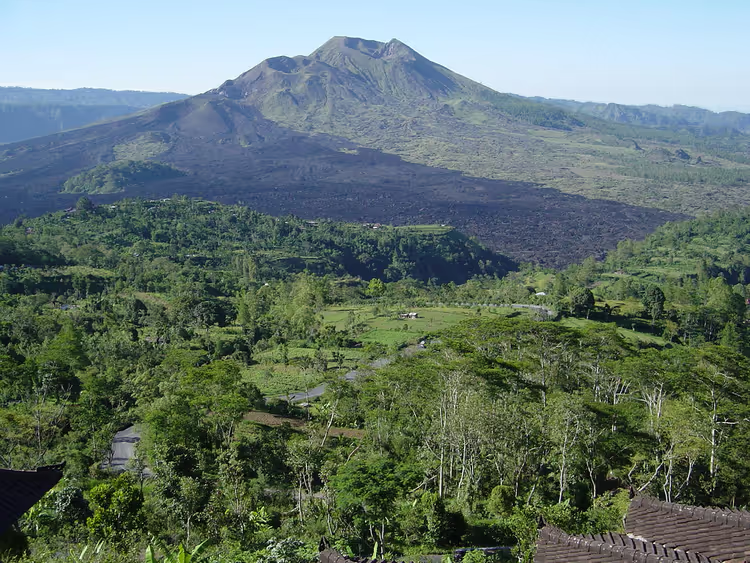 © Jnpet · CC BY-SAPhoto: Jnpet, CC BY-SA (http://creativecommons.org/licenses/by-sa/3.0/), Wikimedia Commons
Batur is lower than Agung and noticeably easier to climb. Ubud's formidable neighbour draws travellers with its hardened lava flows and the jets of hot steam that escape from fissures in the mountain.
The climb takes about two hours and needs no mountaineering training: you follow a well-trodden path and meet the sunrise above the clouds. A tropical panorama opens up along the crater rim. There are hot springs at the foot, and Lake Batur lies nearby.
- Getting there: a road runs from Ubud to the village of Batur past rice fields, and the start is usually at night.
- Cost: the route is paid, and you pay the guide on the spot.
- Who it's for / Not for: for you if you want a sunrise above the clouds without a hard climb. Not for those who aren't ready to get up before dawn.
- Good to know: after the descent you can relax in the hot springs at the foot.
3. Campuhan Ridge Walk in Ubud
 © Fabio Achilli from Milano, Italy · CC BYPhoto: Fabio Achilli from Milano, Italy, CC BY (https://creativecommons.org/licenses/by/2.0), Wikimedia Commons
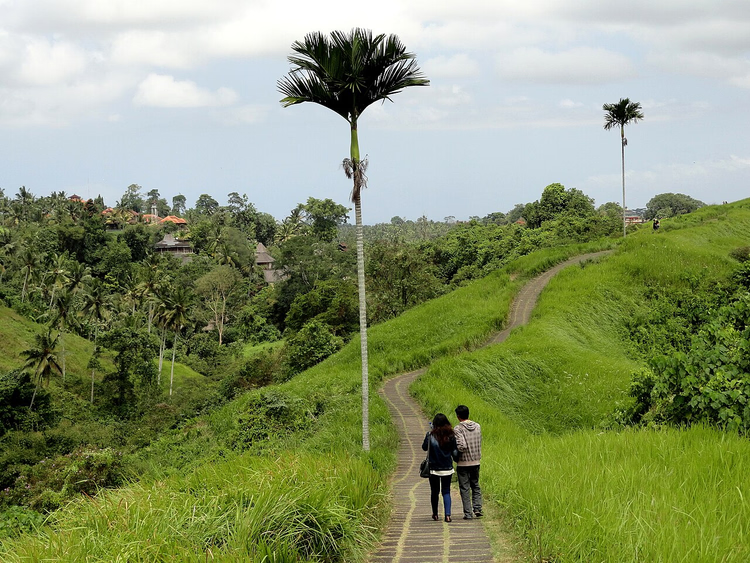
The Campuhan Ridge Walk, known as the artists' trail, runs along the crest of Campuhan hill between two rivers. The narrow paved path stretches along the open ridge, with palms, flowering meadows and stone shrines pressing right up against it.
The route is about two kilometres one way, and there is hardly any uphill walking. At the end you will find a few cafés serving local food, a handy place to call it a day and head back the same way. It is best to do the walk in the morning, before the sun gets high.
- Getting there: the start is on the western edge of Ubud, and you don't need a car.
- Cost: entry is free.
- Who it's for / Not for: for you if you want a short walk without a hard climb. Not for those who expect deep jungle from Ubud, as the scenery here is open.
4. Ubud Monkey Forest
 © rheins · CC BYPhoto: rheins, CC BY (https://creativecommons.org/licenses/by/3.0), Wikimedia Commons
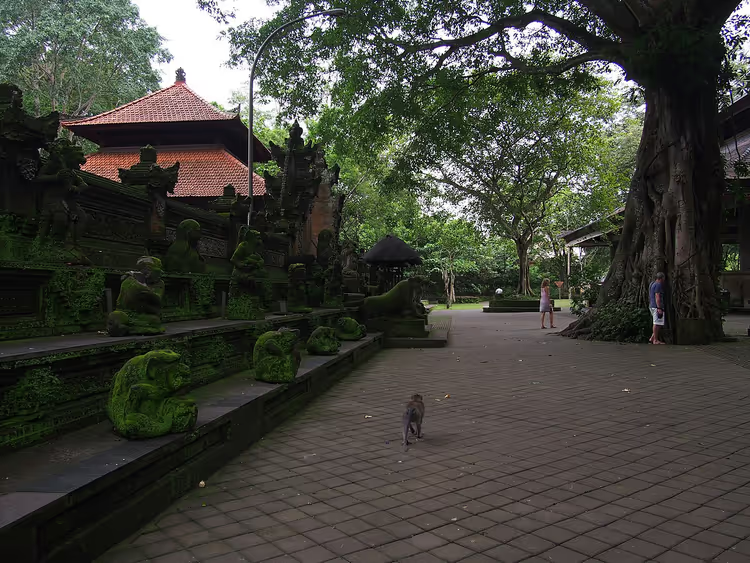
The Ubud Monkey Forest covers a patch of tropical forest with vines, centuries-old trees, banyans and massive boulders. A large colony of primates lives in the sanctuary, and the animals roam the paths freely, climb the branches and swim in the pond.
There is one rule here: hide your glasses, jewellery, hats and anything shiny. The monkeys are shameless and will snatch whatever takes their fancy, and trying to get it back afterwards is pointless. On the other hand, the avenues lined with mossy statues of mythical creatures make for good photos.
- Getting there: the sanctuary is inside Ubud, and you can walk there from the main street.
- Cost: entry is paid, and tickets are sold at the entrance from morning till evening.
- Who it's for / Not for: for you if you are travelling with children and want to see primates up close. Not for those who aren't ready for animals underfoot.
5. Waterbom Bali water park
Waterbom Bali in Kuta stays near the top of the rankings of water parks in Southeast Asia. The park is open-air, set among tropical greenery, and runs winter and summer on a 9:00 to 18:00 schedule (as of 09/2026, according to the park).
The rides are designed for different levels of nerve. Extreme spiral slides and vertical drops deliver speed, the lazy river and fountains suit a slow drift on a tube, and there is a shallow lagoon set aside for children. On top of that there are pools with sun loungers, swim-up bars and massage salons.
- Getting there: the water park is in Kuta, in the south of the island, and you can get here from the airport without changing transport.
- Cost: the children's rate is lower than the adult one, and it is easier to buy Waterbom Bali tickets in advance.
- Who it's for / Not for: for you if you are travelling with children or want a day without temples and history. Not for those looking for quiet.
- The catch: queues for the top slides grow after midday, so arrive at opening time.
6. Tirta Gangga Water Palace
 © rheins · CC BYPhoto: rheins, CC BY (https://creativecommons.org/licenses/by/3.0), Wikimedia Commons
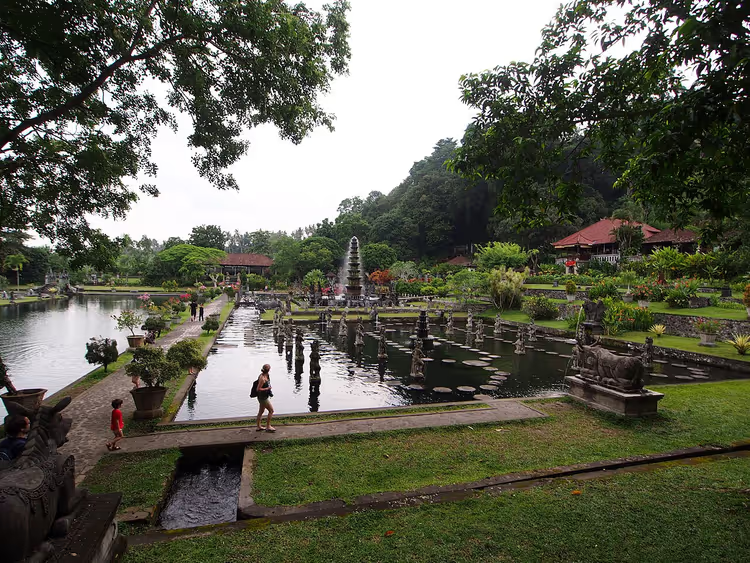
Tirta Gangga appeared in Karangasem in the middle of the last century. The local raja was keen on designing water gardens and took part in the building work himself, which is why traditional architecture is combined here with Chinese pavilions.
The grounds are small but densely packed: ponds, bathing pools, fountains and sculptures in a lush green garden. The centrepiece of the ensemble, a multi-tiered pagoda-shaped fountain, is visible right from the entrance. You can walk across the stepping stones in the middle of the pond, with golden carp swimming beneath your feet.
- Getting there: the palace is in the east, in Karangasem regency, and it is a long drive from the southern beaches.
- Cost: entry is paid, and you buy the ticket at the entrance.
- Who it's for / Not for: for you if you are heading east and want a stop of an hour and a half. Not for those looking for scale and long walks.
7. Taman Ujung Water Palace
 © Manuae · CC BY-SAPhoto: Manuae, CC BY-SA (https://creativecommons.org/licenses/by-sa/4.0), Wikimedia Commons
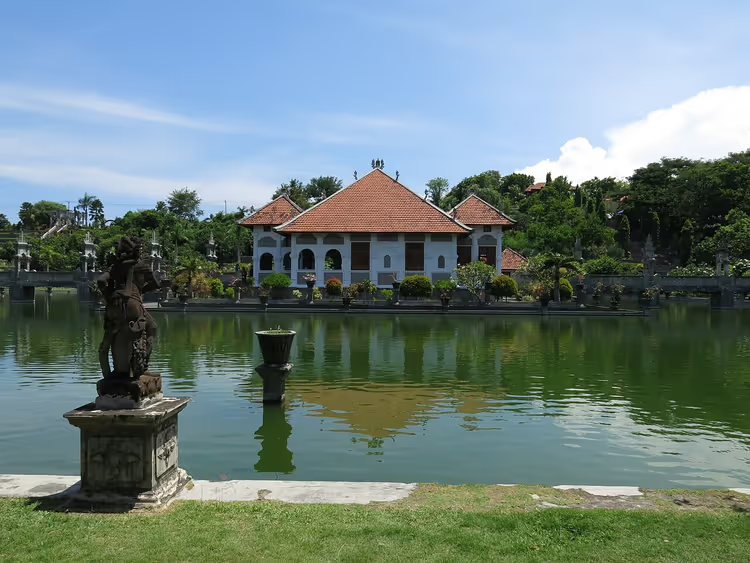
Taman Ujung is in the east, in the Karangasem area, and is considered one of the most beautiful palace ensembles on the island. The complex was built at the start of the last century to a design by Dutch and Chinese architects for the last ruler of the regency, who used it as a summer residence and a place to receive delegations.
The layout is based on the philosophical image of a ship. The lotus pond symbolises life, the building itself resembles a vessel, the ruler acts as captain, the officials as crew, and the citizens as passengers sailing towards prosperity.
The main building stands in the centre of the pond. Its white façade is adorned with an arched gallery with bas-reliefs and a tall hipped roof, with carved statues, columns and delicate little bridges rising beside it. The garden blooms all year round, and you will get a calm walk with no crowds at the entrance.
- Getting there: the palace is in Karangasem, and it is convenient to combine it with Tirta Gangga in one outing.
- Cost: entry is paid, and you pay at the entrance.
- Who it's for / Not for: for you if you love palaces and water. Not for those who came to Bali only for the beaches.
8. Agung Rai Museum of Art
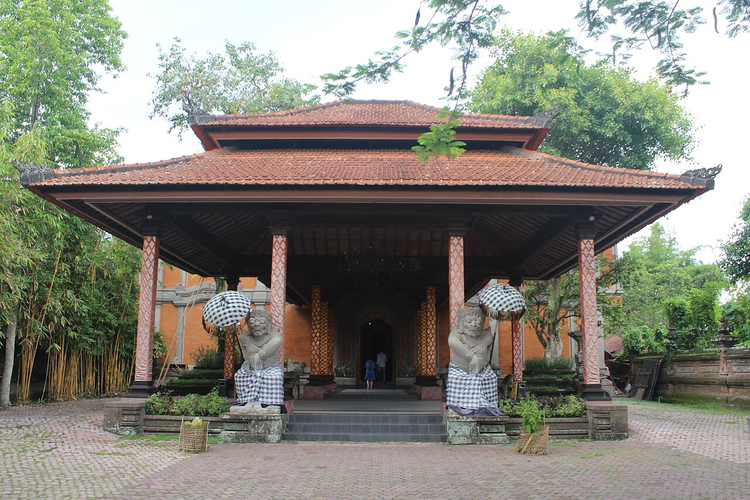
The Agung Rai Museum of Art stands in the centre of Ubud and will enrich the cultural side of your trip. The collection was put together by the collector whose name the building bears, and it spans works by masters of the Indonesian archipelago from the Middle Ages to the present day.
 © Harditaher · CC BY-SAPhoto: Harditaher, CC BY-SA (https://creativecommons.org/licenses/by-sa/4.0), Wikimedia Commons
Paintings and prints form the core of the collection. The painted panels show local nature, mythical creatures, religious scenes and rural life. Besides the gallery, the grounds house a research centre, a library, a theatre and several workshops where woodcarving and batik are demonstrated.
- Getting there: the museum is in Ubud, and you can walk there from the centre.
- Cost: entry is paid, and tickets are sold at the ticket office.
- Who it's for / Not for: for you if you are interested in painting and ready to spend a couple of hours in the halls. Not for those who expect interactive exhibits from a museum.
9. Puri Lukisan Museum
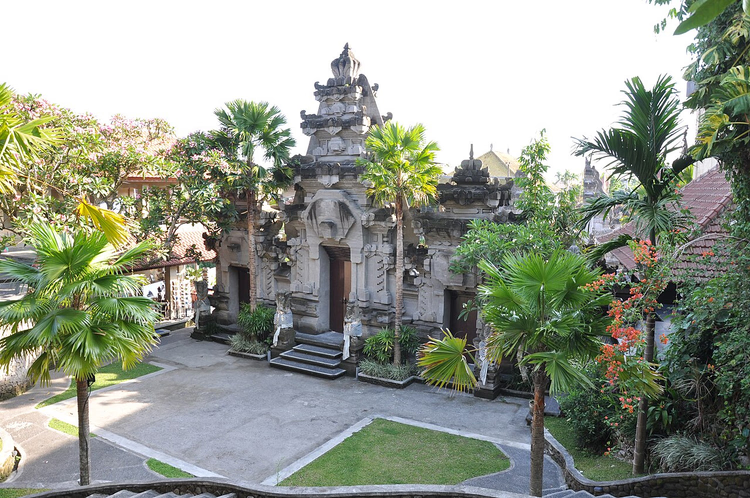
Puri Lukisan in Ubud gives a clear picture of the island's cultural history. Its three buildings are surrounded by lotus ponds and fragrant gardens, and inside are canvases from different eras, wood carvings, photographs and decorative objects.
 © Jorge Láscar from Melbourne, Australia · CC BYPhoto: Jorge Láscar from Melbourne, Australia, CC BY (https://creativecommons.org/licenses/by/2.0), Wikimedia Commons
You will enjoy studying the ancient paintings with religious and mythical subjects, as well as scenes from the everyday life of the Balinese. The pavilion with black-and-white graphic art and intricate geometric patterns deserves special attention.
- Getting there: the museum is in Ubud, close to the town's other galleries.
- Cost: entry is paid, and tickets are sold on the spot.
- Who it's for / Not for: for you if you want to compare Balinese painting from different periods. Not for those looking for temples and nature.
10. Big Tree Farms bamboo chocolate factory
The island is famous for its cocoa plantations and its natural chocolate. The Big Tree Farms factory is one of the places where those with a sweet tooth are taken: it produces up to three tonnes of chocolate a month and uses a low-temperature process.
The main feature of the place is its material. The workshops are built entirely of bamboo: walls, roofs, staircases and furniture, which is why there are so many fire extinguishers inside. The staff show the stages of chocolate making and run a tasting, so you will leave with an understanding of the process and with a purchase.
- Getting there: the factory is in the central part of the island, and it is convenient to stop by on the way between Ubud and the north.
- Cost: the tour with tasting is paid, and tickets are arranged on the spot.
- Who it's for / Not for: for you if you are travelling with children and love food. Not for those looking for historical monuments.
11. Museum Pasifika
 © Museum Pasifika · CC BY-SAPhoto: Museum Pasifika, CC BY-SA (https://creativecommons.org/licenses/by-sa/4.0), Wikimedia Commons
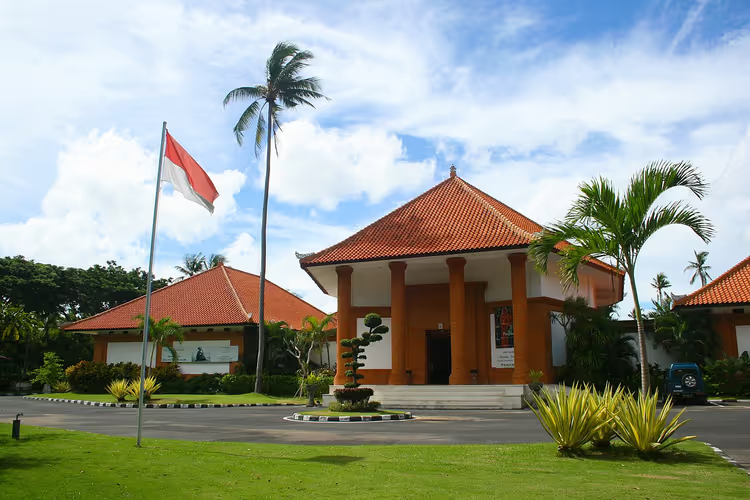
Museum Pasifika is located within the Nusa Dua resort and will suit those who want to get to grips with the culture of the Asia-Pacific region. The collection conveys the centuries-old character of everyday life among the peoples of Indonesia and the neighbouring islands.
Eleven halls display ancient idols, sculptures, indigenous costumes, ritual masks and household objects. A separate section is devoted to painting: here hang canvases by local artists and by European masters who moved to Bali. In the portraits and genre scenes you will see the islanders of the middle of the last century.
- Getting there: the museum is in Nusa Dua, in the south of the island, close to the resort's hotels.
- Cost: entry is paid, and tickets are sold at the museum ticket office.
- Who it's for / Not for: for you if you are staying in the south and want a cultural day without long drives. Not for those who came for the beaches.
12. Neka Art Museum
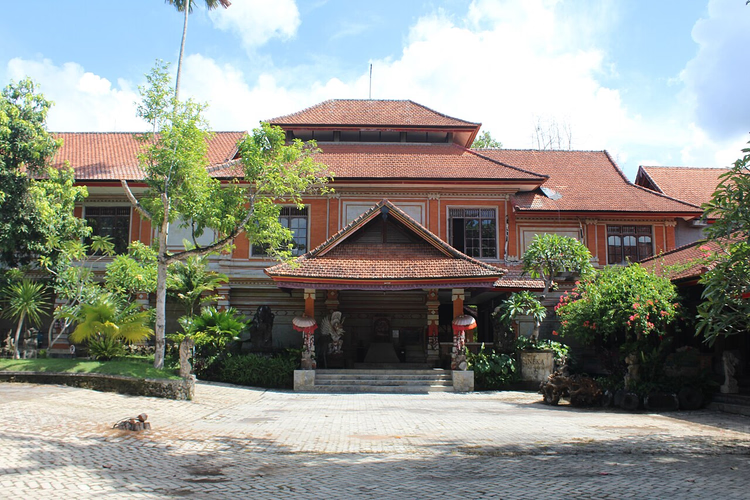
The Neka Art Museum in Ubud is named after the artist and collector Suteja Neka, a native of the town. It holds a large collection of paintings by Indonesian and foreign masters who were inspired by the tropical nature and the culture of the local people.
 © Harditaher · CC BY-SAPhoto: Harditaher, CC BY-SA (https://creativecommons.org/licenses/by-sa/4.0), Wikimedia Commons
The collection shows how Balinese painting developed and what it borrowed from the Western school. You will see portraits, landscapes, impressionism and graphic art, and the subjects of the paintings tell of the islanders' daily life, history and culture. For ethnographers it is a genuine source, and for the ordinary visitor a clear timeline of styles.
- Getting there: the museum is in Ubud, a walk from the town centre.
- Cost: entry is paid, and tickets are sold at the ticket office.
- Who it's for / Not for: for you if you want to understand the difference between the Balinese schools of painting. Not for those looking for entertainment with children.
13. Tegenungan Waterfall
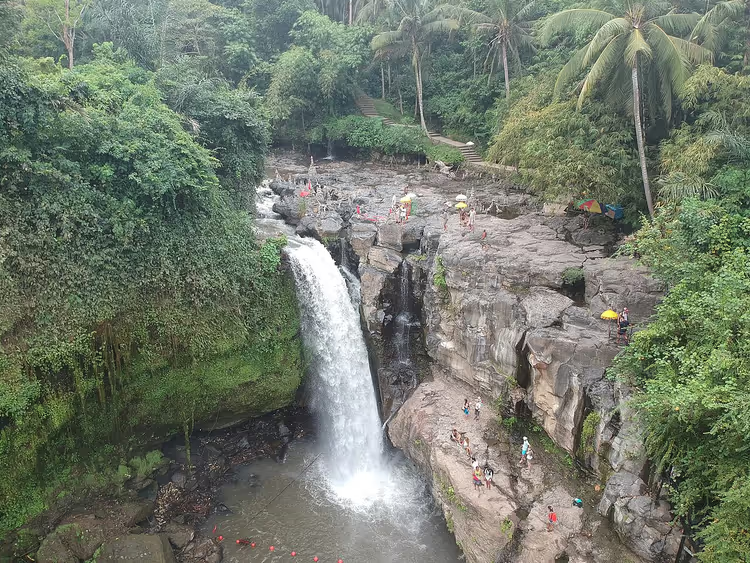 © Magul · CC BY-SAPhoto: Magul, CC BY-SA (https://creativecommons.org/licenses/by-sa/4.0), Wikimedia Commons
Tegenungan hides in forest greenery not far from Ubud. Broad, powerful streams fall from the hillside into a natural pool, and the sheer cliffs are covered in evergreen moss, a sign of the humid tropical climate.
A viewing platform looking onto the falling water has been set up for visitors. Going down the massive steps, you will find yourself at the foot of the falls and feel the force of the current, and on the bank there are bathing pools fed by water spouting through openings in the rock.
- Getting there: the waterfall is on the outskirts of Ubud, and a paved road leads to the entrance.
- Cost: entry is paid, and you buy the ticket at the entrance.
- Who it's for / Not for: for you if you want to bathe under the falls. Not for those who find a long staircase hard going.
- The catch: after your swim you face a climb back up a great many steps.
14. Sekumpul Waterfall
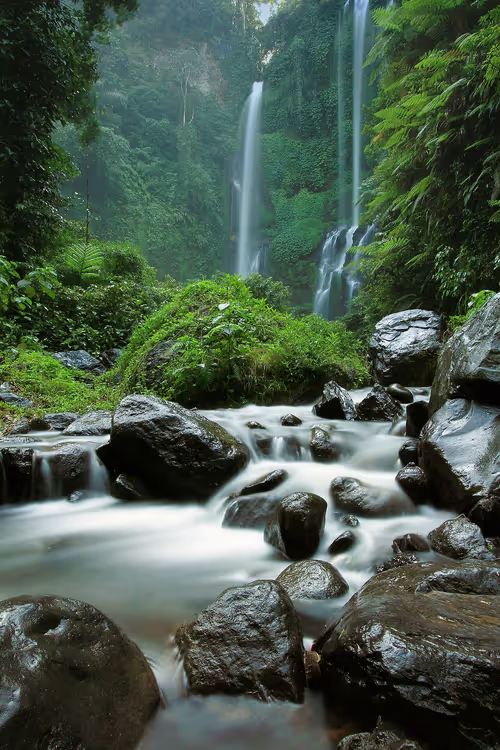 © Nyoman Gita Astadi · CC BY-SAPhoto: Nyoman Gita Astadi, CC BY-SA (https://creativecommons.org/licenses/by-sa/4.0), Wikimedia Commons
Sekumpul is surrounded by jungle and is considered one of the most picturesque waterfalls on the island. Several narrow streams plunge from the cliff at such speed that a mist of fine spray hangs all around, a gusty wind picks up and a deafening roar fills the air.
What sets the waterfall apart is its two sources. One branch stays clear and clean all year round, while the other runs reddish-brown in the rainy season. The way to the viewing platform passes through rice fields, ancient ferns and tropical forest, so you will see more than just water.
- Getting there: the waterfall is in the north of the island, in Buleleng regency, and a dirt road leads to the car park.
- Cost: entry is paid, and tickets are sold at the entrance.
- The catch: in the rainy season one of the waterfall's branches runs muddy, and the trail gets slippery.
15. Munduk Waterfall
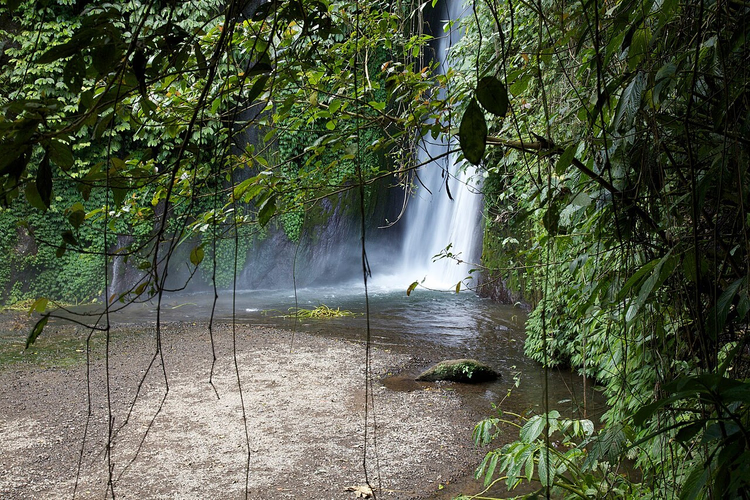 © Jean-Marie Hullot · CC BYPhoto: Jean-Marie Hullot, CC BY (https://creativecommons.org/licenses/by/3.0), Wikimedia Commons
The mountain village of Munduk is home to the waterfall of the same name, which many consider the most photogenic on the island. The cascade first crashes down the rock face, then the streams run over a flat surface and disappear into the depths of the jungle.
The surrounding cliffs are covered in a thick layer of foliage and moss, and their odd shapes resemble a tiled roof. You can walk right up to the water and feel the cool breeze, as there are no railings or viewing platforms here, only nature.
- Getting there: the waterfall is in the village of Munduk, in the centre of the island, close to rice terraces.
- Cost: entry is paid, and you pay on the spot.
- Who it's for / Not for: for you if you want photos without railings and crowds. Not for those who expect developed facilities.
16. Tibumana Waterfall
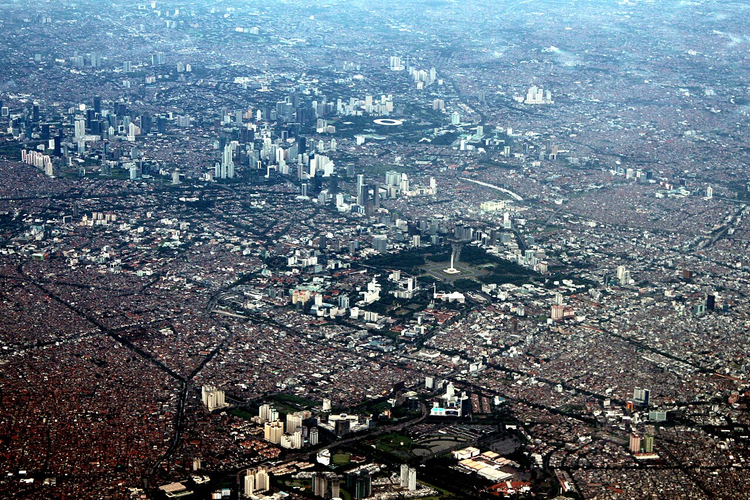 © Thank You (25 Millions ) views from Fresno, USA · CC BYPhoto: Thank You (25 Millions ) views from Fresno, USA, CC BY (https://creativecommons.org/licenses/by/2.0), Wikimedia Commons
Tibumana is on the outskirts of Ubud. Powerful, noisy streams fall from a rocky cliff, and a well-kept path leads to the waterfall through tropical vegetation. Along the way you will come across a small bamboo bridge and a couple of gazebos for resting.
The waterfall has its own pool with a gently sloping bottom and a sandy entry, and a small cave is hidden behind the wall of water. Changing rooms, toilets and benches have been installed for visitors' convenience, so bathing here is a relaxed affair.
- Getting there: the waterfall lies not far from Ubud, and it is convenient to combine it with the forest sanctuary.
- Cost: entry is paid, and you buy the ticket at the entrance.
- Who it's for / Not for: for you if you are travelling with children: the entry into the water is gentle and sandy. Not for those looking for high cliffs.
17. Kanto Lampo Waterfall
 © Lamacchiacosta · CC BY-SAPhoto: Lamacchiacosta, CC BY-SA (https://creativecommons.org/licenses/by-sa/4.0), Wikimedia Commons
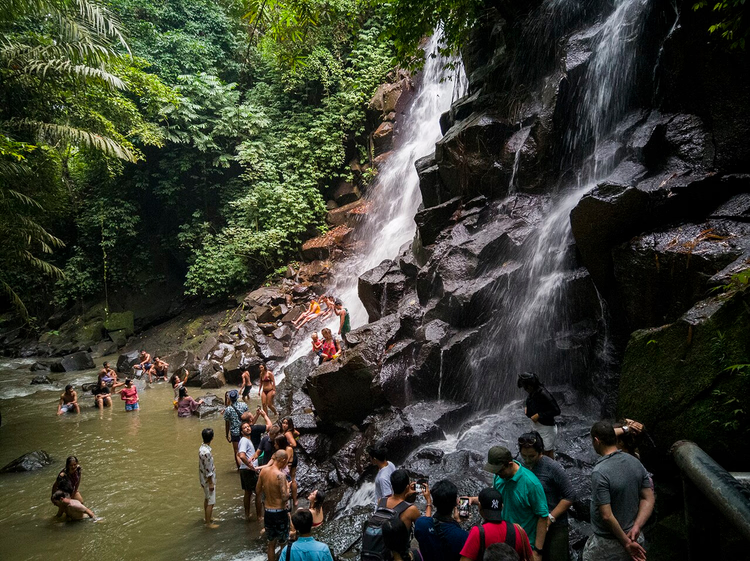
Kanto Lampo is unlike the island's other waterfalls. It lies in a picturesque gorge reached by a proper staircase with handrails, and the canyon is buried in vines and tropical plants.
Figures of mythical creatures are carved into some of the rocks, since for the Balinese any waterfall remains a sacred place. The flow itself is a series of multi-tiered cascades that spread out in broad streams. Visitors climb onto the boulders and let the warm water run down their backs.
- Getting there: the waterfall is near Ubud, in Gianyar regency.
- Cost: entry is paid, and you pay at the entrance.
- Who it's for / Not for: for you if you want to combine bathing with some light trekking. Not for those who aren't ready to go down a staircase.
18. Strawberry farms
 © musnahterinjak · CC BY-SAPhoto: musnahterinjak, CC BY-SA (https://creativecommons.org/licenses/by-sa/3.0), Wikimedia Commons
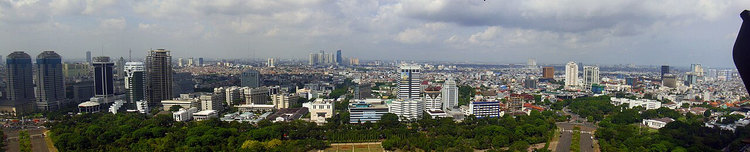
In the north of the island, in the cool and rainy mountain area of Bedugul, lie the strawberry plantations. The local climate allows the berries to be grown all year round, and the beds climb high into the mountains, where the air is noticeably fresher than on the coast.
At one of the farms you will be given a basket, a straw hat and scissors so that you can pick the harvest yourself. You can buy the berries and take them with you, and there is a café on site with desserts, meals and strawberry shakes.
- Getting there: the farms are in the Bedugul area, on the way to Lake Bratan.
- Cost: farm entry and berry picking are paid, and the price depends on the weight of what you pick.
- Who it's for / Not for: for you if you are heading north with children and want a half-hour stop. Not for those in a hurry to reach the volcanoes.
19. Trunyan, the village of the dead
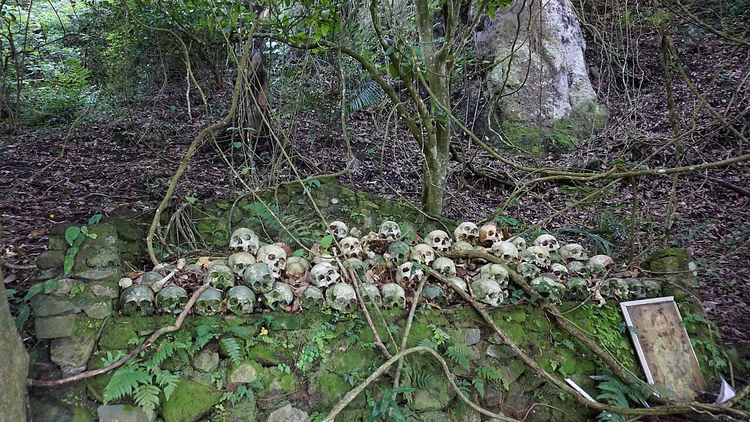
On the shore of Lake Batur stands the village of Trunyan, home to a community of Bali Aga, descendants of the island's first inhabitants. Over the centuries this community did not mix with other islanders and avoided contact with the colonists, so the traditions here have survived almost unchanged.
 © Anggabuana · CC BY-SAPhoto: Anggabuana, CC BY-SA (https://creativecommons.org/licenses/by-sa/4.0), Wikimedia Commons
The tribe is known for its burial rite. The dead are not cremated but left at the foot of a large tree that absorbs the smell: the body is covered with a shelter of bamboo branches, it decomposes under the effect of moisture and wind, and afterwards the skulls are placed on a platform.
- Getting there: the village is on the shore of Lake Batur, and the last stretch is along a narrow road.
- Cost: the visit is paid, you pay on the spot, and access to the residential area is restricted.
- The catch: the sight is not for everyone, and the cemetery leaves a heavy impression.
20. Jatiluwih rice terraces
 © Stefan Fussan · CC BY-SAPhoto: Stefan Fussan, CC BY-SA (https://creativecommons.org/licenses/by-sa/3.0), Wikimedia Commons
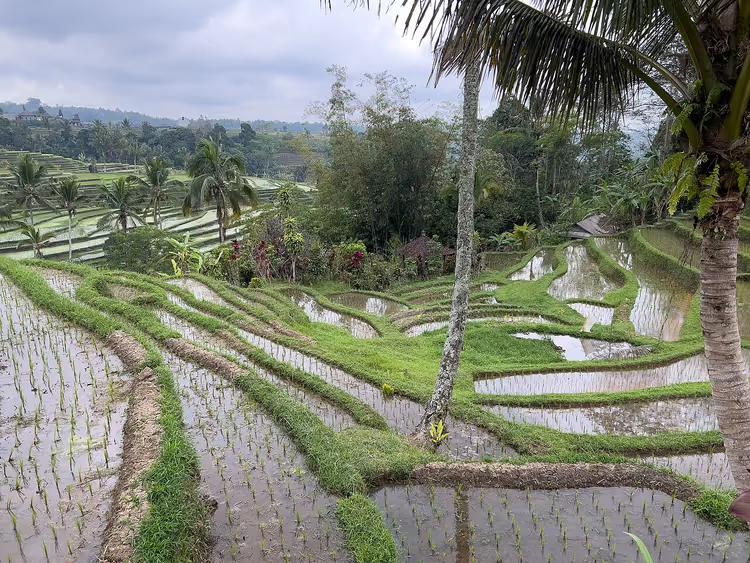
Jatiluwih lies in the island's highlands and is considered one of Bali's main natural attractions. The locals use every scrap of fertile land to grow rice, the staple grain of Asia.
The terraced landscape is on the UNESCO World Heritage List as part of the subak system (as of 09/2026, official Jatiluwih website). The fields cover several hundred hectares of hilly terrain, where more than one variety of rice ripens. The plots are worked by hand with the help of buffalo, and the water arrives through channels from mountain lakes and waterfalls.
- Getting there: the terraces are in Tabanan regency, in the centre of the island, on the way to the northern volcanoes.
- Cost: entry to the area is paid, and you buy the ticket at the entrance.
- Who it's for / Not for: for you if you want to walk the paths between the fields. Not for those looking for entertainment and shows.
21. Tegallalang rice terraces
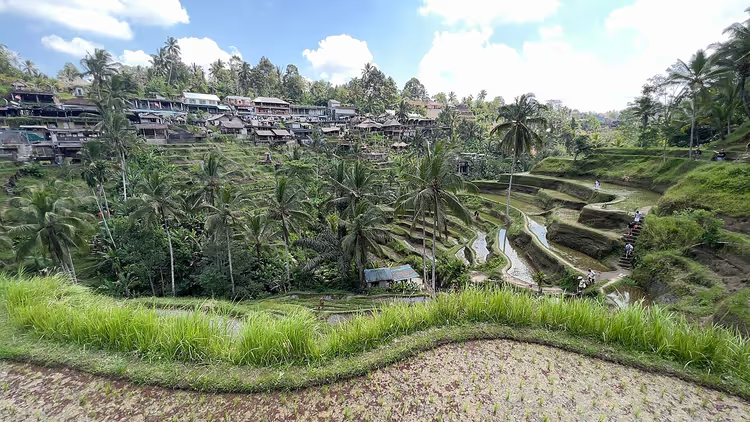 © Stefan Fussan · CC BY-SAPhoto: Stefan Fussan, CC BY-SA (https://creativecommons.org/licenses/by-sa/4.0), Wikimedia Commons
Tegallalang is in the centre of the island and has long been a favourite of photographers and artists. The emerald stepped terraces are laid out on the hillsides among tall palm groves, and in the early stages of the rice's growth the fields are irrigated through a branching network of underwater channels.
The water-filled terraces work like mirrors and reflect the sky. When the rice ripens, the plantation turns golden and the ears look like wheat. Every stage, from planting to harvest, is done by hand here.
- Getting there: the village is north of Ubud, and the road runs through rice fields.
- Cost: entry to the terraces is free, and you only pay for parking.
- Who it's for / Not for: for you if you want lunch on a restaurant terrace overlooking the fields. Not for those looking for long routes.
22. Pura Tanah Lot Temple
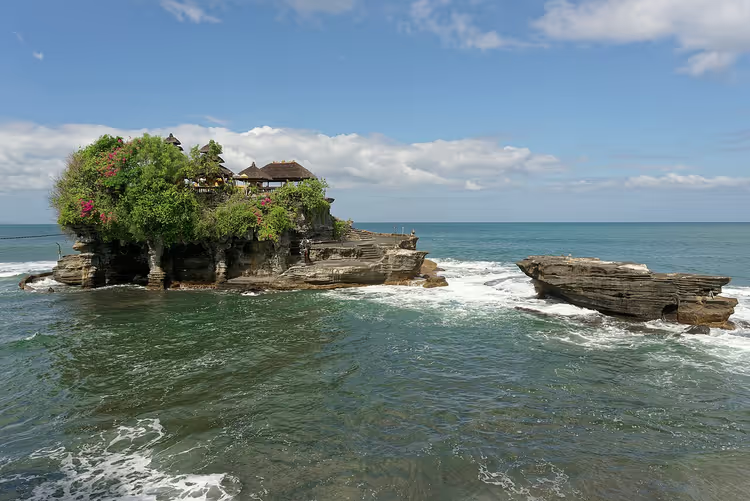 © Jakub Hałun · CC BY-SAPhoto: Jakub Hałun, CC BY-SA (https://creativecommons.org/licenses/by-sa/4.0), Wikimedia Commons
Tanah Lot is built on a small rock just off the coast, and the outline of the stone resembles a ship. You can reach the shrine across the sand spit only at low tide: high tide floods the narrow strip of land and cuts off the way to the temple.
The shrine was founded several centuries ago on the initiative of a respected Brahmin who wanted to protect these lands from the misfortunes brought by the sea. In the temple the Balinese worship the sea gods, and by local custom every islander should visit this place at least once.
- Getting there: the temple is on the south-west coast, about an hour's drive from Kuta along the coastal road.
- Cost: you buy the ticket in cash at the entrance, payment is on the spot only, and tours of Bali's temples are booked in advance.
- The catch: tourists are not allowed into the ritual buildings, so you only walk around the grounds with their towers and pavilions.
23. Pura Besakih Temple
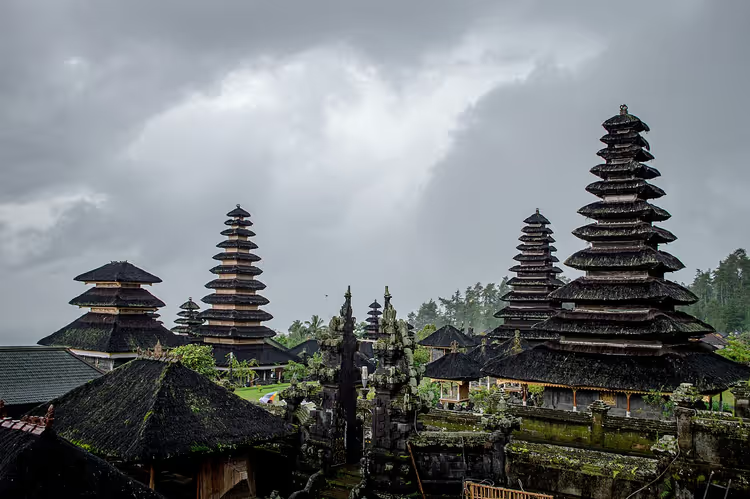 © Philip Nalangan · CC BYPhoto: Philip Nalangan, CC BY (https://creativecommons.org/licenses/by/4.0), Wikimedia Commons
Pura Besakih stands on the southern slope of the sacred Mount Agung and is considered the principal abode of the deities of the Balinese pantheon. The complex consists of numerous temples and structures surrounded by mountain ridges and tropical vegetation, with the shrines arranged on six terraces and linked by broad stairways.
Each temple is dedicated to a particular deity, and columns of pilgrims bearing offerings make their way to it. You will remember the succession of tall pyramid-shaped towers with an odd number of tiers, whose roofs are made of palm fibre. Stone statues of mythical creatures and carved gates complete the picture.
- Getting there: the temple is on the slope of Agung, and the road winds up from the Kintamani area.
- Cost: entry is paid, tickets are sold at the entrance, and you need a sarong to visit.
- Who it's for / Not for: for you if you want to see a working temple where locals pray. Not for those looking for entertainment.
24. Uluwatu Temple
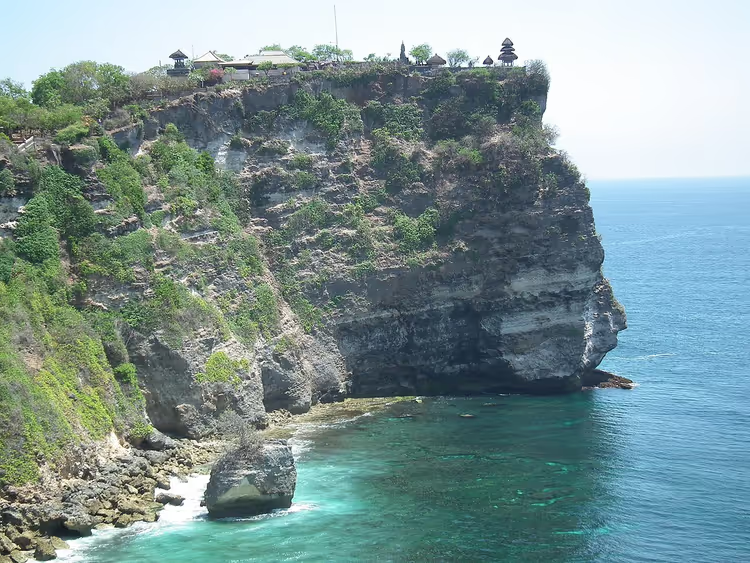 © GeoffClarke · CC BY-SAPhoto: GeoffClarke, CC BY-SA (https://creativecommons.org/licenses/by-sa/3.0), Wikimedia Commons
Uluwatu crowns the top of a sheer cliff above the Indian Ocean and remains on the list of the island's most visited places. Turquoise waves crash against the rock and retreat, leaving seething white foam, and a path runs along the edge behind a stone wall.
The temple is dedicated to the sea goddess Dewi Laut and is built of coral limestone. Inside there are three stone-paved courtyards, a three-tiered pagoda, pavilions and sculptures of divine beings with wings and animal heads. The courtyards are separated by carved gates with floral motifs.
- Getting there: the temple is in the south of the Bukit Peninsula, and the road from Kuta is a winding one.
- Cost: entry is paid, tickets are sold at the gate, and payment is in cash.
- The catch: thieving monkeys have taken a liking to the grounds, so hide your glasses, phones and bags.
25. Tirta Empul Temple
Tirta Empul is known for its sacred spring. Within the temple grounds are three stone pools of life-giving water, where purification rites are held to rid people of troubles of the spirit and the body.
 © Chainwit. · CC BYPhoto: Chainwit., CC BY (https://creativecommons.org/licenses/by/4.0), Wikimedia Commons
Old buildings with exquisite decoration stand around the pools. The pavilions are built of stone and wood and adorned with gilded ornaments, and altars and statues of gods, demons and winged beings are placed everywhere. One pool is fitted with many spouts, each with its own property, in another a freshwater spring bubbles up from the bottom among the lotuses, and in the third carp swim about waiting for a treat from your hand.
- Getting there: the temple is in the central part of the island, north of Ubud.
- Cost: entry is paid, tickets are sold at the entrance, and you need a sarong for the bathing ritual.
- Who it's for / Not for: for you if you want to see a living rite rather than a museum display. Not for those who avoid crowds.
- The catch: during religious ceremonies the pools are taken up by worshippers, and it is hard for tourists to get to the water.
26. Gunung Kawi Temple
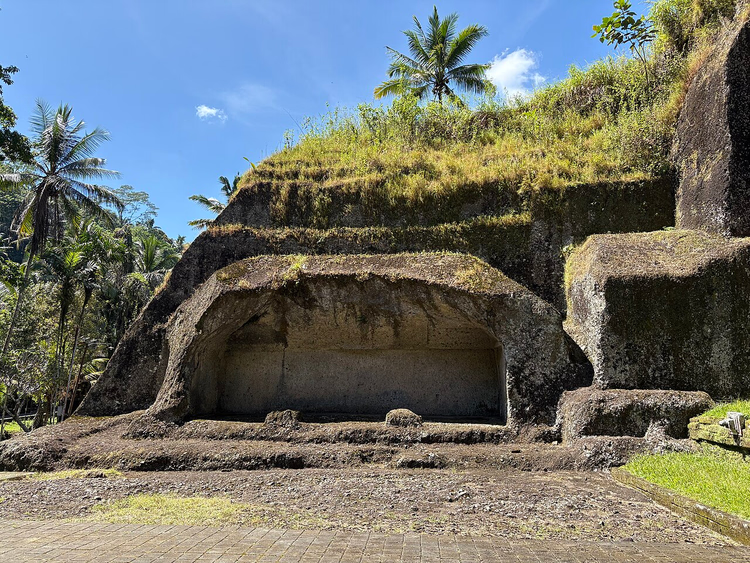
Gunung Kawi lies in the valley of the Pakerisan River, north-east of Ubud. The ancient cave temple consists of royal tombs carved into tall niches in the solid rock, and the walls of the burial chambers are overgrown with moss and still bear bas-reliefs.
 © Chainwit. · CC BYPhoto: Chainwit., CC BY (https://creativecommons.org/licenses/by/4.0), Wikimedia Commons
The temple grounds are filled with spreading banyans hung with vines, and fields and rice paddies stretch out all around. Local people hold prayers and offering rites here every day, and the monks' cells are next to the tombs. You will see a living place of worship, not just ancient stones.
- Getting there: the temple is an hour's drive from Ubud, and the road runs through rice fields.
- Cost: entry is paid, and tickets are sold at the entrance.
- The catch: there are many steps and narrow passages on the grounds, so it is awkward with a pushchair.
27. Lake Bratan and Pura Ulun Danu Temple
 © Konstantinos Trovas · CC BY-SAPhoto: Konstantinos Trovas, CC BY-SA (https://creativecommons.org/licenses/by-sa/3.0), Wikimedia Commons
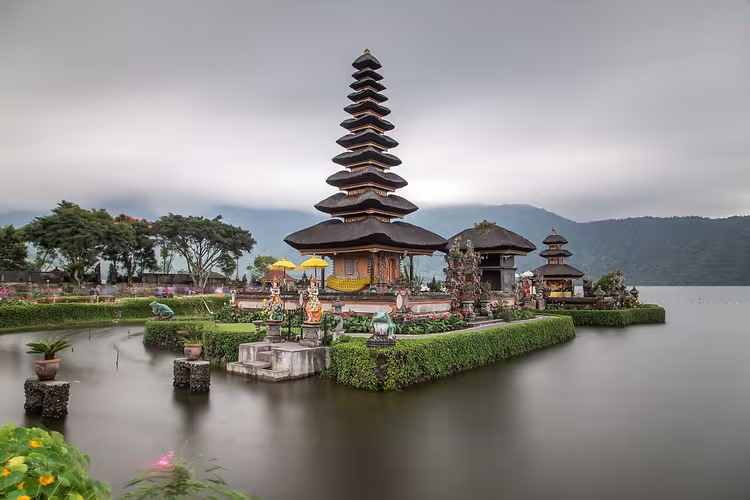
The highland village of Bedugul stands on the shore of Lake Bratan, and the main draw here is Pura Ulun Danu Temple, dedicated to Dewi Danu, the patron goddess of water. Mountain peaks and dense tropical forests show through a light haze of mist, which is why people come here for sunrise shots.
The lake remains a sacred place for the Balinese and the main source of fresh water for the neighbouring rice terraces. People come to the water to pray for the coming harvest. The temple itself was built of volcanic stone several centuries ago on the initiative of the king of Mengwi, and according to legend it was built by the craftsmen who made bladed weapons for the rulers.
The temple is crowned by eleven tiers of palm-leaf roofing. The well-kept grounds and garden hold pavilions with stucco work, colonnades and colourful ornaments, and the statues depict spirits, divine beings, dragons, tigers, elephants and birds. Nearby you will find several more pagoda-style temples that differ in their number of tiers.
- Getting there: the temple is on the shore of Lake Bratan in the Bedugul area, and the road passes the strawberry farms.
- Cost: entry is paid, and tickets are sold at the entrance.
- Who it's for / Not for: for you if you are ready to get up before dawn for the mist over the water. Not for those looking for beaches and swimming.
28. Goa Gajah Elephant Cave
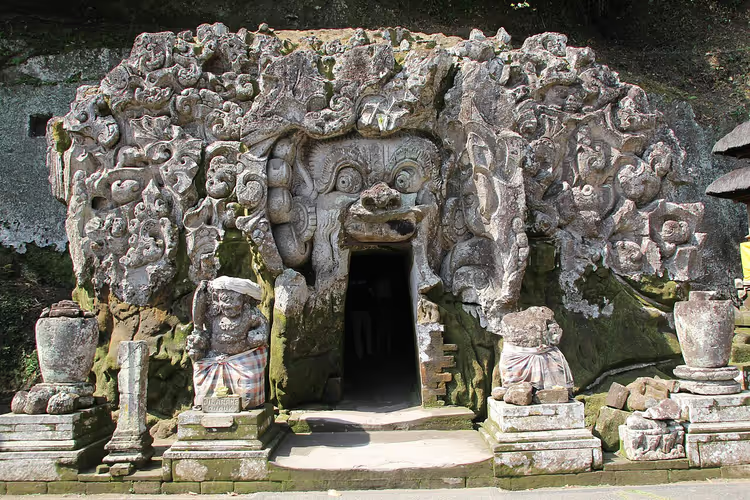
Goa Gajah means the elephant cave, and it is steeped in legend. The small temple complex with pavilions, shrines, pools, statues and artefacts has been known since the early Middle Ages, and the cave itself long served monks as a place to meditate and live.
 © DerGenaue Allrounder · CC BY-SAPhoto: DerGenaue Allrounder, CC BY-SA (https://creativecommons.org/licenses/by-sa/3.0), Wikimedia Commons
The entrance to the cave is decorated with stone carving and a relief of a demon's head. According to belief, this creature feeds on the bad thoughts and doubts of those who enter, so you step inside with pure intentions. Hidden within is a statue of Ganesha, the elephant-headed Hindu god of wisdom.
Stone statues survive on the grounds, many of which have lost their original appearance. Next to the cave you will find bathing pools with statues of women holding jugs, where the monks washed before a ritual. Around the cave grow tropical forests, trees with massive roots and moss-covered boulders.
- Getting there: the complex is close to Ubud, and it is convenient to combine it with a trip to the waterfalls.
- Cost: entry is paid, and tickets are sold at the entrance.
- Who it's for / Not for: for you if you love ancient stones and legends. Not for those who came only for nature.
29. Goa Lawah Bat Cave
 © Anandajoti · CC BY-SAPhoto: Anandajoti, CC BY-SA (https://creativecommons.org/licenses/by-sa/4.0), Wikimedia Commons
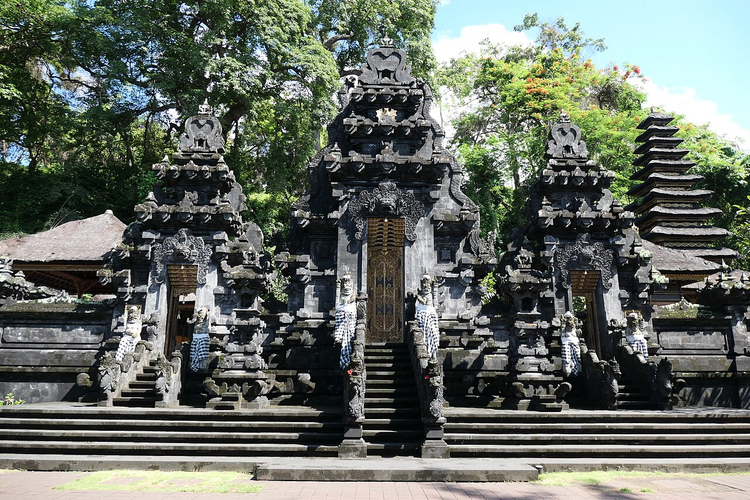
Goa Lawah is not among the island's most hyped places, although the temple of volcanic rock has stood here for a long time. It is a traditional place of prayer with pagodas, altars, pavilions and sculptures, and some of the buildings are decorated with carved gilded ornaments.
The complex's main treasure is a natural cave where worshippers hold religious ceremonies. Its dark vaults are thick with clusters of bats sleeping upside down and making loud noises. The Balinese consider these animals the descendants of dragons that guard sacred places from evil spirits, and leave food for them.
- Getting there: the temple is in the central part of the island, and the road passes rice terraces.
- Cost: entry is paid, and you pay on the spot.
- Who it's for / Not for: for you if you want to see a rare combination of temple and cave. Not for those who are afraid of the dark and of winged animals.
- The catch: inside the cave it is noisy with the chatter of bats, and the smell is strong.
30. Bird park
 © Lasthib · CC BY-SAPhoto: Lasthib, CC BY-SA (https://creativecommons.org/licenses/by-sa/3.0), Wikimedia Commons
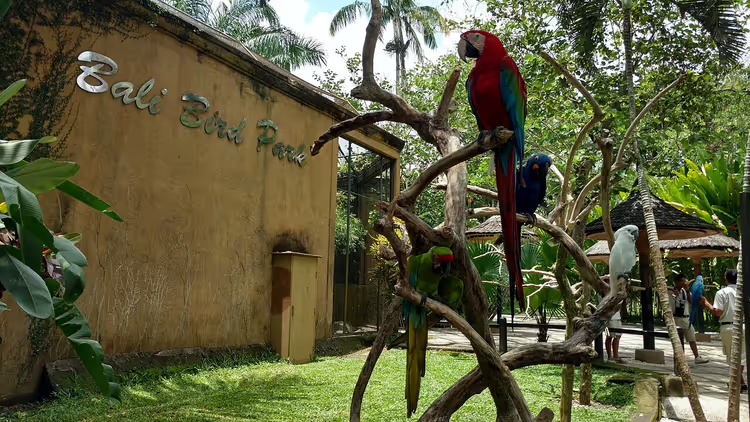
The bird park is one of the island's ecotourism centres. A small area has been turned into a tropical forest with evergreen plantings, exotic gardens, trees and ponds, and the total number of feathered residents here is over a thousand.
Some of the birds live in spacious aviaries, but most walk and fly freely around the park. Peacocks, storks, crowned cranes, flamingos, pheasants, eagle owls and herons show off in front of you, pelicans, ducks and swans swim in the pond, and parrots in every colour of the rainbow perch on the branches. The birds are not afraid of people and readily settle on your arm, which children especially love.
- Getting there: the park is in the central part of the island, close to other nature sights.
- Cost: entry is paid, and tickets are sold at the entrance.
- Who it's for / Not for: for you if you are travelling with children and want a calm walk. Not for those looking for shows and rides.
31. Taman Nusa Park
 © Arthamade · CC BY-SAPhoto: Arthamade, CC BY-SA (https://creativecommons.org/licenses/by-sa/4.0), Wikimedia Commons
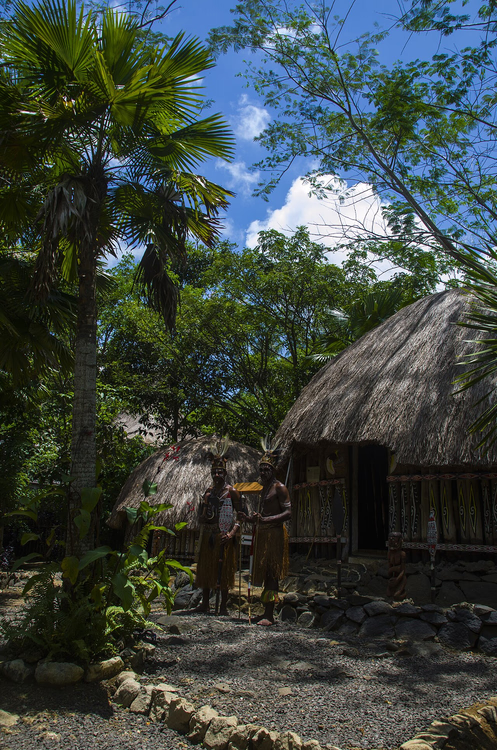
Taman Nusa lets you get an overview of the cultures of the whole Indonesian archipelago in a few hours. Under the open sky, the architectural and religious structures of the peoples who inhabit the country's islands have been recreated at full size.
The park contains more than fifty buildings and temples, as well as a great many statues. Visitors are allowed inside the houses to look at the interiors, household objects, furniture, costumes, figurines and jewellery. Members of the different peoples in national dress add to the atmosphere, so the walk is vivid and doesn't require reading signs.
- Getting there: the park is in the central part of the island, on the way east from Ubud.
- Cost: entry is paid, and a child's ticket is cheaper than an adult's.
- Who it's for / Not for: for you if you want to see all of Indonesia in one place. Not for those looking for genuine ancient temples.
32. Garuda Wisnu Kencana Park
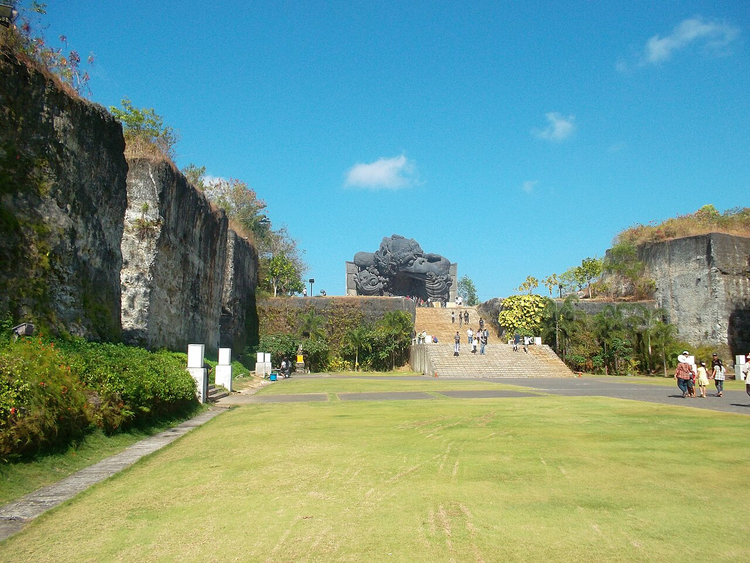
Garuda Wisnu Kencana Park occupies a former limestone quarry on the Bukit Peninsula. The paths run between giant blocks of stone that rise up like columns, and the broad canyon walls are decorated with bas-reliefs. It feels as if the entire site was hollowed straight out of the rock.
 © Syafii muhammad muni… · CC BY-SAPhoto: Syafii muhammad muni…, CC BY-SA (https://creativecommons.org/licenses/by-sa/3.0), Wikimedia Commons
The park's main feature is the sculpture of the god Vishnu riding Garuda, about 121 metres tall (as of 09/2026, GWK Cultural Park), made of a copper and brass alloy. Besides the monument there is an amphitheatre, a gallery, a garden and a fountain, and in the evenings there are dance performances, concerts and festivals.
- Getting there: the park is on the Bukit Peninsula, and a wide road leads there from Kuta.
- Cost: tickets are sold at the ticket office and online, and Garuda Wisnu Kencana Park tickets are booked in advance for the evening show.
- Who it's for / Not for: for you if you want scale and an evening programme. Not for those looking for antiquity and quiet.
33. Safari and marine park
 © Christophe95 · CC BY-SAPhoto: Christophe95, CC BY-SA (https://creativecommons.org/licenses/by-sa/4.0), Wikimedia Commons
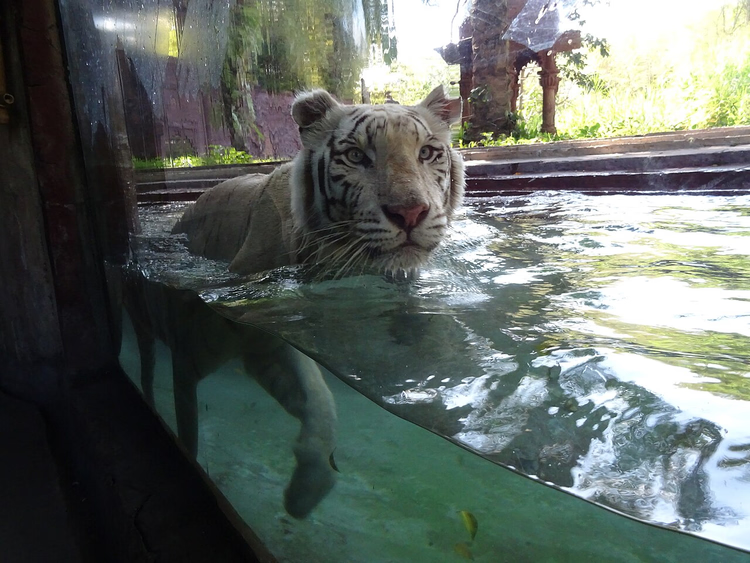
The safari park in Bali is built so that you can see predators and herbivores at close range. Buses, jeeps and sightseeing trams run through the Indonesian jungle setting, while rocks, ponds and thick vegetation create a natural habitat.
During the safari, tigers, lions, cheetahs, zebras, elephants, hippos, giraffes and rhinos brought from different continents pass before you. Some animals come right up to the vehicle windows because they are waiting for a treat from visitors' hands. Shows with parrots, monkeys, elephants and tigers are put on for visitors, and the marine section of the park has aquariums with colourful fish, piranhas and sharks.
Other entertainment on offer includes a Balinese theatre, rides, restaurants serving national cuisine and bungalows for overnight stays, so you can spend a whole day in the park and stay until morning.
- Getting there: the park is in the south-east of the island, and the drive from Kuta follows the coast.
- Cost: tickets are sold at the entrance and online, and the price depends on the package you choose.
- Who it's for / Not for: for you if you are travelling with children and want one big day of entertainment. Not for those looking for quiet nature trails.
34. Elephant park
 © Thank You (25 Millions ) views from Fresno, USA · CC BYPhoto: Thank You (25 Millions ) views from Fresno, USA, CC BY (https://creativecommons.org/licenses/by/2.0), Wikimedia Commons
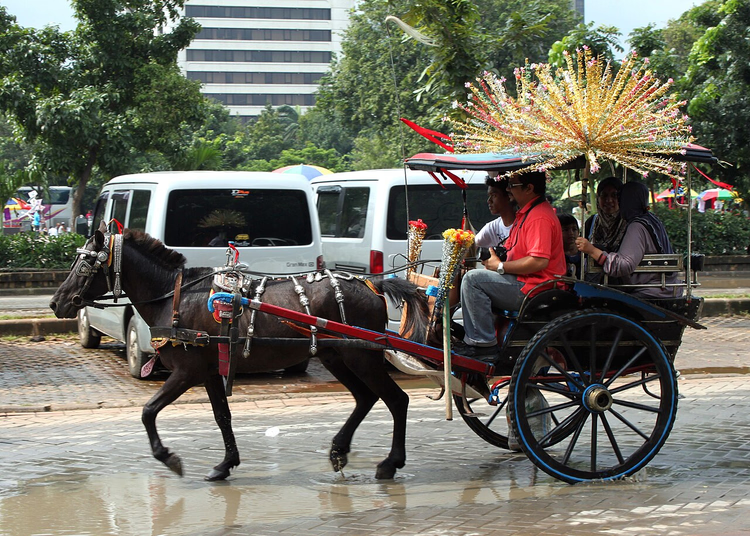
The elephant park is in the village of Taro, not far from Ubud. The animals came here from the Indonesian island of Sumatra, where large-scale logging began at the end of the last century and an environmental disaster unfolded. Deprived of their natural habitat, the elephants found a home on these well-kept tropical grounds.
The park covers about twenty hectares. Rice fields, palm groves, exotic flowers and fruit plants have been planted here, so the elephant families have enough space and food. Visitors can ride the animals, feed them, bathe them and stroke them.
The elephants readily take part in the entertainment programme. They paint pictures, play with balls, perform complex tricks and even solve arithmetic problems, which points to a high level of intelligence. For children these performances remain the highlight of the day.
- Getting there: the park is in the village of Taro, north of Ubud, and the road runs through rice terraces.
- Cost: entry and activities are paid for separately, and tickets are sold at the entrance and online.
- Who it's for / Not for: for you if you are travelling with children and want contact with animals. Not for those who find keeping animals this way questionable.
35. West Bali National Park
 © Joey39965 · CC BY-SAPhoto: Joey39965, CC BY-SA (https://creativecommons.org/licenses/by-sa/4.0), Wikimedia Commons
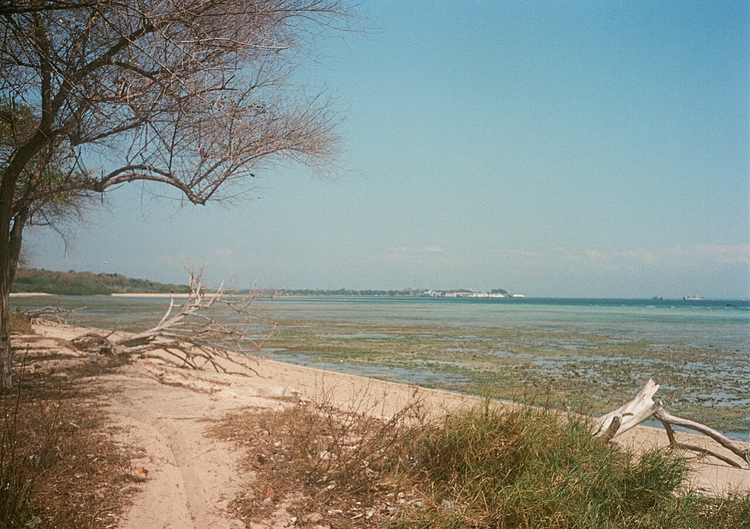
West Bali National Park occupies the western tip of the island and is considered Bali's largest nature reserve. It covers more than one hundred and ninety square kilometres (as of 09/2026, according to Indonesia's tourism office), and most of the area remains untouched.
The scenery here changes as you go: dry savannas give way to mangroves and swamps, beyond them rise tropical forests, mountain ridges and extinct volcanoes, and wild beaches close off the park's western edge. The park is home to more than two hundred species of rare birds and animals, including black monkeys, wild boar, herons and flying foxes.
Walking routes have been laid out for visitors through savanna, jungle and mountain ridges. Diving and snorkelling fans will find a coral reef with fish, molluscs, sea urchins, eels and octopuses, but only scientific expeditions are admitted to most of the reserve.
- Getting there: the park begins in the western part of the island, and the drive from Ubud takes several hours.
- Cost: entry is paid, and trekking requires a permit, which is issued on the spot.
- The catch: a large part of the area is closed to tourists, so you will only see the accessible zone.
Bali attractions on the map
The thirty-five sights on the list are scattered across the island, and you physically won't cover every one of them in a single trip. Plan loop days: two days for the south, two for the centre, one each for the east and the north, and leave the west for a separate trip to the national park. Judge distances by the map, not by the time your sat nav gives: on narrow roads you will lose more than the app shows.
Put your route together so that you end up with no more than three sights a day. Allow for drives between temples and waterfalls, and set aside half a day for parks with shows. Below is a map with the places marked, handy for working out logistics and travel time.
Attractions of Bali
Places on the map
- 1Mount Agung Active volcano, the home of the gods for Balinese, sunrise at the summit
- 2Mount Batur Easier to climb, hot springs at the foot
- 3Campuhan Ridge Walk Paved path along the ridge of Campuhan hill between two rivers
- 4Ubud Monkey Forest Nature reserve with a colony of primates and banyan trees
- 5Waterbom Bali Water park in Kuta, open from 9:00 to 18:00
- 6Tirta Gangga Water Palace Water gardens of a raja in Karangasem, ponds and fountains
- 7Taman Ujung Water Palace Ship-shaped palace ensemble from the early last century
- 8Agung Rai Museum of Art Paintings and prints by masters of the Indonesian archipelago
- 9Big Tree Farms Bamboo Chocolate Factory Chocolate production in bamboo workshops, tasting
- 10Museum Pasifika Culture of the peoples of Indonesia and the Asia-Pacific region
- 11Neka Art Museum Collection of paintings by Indonesian and foreign masters
- 12Tegenungan Waterfall Wide streams into a natural pool, a viewing platform
- 13Sekumpul Waterfall Picturesque waterfall amid the jungle, two springs
- 14Munduk Waterfall The most photogenic waterfall in a mountain village
- 15Tibumana Waterfall Pool with a gently sloping bottom and a small cave behind the water curtain
- 16Kanto Lampo Waterfall Multi-tiered cascades in a picturesque gorge
- 17Jatiluwih Rice Terraces UNESCO site, the subak system, several hundred hectares
- 18Tegallalang Rice Terraces Emerald stepped terraces, a favourite with photographers
- 19Tanah Lot Temple Temple on a rock by the coast, reachable across the spit only at low tide
- 20Besakih Temple The main abode of the pantheon's deities on the slope of Agung
- 21Uluwatu Temple Temple on a sheer cliff above the Indian Ocean
- 22Tirta Empul Temple Sacred spring source, ritual bathing ceremonies
- 23Gunung Kawi Temple Cave temple with royal tombs carved into the rock
- 24Ulun Danu Temple Temple on the shore of Lake Bratan, dedicated to the water goddess
- 25Lake Bratan Sacred lake, the main water source for the rice terraces
- 26Goa Gajah Elephant Cave Temple complex with a statue of Ganesha in a cave
- 27Goa Lawah Bat Cave Prayer site with a natural bat cave
- 28Bird Park More than a thousand birds, some fly freely around the park
- 29Taman Nusa Park Buildings of the peoples of Indonesia under the open sky
- 30Garuda Wisnu Kencana Park Statue of Vishnu on Garuda, about 121 metres tall
- 31Safari and Marine Park Jeep safari and aquariums with sharks and piranhas
- 32Elephant Park Elephants from Sumatra, feeding, bathing and shows
- 33West Bali National Park Bali's largest nature reserve, savannas and mangroves
Many people arrive in Bali without a car and take a transfer from the airport to their hotel. You can fill in the transfer form in advance so that someone meets you in the arrivals hall:
Tours and tickets in Bali
Guided tours, skip-the-line tickets and activities — most offers can be cancelled free of charge.
See offers on KiwitaxiThe widget loads once you give your consent.
If you want to get around on your own, treat transport as a separate part of your budget. Car and scooter hire is available in Bali, but it calls for care on the switchbacks and in the traffic jams of the south.
Tours and tickets in Bali
Guided tours, skip-the-line tickets and activities — most offers can be cancelled free of charge.
See offers on TiqetsThe widget loads once you give your consent.
⁉️🤔 Frequently asked questions
How many days do you need to see the highlights of Bali?
A week is enough for the main sights if you stay in two bases and don't spend time on long drives every day. You will cover the south in two days, the centre with Ubud and the waterfalls will take another two, and that leaves a day each for the east and the north. The west, with West Bali National Park, is best saved for a separate trip.
What should you see in Bali on a first trip?
Put Uluwatu, Tanah Lot, Tirta Empul Temple and Ubud's museum halls on your route, as they give you a feel for the island without long drives. Then add the Tegenungan and Tibumana waterfalls, which are close to Ubud. You can fit in the Ubud Monkey Forest on the way between stops.
Do you need to hire a car or scooter in Bali?
Having your own transport gives you freedom in the centre of the island, where buses are few and taxis get more expensive towards evening. In the south you can get by with a transfer and a car with a driver. The switchbacks in the north and east call for experience, and a road you don't know is rarely an easy one here.
What is there to do in Bali with children?
Children respond best to the Waterbom water park, the bird park, the safari park and the elephant park in Taro. These places offer animals, water and shows, and you get a chance to rest. Leave the ancient temples and long treks for trips without children.
How much does entry to the temples and waterfalls cost?
There is no single rate: every sight has its own ticket office and its own price. At the major temples you pay for a ticket on the spot, and a sarong is sometimes lent against a deposit. Receipts and card payments are not available everywhere, so keep cash on you.
In short: what's worth booking
If your trip is short, take the southern route: Uluwatu, Tanah Lot, Garuda Wisnu Kencana Park and the Bukit beaches can be covered in two days. If you are travelling with children, put Waterbom, the bird park, the safari and the elephant park on your plan. If you want nature without the crowds, head for the centre and the west: the waterfalls, the Jatiluwih terraces and West Bali National Park. For temples and water, it makes sense to go east, to Tirta Gangga and the Taman Ujung palace.
It is best to put a trip around the island together in advance: tours and tickets in Bali are booked before you fly, and hotels in Bali on Trip.com are easier to compare a couple of months before the trip, before prices go up.

A small editorial team writing guides for independent travel. We travel ourselves, but we haven’t been everywhere, so we check prices, opening hours and how to get there against official sources.