
















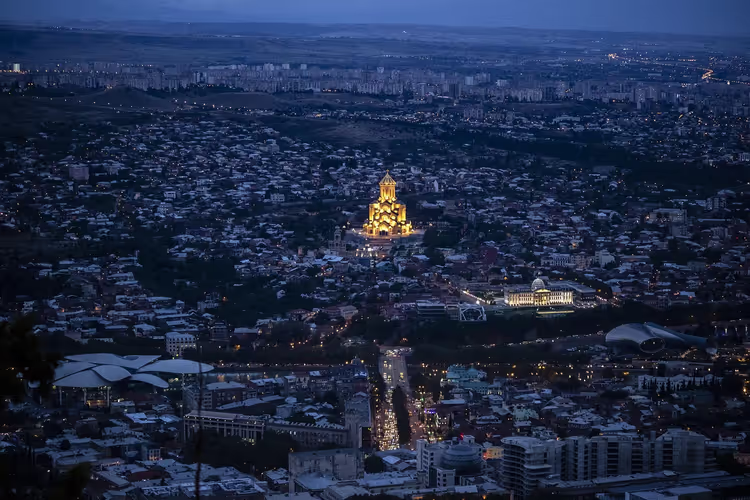
Tbilisi and Kakheti: a route through the old town, Narikala and Sighnaghi wineries
Tbilisi pulls you in fast. You wander the crooked streets of the old town, then climb up to the fortress, and in the evening you sit in a sulfur bath. Two or three days is enough for all of it.
The cable car from Rike Park to Narikala costs 2.5 lari with a transport card (as of 09/2026, schedule and tickets). The ride takes just a few minutes and saves you twenty minutes of a steep climb. We added Kakheti to the city route: Sighnaghi, Bodbe Monastery, and the wineries of the Alazani Valley. Below are all the key sights with time estimates, prices, and honest catches.
Ad: this article contains affiliate links. We earn a commission if you book through them, at no extra cost to you.
Old town
💡 In short:
- You can walk the old town in half a day: Rike Park, the Bridge of Peace, Abanotubani.
- The cable car and Narikala give you the best panorama of the city.
- Set aside a full day for Kakheti: Sighnaghi, Bodbe, wine tasting.
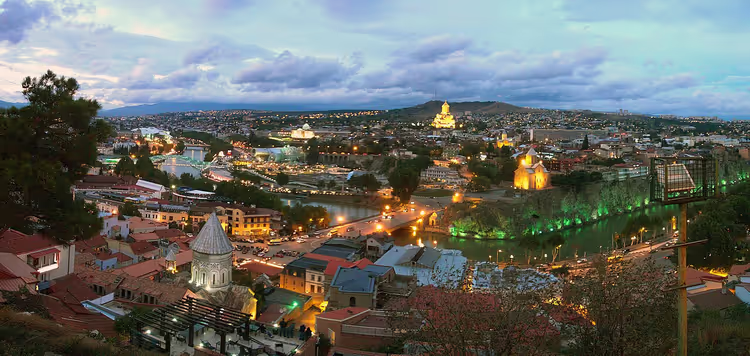
The old town is like a labyrinth of cobblestone streets, carved balconies, and small courtyards. Everything is close by: Rike Park with the Bridge of Peace, the Abanotubani sulfur baths, the cable car, and the fortress on the hill. You can wander without a plan and still see the main sights.
Start at Rike Park. From there the cable car takes you up to Narikala, and the pedestrian Bridge of Peace leads straight into the old quarters. Wear comfortable shoes: the cobblestones get slippery after rain.
At night the lighting transforms the area. Cafes with open terraces stay open late, and a table by the window is best booked in advance.
Money and time estimates for the main sights in the center:
Sight | Entry cost | Time estimate |
|---|---|---|
Rike-Narikala cable car | 2.5 lari with a Metromoney card (tickets with a transport card) | about five minutes |
Narikala Fortress | free | about an hour |
Botanical Garden | 4 lari (as of 09/2026, entry prices) | one and a half to two hours |
Sulfur baths in Abanotubani | from 5 lari for a shared room, from 40 lari for a private room (bath prices) | about an hour |
Hot air balloon in Rike Park | tickets sold online (attraction near Rike Park) | fifteen minutes |
Prices change every season, so check the official websites of the sights before your visit.
 © Vladimer Shioshvili · CC BY-SAPhoto: Vladimer Shioshvili, CC BY-SA (https://creativecommons.org/licenses/by-sa/2.0), Wikimedia Commons
Tsminda Sameba Cathedral
The golden dome of Tsminda Sameba is visible from almost anywhere in the city. It is the main cathedral of Georgia, built in the early 2000s on a hill in the Avlabari district. Entry is free, services are held daily.
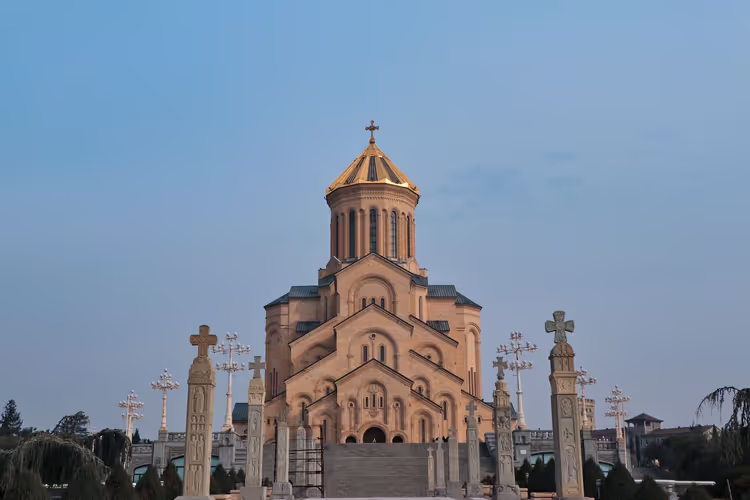
Inside it is cool and quiet even in the heat. Nearby there is an observation deck with a view of the center, the Kura River, and the Bridge of Peace. Women should cover their shoulders and knees; scarves are usually available at the entrance.
The catch: on Sunday mornings large groups arrive, and the observation deck gets crowded. Come at opening time.
Cable car to Narikala
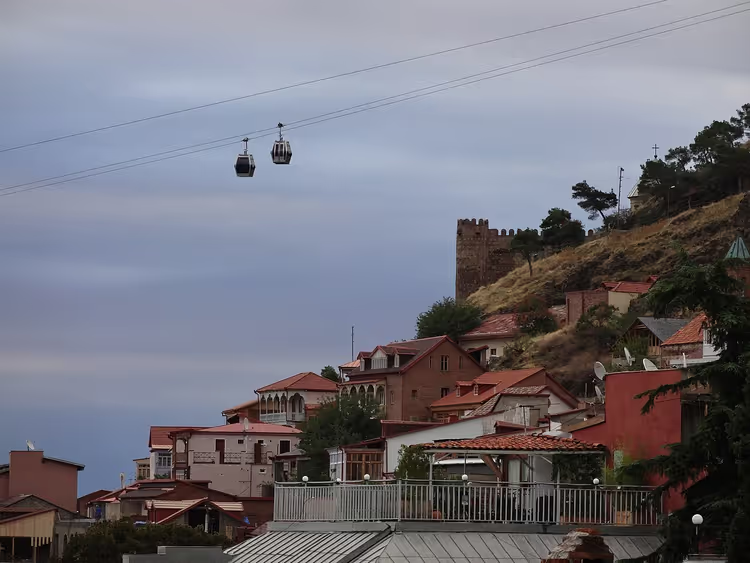
The cable car connects Rike Park and the hill with the fortress. A ride costs 2.5 lari, and you pay with a transport card at the station (as of 09/2026, fare). The cabins are glass and modern.
You get a panorama of the city, the river, and the rooftops without the long climb up. If you are afraid of heights, do not worry: the cabins are enclosed and barely sway. You can walk back down, and the path goes through the old neighborhoods.
The catch: at sunset a line forms. Come in the morning or after eight in the evening.
 © Prasanna Raju · CC BYPhoto: Prasanna Raju, CC BY (https://creativecommons.org/licenses/by/2.0), Wikimedia Commons
Narikala Fortress
Narikala is considered one of the oldest structures in Tbilisi. You can walk up from the sulfur baths or take the cable car. Entry to the grounds is free, no ticket needed.
Inside you will find ancient walls, viewing platforms, and the Mother of Kartli statue nearby. This is the best view of the old town, the river, and the bridges.
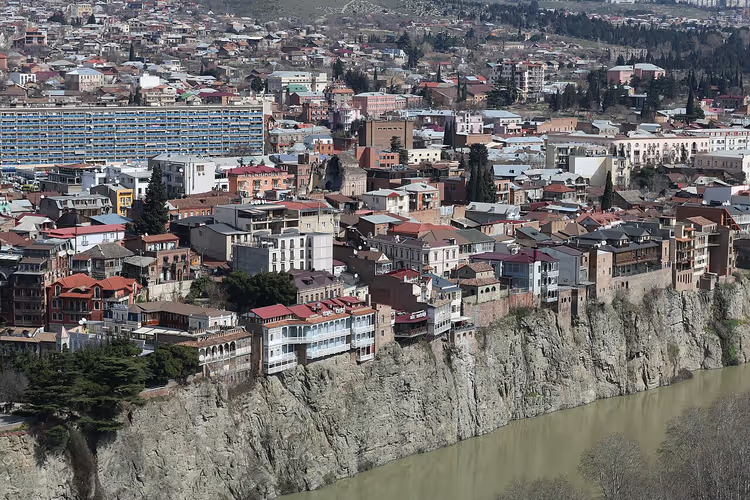 © UG-GE · CC BY-SAPhoto: UG-GE, CC BY-SA (https://creativecommons.org/licenses/by-sa/4.0), Wikimedia Commons
In summer the open platforms get hot, and there is almost no shade. Bring water and come before noon, then you can cover the whole route comfortably.
The catch: the walk up from the baths takes about twenty minutes and is not easy for everyone.
Going up with a guide is more convenient: old Tbilisi tours on GetYourGuide.
Botanical Garden behind Narikala
The Botanical Garden lies right behind the fortress, on the slope of the Legvtakhevi Gorge. Entry costs 4 lari (as of 09/2026, entry price list), and the collection includes more than three and a half thousand plant species.
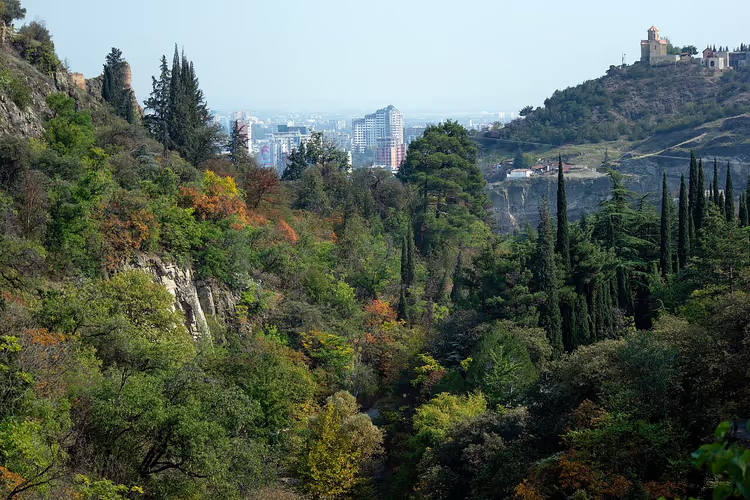 © Mostafameraji · CC BY-SAPhoto: Mostafameraji, CC BY-SA (https://creativecommons.org/licenses/by-sa/4.0), Wikimedia Commons
In summer it is cool here: shade, streams, fountains, and little bridges. You can descend from the fortress through the garden and come out at the sulfur baths. This is a convenient route for one and a half to two hours.
The catch: the schedule depends on the season, and in winter the garden closes much earlier. Check the exact time on site.
Legvtakhevi Waterfall
A waterfall right in the city center is rare, but Tbilisi has one. The Legvtakhevi Gorge was excavated and landscaped in the early 2010s. Now it is a short walk along an embankment with water, little bridges, and cafes.
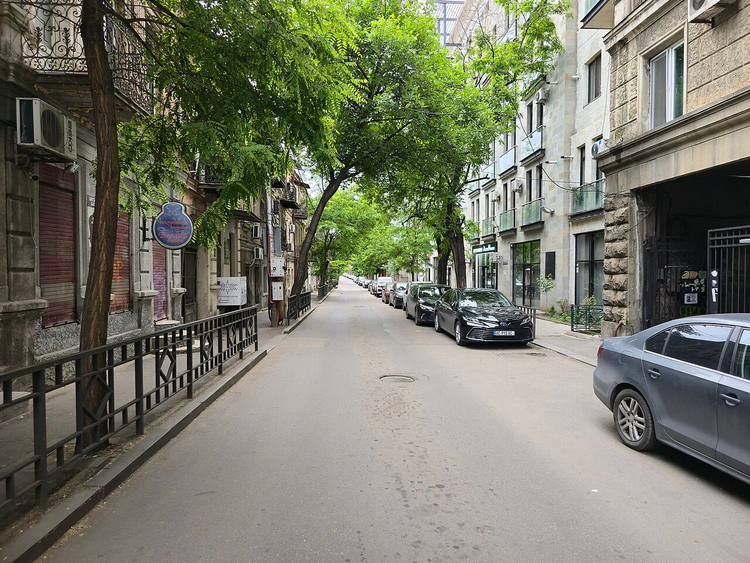 © David1010 · CC BY-SAPhoto: David1010, CC BY-SA (https://creativecommons.org/licenses/by-sa/4.0), Wikimedia Commons
You can stroll here at any time of day, and in the evening the lights come on. From Abanotubani you can reach the waterfall in ten minutes by following the signs.
Mother of Georgia (Mother of Kartli)
The monument stands on top of Sololaki Hill and looks out over the city. The statue was erected in the middle of the last century for Tbilisi's anniversary, first in wood, then in aluminum.
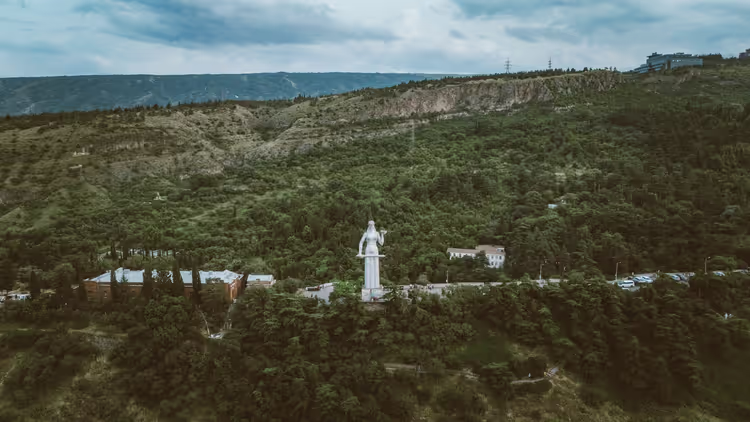
The woman holds a bowl of wine and a sword. That is how the sculptor conveyed the character of the people: hospitality and readiness to defend themselves. Nearby there is a viewing platform that the cable car takes you to.
The catch: walking up takes a long time, and there is almost no shade on the path.
Jumah Mosque in Abanotubani
The Jumah Mosque stands in the very center of Abanotubani, among the baths and old houses. The name translates as "Friday mosque." It was built in the early eighteenth century, and what has survived to this day is a restored replica.
 © Mostafameraji · CC BYPhoto: Mostafameraji, CC BY (https://creativecommons.org/licenses/by/4.0), Wikimedia Commons
This is the only functioning mosque in the city. The minaret and brick facade stand out against the carved balconies, so you definitely won't miss it. In the evening, the lighting comes on and the neighborhood looks completely different.
Bridge of Peace over the Kura
The Bridge of Peace spans the Kura and connects Rike Park with the old town. It opened in the early 2010s, and locals didn't embrace the project right away.
Now it's a convenient pedestrian crossing and a popular photo spot. In the evening, the bridge is illuminated: the lights flash in a specific sequence and transmit Morse code signals. That's how the architect connected people and nature.
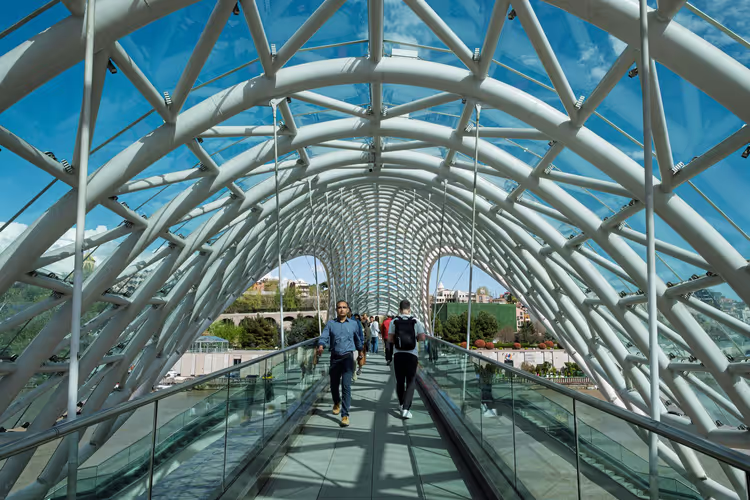
From here, the route continues along the embankment. From the bridge, you can reach Rike Park in five minutes or turn into the old quarters toward the sulfur baths.
Tours and tickets in Tbilisi
Guided tours, skip-the-line tickets and activities — most offers can be cancelled free of charge.
See offers on GetYourGuideThe widget loads once you give your consent.
Clock tower
The leaning clock tower was built in the early 2010s next to the Rezo Gabriadze puppet theater. It's one of the most unusual buildings in the old town, visible from Shavteli.
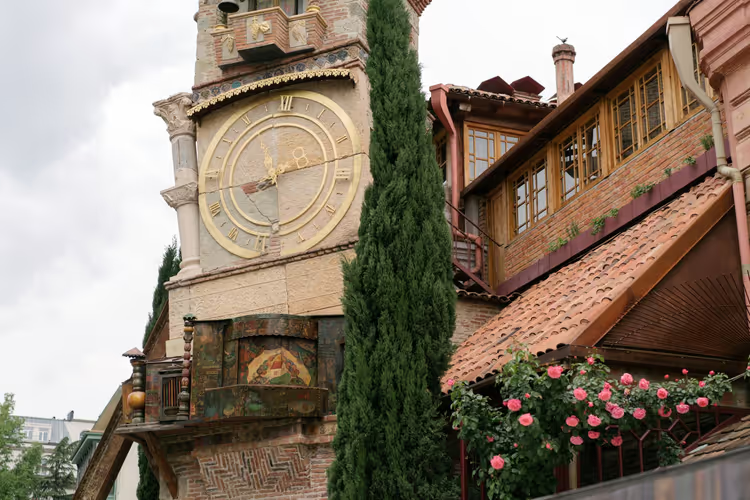
Every hour, an angel comes out of the tower and strikes a bell. At noon and at seven in the evening, they put on the puppet show "The Circle of Life": the figures live an entire life in just a few minutes.
Watch from the street, you don't need a ticket. The catch: there's always a crowd at the tower, and the show itself lasts only a couple of minutes.
Hot air balloon over Rike Park
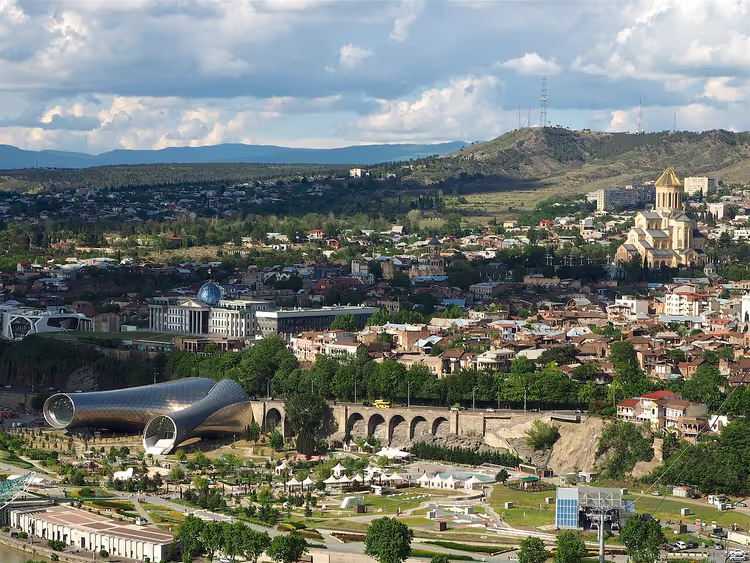
The hot air balloon in Rike Park takes you up 150 meters (as of 09/2026, official website). The flight lasts about fifteen minutes, and the gondola holds up to thirty people.
 © Clay Gilliland from Chandler, U.S.A. · CC BY-SAPhoto: Clay Gilliland from Chandler, U.S.A., CC BY-SA (https://creativecommons.org/licenses/by-sa/2.0), Wikimedia Commons
From above, you can see the Kura, the Bridge of Peace, Narikala, and the rooftops of the old town. The ride is quiet and even operates at night, when the lights come on below.
The catch: flights are canceled in windy weather, so don't leave the balloon for your last day. Tickets are sold online in advance.
Abanotubani sulfur baths
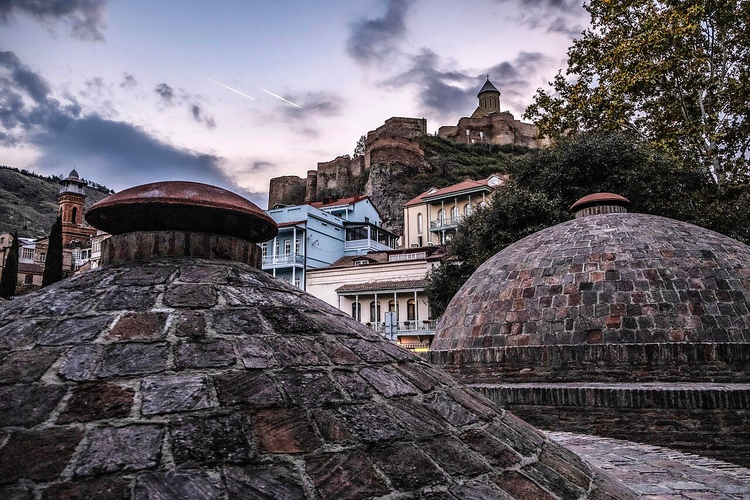
Abanotubani is the sulfur bath district in the city center. According to legend, King Vakhtang Gorgasali was hunting pheasant here, the bird fell into a hot spring, and the city was founded on that spot.
 © Wowan1978 · CC BY-SAPhoto: Wowan1978, CC BY-SA (https://creativecommons.org/licenses/by-sa/4.0), Wikimedia Commons
The water rises from a depth of more than two kilometers and comes to the surface hot. The steam is good for your skin, and you quickly stop noticing the sulfur smell. Come in the morning: the lines are shorter and the water is fresher.
The catch: on weekends after lunch, there may be no private rooms available.
Orbeliani Baths
Orbeliani Baths, also called the Blue Bath, stands in the very heart of the complex. The facade of colored tiles is visible from the street, so you won't miss it.
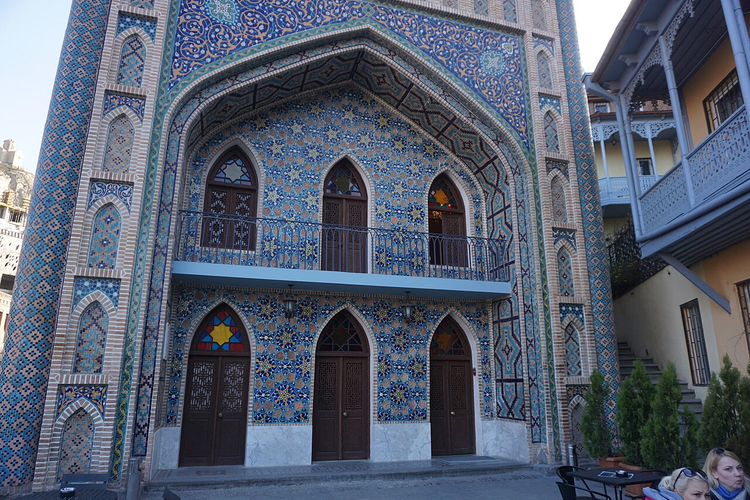 © Andrew Milligan sumo · CC BYPhoto: Andrew Milligan sumo, CC BY (https://creativecommons.org/licenses/by/2.0), Wikimedia Commons
Inside there are shared halls and private rooms where you can bathe without strangers. Two halls are named after Dumas and Pushkin: both writers visited here. A private room costs from 40 GEL per hour (as of 09/2026, Orbeliani Baths prices).
You can book a bath attendant, massage, and scrub. The catch: in high season, popular time slots get taken in advance, so book your room in the morning.
Fabrika creative space
Fabrika is a former Soviet sewing factory, now a hostel and creative space. The courtyard is packed with graffiti, bars, cafes, and workshops, and in the evening it's loud and crowded.
 © Alf Altendorf · CC BY-SAPhoto: Alf Altendorf, CC BY-SA (https://creativecommons.org/licenses/by-sa/2.0), Wikimedia Commons
You can go in without a ticket: check out the street art, grab a coffee, or have dinner. During the day it's quieter, and you can take photos without the crowds.
The catch: in the evenings there are few free tables, and on weekends the courtyard turns into a party.
Kakheti: Sighnaghi and Bodbe monastery
Kakheti lies two hours from the capital, a region of winemaking and the Alazani Valley. People come here for monasteries, vineyards, and tastings.
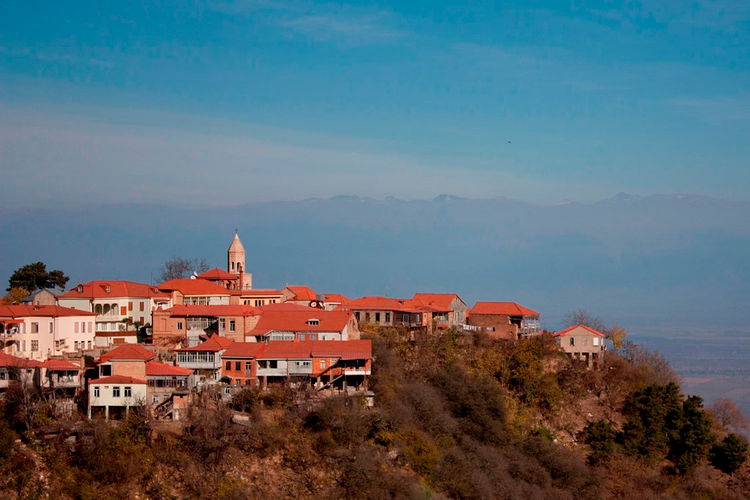 © Silber_Mel · CC BY-SAPhoto: Silber_Mel, CC BY-SA (https://creativecommons.org/licenses/by-sa/2.0/), Flickr
The first stop is usually Sighnaghi, a town on a mountain ridge. It's about 110 km from Tbilisi (on the map), and the drive takes roughly two hours. A zipline stretches over the gorge here, and locals call Sighnaghi the city of love: you can get married quickly and without extra paperwork.
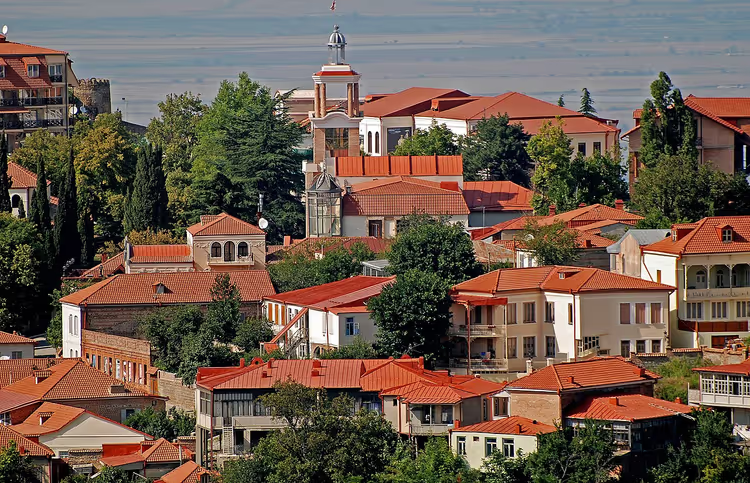
Three kilometers from Sighnaghi stands Bodbe Monastery, where Saint Nino is buried. From there you get a view of the entire Alazani Valley, and along the way you pass vineyards.
For a snack, pick a winery with a tasting. In Kakheti, wine is made in qvevri, large clay vessels buried in the ground. This fermentation method gives a dense flavor you won't confuse with wine made in steel tanks.
It's more convenient to go with a group: group transfer around Kakheti. Then you won't have to find a car and arrange a tasting on the spot.
⁉️🤔 Frequently asked questions
How many days do you need for Tbilisi and Kakheti?
Two full days are enough for the city: the old town, the cable car, Narikala, the sulfur baths, and the Botanical Garden. Kakheti takes a separate day, because the drive one way takes about two hours. If you're short on time, take a ready-made tour with transfer and tasting.
How much does it cost to go up to Narikala?
The cable car ride costs 2.5 GEL with a transport card, and entry to the fortress grounds is free. You can walk up for free from the sulfur baths, and the walk takes about twenty minutes. Hot air balloon tickets are sold separately on tkt.ge.
When is the best time to go to Kakheti for a tasting?
The best time is from May to October, when the vineyards are green, and in September the harvest begins. On weekdays wineries are quieter, and the owners have time to tell you about qvevri. In winter some wineries are closed, so check the schedule in advance.
What should you bring to the sulfur baths?
Bring a swimsuit, slippers, and a towel, although some baths provide everything on site. The sulfur smell seems sharp at first, but you get used to it quickly.
Can you combine Sighnaghi and Bodbe in one day?
Yes, Bodbe Monastery is just three kilometers from Sighnaghi, and both spots are part of the standard Kakheti route. In one day you can cover the town, the monastery, and one or two tastings. You'll be back in Tbilisi by evening.
In short: what to book
If you have two days, stay in the old town and walk everywhere. Go up to Narikala in the morning, before the lines and the heat. If you have three days, add a full day in Kakheti with a tasting.
Quick decision matrix:
Want a hotel near Rike Park: see Tbilisi hotels on Trip.com.
Want tours without a car: tours and tickets on GetYourGuide.
Want to go to Kakheti on your own: Kakheti transfer on Kiwitaxi.
Book your hotel and transfer in advance: in high season, available spots run out quickly.

A small editorial team writing guides for independent travel. We travel ourselves, but we haven’t been everywhere, so we check prices, opening hours and how to get there against official sources.