

















Traveling with children: how to choose a hotel, flight and first aid kit
Vacation with kids seems like complicated logistics. Figuring out how the flight will go, what to feed your child, and where to find a doctor is actually possible in advance: almost all difficulties are solved at the planning stage.
At family-friendly hotels, a child's stay is often not counted as a separate guest. This noticeably affects the budget of the whole trip. Below we break down step by step what to consider: from choosing accommodation and flights to the first aid kit and daily routine, so you understand what to actually prepare for.
Ad: this article contains affiliate links. We earn a commission if you book through them, at no extra cost to you.
How a child's age affects the trip
💡 In short:
- Up to 1.5 years old, a child usually handles flights most easily: feeding is covered by breast milk or formula.
- Ages 2-3 are the hardest: the child still speaks poorly and is not ready to negotiate.
- Child transportation rules: 09/2026, verified against EU passenger rights.
Age determines how the trip will go. The youngest travelers up to 1.5 years old are considered the most easygoing: while the child is breastfed or on formula, feeding takes care of itself. On a plane, children under two fly on a parent's lap, without a separate seat. If you want more space, you buy a seat at full price and install a child car seat there (as of 09/2026, EU passenger rights).
The hardest age is 2-3 years old. At this age, the child speaks poorly, wants things "their way," and has no intention of negotiating. After that it gets easier and more fun: children are more independent and interested in almost everything. At many hotels, children under 12 stay for free. Check this point in the specific hotel's terms, because the age for this benefit varies.
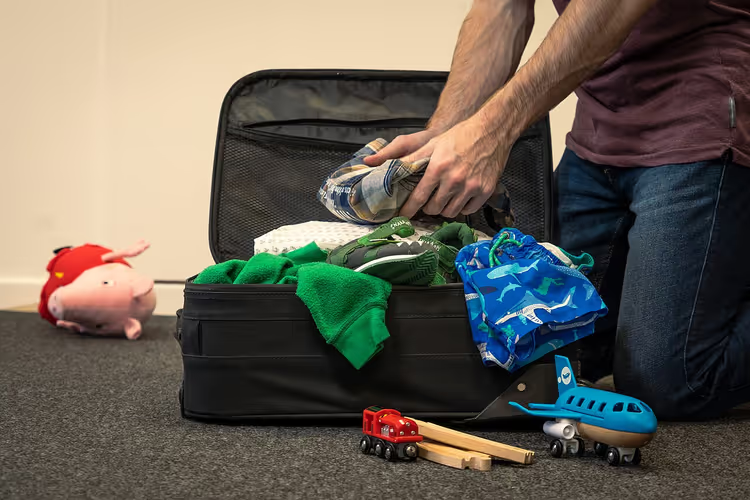 © Familydestinationsguide.com Images · CC BYPhoto: Familydestinationsguide.com Images, CC BY (https://creativecommons.org/licenses/by/2.0), Wikimedia Commons
Where to stay: hotel or apartment
Two workable accommodation formats. The choice depends on how much freedom and care you want.
Apartment
An apartment requires you to plan the trip down to the details: tickets, bookings, entertainment, and cafes that suit both adults and children. Accommodation is easy to find on Trip.com hotel search.
The advantage of an apartment is that you live at your own pace and don't depend on the hotel schedule. The vacation turns out varied, and there's always a kitchen nearby for children's food.
Hotel
Parents choose a hotel because of the ready-made infrastructure for a child. In Turkey, Egypt, and the UAE there are many family-friendly hotels: a water park, heated pools, animation, and playrooms with nannies. With an all-inclusive package, you don't think about food and clean water, which little ones constantly drop from their hands.

What's important to know about climate
Climate remains the main criterion for choosing a country. With children, it turns into a complex calculation: you need to compare temperature, humidity, wind, and water warmth specifically in that season and in that place. In practice this doesn't always work out, so check the forecast for your dates in advance. If the numbers look risky, change the dates, not the hotel.
Stifling heat and sharp temperature swings are harder on children than on adults. Choose months when the sea has already warmed up and the daytime heat has eased.
Where and when to go with kids
Popular destinations for family vacations: Turkey, Egypt, and the UAE. In Turkey, the most comfortable months are June, August, and September, when the weather is steady and the sea is warm. For Egypt, it's best to go in April, May, or from September to early November. In the UAE, choose late October, November, late March, or April to avoid the unbearable summer heat, which little ones are unlikely to enjoy.
In Spain, Italy, Portugal, Greece, Bulgaria, Croatia, France, Montenegro, Albania, Georgia, and Cyprus, ideal weather occurs in late May, June, and September. Japan is attractive during cherry blossom season in April and mid-May, as well as in September and October, during the season of red maples called "momiji."
If you really want a winter vacation and long-haul flights don't scare you, consider Thailand, the Maldives, Vietnam, Sri Lanka, Cuba, the Dominican Republic, Mauritius, Zanzibar, and other destinations.
 © Bjoertvedt · CC BY-SAPhoto: Bjoertvedt, CC BY-SA (https://creativecommons.org/licenses/by-sa/3.0), Wikimedia Commons
How to choose a flight
Choose night flights or flights during nap time. A child may be thrilled by the plane, or may get scared if very young, but then sleep through the whole flight. Comparing schedules and prices is easy on Kiwi.com flight search.
If sleep doesn't happen, bring out educational games, coloring books, and a tablet with cartoons. Games work well if you showed them at home and said they were specially for the plane. Bring a lollipop or pacifier if your child uses them. Respect your neighbors' comfort and think ahead about how to keep your child occupied during the flight.
Remember: a parent is not to blame if a child cries, and there is no magic pill that will calm them down. Try not to get nervous and not to react to neighbors who roll their eyes at a fussy little one.
How to choose a beach area
The beach should be clean and tidy, ideally sandy or with a sandbox. Look for the gentlest possible entry into the water, without seaweed, broken coral, or jellyfish. Such a shore is safer: the child enters the water gradually, and you have time to back them up. If the shore is rocky or pebbly, buy special water shoes in advance.
What to feed children
If you choose a hotel, check reviews about food and trust options that have a simple children's menu. It should include porridge, yogurt, fruit, vegetables, quality meat, and fish. If you stay in an apartment, you need a supermarket nearby and a good kitchen to cook for your child yourself. Scout out cafes with suitable food in advance.
No matter how well children eat before the beach, after one or two swims you'll hear "Mom, I'm hungry." Bring fruit and baked goods, like pancakes, and relax.
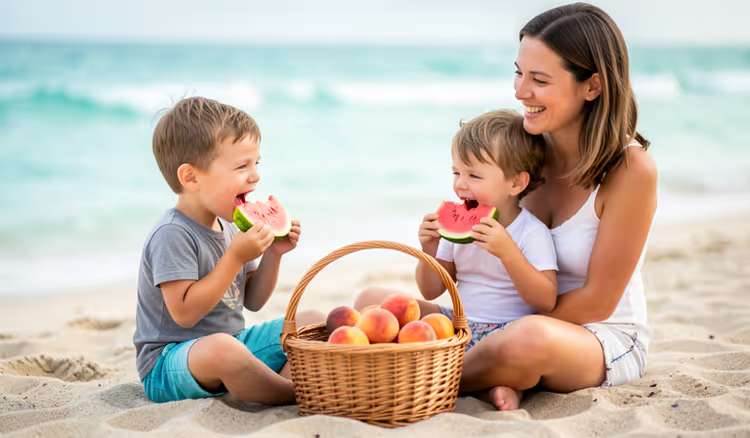 AIIllustrative image: AI-generated
Do you need kids' transport
If your hotel or apartment is not on the first line from the sea, a stroller or scooter will make your life noticeably easier. Sometimes you will still have to carry your child, so choose transport that fits their age and weight. For older kids, a scooter saves energy on long walks to the sea.
How many days to plan
The more days you set aside for the trip, the better. The flight, time zone change, and disruption of the usual routine throw off a child's schedule, and in the first few days they may behave "badly" and get cranky for no particular reason. You may even think the whole thing was a mistake. Around day three, they adapt: they get used to the place, meet the staff, remember the way to the beach, and settle into vacation mode.
Do not move from hotel to hotel or change apartments if everything works for you. Every move starts a new round of adaptation, and your child needs days to get used to the new place all over again.
 © Shixart1985 · CC BYPhoto: Shixart1985, CC BY (https://creativecommons.org/licenses/by/2.0), Wikimedia Commons
How to keep your child entertained
Where adults find things interesting, a child quickly gets bored, and vice versa. Kids enjoy a pool with slides, water parks, animator shows, evening discos, a playroom, and a playground. Children do not want to leave the slides to go to the beach. So set up a system from the start: go to the sea in the morning, and hit the pool after, when you allow it.
When you stay in an apartment, keeping kids entertained is harder: at the sea there is a sandbox and, if you are lucky, a playground. Kids get bored quickly, so plan activities in advance. If you really want to see the sights, choose short excursions on GetYourGuide: long guide lectures about architectural monuments tire little ones out rather than engage them.
What to pack in the first aid kit
A first aid kit for the trip is a must. A practical list looks like this:
- fever reducer, which also works as a pain reliever, based on paracetamol or ibuprofen, in syrup or suppositories;
- isotonic saline solution for nasal hygiene;
- decongestant drops;
- antibacterial eye drops;
- antibacterial ointment;
- hormonal ointment in case of an allergic reaction to a bite;
- natural repellent to protect against insects;
- sunscreen, preferably with mineral filters for kids;
- antiseptic;
- thermometer, nasal aspirator, cotton pads and swabs that you do not stick into ears;
- probiotic and anti-gas remedy for bloating.
Pack the first aid kit at home: when traveling, the medications you need may have different names at a local pharmacy. Keep the instructions for medications in your carry-on.
Medical care nearby
A hospital or clinic should be close enough to your vacation spot that you can get there quickly. If you choose remote islands like the Maldives, plan ahead for how you will reach a medical center fast: by boat or by plane. Check this before booking, not after you land.
Before the trip, compare travel insurance terms: coverage should include hospitalization and medical evacuation for your child. This protects the family budget from unexpected bills.
 © The President's Office, Maldives · CC BYPhoto: The President's Office, Maldives, CC BY (https://creativecommons.org/licenses/by/4.0), Wikimedia Commons
Should you bring grandparents along
Grandparents need a break too. Invite them to travel with you. They get to rest, the kids get to rest, and you get some free time: while grandma puts the child to bed, you can enjoy the evening views and stop by the resort bar.
Mindset: what to prepare for
If you choose a self-planned trip or a hotel without kids' clubs or nannies, and you did not bring grandma, adjust your expectations in advance: this vacation is for the children, not for you. The scenario where parents lounge on sunbeds while the child digs in the sand all day is extremely rare. Kids wander off the moment you relax and look away. A child may go explore the beach or test their skills in the water, so adults need to stay alert at all times.
Bring a positive attitude and the willingness to handle whatever challenges come up, because every trip has them.
 © Fred van der Kraaij · CC BY-SAPhoto: Fred van der Kraaij, CC BY-SA (https://creativecommons.org/licenses/by-sa/4.0), Wikimedia Commons
The catch of family vacations
- Family vacations cost more than traveling on your own.
- You live on the kids' schedule. Planning is harder, and long drives and excursions are more difficult. Only timely sleep and food keep a child in good shape.
- There is almost no evening or nightlife: you cannot go out to a bar as a couple. You cannot leave children alone, and parents need to stay clear-headed. If you need to step away from a sleeping child briefly, use a baby monitor in the room and keep the receiver with you.
- Acclimatization. A runny nose from warm sand and salt water clears up in a couple of days, but issues more often show up back home. For example, a child can catch the Coxsackie virus, which causes hand, foot, and mouth disease (according to CDC data).
- In a one-room hotel room or apartment, parents find it hard to get any privacy.
The upsides of a family vacation
- Kids bring more joy. Children get excited about plants and animals, and adults get to be kids again, trying water park slides instead of keeping a serious face with a cocktail in hand.
- A health boost for the whole family.
- Kids see you in a completely different light. Instead of the usual tired adults coming home from work, they get companions for cannonball dives and hide-and-seek. Everyone is in a good mood on vacation.
- Traveling together brings you closer and strengthens relationships. Parents work as a team and share all responsibilities equally when grandparents are not around.
How traveling with kids differs from traveling solo
Traveling with kids means considering more factors than traveling on your own. Without children, you take daily life more lightly: you can stay, sleep, and eat anywhere. With kids, relaxing and having adult fun is harder, but you want to show your child all the beauty of this world.
For children, travel is a huge developmental leap. Even very young kids remember details from trips and later bring them up unexpectedly. For example, they ask their parents to go back to their little house by the sea.
The main thing to add is this: do not be afraid to travel with kids. This kind of vacation is fun, makes the family closer, and stays in your memory for a long time.
⁉️🤔 Frequently asked questions
At what age can you take a child to the seaside?
There are no formal restrictions; it all depends on your readiness and logistics. Choose destinations with a short flight, a warm sea, and a family-friendly hotel that has a doctor and a kids' menu.
What should you do if your child is afraid of flying?
Book a flight that lines up with nap time or nighttime sleep. Bring a tablet with cartoons, coloring books, and a lollipop. Crying on a flight is not your fault, and there is no magic pill. Be considerate of your neighbors, but do not waste energy apologizing: a calm child matters more.
What is better for a family vacation: a hotel or an apartment?
A hotel is easier: there is entertainment, a pool with slides, nannies, and all-inclusive dining. An apartment gives you freedom and a kitchen, but all the planning falls on you. For a first trip with a baby, a hotel is the better value; for a long vacation with older kids, an apartment is more convenient.
How do you protect against intestinal infections and the Coxsackie virus?
Drink bottled water, wash your hands and fruit, and avoid raw street food. The Coxsackie virus is highly contagious and more common in children under five, but it usually clears up on its own in 7-10 days (as of 09/2026, US Centers for Disease Control and Prevention). See a doctor if the fever is high.
How many days should you plan for a first vacation with a child?
Plan for at least 10-14 days if your budget allows. The first two or three days go to adjustment: a new time zone, food, and schedule throw a child off. Give them time to settle in and avoid moving from hotel to hotel unless necessary.
In short: what to book
A family vacation comes down to three decisions: the right age for the child, the type of accommodation, and the right dates. If you want simple logistics and ready-made entertainment, book a hotel with all-inclusive dining. If you want freedom and a kitchen, choose an apartment near a supermarket.
A quick guide by situation: with a baby under two, pick a short flight and a hotel by the sea; with a child aged 2-3, add extra days for adjustment; with older kids, look for hotels with a water park. Break excursions into short chunks, pack your first aid kit at home, and arrange insurance with evacuation before you fly.

A small editorial team writing guides for independent travel. We travel ourselves, but we haven’t been everywhere, so we check prices, opening hours and how to get there against official sources.