
















Earthquake on vacation: how to prepare and what to do in the first seconds
Earthquakes cannot be predicted in advance. Science can only estimate the probability of tremors in a specific region, but it cannot give a date or magnitude. According to the United States Geological Survey (USGS), about 500,000 earthquakes are recorded worldwide every year, of which people feel roughly 100,000, and about 100 cause damage.
If you are traveling to a seismically active country, preparation takes one evening, and the right actions in the first seconds reduce the risk of injury. Below are the rules for your trip: what to check before you leave, how to behave during tremors in a hotel, on the street, in a car, and near the sea, and what to do when the shaking stops.
Ad: this article contains affiliate links, we earn a commission if you book through them, at no extra cost to you.
Check the seismic activity along your route
💡 In short:
- Open a seismic zone map and check your route before you leave.
- Install an app with earthquake alerts and turn on notifications.
- Save an offline map of the area and the address of the nearest aid point.
- As of 09/2026, verified on the USGS seismic zone map.
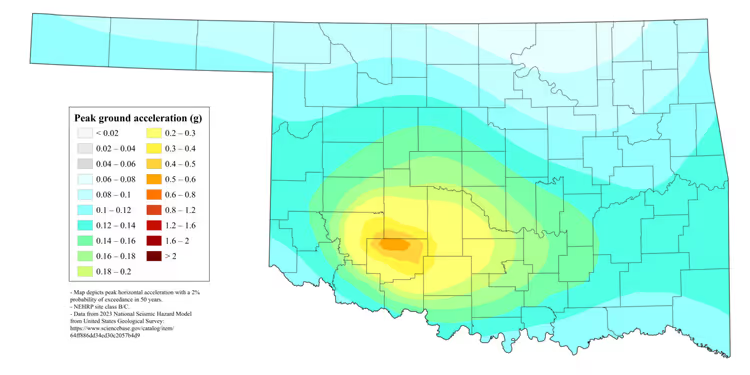
The world's most active regions have been known for a long time. The list includes the Philippines, Japan, Indonesia, Mexico, China, and Fiji. If your route passes through them, start preparing at home, not on the ground.
Seismic zone maps exist both for individual countries and for the entire planet.
Do not stop at a general list. Check the situation in the specific city and neighborhood where you will be staying. That way you will know whether to choose accommodation on rock ground or in a newer building.
Subscribe to the mobile apps My Earthquake Alerts and Earthquake Network. They send a notification within seconds after tremors are registered and show the epicenter on a map. Notifications must be turned on, otherwise they are useless.
 © Master of Time · CC BY-SAPhoto: Master of Time, CC BY-SA (https://creativecommons.org/licenses/by-sa/4.0), Wikimedia Commons
Subscribe to local news and alerts
On vacation it is easy to put your phone away and go on a full media detox. In a seismically active region, that is not a good idea. Subscribe to local news channels and find a TV channel in a language you know. Warnings are often reported there.
Check whether the country has its own early warning system. On Android smartphones, the built-in warning system works as a network of mini seismometers: devices detect tremors and send out a signal seconds before strong shaking (as of 09/2026, Android).
Check your phone's notification settings in advance. Save the country's emergency number and the address of the nearest consulate.
Pack an emergency kit for the trip
Put together a compact kit that fits in a backpack. It includes documents and cash. Put them in a waterproof bag: after tremors, papers can get wet.
Add essential medications, a power bank, and a flashlight. A whistle takes up minimal space, but it is what you will use to signal if you end up trapped under debris.
Add a bottle of drinking water. Instead of canned food, take energy bars and nuts: they are light, keep without refrigeration, and keep you full for a long time. That way you can hold out until help arrives, even if stores are closed.
Learn the "Drop. Cover. Hold on" rule
The "Drop. Cover. Hold on" rule is recognized by official agencies in various countries, including Ready.gov in the US (as of 09/2026, Ready.gov recommendations).
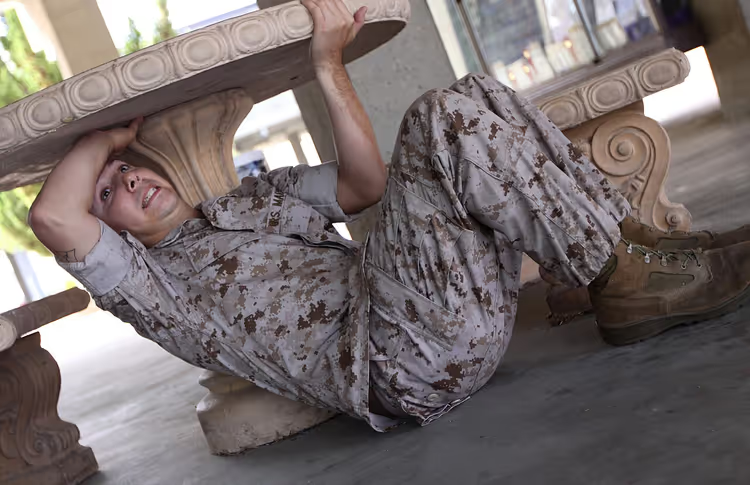
First, get down on your hands and knees on the floor or another solid surface. Do not lie on your stomach. This way you keep your balance and protect your body.
Then take cover under a table or press yourself against an interior wall. They will protect you from falling objects and debris.
Cover your head and neck with one hand. Place your palm on your neck and your elbow on the back of your head. If you are sheltering under a table, hold on to a table leg with your other hand. Without cover, protect your head with both hands.
Also learn first aid. Watch short videos or read guides. After a strong earthquake, medical workers sometimes cannot reach victims quickly, and ordinary people end up being the ones nearby. This way you can help both yourself and others.
Make your accommodation safer
In a house or rented apartment, falling objects are the biggest danger. You cannot secure furniture in someone else's home, so take heavy items off the top shelves.
Check that chandeliers and pictures are hanging securely. Move the bed and sofa away from windows and from walls with shelves. A sleeping spot without glass above your head is safer during shaking.
In a hotel, you can choose your room. A middle floor is more convenient for getting out after tremors, while panoramic windows add risk. Ask for a room away from display windows and mirrors.
What to do during tremors
Where you are | First actions | Main danger |
|---|---|---|
In a building | Take cover under a table and hold on | Falling objects, glass |
In open ground | Move away from building facades and power lines | Debris, gas leaks |
In a car | Pull over to the side of the road | Bridges, signs, trees |
On the coast | Move to higher ground | Tsunami |
In the mountains | Get to open, level ground | Rockfalls, landslides |
In a building
The first tremors are usually short, but that is exactly when falling debris causes injuries. Stay inside until the shaking stops and keep your emergency kit with you (as of 09/2026, according to Ready.gov).
Move away from staircases and elevators. An elevator can get stuck, and you will not be able to get out. Do not stand in doorways, because they are no stronger than the rest of the walls (as of 09/2026, ShakeOut materials).
When the shaking stops, go outside. Take a book, a pillow, or a thick notebook to protect your head. A shield like this does not restrict your movement, but it does block falling fragments.
In open areas
Move away from power lines, building facades, and windows. Avoid gas stations, gas pipelines, and manholes: they are more dangerous than the tremors themselves. In 1906, about 3,000 people died in San Francisco, and most of the deaths were linked to fires and ruptured gas pipes, not to building debris (as of 09/2026, USGS data on the 1906 earthquake).
Stay in an open space with no wires or advertising structures overhead.
On the road
If you are in a car, pull over to the side of the road. Do not try to outrun the tremors: the car serves as good shelter. Put it in park with the parking brake on and turn on the radio.
Do not go near bridges, overpasses, power plants, or trees. During strong shaking, debris from them can damage the car, and you will be left without shelter.
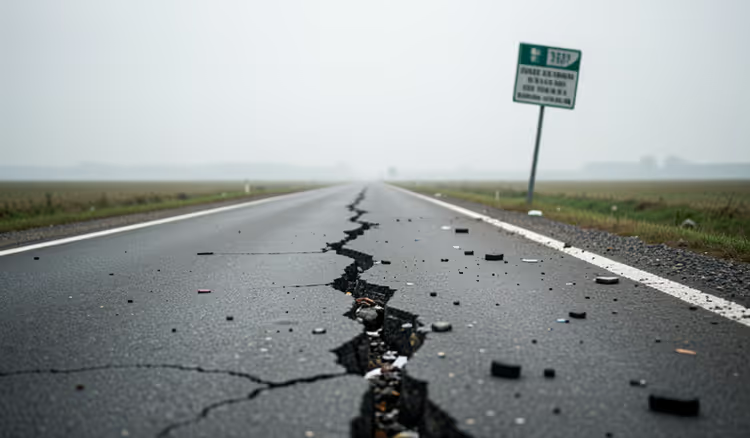
Wait for the shaking to end and check the route. Trees and road signs can block the road, and the pavement sometimes cracks.
 AIIllustrative image: AI-generated
On the coast
Do not stay by the sea to watch. Strong tremors cause tsunamis, and the waves can be more dangerous than the earthquake itself: speeds reach 30 to 50 km/h, and heights in some cases up to 30 meters (as of 09/2026, Ready.gov).
Move to higher ground or further inland, because you should not wait for an official warning (as of 09/2026, NWS advisory). Stay at higher elevation until it is confirmed that the threat has passed.
In the mountains
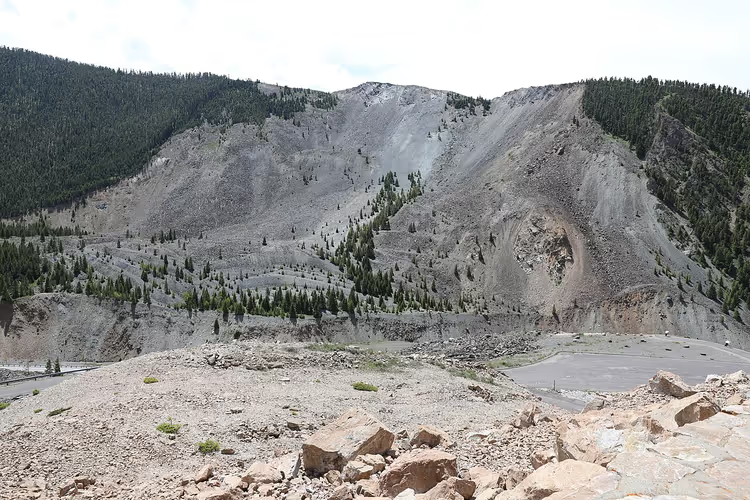
In the mountains, an earthquake dislodges rocks. Look around and move away from cliffs, scree slopes, and bodies of water. Landslides are more dangerous than they seem at first glance.
Choose an open, flat area at a modest elevation. Stay away from cliff edges and from trails below steep slopes.
What to do after an earthquake
When the shaking stops, follow a few simple rules. Each one saves time and reduces risk.
- Call and text only in emergencies. This keeps the network from overloading and leaves lines free for people who need help. Turn on the radio to get updates on the situation in your area.
- If you took shelter in a damaged building, go outside and move away from the walls. Check gas and water pipes, and unplug appliances. Use matches and lighters only after checking for leaks. You can check with soapy water: it will bubble where gas is escaping.
- Check yourself for injuries. If you know first aid, help the injured until paramedics arrive.
- Put on thick-soled shoes. Glass and debris on the floor cut your feet, and any injury will slow you down.
- Remember aftershocks. These are a series of repeated tremors after the main one, and each time apply the rule "Drop. Cover. Hold on" (as of 09/2026, Ready.gov aftershock guide).
The first hours after the shaking are the most dangerous. Stay away from damaged buildings and do not go inside. Wait for information from local services.
⁉️🤔 Frequently asked questions
Can an earthquake be predicted in advance?
No, science can only estimate probability (as of 09/2026, USGS earthquake statistics). That is why preparation matters more than prediction: you are not preparing for a specific day, but for a scenario.
What should I do in the first seconds of shaking?
Drop to your hands and knees, take cover under a table or near an interior wall, and hold on to something sturdy. Cover your head and neck with your arm. Do not run for the exit: falling objects and glass are more dangerous than the building itself.
Is it true that the "triangle of life" is more reliable?
No. Official agencies in several countries tested this theory and did not confirm it. They still recommend the rule "Drop. Cover. Hold on" (as of 09/2026, ShakeOut fact check). Practice it until it becomes automatic.
Should I run out of a building during shaking?
No, if you are already inside. Leaving early is more dangerous: debris and glass fall near the facade and on stairs (as of 09/2026, Ready.gov advice).
What should I do near the sea if shaking starts?
Move away from the water immediately, to higher ground or inland. Do not wait for an official warning: a tsunami can arrive within the first minutes (as of 09/2026, NWS tsunami guidance).
In short: what to book
Preparing for a seismic zone starts at home. Pack a kit, check the map, and turn on alerts.
- If you are traveling to an active region for the first time: choose accommodation on a middle floor and check the exits in advance.
- If you are traveling with children: keep everyone's documents in one waterproof bag.
- If the trip is long: add extra water and flat shoes to your list.
One item you can settle before you leave. Before traveling to an active region, compare insurance options.

A small editorial team writing guides for independent travel. We travel ourselves, but we haven’t been everywhere, so we check prices, opening hours and how to get there against official sources.