
















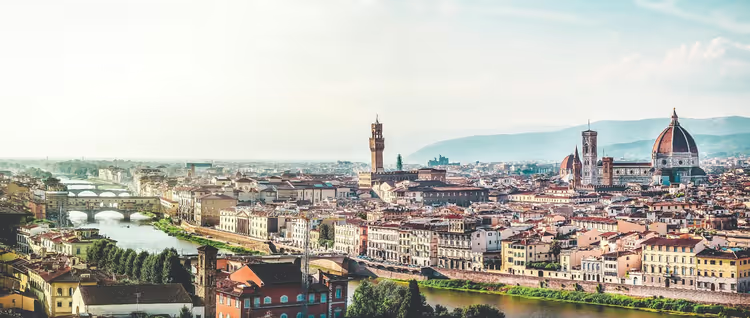
Uffizi Gallery: tickets, hours and main paintings
The line for the Uffizi Gallery in summer stretches for more than an hour. So get your ticket in advance and for a specific time slot. The Uffizi Gallery is one of the oldest art museums in Europe. The building in Florence was built to a design by Giorgio Vasari between 1560 and 1580 (as of 09/2026, gallery page). An admission ticket costs €25 on the day of your visit and €29 if purchased in advance (as of 09/2026, tickets on the official website). The museum is closed on Mondays. The main halls will take you three to four hours if you pick Botticelli, Michelangelo, and Leonardo in advance.
Ad: this article contains affiliate links, we earn a commission if you book through them, at no extra cost to you.
History of the Uffizi Gallery
💡 In short:
- Uffizi ticket: €25 on the day of your visit or €29 if purchased in advance (as of 09/2026, prices on the official website).
- The museum is open Tuesday through Sunday, from 8:15 AM to 6:30 PM, closed on Mondays.
- Starting January 1, 2026, admission after 4:00 PM costs €16.
- Prices and hours: 09/2026, verified on the official website.
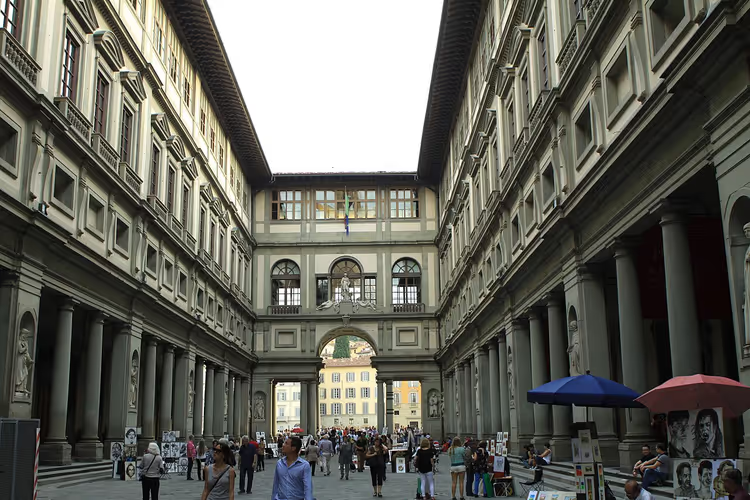
The gallery was conceived by Cosimo I de' Medici. He wanted to bring all of Florence's municipal offices into one building, from the courts to the archives. The project was carried out by Giorgio Vasari, and construction ran from 1560 to 1580 (as of 09/2026, gallery website). The Italian word uffici means "offices." Even then, the patron had a second goal hidden behind the administrative purpose: to showcase the wealth and power of the Medici family.
 © Arek N. · CC BY-SAPhoto: Arek N., CC BY-SA (https://creativecommons.org/licenses/by-sa/3.0), Wikimedia Commons
Vasari never saw the finished building. The architect died in 1574, a few years before the work was completed. The building's purpose, however, changed quickly: instead of an administrative complex, it became a museum. The collection grew every year, and the halls filled with paintings by Italian masters. At first, entry was by invitation only.
The gallery opened to the public in the late 16th century, but only the nobility were admitted. Ordinary citizens were let in much later, in the 18th century. The decisive role was played by Anna Maria Luisa de' Medici, the last of the family line. In 1737, she bequeathed the collection to Florence on the condition that the masterpieces never leave the city. That is how the Medici's private collection became a city museum.
If you are standing in front of the facade on Piazzale degli Uffizi, remember this story. Today, a stream of visitors from around the world comes here, and in high season it never lets up. Hence the lines you have probably read about before your trip.
What to see: the main paintings of the Uffizi
The Uffizi's masterpieces are recognizable from reproductions even before your trip. The core of the collection is painting from the 13th to 18th centuries (as of 09/2026, official Uffizi website). The list of masters is impressive: Giotto, Simone Martini, Piero della Francesca, Fra Angelico, Filippo Lippi, Botticelli, Mantegna, Leonardo, Raphael, Michelangelo, and Caravaggio.
 © Wikibusters · CC BY-SAPhoto: Wikibusters, CC BY-SA (https://creativecommons.org/licenses/by-sa/4.0), Wikimedia Commons
Start with Michelangelo's "Doni Tondo." The artist painted this work on wood rather than canvas, commissioned by the merchant Doni. The round shape is the reason for its second name: tondo means "round" in Italian. The figures of Mary, Joseph, and the infant look three-dimensional, as if sculpted.
Botticelli is represented by two major works. "The Birth of Venus" shows the goddess emerging from a seashell. "Primavera" retells the ancient myth of the wind Zephyr and the nymph Chloris. Both paintings draw a crowd to one wall, so approach them in the first minutes after opening.
Next, look for Leonardo da Vinci with "The Annunciation" and "The Adoration of the Magi." Raphael is represented by madonnas with infants, and Titian by the serene "Penitent Magdalene." Separate rooms are devoted to Caravaggio: his "Medusa" and "Bacchus" hang here as well.
The collection also includes works by Verrocchio, Perugino, and Piero di Cosimo. Some of the paintings arrived in Florence as gifts from other countries, which is why German, Dutch, and Flemish schools are represented here (as of 09/2026, collection description). You don't need to see everything.
Pick up a floor plan at the entrance and mark three or four names that matter to you personally. In three hours you can comfortably cover both floors if you don't linger at every painting. That's enough time for the highlights.
Vasari's architecture and the corridors
The building itself deserves no less attention than the paintings. The structure stretches out in a U shape and nearly closes at the Arno River. Vasari designed the long corridors from the start as exhibition space: the upper galleries are flooded with light from large windows. Here you'll see ancient statues and busts from the Medici collection.
 © Txllxt TxllxT · CC BY-SAPhoto: Txllxt TxllxT, CC BY-SA (https://creativecommons.org/licenses/by-sa/4.0), Wikimedia Commons
From the gallery, the Vasari Corridor, or Corridoio Vasariano, stretches across the river. It's a covered passageway that connected the Uffizi with the Pitti Palace. This allowed rulers to move between their residences without being seen by the city. A separate ticket with corridor access costs €43 on the day of your visit and €47 if purchased in advance (as of 09/2026, ticket page).
Tickets, hours, and lines (as of 09/2026)
We checked prices and schedules on the museum's official website. The key figures look like this.
What | Price | Condition |
|---|---|---|
Full ticket on the day of visit | €25 | named, for a specific date |
Full ticket in advance | €29 | purchased before the visit date |
Entry after 4:00 PM | €16 | from January 1, 2026 |
Reduced ticket | €2 | per museum criteria |
Uffizi and Vasari Corridor | €43-47 | separate booking for each guest |
Hours: Tuesday through Sunday, 8:15 AM to 6:30 PM. The ticket office closes at 5:30 PM, and at 6:30 PM you'll be asked to leave (as of 09/2026, museum page). Monday is closed year-round. The museum is also closed on January 1 and December 25. On the first Sunday of the month admission is free, but that's exactly when it gets especially crowded.
Buy your ticket online at tickets.uffizi.it and get a time slot. Without a slot, you'll stand in line for over an hour in July and August. Slots are also sold by partners: Uffizi tickets with time slots. The official website remains the primary channel, and you can verify the price there.
Tours and tickets in Uffizi
Guided tours, skip-the-line tickets and activities — most offers can be cancelled free of charge.
See offers on TiqetsThe widget loads once you give your consent.
Tips before your visit
Before entering, leave your backpack, umbrella, and bulky bag in the cloakroom. The cloakroom is free and located just past the entrance, under the eastern colonnade (as of 09/2026, visitor rules). Don't bring drinks with you: food and water are not allowed inside.
The audio guide costs €6 and is issued at the entrance against an ID. Italian, English, French, Spanish, German, Polish, Russian, and Japanese are available (as of 09/2026, services description). The rental desk operates until 5:00 PM, so plan this for the first half of the day.
Arrive at opening time, 8:15 AM, on a weekday. Tuesday or Wednesday mornings are noticeably calmer than Saturday. If you get tired, head up to the café on the second floor: it has a terrace with a view of the city. A break fits easily into your route.
Book priority entry in advance to avoid the general line. Priority entry to the Uffizi with a guide saves time in high season, although an official time slot gives a similar result for less.
How to get there and where the entrance is
The gallery address is Piazzale degli Uffizi, 6. The building stands between the Palazzo Vecchio and the Arno River, on Piazza della Signoria. From the Santa Maria Novella station you can walk there in 15-20 minutes. Go through Piazza del Duomo, then along Via de' Calzaioli to Piazza della Signoria.
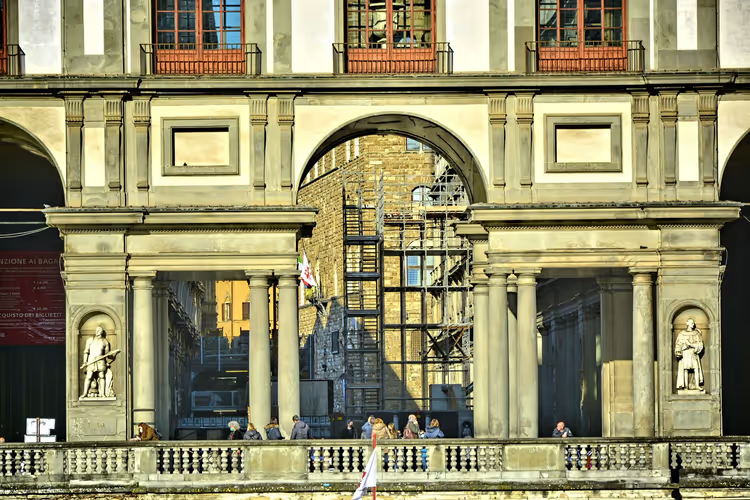
Expect the gallery entrance under the eastern colonnade of the inner courtyard. The information desk is on the left on Piazzale degli Uffizi, near Piazza della Signoria. If you get lost in the narrow streets, open the map and check your route. You don't need to take a taxi: the walk takes the same 15-20 minutes and passes old palaces.
What to see nearby
The Uffizi is convenient to visit together with neighboring sights. Palazzo Vecchio is a two-minute walk away, right on Piazza della Signoria. The Galleria dell'Accademia with Michelangelo's David is the choice for those who care about sculpture. The Duomo with Brunelleschi's dome rounds out a walking tour of the center. Book a timed-entry ticket to Michelangelo's David in advance: the Accademia also gets a line.
If you have two days, it makes sense to split art and the city. Our one-day Florence guide will help you put together a route without unnecessary rushing around.
Uffizi Gallery on the map
The map below will help you get your bearings before leaving the hotel and figure out in advance exactly where to find the entrance.
Uffizi Gallery in Florence
Places on the map
- Uffizi Gallery One of Europe's oldest art museums, Botticelli, Leonardo, Michelangelo
⁉️🤔 Frequently asked questions
How much time do you need for the Uffizi?
You can realistically cover both floors of the gallery in three to four hours if you don't linger at every painting. Take a morning slot and mark the Botticelli, Michelangelo, and Leonardo rooms in advance. With an audio guide, the time goes up to about five hours.
Do you need to buy tickets in advance?
Yes. In summer, the line without a slot exceeds an hour, and timed entry saves your morning. A ticket in advance costs 29 €, on the day of the visit 25 € (as of 09/2026, tickets section). On the first Sunday of the month, admission is free, but those days are especially crowded.
Is the Uffizi open on Mondays?
No. Monday is a day off year-round. The museum is also closed on January 1 and December 25. On other days it is open from 8:15 to 18:30, with the ticket office closing at 17:30 (as of 09/2026, official website).
Which paintings should you not miss?
At least three works: Michelangelo's "Doni Tondo," Botticelli's "The Birth of Venus" and "Primavera," and Leonardo's "Annunciation." Add to those the Caravaggio room with "Medusa." You'll find these paintings by following the signs on the walls.
Can you take photos of the paintings?
Check the photography rules at the entrance, as they vary by room. Flash, tripods, and selfie sticks are prohibited inside. Leave drinks and bulky bags in the free cloakroom right past the entrance.
In short: what's worth booking
- If it's your first visit and you want to see the highlights: get a Uffizi ticket for a Tuesday or Wednesday morning.
- If sculpture matters to you: add the Galleria dell'Accademia with "David."
- If you want to understand the city: start with the Uffizi, then walk through Piazza della Signoria and the Duomo.
- If you're worried about lines: book a slot in advance and arrive by 8:15.
A Uffizi ticket is cheaper on the museum's official website, and priority entry only pays off in the hottest season. In high season, available slots run out quickly, and that's when booking a Uffizi ticket on GetYourGuide saves the day.

A small editorial team writing guides for independent travel. We travel ourselves, but we haven’t been everywhere, so we check prices, opening hours and how to get there against official sources.