
















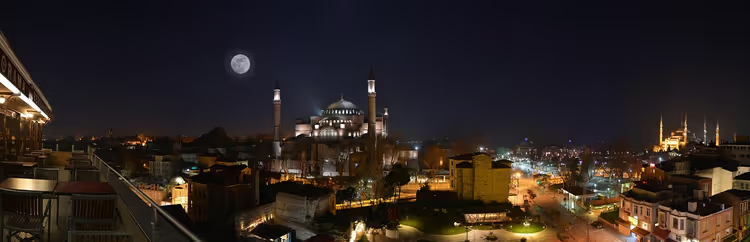
Istanbul in 4 days: day by day itinerary, ticket prices and where to stay
Istanbul sprawls across two continents, and in four days you'll see both halves of it. The city's main treasures are packed into a tiny patch of the Sultanahmet peninsula, but without a plan you'll spend half your time in lines. We've broken the route down by day: from Hagia Sophia and Topkapi Palace to Galata and the Grand Bazaar.
Leave the first evening for a walk without tickets, and move the heavy museums to the morning. A ticket to the upper gallery of Hagia Sophia costs €25 (as of 09/2026, Istanbul ticket guide), and without a time slot you'll stand at the entrance for over an hour.
Ad: this article contains affiliate links, we earn a commission if you book through them, at no extra cost to you.
How to get from the airport to the center
💡 In short:
- Most scheduled flights arrive at the new Istanbul Airport (IST), 50 km north of the city; some flights go to SAW.
- The M11 metro with a transfer to the M2 line at Gayrettepe and Havaist buses take you into the city.
- Prices and opening hours: 09/2026, check the official airport website.
The old Ataturk airport was closed to scheduled flights back in 2019, and its flights were moved to the new Istanbul Airport. The complex is being built in phases, so some terminals are still under construction.
It's easy to get lost inside the terminal: it stretches for kilometers, and trains run between gates. Allow at least an hour and a half for a connection and don't book a layover shorter than two hours.
There are two ways to get to the center. The M11 metro runs from the airport to Gayrettepe station, where you transfer to the M2 line (according to transport schedules, 09/2026). Havaist buses are cheaper and go directly to Sultanahmet and Taksim, but they depend on traffic: at rush hour the trip takes up to two hours. A taxi is more convenient but noticeably more expensive than the metro, and in the morning rush hour you'll just sit in a jam on the ring road.
Tours and tickets in Istanbul
Guided tours, skip-the-line tickets and activities — most offers can be cancelled free of charge.
See offers on KiwitaxiThe widget loads once you give your consent.
Where to stay in Istanbul
Where to stay in Istanbul depends on how much you're willing to walk. For a first visit, Sultanahmet is the most convenient: Hagia Sophia, the Blue Mosque, and Topkapi are right next to each other, and the tram stop is five minutes away. There are plenty of hotels here, and hotel prices in Sultanahmet rise noticeably in high season.
If cafes, bars, and nightlife matter to you, go for Beyoglu near İstiklal Caddesi. The Aksaray and Laleli neighborhoods are cheaper, and you can reach the center on the same T1 line. The short version: with kids, stay in Sultanahmet; for atmosphere, move to Beyoglu.
Day 1: Sultanahmet and Byzantine landmarks
The first day is spent entirely on the historic peninsula, between Hagia Sophia and the Rustem Pasha Mosque. The route is compact: almost everything is within walking distance, so you'll cover eight sites without a taxi. Start at 9:00 at the entrance to Hagia Sophia and move counterclockwise.
Hagia Sophia
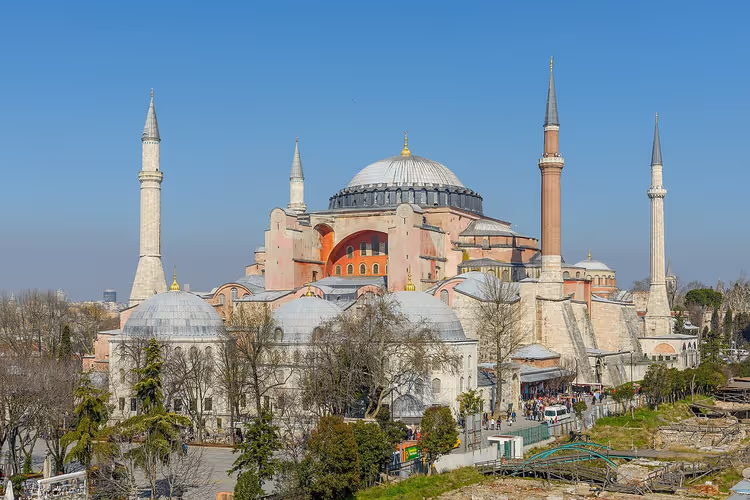 © Arild Vågen · CC BY-SAPhoto: Arild Vågen, CC BY-SA (https://creativecommons.org/licenses/by-sa/3.0), Wikimedia Commons
Hagia Sophia remained the largest church in the Christian world for nearly a thousand years. The cathedral was built in 537 by order of Justinian. Today it is a working mosque: entry for prayer is free, while tourists go up to the upper gallery with a separate ticket.
Around ten thousand workers labored on the building. The walls were faced with white marble, the green columns were brought from Ephesus, and the porphyry ones from Rome. The cathedral survived earthquakes, was looted by crusaders in 1204, and after the Ottoman conquest it became a mosque with four minarets.
Arrive at opening time, by 9:00. On Fridays the gallery is closed for two and a half hours during prayer (as of 09/2026, hours and entry). Allow about an hour for the visit.
- Cost: upper gallery 25 € (as of 09/2026, upper gallery ticket).
- Hours: daily 9:00-19:00, Friday with a prayer break.
- Getting there: tram T1 to Sultanahmet stop, then a three-minute walk.
- The catch: morning slots sell out quickly, book online in advance.
Blue Mosque
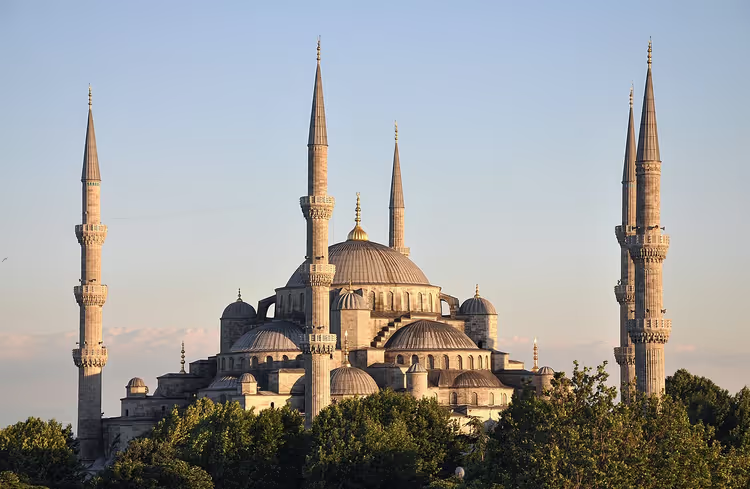 © Moonik · CC BY-SAPhoto: Moonik, CC BY-SA (https://creativecommons.org/licenses/by-sa/3.0), Wikimedia Commons
The Blue Mosque (Sultanahmet Camii) stands opposite Hagia Sophia, across the square. Sultan Ahmed I commissioned it in the early 17th century, and construction took seven years. Entry is free, but it is a working place of worship: women need a headscarf, and tourists are not admitted during prayer times.
Inside, it's not the paintings that matter but the tiles: the walls and domes are covered with thousands of blue and white tiles. Come between prayers, ideally in the middle of the day. A five-minute stop in the square in front of the entrance already gives you the best shot of the whole neighborhood.
- Cost: free entry.
- Hours: outside prayer times, morning and evening windows vary by season.
- The catch: during prayer times tourists are asked to leave, so come between prayers.
Topkapi Palace
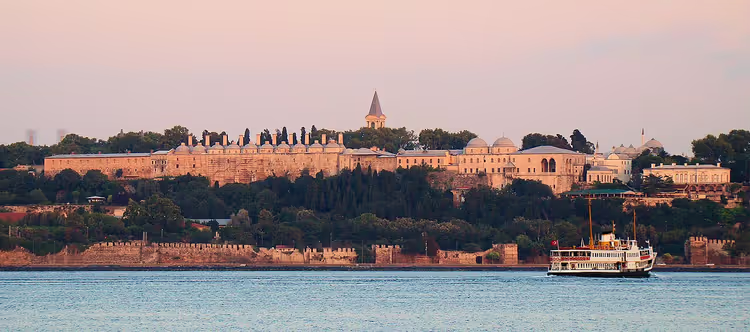 © Bjørn Christian Tørrissen · CC BY-SAPhoto: Bjørn Christian Tørrissen, CC BY-SA (https://creativecommons.org/licenses/by-sa/3.0), Wikimedia Commons
Topkapi Palace served as the residence of the Ottomans for four centuries, and the complex covers about 70 hectares. It was essentially a city within a city: mosques, barracks, a treasury, and a harem behind the same walls. Today it is a museum with four courtyards, each opening up gradually.
The visit takes half a day. The highlights are the treasury and the harem, so get a ticket that includes the harem right away. The palace is closed on Tuesdays (as of 09/2026, palace schedule).
- Cost: museum 30 €, harem an additional 15 € (as of 09/2026, Topkapi tickets).
- Hours: 9:00-18:00, closed Tuesday.
- Who it's for: those willing to walk for three to four hours and not tired of museums.
- The catch: the harem costs extra, and many people only find out at the ticket office.
Mosaic Museum
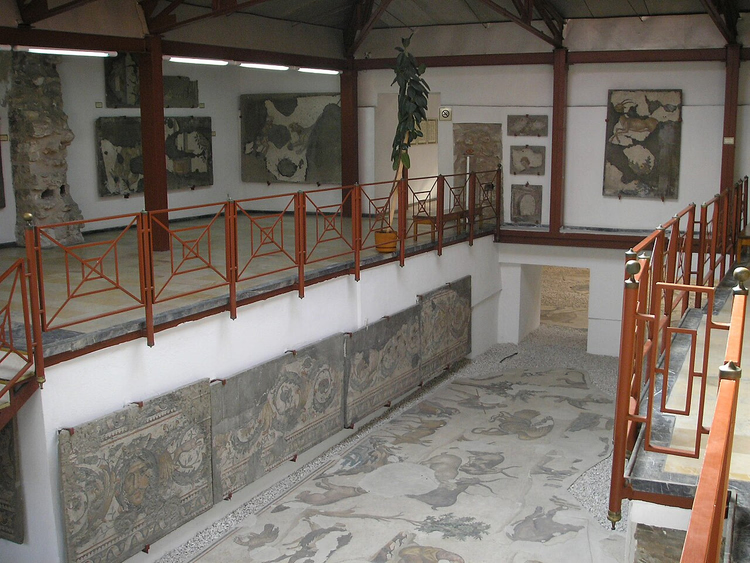
The Mosaic Museum hides behind the Blue Mosque, in the Arasta Bazaar quarter. Here, under a canopy, the floor of a Byzantine palace has been preserved: about two thousand square meters were covered with mosaics. Excavations began in the 1930s, the museum opened in 1953, and later the mosaics were moved into a stone building.
The scenes are everyday and mythical: feeding a baby, hunting, animals. Twenty minutes is enough for the visit. The place is often empty because tourists walk past the entrance and don't notice it.
- Cost: paid entry, check the exact price on site.
- Hours: daytime hours, closing day varies by season.
- The catch: the hall is small, and it gets cramped with a group.
Bayezid Mosque
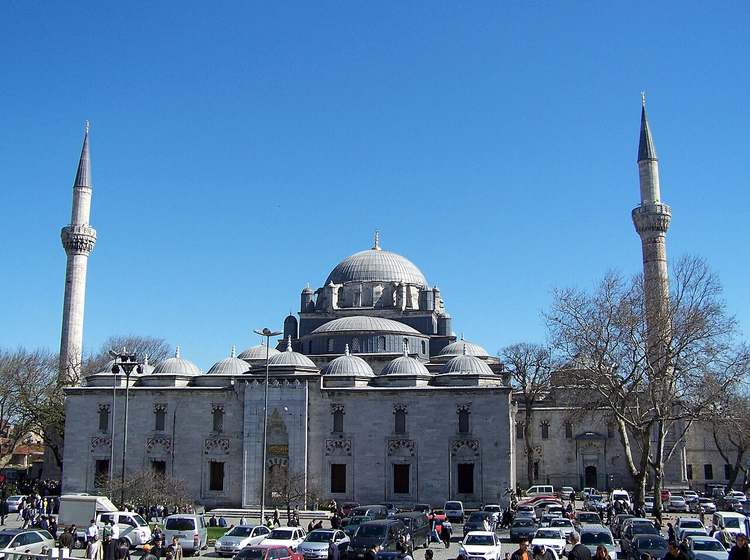 © User:Darwinek · CC BY-SAPhoto: User:Darwinek, CC BY-SA (https://creativecommons.org/licenses/by-sa/3.0), Wikimedia Commons
The Bayezid Mosque is the second-largest domed mosque in the old city. It was founded in the 16th century under Sultan Bayezid II on the site of a Byzantine forum. Building materials were taken from dismantled ancient structures, so marble columns and colored stone appear in the masonry.
A book bazaar operates next to the mosque, and a calligraphy museum is open in the former madrasa. Step into the courtyard: from here you can see how the main dome rests on two half-domes and dozens of windows. Entry is free.
- Cost: free entry.
- Getting there: tram T1 to Beyazıt-Kapalıçarşı stop.
- The catch: the courtyard is full of book stalls, so you make your way to the mosque between the shelves.
Valens Aqueduct
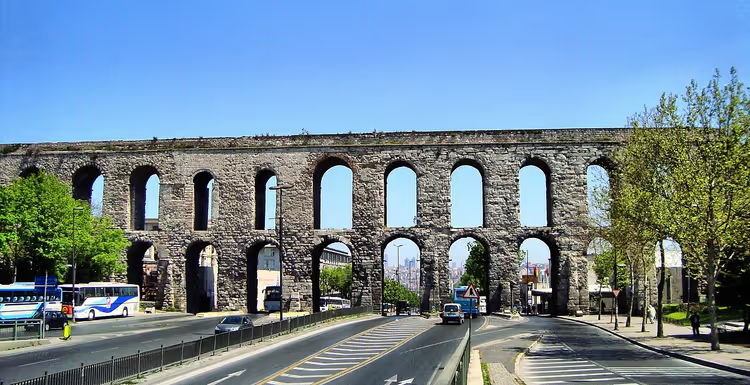 © HALUK COMERTEL · CC BYPhoto: HALUK COMERTEL, CC BY (https://creativecommons.org/licenses/by/3.0), Wikimedia Commons
The Valens Aqueduct cuts across the boulevard in the Fatih district and has served the city for more than sixteen centuries. It was built in the 4th century under Emperor Valens, was a kilometer long, and reached a height of 26 meters.
You can see it for free, no ticket needed: the arches are visible right from the street. The best view is from the boulevard in the evening, when the lighting comes on. Many tourists ride past on the tram and mistake the aqueduct for part of the old wall.
- Cost: viewing from outside is free.
- Getting there: tram T1 to Vezneciler or Laleli stop.
- The catch: a busy road runs nearby, and the noise makes it hard to linger.
Suleymaniye Mosque
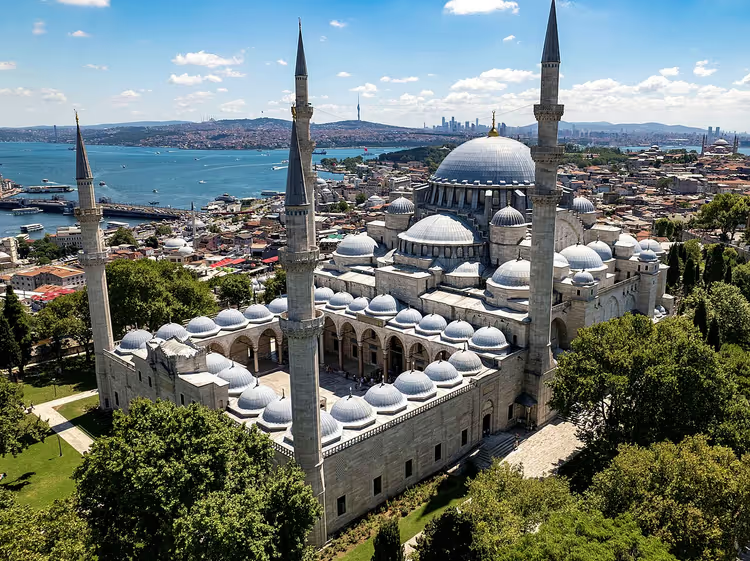
Süleymaniye Mosque stands on the city's third hill and is visible from almost all of Sultanahmet. It was built by the architect Sinan for Suleiman the Magnificent, and the sultan himself and his wife Hürrem rest nearby. Sinan considered this mosque his greatest work, and its supports have held for five centuries.
Entry is free, but there are many worshippers, so go in the morning or an hour before sunset. The observation terrace behind the mosque offers a view of the Golden Horn. The terrace between the mosque and the mausoleums is a good spot for a tea break.
- Cost: free entry.
- Getting there: from the Grand Bazaar up the boulevard, about 15 minutes on foot.
- The catch: the uphill walk along steep streets is tiring in the heat.
Rüstem Pasha Mosque
Rüstem Pasha Mosque is easy to miss: it is tucked away in the merchants' quarter near the Spice Bazaar. It was built by the same Sinan in 1561-1562 for the grand vizier Rüstem Pasha. The exterior is modest, but inside the walls are covered with Iznik tiles featuring floral patterns.
It is quiet inside and there are almost no tourists, so linger for fifteen minutes on your way from the bazaar. Entry is free, and there is rarely a line except on Fridays. Climb the narrow staircase to the gallery: from there the tiles are best seen.
- Cost: free entry.
- Getting there: three minutes from the Eminönü tram stop.
- The catch: the entrance is hard to find, with almost no signs.
Planning your first day is easier with a guide: old town sightseeing tours cover the same itinerary in half a day.
Day 2: Beyoğlu, Galata and the Bosphorus
Day two takes you north, across the Golden Horn, into modern Istanbul. In the morning you'll tour a palace on the Bosphorus shore, and by evening you'll climb the Galata Tower. In between, there's time for İstiklal Caddesi, a church and the spice market.
Dolmabahçe Palace
 © Diego Delso · CC BY-SAPhoto: Diego Delso, CC BY-SA (https://creativecommons.org/licenses/by-sa/4.0), Wikimedia Commons
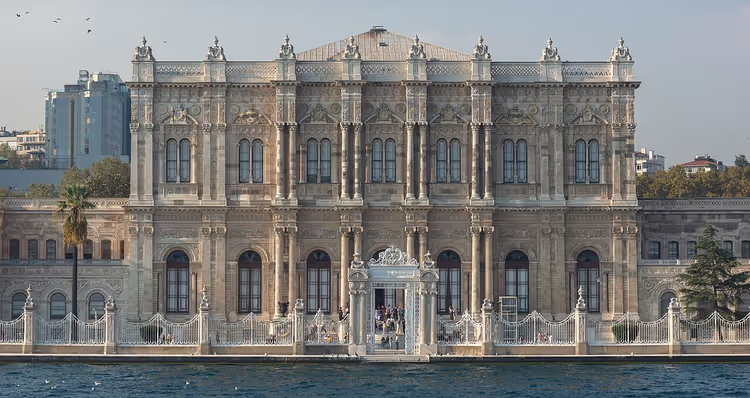
Dolmabahçe Palace was built in 1843-1856 as the sultans' new residence, on the Bosphorus shore in the Beşiktaş district. Sultan Abdülmecid I wanted to outdo European monarchs, so no expense was spared on gold and silver in the interiors. Today it's a museum, and you tour the halls with a guide on a set schedule.
Photography is not allowed inside, and shoe covers are handed out at the entrance. The tour takes about an hour and a half. The palace is closed on Mondays (as of 09/2026, Dolmabahçe opening hours).
- Cost: €20 (as of 09/2026, Dolmabahçe ticket).
- Hours: 9:00-18:00, closed Mondays.
- Getting there: tram T1 to Kabataş, then along the waterfront.
- The catch: you can only go inside with a group, and tickets sell out in advance.
Taksim Square
 © Fargoh · CC BY-SAPhoto: Fargoh, CC BY-SA (https://creativecommons.org/licenses/by-sa/4.0), Wikimedia Commons
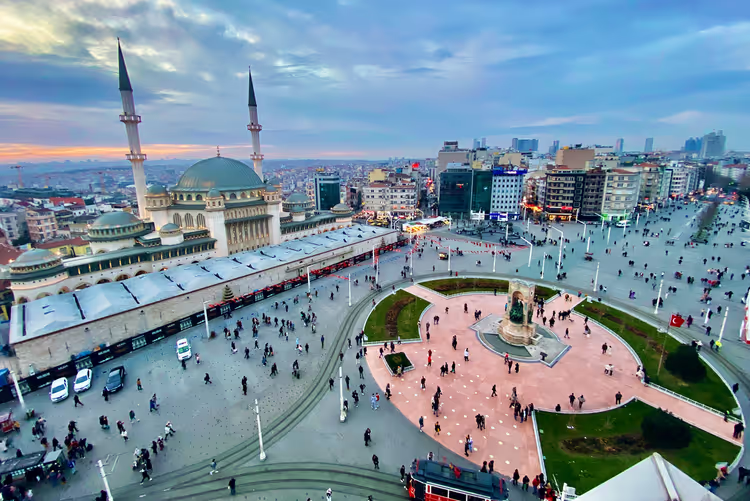
Taksim Square serves as the unofficial boundary between the old city and the newer part of Istanbul. The name translates as "distribution": water once flowed from here into the city's network. A funicular from Kabataş runs beneath the square, so from the Bosphorus side you can get up here in two minutes.
At the center stands the Republic Monument with figures of Atatürk and his comrades, erected in 1928. İstiklal Caddesi starts at the square. From here it's easy to walk downhill toward Galata and explore the whole neighborhood along the way.
- Cost: free to visit.
- Getting there: funicular F1 from Kabataş or metro M2 to Taksim.
- The catch: apart from the monument there's almost nothing to see here, it's a transit hub.
İstiklal Caddesi
 © Antimuonium · CC BY-SAPhoto: Antimuonium, CC BY-SA (https://creativecommons.org/licenses/by-sa/4.0), Wikimedia Commons
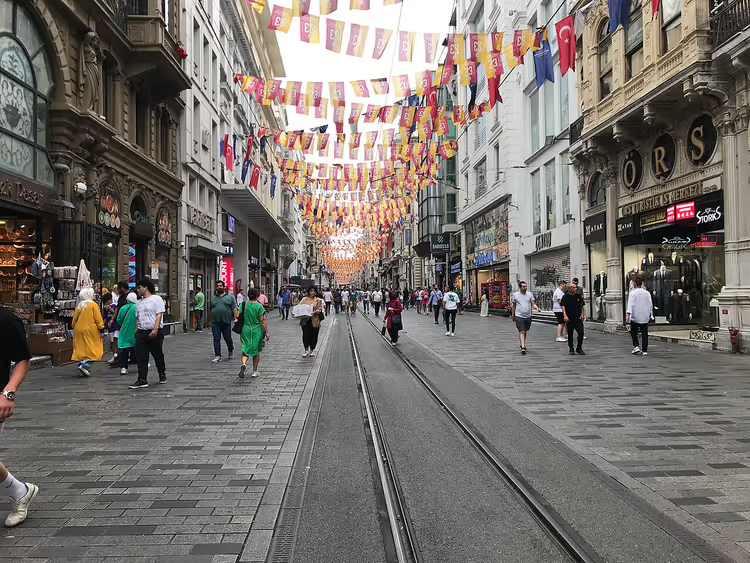
İstiklal Caddesi runs from Taksim to Galata and remains the city's main pedestrian street. It was once Pera Avenue, and the street got its name "İstiklal" (independence) in 1928. Today crowds stroll here, street musicians play and hundreds of cafes do business.
A historic tram still runs along the street, first introduced back in 1871. The walk takes about half an hour, but you can easily spend two hours. Duck into the side alleys: prices are lower and there are noticeably fewer people.
- Cost: walking is free, the tram requires a separate ticket.
- Getting there: on foot from Taksim Square or the Galata Tower.
- The catch: on weekends the street is literally packed.
Church of St. Anthony
 © Andrey · CC BYPhoto: Andrey, CC BY (https://creativecommons.org/licenses/by/2.0), Wikimedia Commons
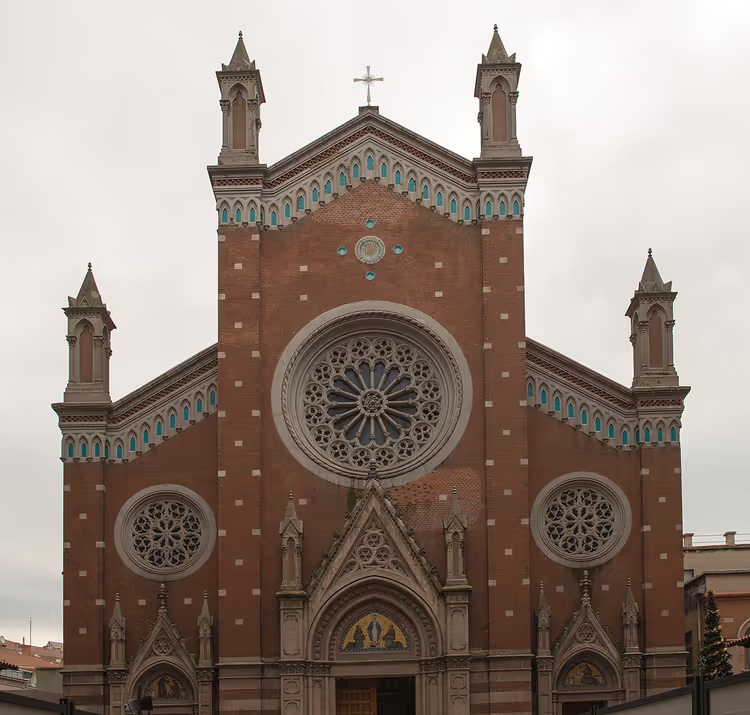
The Church of St. Anthony of Padua is the largest Catholic church in Istanbul. It was built in the neo-Gothic style, and the first service was held on February 15, 1912. The building stands a stone's throw from İstiklal Caddesi, but tourists often walk right past its austere facade.
Inside it's cool and quiet, a welcome pause from the noisy street. Entry is free, but it's best not to walk in with a tour group during Mass. Fifteen minutes is enough for a visit.
- Cost: free entry.
- Hours: open during daytime hours, Mass schedule varies.
- The catch: tourist access is restricted during services.
Galata Tower
 © Melih1969 · CC BY-SAPhoto: Melih1969, CC BY-SA (https://creativecommons.org/licenses/by-sa/4.0), Wikimedia Commons
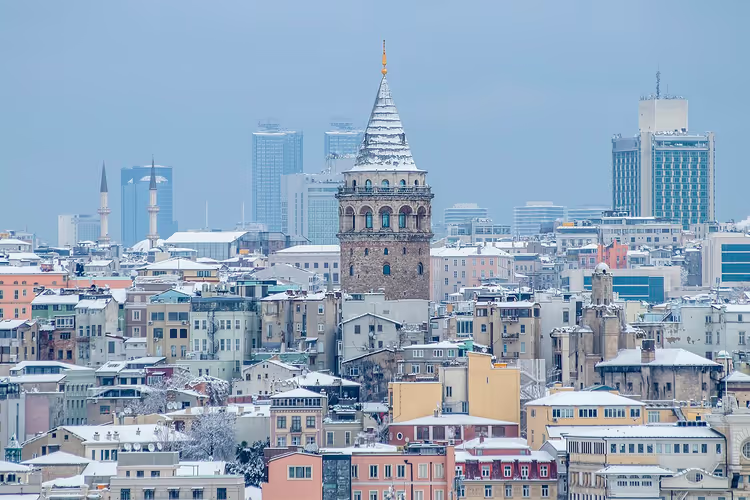
Galata Tower stands on a hill in Beyoğlu and is visible from almost anywhere in the city. The Genoese built it in 1348 as a watchtower; today it is 62.6 meters tall, and the observation deck sits at about 51 meters (tower overview, 09/2026). After restoration, the tower reopened in May 2024 with entry limited to one hundred people per hour.
An elevator takes you almost to the top, and the last few steps you have to climb on foot. Come half an hour before sunset: the city below takes on a warm light. The panorama puts the Bosphorus, the Golden Horn, and the domes of Sultanahmet in a single frame.
- Cost: €15 (as of 09/2026, tower ticket).
- Hours: 9:00-20:00, daily.
- Getting there: walk uphill from the Karaköy stop or take the Tünel funicular.
- The catch: the limit of one hundred people per hour creates a line even on weekdays.
Galata Bridge
 © Bjørn Christian Tørrissen · CC BY-SAPhoto: Bjørn Christian Tørrissen, CC BY-SA (https://creativecommons.org/licenses/by-sa/3.0), Wikimedia Commons
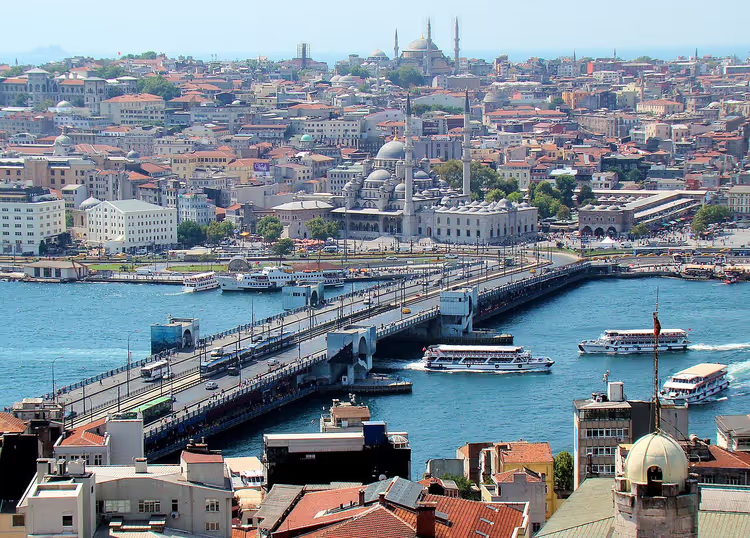
Galata Bridge connects the shores of the Golden Horn and serves as the calling card of the Karaköy district. The two-level crossing, about 484 meters long, carries trams and cars on top, while restaurants and fish shops operate below. The current bridge is already the fifth one, opened in the 1990s.
The lower level turns into a continuous line of restaurants and hookah lounges in the evening. Walk across the bridge at sunset, when the lights of Galata Tower reflect in the water. It is the city's free observation deck.
- Cost: free to cross.
- Getting there: from the Eminönü or Karaköy stop.
- The catch: fishing gear and smells from the lower level get in the way of enjoying the water.
Egyptian Bazaar
 © Dosseman · CC BY-SAPhoto: Dosseman, CC BY-SA (https://creativecommons.org/licenses/by-sa/4.0), Wikimedia Commons
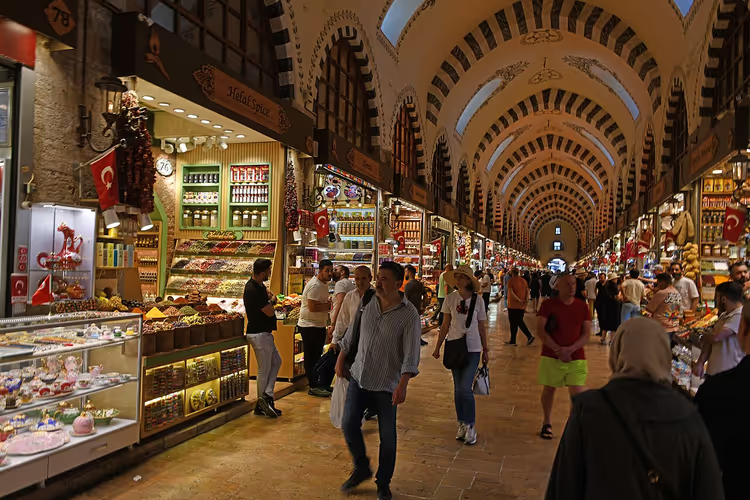
The Egyptian Bazaar, also known as the Spice Bazaar, smells of cinnamon and pepper long before you enter. Spices were brought here from India via Egypt, hence the name. The current stone building was constructed in the 1660s using revenue from the New Mosque, and the market got its modern look after a 1940s reconstruction.
The building is shaped like the letter L, with six arched entrances leading inside under a lead dome. Besides spices, it sells dried fruit, tea, and cheese. Allow half an hour for shopping and haggle: the starting price is usually inflated.
- Cost: free entry.
- Hours: daytime, some shops closed on Sundays.
- The catch: vendors push tea and sweets on you, making it easy to spend more than planned.
If you want to see the city from the water, add an evening Bosphorus boat tour.
Day 3: walls, Kariye and panoramas
The third day takes you to the western walls of the old city and the far-off viewpoints. There are fewer sights, but the distances between them are more noticeable, so it's easier to cover half the route by transport. Start at the Kariye Museum and finish at Pierre Loti Hill.
Kariye Museum
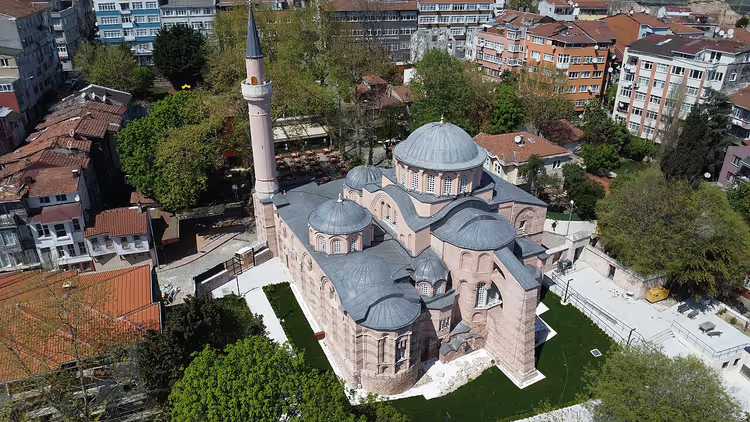
The Kariye Museum is tucked away in the far-off Edirnekapı district, by the old walls. The building was constructed in the 4th-5th centuries as the Church of Christ the Savior, later served as the Chora Monastery and a mosque. Under a layer of plaster applied during the Ottoman period, Byzantine mosaics and frescoes have survived.
Inside there are three halls with 14th-century mosaics depicting biblical scenes. The museum is closed on Wednesdays, and admission costs €20 (as of 09/2026, Kariye Museum hours). The easiest way to get there is by tram T4 to the stop near Edirnekapı.
- Cost: €20 (as of 09/2026, Kariye ticket).
- Hours: 9:00-18:00, closed on Wednesdays.
- The catch: the museum is far from Sultanahmet, so getting there takes time.
Mihrimah Sultan Mosque
The Mihrimah Sultan Mosque stands next to the Kariye Museum, right by the walls. Sinan built it for the beloved daughter of Suleiman and Hürrem. It is said that the double porticos at the base and under the domes echo the figure of a girl in a long dress.
Admission is free, the prayer hall is small, and twenty minutes is enough for a visit. During the day, light falls through the stained glass and colors the walls. A pause here nicely wraps up the morning part of day three.
- Cost: free admission.
- Getting there: on foot from the Kariye Museum, about 10 minutes.
- The catch: the area is quiet and has no cafes, so there is almost nowhere to grab a bite nearby.
Walls of Constantinople
 © The original uploader was -jha- at German Wikipedia . · CC BY-SAPhoto: The original uploader was -jha- at German Wikipedia ., CC BY-SA (http://creativecommons.org/licenses/by-sa/3.0/), Wikimedia Commons
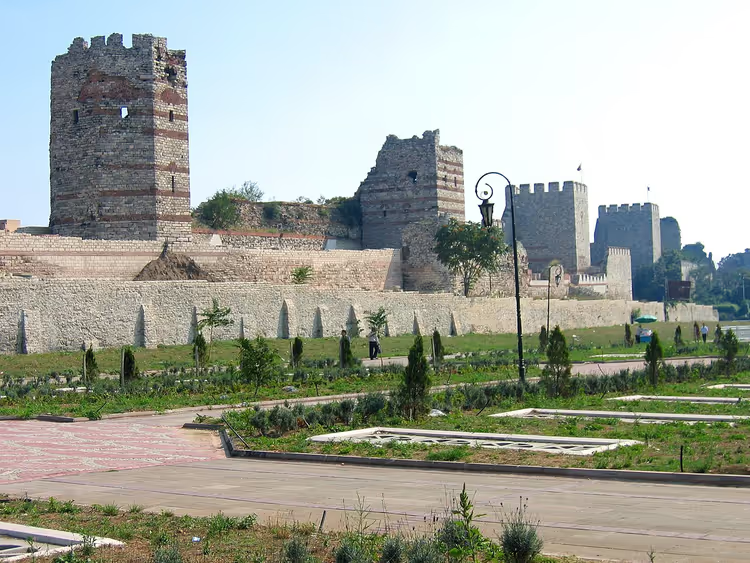
The Walls of Constantinople, or the Theodosian Walls, stretch along the western boundary of the old city. Emperor Theodosius II built them in the early 5th century, when the city outgrew its previous fortifications. For three centuries they held the line, until the earthquake of 747 destroyed part of the masonry.
The walls were restored in the 1980s, but the newer sections suffered damage in recent earthquakes. Viewing them is free, and you can walk along the rampart any day. The best stretch runs near the Edirnekapı district, next to the Kariye Museum.
- Cost: free to view.
- Getting there: tram T4 to the stop near Edirnekapı.
- The catch: there are few signs and benches along the walls, so bring water with you.
Pierre Loti Hill and cafe
 © Kayhan ERTUGRUL · CC BY-SAPhoto: Kayhan ERTUGRUL, CC BY-SA (https://creativecommons.org/licenses/by-sa/3.0), Wikimedia Commons
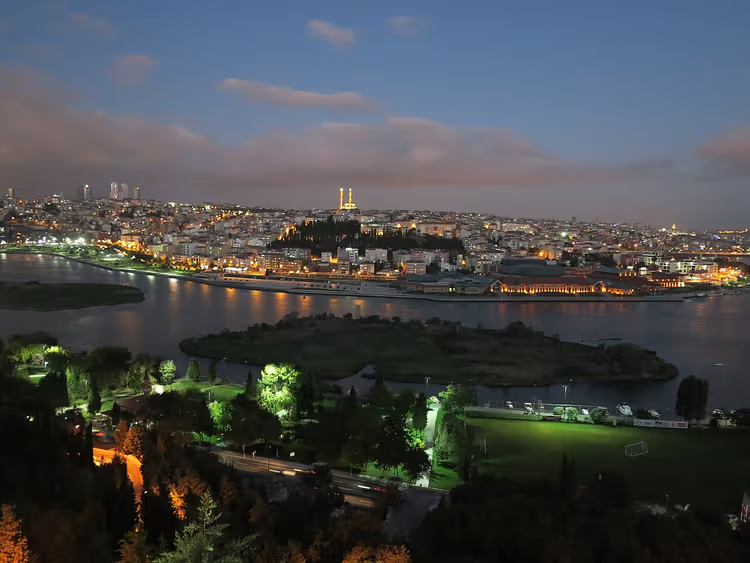
Pierre Loti Hill rises above the Eyüp district, on the site of an old Ottoman cemetery. From the top there is a view of the Golden Horn and the city. You can climb on foot or take the cable car; the lower station is by the Eyüp pier.
The cafe at the top was named after the French writer Pierre Loti, who wrote about the East. Today people come up here for apple tea and the sunset. The cable car is paid, while the walk up is free.
- Cost: walking up is free, the cable car requires a ticket.
- Getting there: ferry to Eyüp, then cable car or on foot.
- The catch: at sunset the viewing platform gets crowded.
It's more convenient to buy museum and viewpoint tickets in advance: museum tickets with a time slot are sold online.
Day 4: fortress, museum and bazaars
The fourth day combines the northern fortress on the Bosphorus, archaeological finds and an underground cistern. Finish at the Grand Bazaar, where it's easy to lose a couple of hours. This is the busiest day in terms of getting around, so part of the route is better covered by transport.
Rumeli Hisarı Fortress
 © Jwslubbock · CC BY-SAPhoto: Jwslubbock, CC BY-SA (https://creativecommons.org/licenses/by-sa/4.0), Wikimedia Commons
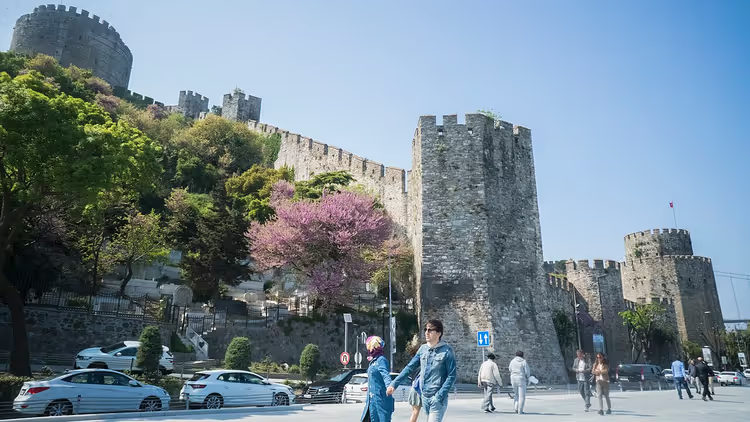
Rumeli Hisarı Fortress was built in 1452 on the orders of Mehmed the Conqueror for the siege of Constantinople. Two thousand builders and one thousand planners raised the walls and towers in four and a half months. The task was simple: cut the city off from the sea.
The fortress interior is closed on Wednesdays, and admission costs €6 (as of 09/2026, fortress hours). Even if the museum is closed, you can see the three main towers connected by walls from the outside.
- Cost: €6 (as of 09/2026, fortress ticket).
- Hours: 9:00-18:00, closed on Wednesdays.
- Getting there: bus to the Rumeli Hisarı stop.
- The catch: the steep climb takes a toll on your legs before the evening bazaar.
Archaeological Museum
 © Dosseman · CC BY-SAPhoto: Dosseman, CC BY-SA (https://creativecommons.org/licenses/by-sa/4.0), Wikimedia Commons
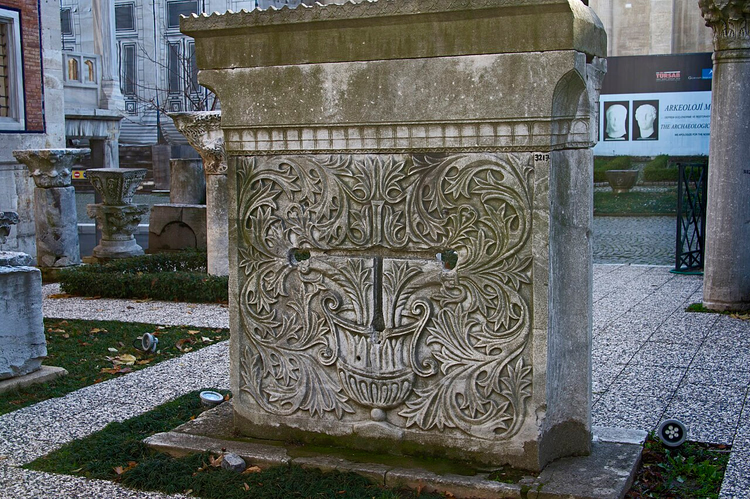
The Archaeological Museum grew out of the "museum of sarcophagi": the first exhibits were precisely sarcophagi. The first building, in the neoclassical style, opened in 1896, and two more were added later. Today it is three museums with finds from Istanbul, Africa and the Balkans.
The main exhibits are the sarcophagi from ancient Syria and the cuneiform tablets. Many people skip the Tiled Pavilion, and that's a mistake. The museum is closed on Mondays, and the ticket costs 400 lira (as of 09/2026, museum tickets). Allow about two hours for the visit.
- Cost: 400 lira (as of 09/2026, admission price).
- Hours: 9:00 AM to 6:00 PM, closed on Mondays.
- Getting there: same stop as Topkapi Palace.
- The catch: the complex has three buildings, and after three days of sightseeing it's easy to get tired.
Basilica Cistern
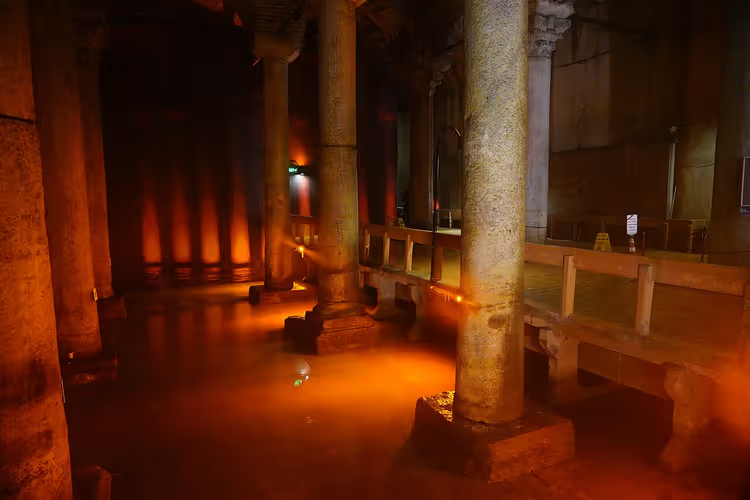 © Ray Swi-hymn from Sijhih-Taipei, Taiwan · CC BY-SAPhoto: Ray Swi-hymn from Sijhih-Taipei, Taiwan, CC BY-SA (https://creativecommons.org/licenses/by-sa/2.0), Wikimedia Commons
The Basilica Cistern is a 6th-century underground reservoir built under Justinian. The vault is supported by 336 marble columns about nine meters high, brought from ancient temples. The most famous are two columns with bases shaped like the heads of Medusa the Gorgon.
Inside it's cool and dark, and the original lighting creates a special atmosphere. The 2020-2022 restoration was carried out by the city team İBB Miras, after which the wooden walkways were replaced with steel ones (cistern restoration, 09/2026). The ticket costs 20 EUR, and the museum is open daily (as of 09/2026, ticket price).
- Cost: 20 EUR (as of 09/2026, cistern ticket).
- Hours: 9:00 AM to 7:00 PM, open daily.
- The catch: the line at the entrance is long, so book a time slot in advance.
Grand Bazaar and Cemberlitas
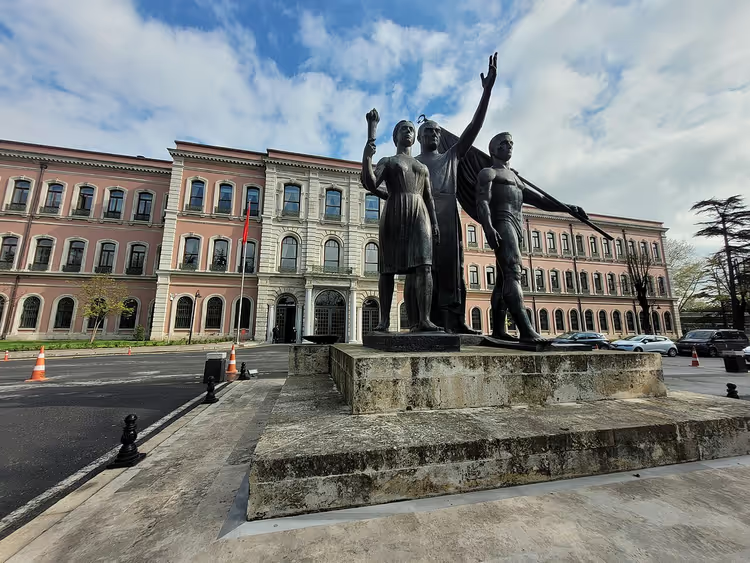 © Zafer · CC BY-SAPhoto: Zafer, CC BY-SA (https://creativecommons.org/licenses/by-sa/4.0), Wikimedia Commons
The Grand Bazaar grew on this spot back under Mehmed the Conqueror, in 1453. Over the centuries, the covered market expanded and became the center of city trade. By the early 17th century, it had 67 streets, five mosques, and eighteen gates.
Nearby lies the Cemberlitas quarter with the Column of Constantine and historic hammams. Entry to the bazaar is free, but you should always haggle: the first price is almost always inflated. Allow at least two hours for walking through the streets.
- Cost: free entry.
- Hours: daytime, closed on Sundays.
- The catch: it's easy to lose your bearings in the maze of streets, so go in with a map.
Tours and tickets in Istanbul
Guided tours, skip-the-line tickets and activities — most offers can be cancelled free of charge.
See offers on GetYourGuideThe widget loads once you give your consent.
4-Day Istanbul itinerary on the map
The map below brings together all the route points on one page, so save it to your bookmarks for your walking days. You can also open the route on the map separately. Before heading out, check the plan against the weather and schedule the farther points for the first half of the day.
Day | Main focus | Book tickets in advance | Walking, km |
|---|---|---|---|
1 | Sultanahmet and Byzantine shrines | Hagia Sophia, Topkapi with harem | 4-5 |
2 | Beyoglu, Galata, and the Bosphorus | Dolmabahce, Galata Tower | 5-6 |
3 | Walls, Chora, and panoramas | Chora Museum | 3-4 |
4 | Fortress, museum, and bazaars | Basilica Cistern, Rumeli Hisari | 4-5 |
Prices and hours: as of 09/2026, museum overview.
A 4-day Istanbul itinerary
Places on the map
- Hagia Sophia Upper gallery 25 euros, arrive at opening at 9:00
- Blue Mosque Free entry, visit between prayer times, women need a headscarf
- Topkapi Palace Museum 30 euros plus the harem 15 euros, closed on Tuesdays
- Mosaic Museum Floor of a Byzantine palace behind the Blue Mosque, a 20-minute visit
- Beyazit Mosque The old city's second-largest domed mosque, next to a book bazaar
- Valens Aqueduct 4th-century arches over a boulevard in Fatih, lit up in the evening
- Suleymaniye Mosque Sinan's main work, a view of the Golden Horn behind the mosque
- Dolmabahce Palace 20 euros, tours only in a group, closed on Mondays
- Taksim Square The Republic Monument and the start of Istiklal, a funicular from Kabatas
- Istiklal Avenue The main pedestrian street with a historic tram
- St. Anthony of Padua Church The city's largest Catholic church, free entry
- Galata Tower 15 euros, limit of a hundred people an hour, arrive half an hour before sunset
- Galata Bridge Free viewpoint: a tram above, fish restaurants below
- Egyptian Bazaar The spice market under a lead-covered dome, haggling is a must
- Chora Museum 14th-century Byzantine mosaics, 20 euros, closed on Wednesdays
- Mihrimah Sultan Mosque A work by Sinan right by the walls, free entry, a 20-minute visit
- Walls of Constantinople 5th-century Theodosian Walls, the best stretch is near Edirnekapi
- Rumeli Hisari Fortress A fortress from 1452 on the Bosphorus, 6 euros, closed on Wednesdays
- Archaeological Museum Sarcophagi and cuneiform tablets, 400 lira, closed on Mondays
- Basilica Cistern 336 columns and the Medusa heads, 20 euros, open every day
- Grand Bazaar A covered market since 1453, free entry, closed on Sundays
- Cemberlitas A quarter with the Column of Constantine and old hammams
⁉️🤔 Frequently asked questions
How much money will tickets cost over four days?
If you visit every paid attraction on the route, it comes to about €150 per person plus 400 lira (as of 09/2026, Istanbul museum prices). Hagia Sophia costs €25, Topkapi with the harem €45, Dolmabahce €20, Galata Tower €15, Basilica Cistern and Chora Museum €20 each (as of 09/2026, museum prices). Mosques, the Walls of Constantinople, and bazaars are free.
Do I need a Museum Pass?
A five-day Museum Pass costs about €114 and covers Topkapi, the harem, Galata Tower, the Archaeological Museum, and about a dozen other sites (as of 09/2026, pass comparison). Hagia Sophia, Basilica Cistern, and Dolmabahce are not included. The pass pays off if you plan to visit four or more paid museums.
How much time should I allow for Hagia Sophia and Topkapi?
Hagia Sophia takes about an hour, Topkapi with the harem three to four hours. Take the first 9:00 slot, after that the lines grow by the hour. Topkapi is closed on Tuesdays, and on Fridays the gallery in Hagia Sophia is closed during prayer (as of 09/2026, museum hours).
How do I get from the airport to Sultanahmet?
The most predictable route is the M11 metro to Gayrettepe station, then transfer to the M2 line. Havaist buses are cheaper and go straight to the center, but they depend on traffic. Taxis are more convenient but more expensive, and in the morning rush hour you risk getting stuck in a jam (based on airport transport data, 09/2026).
Where to go when it rains?
When it rains, the Basilica Cistern, the Archaeological Museum, and the Mosaic Museum come to the rescue: all three are indoors and operate without long breaks. Add the Grand Bazaar and the Egyptian Bazaar, where you can wander under the vaulted ceilings for hours. Open-air walls and viewpoints are better saved for a clear day.
In short: what to book
If you only have four days, stay in Sultanahmet, get up in time for Hagia Sophia's opening, and keep one free evening for the Bosphorus. That way the route won't turn into a race, and you'll get through the most crowded museums before the masses arrive.
- If it's your first time and you're traveling with kids: book a hotel in Sultanahmet.
- If you love panoramas: plan Galata Tower for sunset.
- If you want to see as many museums as possible: compare the Museum Pass with the price of individual tickets.
It's better to book accommodation and tours in advance. Istanbul hotels on Trip.com and Bosphorus boat tours sell out quickly in high season.
For museums, get Istanbul museum tickets online in advance.

A small editorial team writing guides for independent travel. We travel ourselves, but we haven’t been everywhere, so we check prices, opening hours and how to get there against official sources.