
















Three days in Istanbul: route through Sultanahmet, Galata and the Asian side
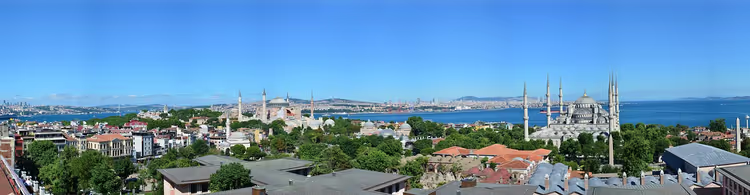
Istanbul is hard to fit into three days. We put together a route that lets you cover Sultanahmet, Galata, and the Asian side without rushing. The Old City is compact: the main sights sit within a two-kilometer radius, and the high-speed tram connects them in minutes (see map).
Tickets for Topkapi Palace and the Basilica Cistern are best bought in advance, and the entry procedure for Hagia Sophia is worth checking on the official website before your trip (as of 09/2026). Below you'll find transport details, the honest catch of each place, and a ready-made plan for each of the three days.
Ad: this article contains affiliate links, and we earn a commission if you book through them. At no extra cost to you.
Day 1: Sultanahmet and the Bosphorus
💡 In short:
- Sultanahmet is walkable: Hagia Sophia, the Blue Mosque, Topkapi, and the hammam are all in the same neighborhood.
- The underground cisterns fit nicely between the palace and the evening ferry.
- Spend the evening on the water: a Bosphorus cruise wraps up day one without extra logistics.
- Check prices and opening hours before your trip on the National Palaces website
You spend day one in Sultanahmet, the historic core of the city on the headland between the Bosphorus and the Sea of Marmara. Everything major is close by: from Hagia Sophia to Topkapi is a ten-minute stroll at a relaxed pace (on the map). Start at opening time, otherwise by midday the line at the entrance will stretch around the block and you will have to push back half your plans.
Hagia Sophia
 © Kecags · CC BY-SAPhoto: Kecags, CC BY-SA (https://creativecommons.org/licenses/by-sa/4.0), Wikimedia Commons
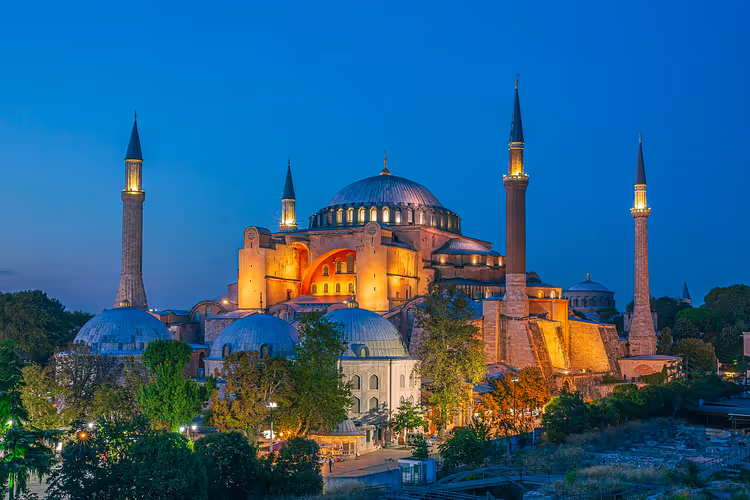
Hagia Sophia was built in the sixth century under Emperor Justinian I and has remained the main landmark of the old city for nearly fifteen hundred years. The vast dome, slender minarets, and Arabic calligraphy on the walls sit alongside Christian mosaics. You are standing in a building that has been a patriarchal cathedral, a mosque, a burial place, and a museum.
Since 2020 it has been a working mosque again, so the visiting rules and opening hours have been rewritten several times. Before your visit, open the official museums and mosques page (as of 09/2026): Directorate of Culture and Tourism. During prayer times tourists are not allowed inside, and you will have to wait by the side door with everyone else.
- Entry: check the official website, the visiting procedure changes every season.
- Getting there: light rail to Sultanahmet stop, then a two-minute walk.
- The catch: the line at the entrance grows by the hour, arrive right at opening.
Blue Mosque
 © Karelj · CC BY-SAPhoto: Karelj, CC BY-SA (https://creativecommons.org/licenses/by-sa/3.0), Wikimedia Commons
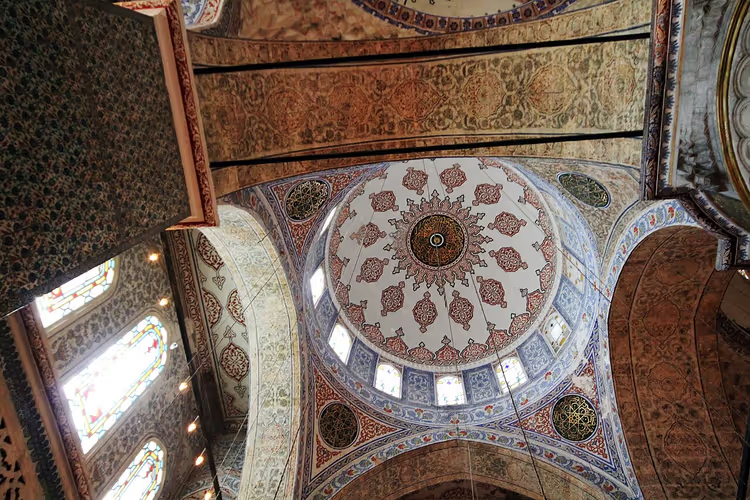
Across the square from Hagia Sophia stands the Blue Mosque, also known as the Sultan Ahmed Mosque. Six minarets and the blue Iznik tiles in its decoration have made it one of the most recognizable silhouettes in the city. Construction was completed in the early seventeenth century, when the Iznik ceramic workshops were at their peak.
Inside you will see tens of thousands of tiles, which gave the mosque its second name. Standard rules apply at the entrance: shoes come off, women are given a headscarf, and it is best to cover shoulders and knees in advance. Men pray on the lower level and women on the second floor, so during prayer times some halls are closed to visitors.
- Entry: free, but visitors are not admitted during prayer.
- Getting there: the same Sultanahmet tram stop as Hagia Sophia.
- The catch: photography during prayer is prohibited, equipment must stay in your bag.
Hürrem Sultan Hamamı
 © Yair Haklai · CC BY-SAPhoto: Yair Haklai, CC BY-SA (https://creativecommons.org/licenses/by-sa/4.0), Wikimedia Commons
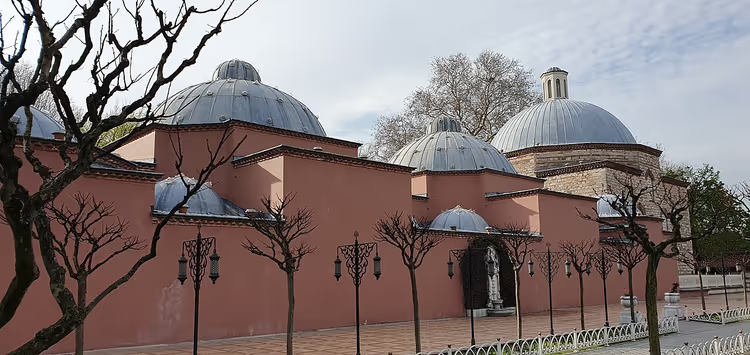
Between the two main mosques you will find Hürrem Sultan Hamamı, one of the city's historic bathhouses. It was built in the mid-sixteenth century for Hürrem, the wife of Suleiman the Magnificent, on the site of the ancient Baths of Zeuxippus. Before that, the same walls had housed a prison, a warehouse, and a court.
Today the men's and women's sections mirror each other, and visitors can choose from several programs of different lengths. For the first forty-five minutes you are scrubbed with a coarse mitt, followed by exfoliation, clay masks, and a foam wash with aromatic oils. The longest program takes almost two hours. At the end you are wrapped in a snow-white towel and served Ottoman sherbet.
- Entry: programs are paid, the price is given at booking.
- Tradition: locals come in the morning, tourists fill the halls by evening.
- Getting there: tram to Sultanahmet, entrance from the Hagia Sophia square side.
- The catch: you will not get in without a reservation, and evening slots go first.
Topkapi Palace
 © Jorge Láscar from Australia · CC BYPhoto: Jorge Láscar from Australia, CC BY (https://creativecommons.org/licenses/by/2.0), Wikimedia Commons
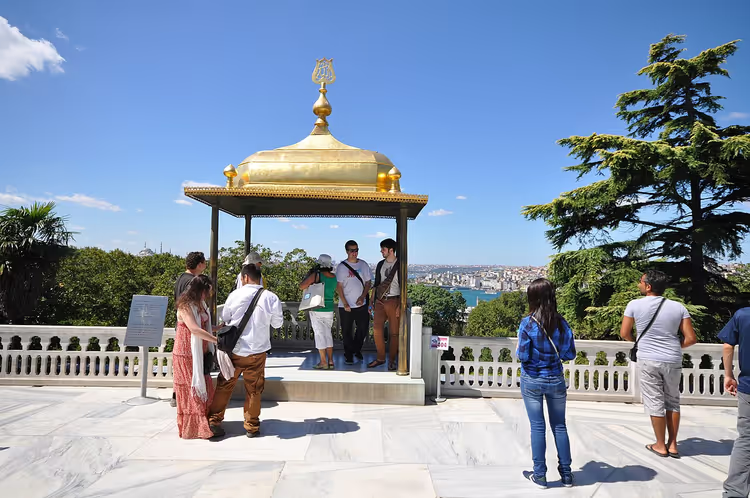
Topkapi occupies the headland where the Bosphorus meets the Sea of Marmara. A settlement existed on this site as far back as the Neolithic era, later Byzantine Constantinople grew here, and the first stone of the palace was laid in the second half of the fifteenth century. Twenty-five sultans ruled the country from here, and this is where the history of the Ottoman Empire was shaped.
The palace got its name from the Cannon Gate, which still serves as the main entrance, and beyond it opens the largest courtyard of the complex. Further on you enter the harem, where the story of Suleiman and Hürrem unfolded, and the throne room. The palace became a museum in the early 1920s, and since then it has displayed a collection of weapons, porcelain, and Christian relics.
The Church of St. Irene deserves special attention, one of the oldest Christian basilicas in the city: the apse preserves a mosaic of a black cross on a gold background, and the church itself predates Hagia Sophia.
- Entry: paid, the harem ticket is sold separately or in combination with the palace.
- Getting there: tram to Gulhane or Sultanahmet stops, then up Divan Yolu street.
- Tickets in advance: Topkapi Palace tickets on GetYourGuide
- The catch: closing days have changed, check the official palace website before your visit.
Beneath the palace, Byzantine passages still exist, leading to old structures, and prisoners once awaited execution in the gate towers: the executioners' rooms are also open to visitors. To avoid getting lost among dozens of halls, take an audio guide or go with a guide, otherwise half the names will mean nothing to you.
Basilica Cistern
 © Ray Swi-hymn from Sijhih-Taipei, Taiwan · CC BY-SAPhoto: Ray Swi-hymn from Sijhih-Taipei, Taiwan, CC BY-SA (https://creativecommons.org/licenses/by-sa/2.0), Wikimedia Commons
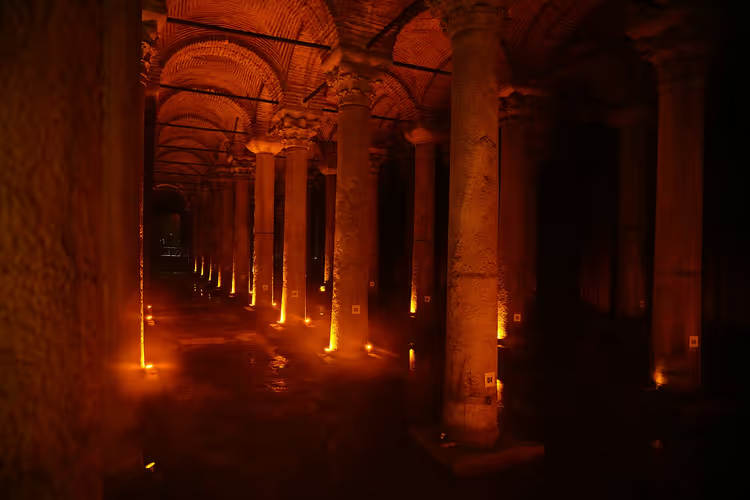
A whole underground world is hidden beneath the old city, and its most famous hall is the Basilica Cistern. The reservoir was carved out under Justinian in the sixth century: hundreds of columns as tall as a three-story building support the vault that once held drinking water for the Great Palace. The site's full name is the Basilica Cistern, or Yerebatan.
The cistern was rediscovered in the mid-sixteenth century by the French traveler Pierre Gilles, who noticed locals drawing water from underground wells. Before that, the reservoir had simply been forgotten for several centuries. Today you walk along wooden platforms past two Medusa heads, peek into the Wishing Pool, and listen to classical music concerts echoing through the hall.
- Admission: paid, tickets are sold with a fixed time slot.
- Getting there: tram to Sultanahmet, the entrance is across from Hagia Sophia.
- The catch: the line moves slowly, so book a morning or late evening slot.
Theodosius Cistern
 © Izabela Miszczak · CC BY-SAPhoto: Izabela Miszczak, CC BY-SA (https://creativecommons.org/licenses/by-sa/4.0), Wikimedia Commons
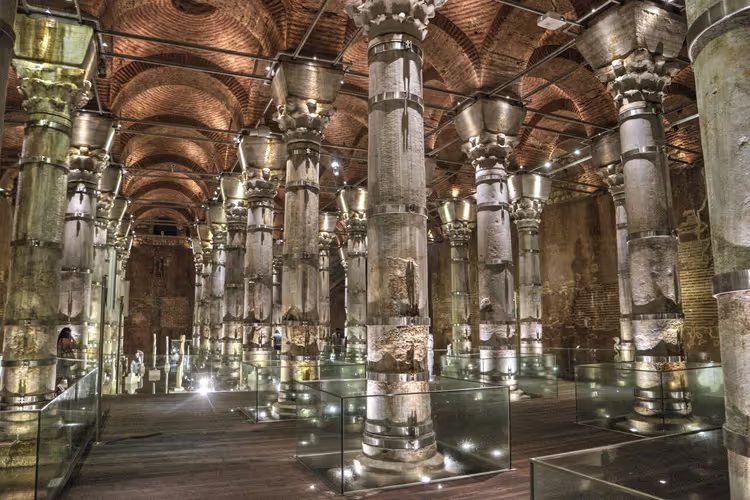
The Theodosius Cistern (Şerefiye Sarnıcı) is only a hundred years older than the Basilica Cistern, but it opened to visitors quite recently. The reservoir was discovered during the demolition of the old municipal building in Eminönü, restored, and covered with a glass pavilion, so it is bright and dry inside. Water was supplied here from the Aqueduct of Valens.
Inside you will see illuminated columns, a small exhibition about the city's forty reservoirs, and on Saturdays you can catch acoustic concerts with light projections playing across the ancient walls. The place is noticeably quieter and calmer than its neighbor, though also smaller.
- Admission: paid, tickets are sold on site and online.
- Getting there: tram to Çemberlitaş, then along Piyer Loti Cd.
- The catch: there are few halls, and the visit takes about half an hour.
Evening Bosphorus cruise
 © Tarikkaanmuslu · CC BY-SAPhoto: Tarikkaanmuslu, CC BY-SA (https://creativecommons.org/licenses/by-sa/4.0), Wikimedia Commons
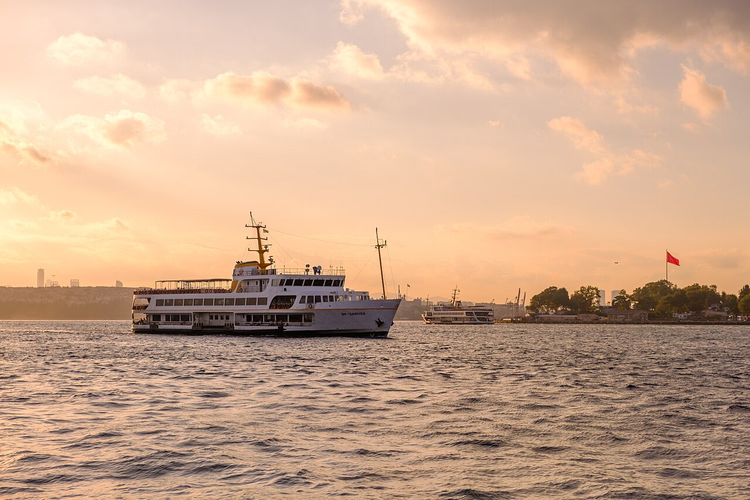
The best way to end the day is on the water. Ferries depart from the Eminönü pier and sail past palaces, mosques, and wooden mansions, which you pass closer to than from any observation deck. The evening trip lasts several hours and usually includes dinner with folk dances and music.
If you want the city rather than dinner, take a daytime trip: a six-hour ride with a stop in the village of Anadolu Kavağı at the far end of the strait shows you the entire Bosphorus. Grab a seat on the port side for the best view of the European shore and the bridges.
- Admission: buy tickets at the pier or online, dinner is not included on all trips.
- Getting there: tram to Eminönü, then a five-minute walk from the stop to the pier.
- The catch: evening cruises with dinner cost noticeably more than daytime trips.
Plan your first day like this: spend the morning in Sultanahmet, use the time until evening for the palace complex and the underground cisterns, and board the ferry before sunset. Between sights you can easily grab a bite near Gülhane Park, where the tram line along the old city begins.
Keep prayer times in mind: Hagia Sophia and the Blue Mosque close their doors to visitors several times a day, so it is best not to build a rigid schedule. Book morning slots for the palace and cisterns, and your evening will stay free for the Bosphorus.
Day 2: Grand Bazaar, Galata and Taksim
The second day starts off hearty. A Turkish breakfast made up of dozens of small plates takes almost two hours, and that is part of the local tradition, not slow service. After that, you walk from the museums near Gülhane Park to the Grand Bazaar, climb up to the Süleymaniye Mosque and finish the evening on Istiklal Street near the Galata Tower.
Archaeological Museum
 © Dosseman · CC BY-SAPhoto: Dosseman, CC BY-SA (https://creativecommons.org/licenses/by-sa/4.0), Wikimedia Commons
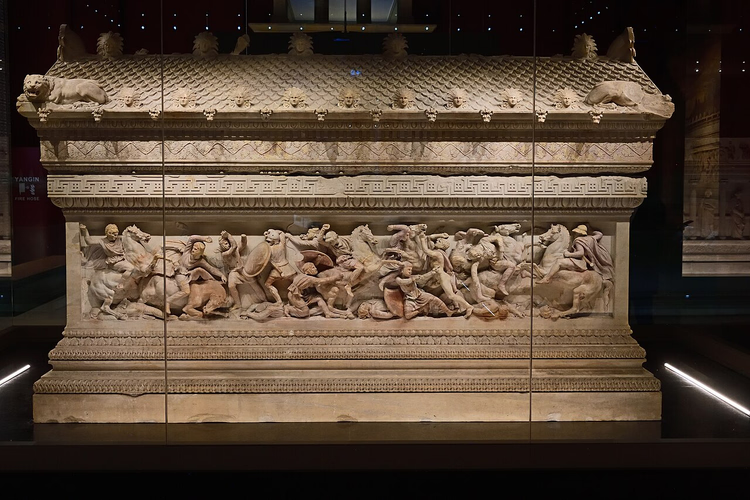
The Archaeological Museum brings together three collections: the archaeological collection itself, the Museum of the Ancient Orient and the Tiled Pavilion. You should allow about three hours for the visit, otherwise you will rush past the most interesting parts. The complex is in Eminönü, next to Topkapi and Gülhane Park, so it is a convenient place to start the second day. Exhibit labels are in English, and there is no audio guide.
The idea for the museum came from the artist Osman Hamdi Bey, who campaigned for the preservation of Turkish antiquities. The first item in what would become the collection was a tomb, and the building itself was initially called the museum of sarcophagi. Today it holds more than a million objects: the original Sidon sarcophagus, busts of Alexander the Great and Zeus, fragments of the Temple of Zeus at Pergamon and the head from the Serpent Column on the Hippodrome square.
- Admission: paid, the ticket covers all three buildings in the complex.
- Getting there: tram to Gülhane or Sultanahmet stops.
- The catch: after lunch, tour groups come one after another, so mornings are quieter.
Mosaic Museum
 © Ninara · CC BYPhoto: Ninara, CC BY (https://creativecommons.org/licenses/by/2.0), Wikimedia Commons
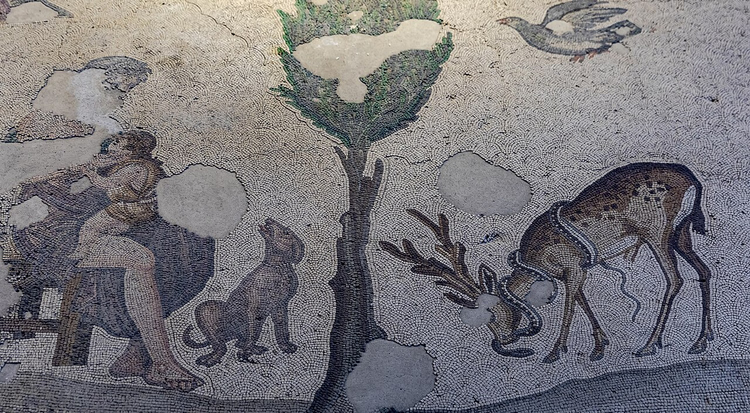
The Mosaic Museum grew out of excavations that uncovered the floor of the Great Palace of the Byzantine emperors. The mosaics decorated the palace gallery, and later a market stood on the site until it was destroyed in the thirteenth century. The first visitors saw the restored panels in the 1950s, and the collection has barely changed since then.
The exhibition occupies two small rooms and dates from the era of Justinian. The subjects are classical rather than Christian: animal hunts, harvest scenes, battle scenes. You will appreciate the quality of the ancient craftsmen's work from up close, because the rooms are tiny and you examine the mosaics almost at arm's length.
- Admission: paid, tickets are bought on site.
- Getting there: look for the entrance among the stalls of Arasta Bazaar or from Torun Sk.
- The catch: the two rooms can be seen in twenty minutes, so it is not worth making a special trip here.
Grand Bazaar
 © qwesy qwesy · CC BYPhoto: qwesy qwesy, CC BY (https://creativecommons.org/licenses/by/3.0), Wikimedia Commons
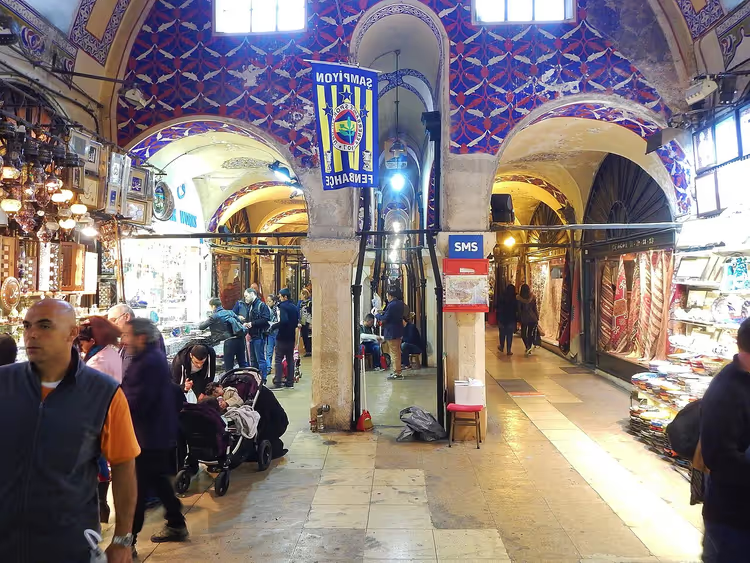
The Grand Bazaar, or Kapalıçarşı, is often called a city within a city, and that is close to the truth. Under its roof are dozens of streets, thousands of shops, workshops, mosques, fountains for resting, cafes and even a school. The area is roughly divided into two historic parts: the Sandal Bedesten and the Inner Bedesten with columns and domes.
Trade is organized by quarter: separate streets are given over to carpets, leather, jewelry, ceramics and fabrics. In Ottoman times, banks and exchanges operated here, and eighteen gates led into the market, the main ones built in the Moorish style. It got the name "covered bazaar" because the gates were opened from dawn to dusk.
- Admission: free, haggling is appropriate almost everywhere except for antiques.
- Getting there: tram to Beyazit or the Grand Bazaar stop.
- The catch: the market is closed on Sundays, and Saturdays are especially crowded.
Enter through the main Moorish-style gates, not the side doors: that way you will immediately find yourself in the central section with columns and domes. Haggling is customary here, but keep it calm: prices are quoted with a cushion, so start at half the amount and stay polite.
Süleymaniye Mosque
 © Giorgio Galeotti · CC BY-SAPhoto: Giorgio Galeotti, CC BY-SA (https://creativecommons.org/licenses/by-sa/4.0), Wikimedia Commons
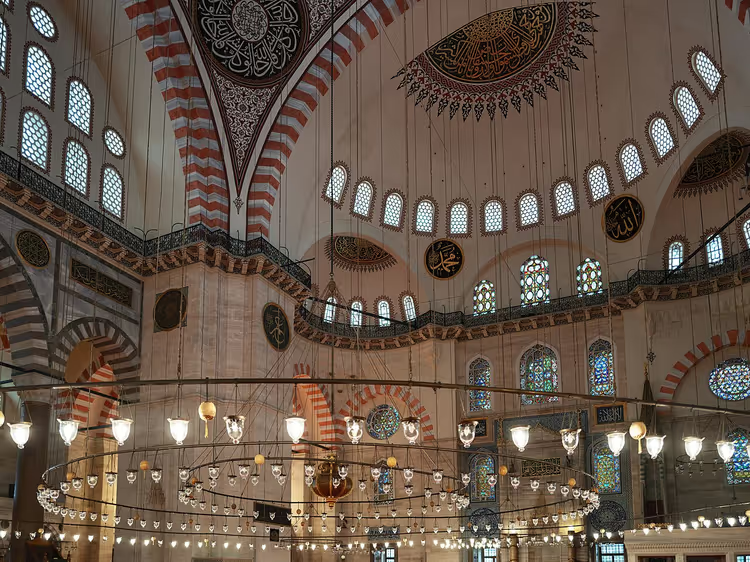
On one of the hills of the old city stands the Süleymaniye Mosque, one of the largest in Istanbul. It was built on the orders of Suleiman the Magnificent in the mid-sixteenth century, during the golden age of the Ottoman Empire. The four minarets and their balconies reflect events from the sultan's reign, and the stained glass for the mosque was made by a master nicknamed Sarhoş.
The complex includes madrasas, a library, kitchens and an old cemetery where Suleiman himself, Hürrem and later rulers are buried. The tombs of Hürrem and Suleiman are built as octagonal mausoleums, and you view their interiors through a window. The mosque is active, so you cannot enter during services; at other times tourists are admitted through a side entrance.
- Admission: free, cover your shoulders and knees in advance.
- Getting there: tram to Eminönü, then up Prof. Sıddık Sami Onar Cd.
- The catch: the viewing terrace near the mosque is not always open, so you will need to check access on site.
Taksim Square
 © TheRunnerUp · CC BY-SAPhoto: TheRunnerUp, CC BY-SA (https://creativecommons.org/licenses/by-sa/4.0), Wikimedia Commons
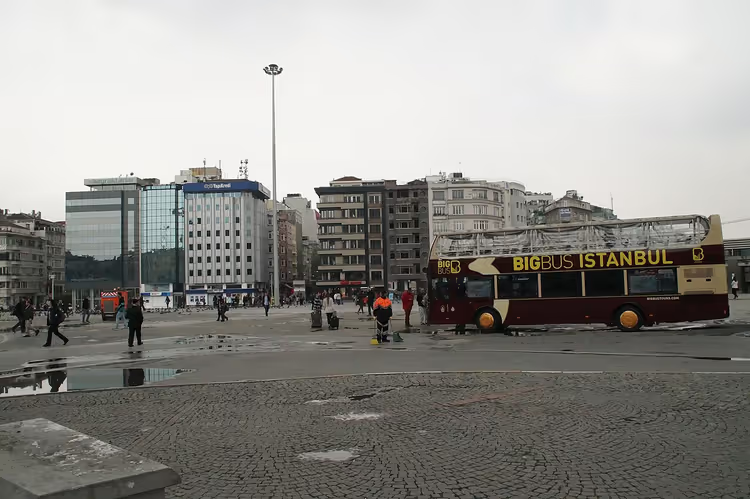
Taksim is the boundary between old Istanbul and the modern districts, and also the city's main square for celebrations and gatherings. The name translates as "distribution": from here water was distributed through the city's water supply system. The site was once an Armenian cemetery, and later the square witnessed tragic events in the 1970s, commemorated by memorial plaques.
Today the square is surrounded by hotels, restaurants and transport hubs, and it is a convenient starting point for a walk through the European side. On the eastern side stands the Atatürk Cultural Center with its concert halls, and in the center rises the Republic Monument with the founders of the republic. The Church of the Holy Trinity is nearby.
- Admission: free.
- Getting there: buses and metro to Taksim stop, which is also the terminus of the historic tram.
- The catch: the square is noisy in the evening, so mornings are calmer.
Istiklal Street
 © Robot8A · CC BY-SAPhoto: Robot8A, CC BY-SA (https://creativecommons.org/licenses/by-sa/4.0), Wikimedia Commons
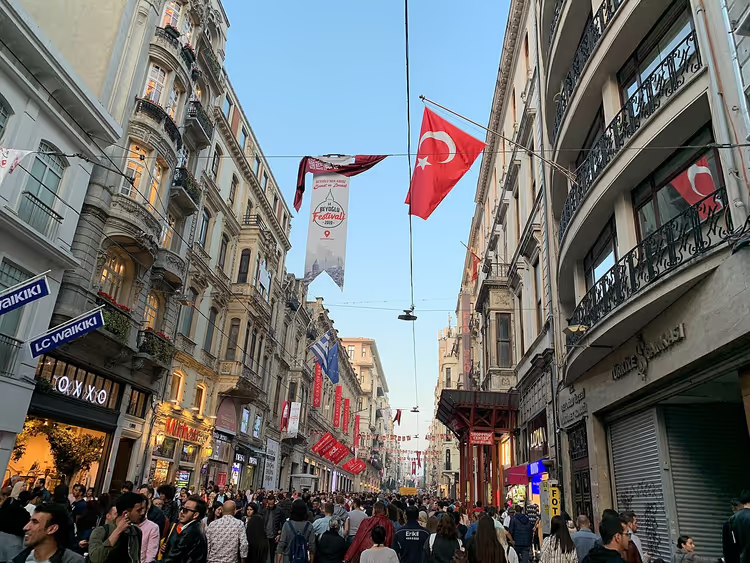
Istiklal translates as "Independence Street" and runs for about one and a half kilometers from Taksim to the Galata quarter (on the map). Formally it is a typical European district: the buildings were built by foreigners, shops and workshops opened here, and churches and mosques survive nearby. The street is considered a place where East and West meet.
You will walk here in a stream of people: street musicians, confectioners, bookstores and nightclubs operate almost around the clock. Hidden beneath the street is the historic Tünel funicular, one of the oldest underground railways in the world, and a retro tram runs along Istiklal itself. If you are short on time, ride part of the route and walk back.
- Admission: free.
- Getting there: walk down from Taksim Square or ride part of the way on the retro tram.
- The catch: on weekends the crowd is so dense that you have to walk slowly.
Galata Mevlevi Museum
 © Dosseman · CC BY-SAPhoto: Dosseman, CC BY-SA (https://creativecommons.org/licenses/by-sa/4.0), Wikimedia Commons
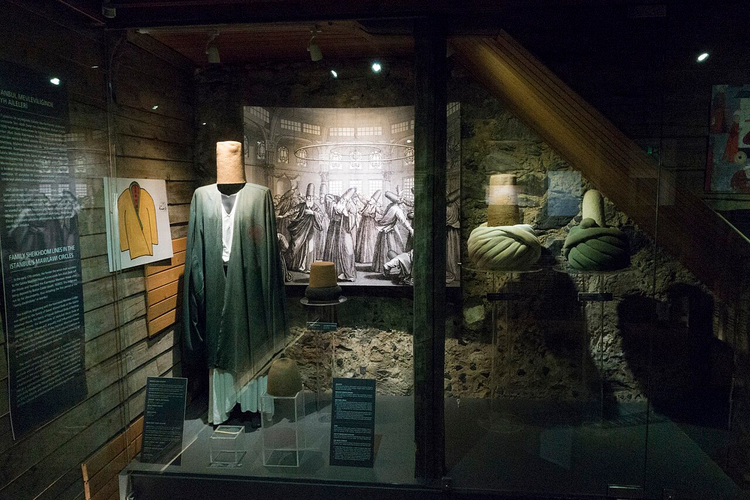
The Galata Mevlevi Museum is dedicated to the whirling dervishes, members of the Mevlevi order. The building long served as a dervish lodge, meaning a residence for the religious community of followers of the Persian poet Jalal ad-Din Rumi. Today the order's center is in Konya, and the Istanbul lodge has become a museum.
The main attraction here is the ritual dance of the dervishes, performed in a magnificent wooden hall. Every movement in this dance has its own meaning, and the whirl of white skirts affects audiences more powerfully than any concert. You will also see an exhibition of monastic everyday objects and a separate room devoted to early book printing.
- Admission: paid, check the performance schedule on site.
- Getting there: tram or funicular to Tünel stop, entrance from Galip Dede Cd.
- The catch: the rooms are small, and on performance days it gets packed by evening.
Galata Tower
 © Melih1969 · CC BY-SAPhoto: Melih1969, CC BY-SA (https://creativecommons.org/licenses/by-sa/4.0), Wikimedia Commons
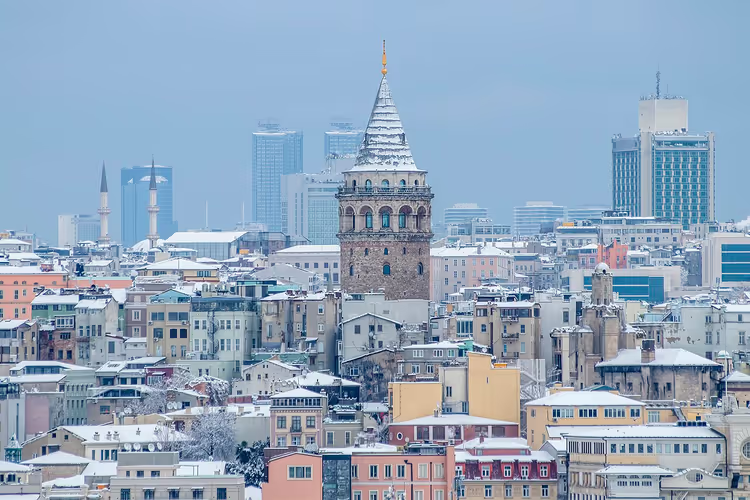
The Galata Tower, once called the Tower of Christ, was built by the Genoese on the hill of Galata in the Middle Ages on the site of an older fortification. Over its long history it has served as an observatory, a fire watchtower and a lighthouse. Today it is one of the city's main viewpoints, where all of Istanbul with its minarets, bridges and street lights is visible at a glance.
You can go up by elevator or by the ancient stone steps, and this choice is worth thinking through in advance: the elevator is faster, the staircase more atmospheric. A restaurant operates on the upper levels, and the tower itself is open until late evening, so sunsets are seen here more often than sunrises. Tickets are sold with a fixed entry time.
- Entry: paid, buy a slot in advance and arrive ten minutes early.
- Getting there: tram to Karaköy, then up through the narrow streets of Galata.
- Tickets in advance: Galata Tower tickets on GetYourGuide
- The catch: the viewing platform is small, and at sunset dozens of people stand at the railing at the same time.
It's convenient to end the second day in Galata, but if you still have energy, walk down to the bridge and cross to the other side: from there the tower is visible from below, and fish restaurants operate right by the water. You'll get back to the hotel by tram or ferry from Karaköy.
The only thing worth booking in advance on the second day is the tower climb; everything else you can easily fit in as you go. Keep in mind that the Grand Bazaar closes in the evening, so head there right after the museums if you want to have time to pick out a carpet or leather goods.
Day 3: Kadıköy and the Princes' Islands
On the third day you spend time on the Asian shore, where Istanbul looks completely different. There are fewer monuments here, but more everyday life, ferries, and water all around. This kind of finale helps you see the city as a whole, not just the tourist core, and also gives you a pause before the trip home.
Kadıköy
 © Kadı · CC BYPhoto: Kadı, CC BY (https://creativecommons.org/licenses/by/4.0), Wikimedia Commons
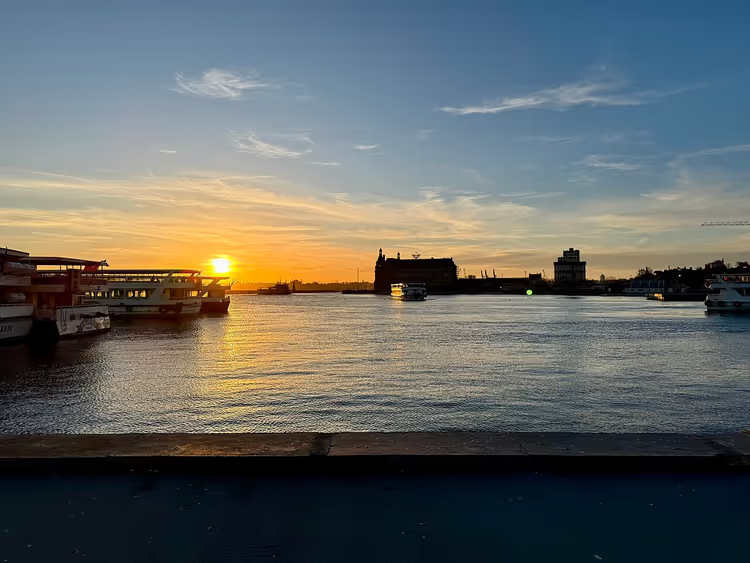
You get to Kadıköy by ferry from Eminönü or from the European shore. There are no outstanding historical monuments here, but Byzantine monasteries, wooden houses of Greek families, and greenery in the courtyards have survived. This neighborhood is chosen by those who want to see ordinary city life: the market, pastry shops, bookstores.
The pace in Kadıköy is calmer than in Sultanahmet. You can order Turkish coffee in a small cafe, try seasonal fruit from the market, and simply sit by the water, watching the ferries and the silhouette of the old city across the way. In the evening, musicians gather on the waterfront, and the coastal streets turn into one long promenade.
- Admission: free, the ferry is paid with a transport card.
- How to get there: ferry from the Eminönü or Karaköy piers to Kadıköy, travel time about twenty minutes.
- The catch: there is not much to see here, this is a day for food and walks, not for museums.
Princes' Islands
 © Kadı · CC BY-SAPhoto: Kadı, CC BY-SA (https://creativecommons.org/licenses/by-sa/4.0), Wikimedia Commons
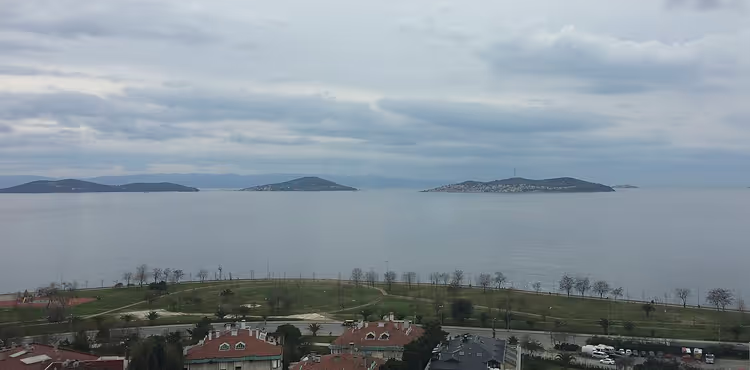
From the Kadıköy pier, a ferry goes to the Princes' Islands, where there are no cars. There are nine islands, but four are accessible to tourists, and the largest of them is Büyükada. Because of the ban on cars, you hear only bicycles and footsteps here, and the air is noticeably cleaner than in the center. Horse-drawn carriages have been banned on the islands since 2020.
In Byzantine times, families of princes were exiled here, hence the name. Houses, churches of different denominations, and monasteries have survived to this day, and on Büyükada you can climb to a viewpoint or circle the island. On weekdays it is quiet here; on weekends all of Istanbul comes, so choose a weekday.
- Admission: free, you only pay for the ferry.
- How to get there: ferry from the Kadıköy pier to Büyükada, then on foot or by bicycle.
- The catch: on weekends the ferries are packed, and there is almost no shade on the island.
If you want to add guided tours and tickets to your itinerary, check out current options for Istanbul.
Tours and tickets in Istanbul
Guided tours, skip-the-line tickets and activities — most offers can be cancelled free of charge.
See offers on TiqetsThe widget loads once you give your consent.
How to get from the airport to the center
The old Atatürk Airport was closed to scheduled flights in the late 2010s, so now you arrive at the new Istanbul Airport on the European side. It is far from the center: the trip to Sultanahmet takes about an hour, and to Taksim Square a bit less. This is worth keeping in mind if you have a short trip or a late arrival. Low-cost airlines from the EU often fly into the city's second airport, Sabiha Gökçen.
The simplest option is the Havaist buses: they run from the terminal to Taksim, Sultanahmet, and other parts of the city. The second option is the metro to Gayrettepe with a transfer to other lines; it is cheaper, but requires transfers with luggage. Taxis and pre-booked transfers are more expensive, but they take you straight to your hotel, which is convenient at night or with children.
If after a long flight you do not want to figure out transfers, look at a ready-made option: private airport transfer.
Tours and tickets in Istanbul
Guided tours, skip-the-line tickets and activities — most offers can be cancelled free of charge.
See offers on KiwitaxiThe widget loads once you give your consent.
⁉️🤔 Frequently asked questions
Is three days enough for Istanbul?
For the main sights of the old city, Galata, and the Asian shore, three days is enough if you are not trying to visit every museum in a row. Set aside one day for Sultanahmet, one for the Grand Bazaar and Galata, one for Kadıköy and the islands. With children, or for palaces and cisterns without rushing, plan four days.
Do I need an Istanbulkart?
Yes, if you use public transport more than twice a day. The card works on trams, the metro, buses, and ferries, and one card can pay for trips for your whole group. Each tap deducts money separately, so top up the card with enough for the whole day.
How do I get from the airport to the center at night?
At night the metro does not run, so the options are Havaist buses, taxis, and pre-booked transfers. Buses do run after dark, but you need to find the stop in advance. If you arrive late, take a transfer to your hotel: the driver will meet you in the terminal, and you will not have to look for a car in the parking lot.
When are Hagia Sophia and the Basilica Cistern least crowded?
Come at opening time or in the last hours before closing. During the day the lines grow, especially in season, and on Friday around midday some halls are closed for prayer. Cistern tickets are sold by time slot, so an early morning slot saves you half an hour at the entrance.
What can I fit in on the Asian shore in one day?
Start with the ferry to Kadıköy, walk around the market and the waterfront, have lunch at a local cafe, and after lunch take the ferry to the Princes' Islands. On Büyükada, three hours is enough to walk around the center and climb to the viewpoint. Head back before sunset.
Three-day Istanbul itinerary on the map
Below is a map with the points from this itinerary, so you can estimate distances between sights and the order of your walks in advance. Open it on your phone before leaving the hotel and pace your day as you like.
What to see in Istanbul in 3 days
Places on the map
- 1Hagia Sophia Working mosque since 2020, dome and sixth-century Christian mosaics
- 2Blue Mosque Mosque of Sultan Ahmed I, six minarets and Iznik ceramics
- 3Hürrem Sultan Hamamı The city's oldest working bathhouse, built for the wife of Süleyman the Magnificent
- 4Topkapı Palace Residence of the sultans on a Bosphorus headland, harem, throne room and the Church of Hagia Irene
- 5Basilica Cistern Sixth-century underground reservoir with columns and Medusa heads
- 6Theodosius Cistern Şerefiye Sarnıcı, underground reservoir beneath a glass pavilion in Eminönü
- 7Evening Bosphorus cruise Ferry from the Eminönü pier past palaces and mosques at sunset
- 8Archaeological Museum Three collections in Eminönü, the original Sidon Sarcophagus and busts of ancient gods
- 9Mosaic Museum Restored floor mosaics of the Great Palace of the Byzantine emperors
- 10Grand Bazaar Kapalıçarşı, dozens of streets and thousands of shops under the old city's roof
- 11Süleymaniye Mosque Istanbul's largest mosque, a madrasa, kitchens and the tombs of Süleyman and Hürrem
- 12Taksim Square The city's main square, the Republic Monument and the Atatürk Cultural Centre
- 13İstiklal Street A kilometre and a half from Taksim to Galata, street musicians, shops and a heritage tram
- 14Galata Mevlevi Museum Home of the Mevlevi order of dervishes, the ritual dance in a wooden hall
- 15Galata Tower One of the city's main viewpoints, reached by lift or by stairs
- 16Kadıköy The Asian shore, a market, cafés and a promenade with a view of the old city
- 17Princes' Islands Car-free islands, with Büyükada, the largest, and its viewpoint
In short: what to book
If you have three days and the center is your priority, staying in Sultanahmet will save you hours of travel: Istanbul hotels on Trip.com. If you want tickets with a guide and no lines, look at tours in advance: tours and tickets on GetYourGuide. A late-night arrival becomes a simple task when a car is already waiting: airport transfer to your hotel.
Start by booking your accommodation and first-day tickets; the rest will fall into place as you go: the itinerary is compact, and transport in Istanbul runs until late in the evening.

A small editorial team writing guides for independent travel. We travel ourselves, but we haven’t been everywhere, so we check prices, opening hours and how to get there against official sources.