
















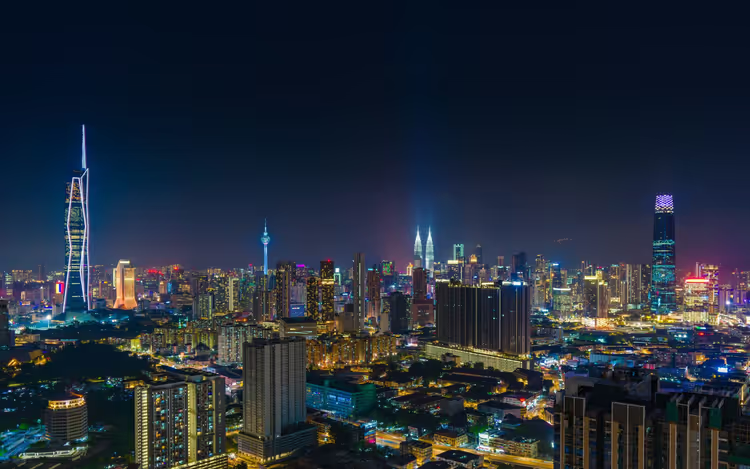
What to do in Kuala Lumpur in 1 day: 15 places and a ready route
One day in Kuala Lumpur can be covered without rushing if you stick to the center. The main sights are clustered together: the Petronas Towers, KLCC Park, the aquarium, and the Menara TV tower are all within a two-kilometer radius. After that, everything comes down to the order of stops.
Two things get in the way: tickets and time. Observation decks sell entry by time slots, and some museums close by six in the evening. We put together a route of 15 places with addresses, prices, and how to get there. Covering all 15 spots in one day is tough, so mark the main ones and keep the rest as backup.
For reference: the Petronas Towers rise to 452 m, making them the tallest twin towers in the world (as of 09/2026, Petronas Towers).
Ad: this article contains affiliate links, we earn a commission if you book through them, at no extra cost to you.
Petronas Towers and the Skybridge
💡 In short:
- Start at the Petronas Towers and go up to the observation deck on the 86th floor.
- Walk through KLCC Park to the aquarium and the Menara TV tower.
- Book paid observation decks in advance: entry is sold by time slot.
 © Smuconlaw · CC BY-SAPhoto: Smuconlaw, CC BY-SA (https://creativecommons.org/licenses/by-sa/4.0), Wikimedia Commons
The Petronas Towers open the route first. Two 88-story towers are connected by a two-level Skybridge on the 41st and 42nd floors. The bridge is not fixed rigidly: when it sways, it slides into the towers. You go up quickly, on a high-speed elevator.
The visit happens in two steps: first the bridge, then the observation deck on the 86th floor with a panorama of the whole city (as of 09/2026, observation deck of the towers). From the windows, the houses below look low-rise, and the center opens up almost right in front of you.
From the ground, the towers win in the evening, when the spire lighting comes on. That's when photographers gather at the plaza by the lake, and demand for the observation deck goes up.
- How to get there: KLCC LRT station, the exit leads directly to the base of the towers.
- Cost: observation deck, around 80 RM per adult (as of 09/2026, description of the towers).
- Who it's for: those who want to see the city from above on their very first day.
- The catch: entry is sold by time slots, evening windows get booked up in advance.
Petrosains Museum in the towers
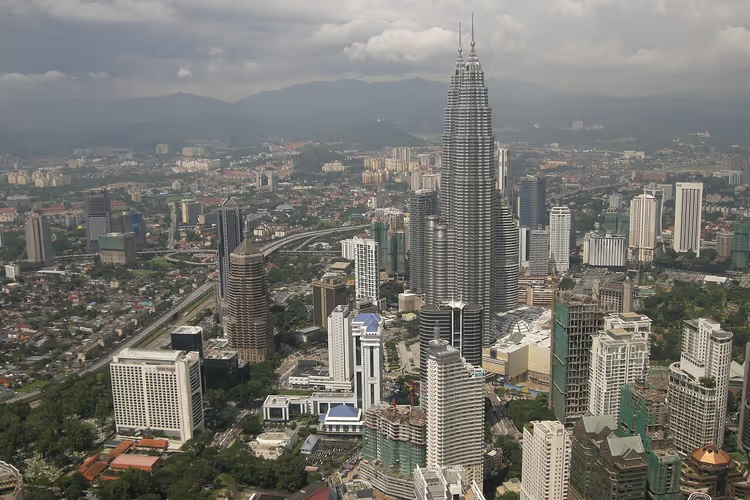
Petrosains occupies the 4th and 5th floors of the towers, with the entrance from the Suria KLCC shopping center. The museum was created at the initiative of an oil company, so the theme of oil remains one of the main ones. You'll see equipment for extraction and refining, alongside interactive exhibits on physics and chemistry.
 © Vyacheslav Argenberg · CC BYPhoto: Vyacheslav Argenberg, CC BY (https://creativecommons.org/licenses/by/4.0), Wikimedia Commons
The visit starts with a ride in a small car shaped like a drop of oil. After that come an earthquake zone, a Formula I simulator, and a wall with real nails that you can lie on. A separate section is dedicated to a prehistoric forest with dinosaurs among ferns.
The cinema shows science films in 3D. The museum is considered one of the largest science museums in the region, so it's interesting for both schoolchildren and adults (as of 09/2026, museum in Suria KLCC).
- How to get there: same complex as the Petronas Towers, entrance from the 4th floor of Suria KLCC.
- Entry: paid, check the website for slots and prices (as of 09/2026, source).
- Who it's for: families with children and anyone interested in interactive science.
KLCC Park
 © Marcin Konsek · CC BY-SAPhoto: Marcin Konsek, CC BY-SA (https://creativecommons.org/licenses/by-sa/4.0), Wikimedia Commons
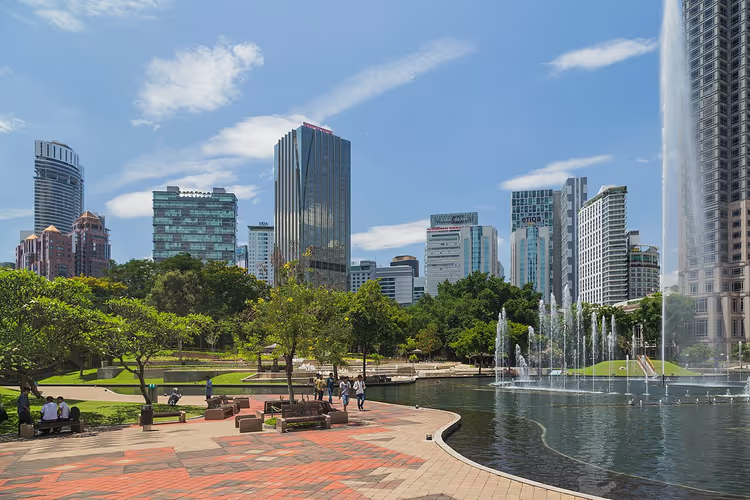
KLCC Park was laid out right beneath the towers, so it fits easily into your route. Rare tropical trees line the paths, and at the center there is a man-made lake with a fountain about 42 m high (as of 09/2026, KLCC Park).
The park was built on the site of an old racecourse, and some of its mature trees were relocated and preserved. The place offers a sharp contrast: a highway roars on one side, while deeper along the paths you find yourself in a quiet tropical garden. There are plenty of benches here, so this is the easiest place to rest between viewpoints.
There is also a free outdoor children's pool and a playground with slides. Adults will find the jogging track and shaded paths more interesting, as they offer the best low-angle view of the towers.
In the evenings, a musical fountain show takes place by the lake. Arrive early to grab a spot near the water.
- Hours: the park is open all day, admission is free.
- Getting there: walk from KLCC LRT station, enter from Jalan Kia Peng.
- Who it's for: those who want to rest in the shade between viewpoints.
- The catch: during the day the open lawns have little shade; only the area near the lake helps.
Aquaria KLCC
 © Phalinn Ooi from Kuala Lumpur, Malaysia · CC BYPhoto: Phalinn Ooi from Kuala Lumpur, Malaysia, CC BY (https://creativecommons.org/licenses/by/2.0), Wikimedia Commons
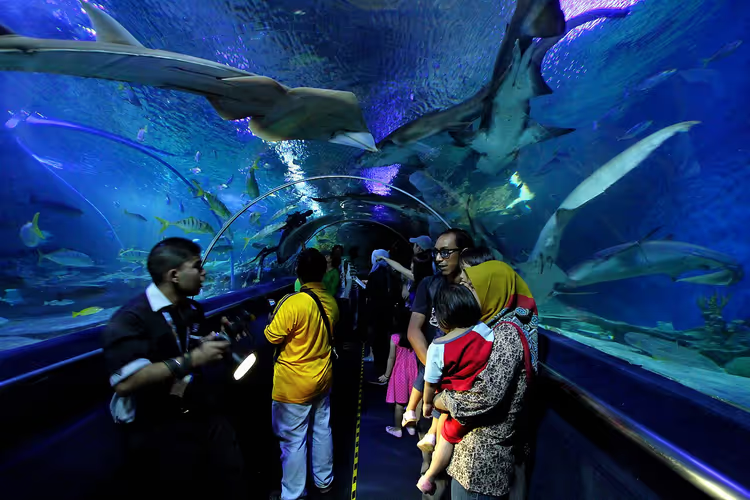
Aquaria KLCC is located in the basement of the KLCC convention center, a short walk from the towers. It houses about 5,000 marine and land creatures, and the exhibition spans 15 zones across 60,000 sq ft (as of 09/2026, Aquaria tickets).
The most impressive feature is the 90-meter underwater tunnel (as of 09/2026, aquarium tickets). Tiger sharks, turtles, and rays swim above the glass. Divers feed the fish on a schedule, and that is the best time for photos.
In the touch pool, you can touch starfish and crabs. The route starts with jungles and mangrove forests, then leads through a reef to the open ocean.
- Getting there: walk from KLCC LRT station, enter from the Concourse level of the convention center.
- Tickets: buy online, entry is timed (as of 09/2026, source).
- Who it's for: families with children and fans of the underwater world.
- The catch: groups gather at the tunnel; it is quietest right after opening.
KL Forest Eco Park in the city center
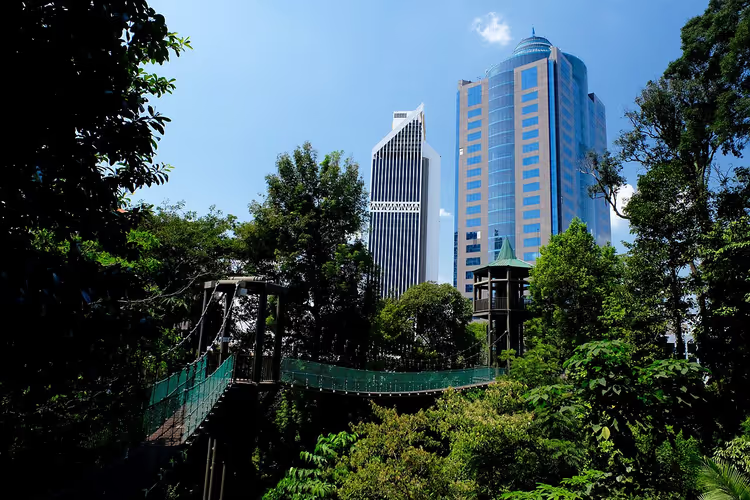 © RivieraBarnes · CC BY-SAPhoto: RivieraBarnes, CC BY-SA (https://creativecommons.org/licenses/by-sa/4.0), Wikimedia Commons
KL Forest Eco Park preserves a piece of real jungle right among the skyscrapers. Trails lead through dense growth, with suspension bridges and rope walkways stretched overhead. Rare plants are labeled with name tags.
The park was created to show the value of the tropical forest, which has been displaced by palm plantations in the country. Orchids and vines that are almost impossible to find in the city grow here. The park is managed by the country's forestry service (as of 09/2026, Bukit Nanas reserve).
The canopy walkway offers a rare shot: green forest and glass towers in one frame. Go in the morning, before it gets hot and while there are fewer people.
- Getting there: walk from KLCC LRT station, enter from Jalan Raja Chulan.
- Admission: free, the walkway is open during forestry service working hours.
- Who it's for: those who want jungle without leaving the city.
- The catch: some of the suspension walkways are periodically closed for repairs.
Menara Tower and observation decks
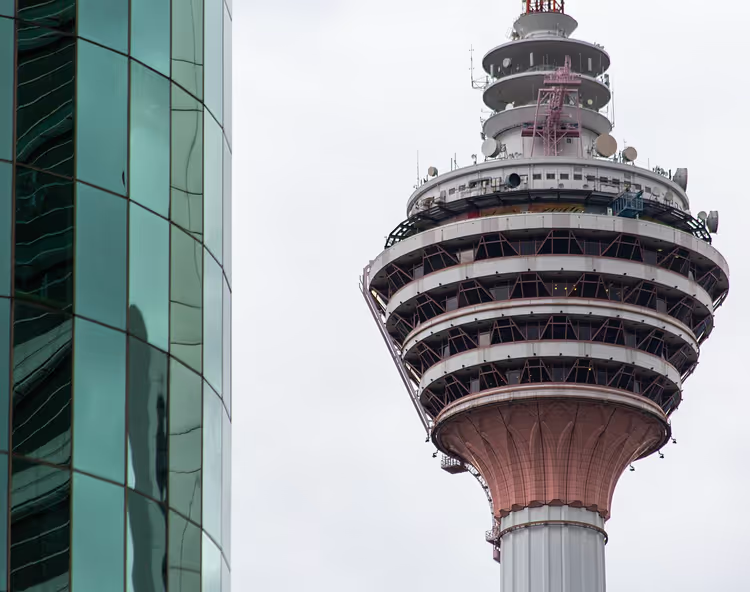 © Shesmax · CC BY-SAPhoto: Shesmax, CC BY-SA (https://creativecommons.org/licenses/by-sa/4.0), Wikimedia Commons
Menara Tower stands on a hill, which is why it dominates the city. The structure reaches 421 m in height and was built in 1996 (as of 09/2026, official website). Fast elevators take you to the top, and the walking part of the route remains only for athletic climbs.
Closed and open observation decks with 360-degree views operate on different levels. From them you can see the whole city and the Petronas Towers in the distance. For the best shots, go up around sunset.
Another feature of the tower is the Sky Box: two glass cubes with transparent floors. Walking on glass at height adds an adrenaline rush.
You can grab a bite at the revolving restaurant Atmosphere 360, which makes a full rotation every hour. The observation deck at 276 m is open to visitors throughout the day (as of 09/2026, KL Tower website).
- Getting there: Bukit Nanas monorail station or Dang Wangi LRT station, then a free shuttle from the foot of the hill.
- Cost: buy your observation deck ticket online (as of 09/2026, source).
- Who it's for: those who want more than one observation deck and are looking for shots from different angles.
- The catch: the Sky Box requires signing a health waiver, and the open deck closes when it rains.
Merdeka Square
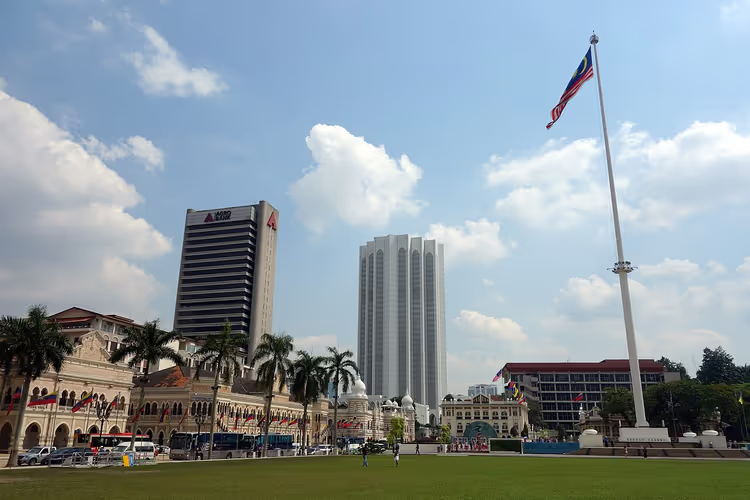 © Haakon S. Krohn · CC BY-SAPhoto: Haakon S. Krohn, CC BY-SA (https://creativecommons.org/licenses/by-sa/3.0), Wikimedia Commons
Merdeka Square, or Independence Square, is the site of parades and national holidays. On August 31, 1957, the flag of independent Malaya was raised here for the first time, and the country's main parade has been held here ever since (as of 09/2026, Merdeka).
The edge of the square is lined with colonial-era buildings in the Moorish style designed by architect A. C. Norman. You'll recognize them by their long arched galleries. The ensemble includes the City Council complex, the General Post Office building, and the Department of Information.
Behind them you can see the Royal Selangor Club building, and nearby stands the Sultan Abdul Samad Building with its 40-meter tower and gilded dome. It used to house the Supreme Court, but the court is no longer there. Photos on the square are taken at the large "I Love KL" letters.
- Hours: the square is open 24 hours, admission is free.
- Getting there: LRT Masjid Jamek station, then a five-minute walk.
- Who it's for: those interested in history and colonial architecture.
- The catch: at midday the lawn is scorching hot, so it's better to plan your visit for morning or evening.
Masjid Jamek at the confluence of the rivers
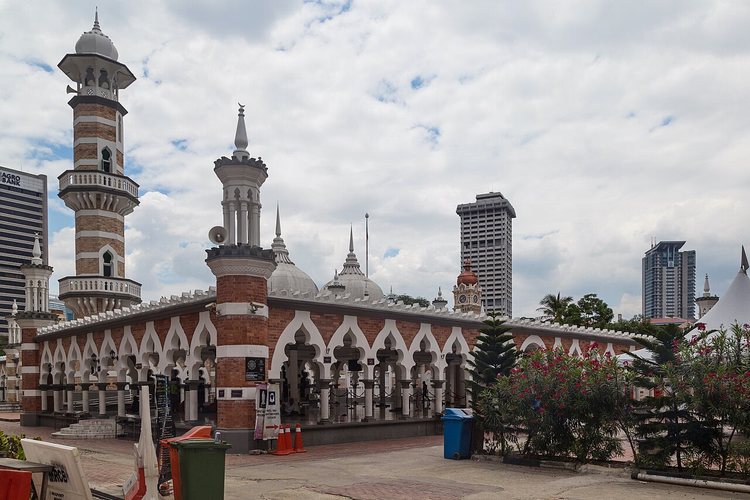 © Marcin Konsek · CC BY-SAPhoto: Marcin Konsek, CC BY-SA (https://creativecommons.org/licenses/by-sa/4.0), Wikimedia Commons
Masjid Jamek stands where the Gombak and Klang rivers meet, next to the city's founding point. It is the capital's oldest mosque, built to a design by English architect Hubbock (as of 09/2026, Masjid Jamek).
The building is done in the Moorish style and resembles the Mughal mosques of North India. You'll see red-and-white facades, three onion-shaped domes, arcades, and two minarets. The most recent restoration was carried out in 2018.
The graves of prominent national figures are not here but at the Masjid Negara mosque. Women are given a hooded cloak to enter, and men a robe if needed. After your visit, walk along Jalan Tuanku Abdul Rahman, where the most beautiful 20th-century buildings stand.
- Getting there: LRT Masjid Jamek station, the mosque is visible right from the exit.
- Admission: free, outside prayer times (as of 09/2026, source).
- Who it's for: those who want to see the city's oldest mosque.
- The catch: on Friday afternoons the mosque is closed for prayer, and in the heat there is almost no shade in the courtyard.
Kuala lumpur bird park
The Bird Park opens the green part of the route, away from the skyscrapers. It has four zones, and in the first two the birds fly freely under netting. The aviaries replicate natural habitats, so the birds behave calmly.
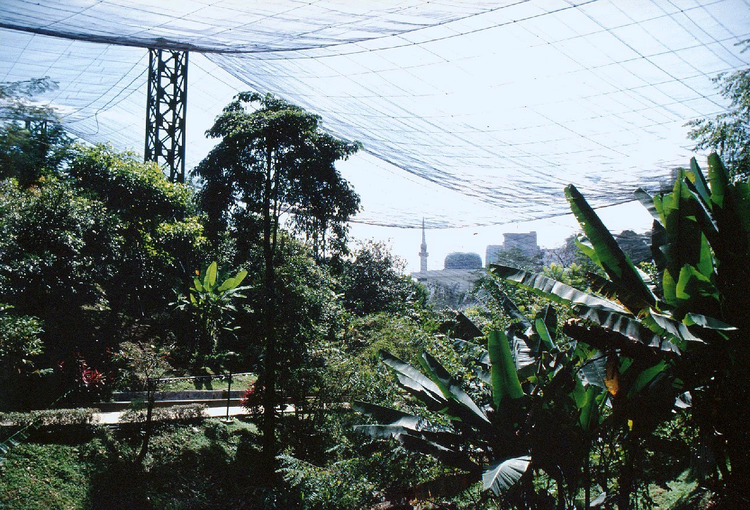
You'll see ostriches, crested eagles, rare ducks, pink flamingos, and owls. A separate zone is dedicated to hornbills, and birds of prey have their own cages. In total, the park houses about 2,000 birds (as of 09/2026, official website).
The park is one of the world's largest open-air aviaries. On a guided tour you'll peek into the incubator and catch a feeding show. The parrots are so used to people that they readily interact with visitors.
- Getting there: taxi to the gate on Jalan Cenderawasih.
- Tickets: buy at the entrance or online (as of 09/2026, source).
- Who it's for: families with children and bird lovers.
- The catch: a significant part of the route is outdoors, so walking in a downpour is inconvenient.
Butterfly park and insect museum
 © Gryffindor · CC BY-SAPhoto: Gryffindor, CC BY-SA (https://creativecommons.org/licenses/by-sa/3.0), Wikimedia Commons
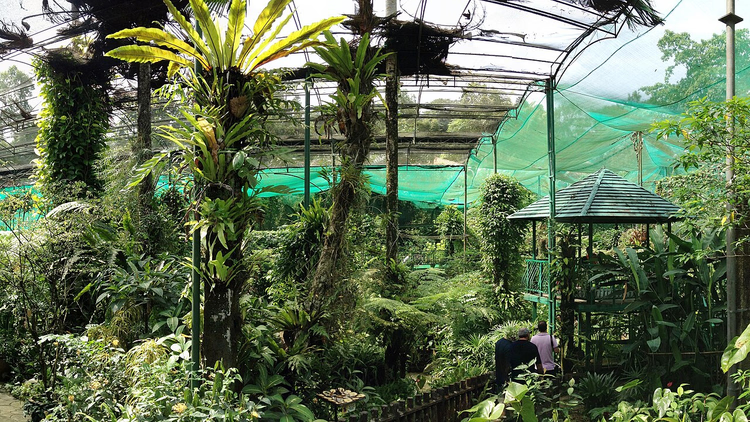
The Butterfly Park looks like an overgrown tropical garden under netting. It is home to over 6,000 butterflies, with nearly 15,000 plants grown for them (as of 09/2026, butterfly park). Among the greenery there are tables with treats made of fruit and flowers.
Many species are used to visitors and are not afraid of people. Sometimes butterflies land right on your hands. Near the netting and along the paths you can see rare species up close.
The Insect Museum operates on the grounds. In addition to butterflies from around the world, it displays dragonflies, stick insects, and mantises. The nursery introduces you to the transformation of a chrysalis into a butterfly, and morning is the best time for this.
- Getting there: walk from the bird park, the butterfly park is right next to it.
- Tickets: sold at the entrance (as of 09/2026, source).
- Who it's for: anyone who wants to see tropical butterflies up close.
- The catch: in the heat the butterflies hide, so come in the morning to see them active.
Perdana Botanical Garden
 © Renek78 · CC BY-SAPhoto: Renek78, CC BY-SA (https://creativecommons.org/licenses/by-sa/4.0), Wikimedia Commons
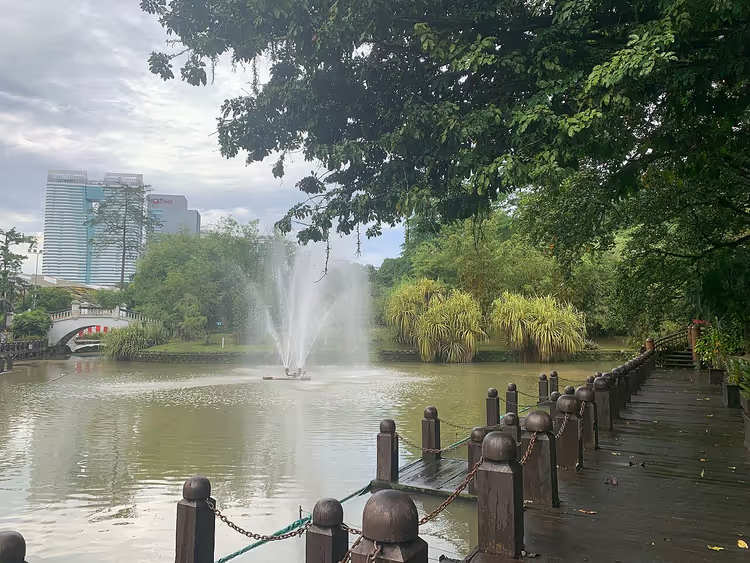
Perdana Botanical Garden opened in 1888, but the Penang Botanical Garden is older (as of 09/2026, Botanical Garden). It used to be called the Lake Gardens. Paths run over the hills toward a large lake surrounded by greenery.
Along the way you'll find a sausage tree, a rainbow eucalyptus, an umbrella palm, and a baobab. Separate sections are devoted to heliconias, gingers, and a collection of cycads. Cacti and ferns are housed under glass roofs.
There is also a garden of medicinal herbs and spices, and small shelters built into the trees where you can hide from a downpour. Admission is free, and the paths are lit in the evening. It's an easy walk from the bird park or a ride on the tourist bus.
- Hours: the garden is open from morning to evening, admission is free.
- Getting there: KTM Bank Negara station or a taxi to the main gate.
- Who it's for: anyone who wants quiet greenery away from the skyscrapers.
- The catch: the grounds are large, and without a plan you'll spend over an hour just walking between areas.
Sri Mahamariamman Temple
 © *angys* · CC BY-SAPhoto: *angys*, CC BY-SA (https://creativecommons.org/licenses/by-sa/4.0), Wikimedia Commons
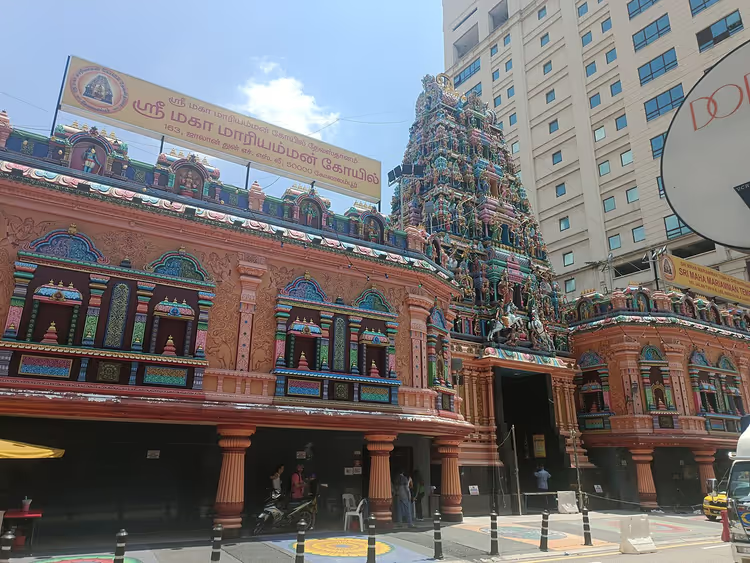
Sri Mahamariamman Temple is the city's oldest Hindu temple. It was built by immigrants from southern India in 1873 as a family shrine (as of 09/2026, Sri Mahamariamman Temple). The temple later became a public place of worship and remains the richest among Hindu temples in Malaysia.
The facade is decorated with 228 sculptures of gods, and a multi-tiered gopuram rises above the entrance. The figures were finished with precious stones and gold. The temple is dedicated to the goddess Mariamman, who is regarded as a protector against illness and epidemics.
Inside you'll see frescoes and a statue of the goddess in a separate pavilion. The building's layout mirrors the human body: the head faces west, the feet face east. The inner sanctum is closed to outsiders, but the courtyards and facade are open for viewing.
- Getting there: between Jalan Tun H. S. Lee and Jalan Bandar, five minutes from Masjid Jamek LRT station.
- Admission: free, shoes are removed at the entrance (as of 09/2026, source).
- Who it's for: anyone interested in Hindu architecture.
- The catch: photography is prohibited inside, and during festivals the temple is packed.
Petaling Street in Chinatown
 © Goosmurft · CC BY-SAPhoto: Goosmurft, CC BY-SA (https://creativecommons.org/licenses/by-sa/2.0), Wikimedia Commons
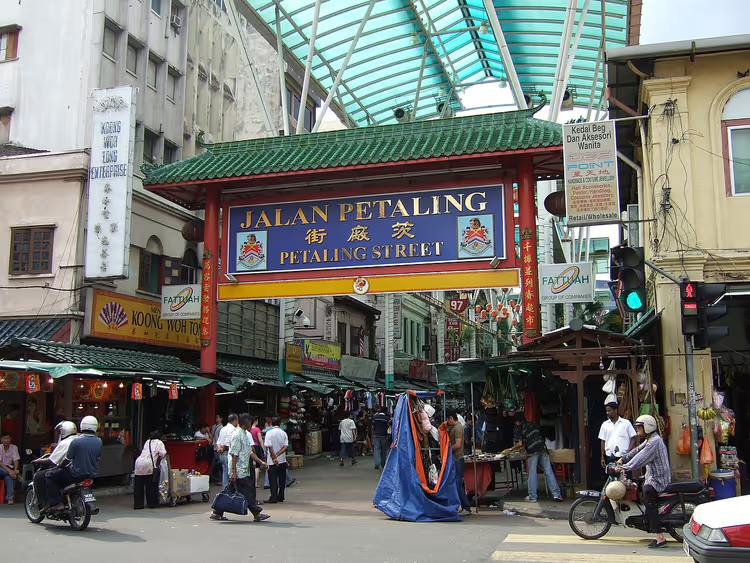
Petaling Street is a pedestrian market in the very heart of Chinatown. In 2003 it was covered with a transparent roof and turned into a long shopping arcade (as of 09/2026, Petaling). Bright Chinese-style arches mark the entrances.
The rows of stalls start right at the first step. Here you can buy fruit and spices, feng shui items, clothing, tea, and souvenirs. Massage and fortune-telling booths operate nearby, and small kitchens smoke between the stalls.
Cafes and tea houses brew herbal tea according to old recipes. There's no loud music or bars here, but toward the end of the street stands Chan She Shu Yuen Temple, clad in glazed ceramics. Its open courtyards with pavilions are also open for viewing.
- Getting there: Pasar Seni LRT station or Pasar Seni MRT station, then a two-minute walk.
- Hours: the market runs from morning until late evening, street stalls stay open longer (as of 09/2026, source).
- Who it's for: anyone looking for inexpensive souvenirs and local food.
- The catch: there are many pushy vendors at the stalls, and prices are inflated for tourists.
Bukit Bintang district for shopping
 © Will Simmonds from Kuala Lumpur, Malaysia, China · CC BYPhoto: Will Simmonds from Kuala Lumpur, Malaysia, China, CC BY (https://creativecommons.org/licenses/by/2.0), Wikimedia Commons
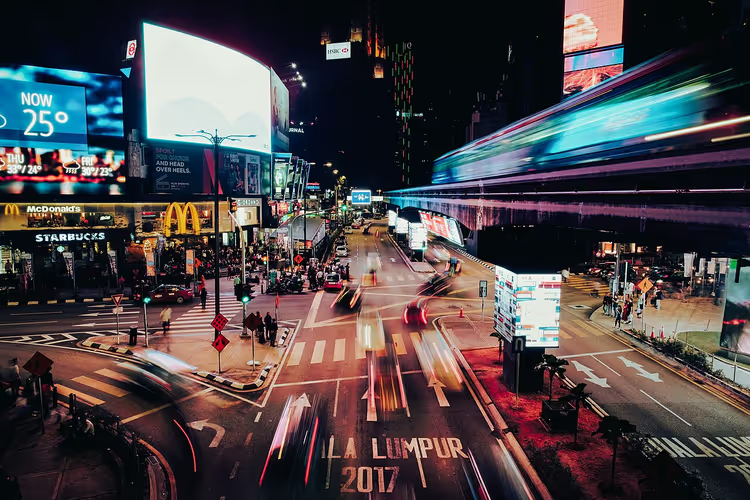
Bukit Bintang is the city's main shopping district. It is bounded by three streets: Jalan Sultan Ismail, Jalan Imbi, and Jalan Bukit Bintang (as of 09/2026, Bukit Bintang). The pedestrian "Arab Street" with cafes and restaurants also runs through here.
The district is home to major shopping malls Pavilion, Berjaya Times Square, and Sungai Wang Plaza. Each has between 200 and 700 stores with global brands. Nearby there is a concentration of massage and reflexology salons that operate around the clock.
The district also has an indoor amusement park with roller coasters and a loop-the-loop. The district is easy to combine with the night market. It's best to get here by metro or bus, as parking is hard to find.
- How to get there: Bukit Bintang monorail station and Bukit Bintang MRT station.
- Hotels: the area is convenient for overnight stays, with rooms ranging from budget to five-star (as of 09/2026, hotels in Kuala Lumpur on Trip.com).
- Who it's for: those who want to combine shopping, food, and evening entertainment.
- The catch: the district is noisy and crowded in the evenings, so look for quiet rooms away from the main street.
Batu Caves and the Murugan statue
 © Shesmax · CC BY-SAPhoto: Shesmax, CC BY-SA (https://creativecommons.org/licenses/by-sa/4.0), Wikimedia Commons
Batu Caves are located 13 km from the center, by the Batu River (as of 09/2026, Batu Caves). The limestone here is about 400 million years old. The site is known as a Hindu shrine and as the venue for the Thaipusam festival, which has been held here since 1892.
A giant statue of the god Murugan, 43 m tall, stands in front of the entrance. A staircase of 272 steps leads to the main Temple Cave (as of 09/2026, description of Batu Caves). The climb takes about 15 minutes and is worth it for the view of the city from the cave.
The complex has four limestone caves in total. The Temple Cave is the most accessible, while in the Ramayana Cave the walls are covered with paintings from the life of the ancient king. The Dark Cave extends two kilometers deep, and tours there are guided.
The easiest way to get there is by KTM Komuter train (as of 09/2026, KTM Komuter). The journey takes about 35 minutes, and the terminal station is right opposite the entrance. An alternative is a taxi or Grab, but the train is more reliable during rush hour.
- How to get there: KTM Seremban line from KL Sentral to Batu Caves station.
- Cost: train 2.60 RM one way (as of 09/2026, source).
- Who it's for: those willing to climb 272 steps for a cave temple.
- The catch: the climb is long and exposed to the sun, so bring water and arrive at opening time.
Tours and tickets in Kuala Lumpur
Guided tours, skip-the-line tickets and activities — most offers can be cancelled free of charge.
See offers on GetYourGuideThe widget loads once you give your consent.
⁉️🤔 Frequently asked questions
What can you see in Kuala Lumpur in one day?
The city center is compact, so in one day you can cover the Petronas Towers, KLCC Park, the aquarium, Menara Tower, and Merdeka Square. You can't cover all 15 places in one day, and Batu Caves with travel and the climb will take several hours. Plan an early start, otherwise you'll have to cut evening stops.
What to see in Kuala Lumpur for free?
KLCC Park, the forest eco-park, and Perdana Botanical Garden remain free. You can also enter Merdeka Square and Masjid Jamek Mosque freely. Only the observation decks, the aquarium, and the bird and butterfly parks charge admission.
How do you get to Batu Caves without a tour?
Take the KTM Komuter train from KL Sentral station on the Seremban line. The ticket costs 2.60 RM, the train takes about 35 minutes, and the terminal station is opposite the cave entrance. You climb the 272-step staircase on your own, and no ticket is needed to enter the grounds.
Is it worth going up both observation decks?
Both observation decks give you different angles. From the Petronas Towers you look along the center, while from Menara Tower you can see the towers themselves and the whole city. If time is limited, choose one, but Menara's open deck closes in the rain, so book a slot with some buffer.
Where to eat in central Kuala Lumpur?
Affordable food is concentrated around Petaling Street and Chinatown, where tea houses and small kitchens operate. For a city view, the revolving restaurant Atmosphere 360 in the Menara Tower is a good choice. In the Bukit Bintang area, the selection is wider, but prices are higher.
One-day Kuala Lumpur route on the map
It's convenient to plan the whole day using the map below. The points run clockwise from the Petronas Towers so you backtrack less. Between central sights, you walk or take one or two metro stops.
Part of the day | What to see | Tickets in advance | Transport |
|---|---|---|---|
Morning | Petronas Towers, KLCC Park, Petrosains | observation deck by time slot | on foot |
Day | Aquaria KLCC, forest eco-park, Menara Tower | aquarium and tower online | on foot and metro |
After lunch | Bird Park, Butterfly Park, Perdana Botanical Garden | at the entrance | taxi, then on foot |
Evening | Merdeka, Masjid Jamek, Sri Mahamariamman Temple, Petaling, Bukit Bintang | not needed | on foot |
Separately | Batu Caves | KTM ticket at the station | train from KL Sentral |
The easiest way to get from the airport is with a pre-booked transfer, especially if you arrive in the evening with luggage.
What to see in Kuala Lumpur in 1 day
Places on the map
- 1Petronas Towers The world's tallest twin towers, with the Skybridge
- 2Petrosains Museum Interactive science museum about oil and physics
- 3KLCC Park Tropical garden with a lake and a 42-metre fountain
- 4Aquaria KLCC 90-metre underwater tunnel with sharks
- 5KL Forest Eco Park A patch of jungle with suspension bridges among skyscrapers
- 6Menara KL Tower Observation decks and the glass Sky Box at height
- 7Merdeka Square Site of parades, colonial architecture in Moorish style
- 8Masjid Jamek Mosque The city's oldest mosque at the confluence of two rivers
- 9KL Bird Park About 2,000 birds in the world's largest open-air aviary
- 10Butterfly Park Over 6,000 butterflies and an insect museum
- 11Perdana Botanical Garden The country's oldest botanical garden, since 1888
- 12Sri Mahamariamman Temple The oldest Hindu temple with 228 statues of deities
- 13Petaling Street Chinatown's covered pedestrian market
- 14Bukit Bintang Main shopping district with large malls
- 15Batu Caves Statue of Murugan and a staircase of 272 steps
In short: what's worth booking
In one day, you cover the center on foot and head to the Batu Caves by train. If you're short on time, keep the Petronas Towers, the aquarium, and the Menara Tower in your plan. For a family trip, the Bird Park and Butterfly Park work well, and the evening is best spent at Merdeka Square.
- If it's your first time in the city: start with the Petronas Towers observation deck.
- If you're traveling with kids: add Aquaria KLCC and the Bird Park.
- If you want nature: head to the forest eco-park and the Batu Caves.
Observation deck slots get booked up in advance, so reserve before your trip: see Kuala Lumpur hotels on Trip.com, tickets and tours on GetYourGuide, and airport transfer.

A small editorial team writing guides for independent travel. We travel ourselves, but we haven’t been everywhere, so we check prices, opening hours and how to get there against official sources.