
















Czechia by car: 17 places from Prague to Brno and the Moravian Karst
Czechia is a compact country with a dense map of sights. By car, you can fit Prague, the spa colonnades, and a dozen castles into a single vacation. A train or bus won't give you that kind of freedom. We've put together 17 places that are genuinely worth a stop and laid them out in a route from Prague to Brno. Below you'll find distances, opening hours, and the honest catch of each spot.
Ad: this article contains affiliate links, we earn a commission if you book through them, at no extra cost to you.
How to plan a driving route through Czechia
💡 In short:
- Western loop: Prague, Karlovy Vary, Loket, and Marianske Lazne. These take two to three days.
- South and Moravia: Cesky Krumlov, Hluboka, Brno, and the Moravian Karst. That's another three to four days behind the wheel.
- Prices and opening hours: 09/2026, verified on the official Prague Castle website
Czechia doesn't require heroic drives. Most cities here are 100-200 km apart, meaning one to two hours on the road. You leave in the morning and by lunch you're already parking at a castle. Historic centers are compact, and you can walk them in half a day.
The road network is dense. The D1 and D5 highways connect Prague with Brno and Plzen, while secondary roads lead straight to small castles and spa towns. Only expressway sections are tolled, so buy an electronic vignette before you set off. The fine for driving on a motorway without a vignette is issued on the spot.
Plan a loop, not an out-and-back. Start in Prague, then head west to Karlovy Vary and Loket. After that, go south to Krumlov, and from there through Moravia to Brno. That way you don't rack up extra kilometers and don't retrace the same road.
Roads, parking, and car rental
If you don't have your own car, rent one. We recommend the Discover Cars rental service: it compares rental companies by price and terms, and shows the final cost before you book. Get a compact car, parking spots in old towns are narrow.
In Prague, leave your car on the outskirts near a metro station and take the tram into the center. In paid parking zones, finding a spot is hard even during the day, and the tow truck operates around the clock here. In small towns, parking lots near castles are marked with blue signs. Rates are moderate, and payment is usually by the hour, so keep change or a card handy.
Speed limits are standard for Europe: 50 km/h in town, 90 km/h outside town, 130 km/h on the motorway. Czechia has a zero-tolerance policy on alcohol. Don't drink at all before driving, the limit here is zero.
1. Prague
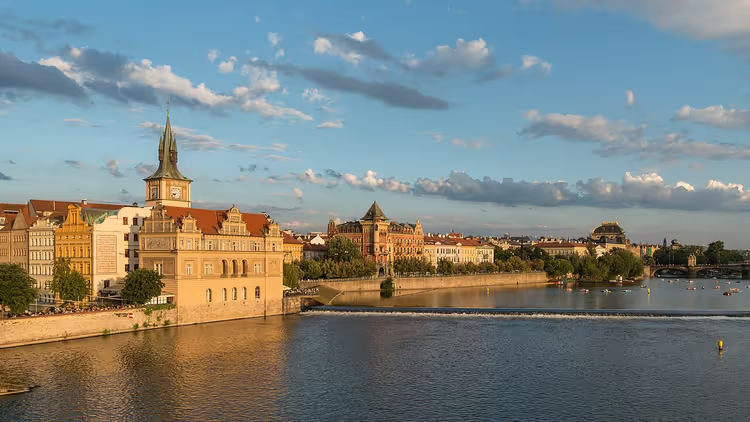 © DXR · CC BY-SAPhoto: DXR, CC BY-SA (https://creativecommons.org/licenses/by-sa/4.0), Wikimedia Commons
Prague is a convenient first city: trains and planes arrive here, and the loop starts here too. The center is compact, and you can walk it in a day. The main points: Old Town Square with the astronomical clock, Charles Bridge, and Prague Castle on the hill opposite.
On Old Town Square you'll hear the chimes of the astronomical clock. Nearby stand the Gothic Church of Our Lady before Tyn and the Baroque Church of St. Nicholas, while the Jan Hus monument marks the center of the square. Off to the side lies the Jewish Quarter with its synagogues and old cemetery.
Cross Charles Bridge early in the morning, by nine there's already a dense flow of people here. On the other bank, head up to Prague Castle. Entry to its grounds is free, and the courtyards are open daily from early morning until late evening (as of 09/2026, hrad.cz). St. Vitus Cathedral, Golden Lane, and the Old Royal Palace are part of the paid "main route," and the ticket is valid for two days.
- Getting there: 40 minutes from the airport by bus 119 and metro, 15 minutes on foot from the train station.
- Cost: museum tickets in the low double digits in euros, check opening hours on the website.
- Who it's for: first-time visitors to Czechia who want to see the capital without rushing.
- The catch: in July and August the center is packed, get there at opening time.
- Guided tours of Prague on GetYourGuide are a good option for your first day.
2. Karlovy Vary
Karlovy Vary is the country's most famous spa town. People come here for mineral water treatment, but the town is beautiful even without it. The spa area stretches along the Teplá River, and all the main sights are within walking distance.
The main landmark is the Vřídelní kolonáda colonnade. Under its glass roof, the Vřídlo geyser shoots up to 12 meters high, and the water temperature stays around 72 °C (as of 09/2026, karlovyvary.cz). A spa cup is inexpensive, and you can taste water from different springs.
Climb the Diana Tower on foot or by funicular. The top offers the best viewpoint in town. Also check out the Dvořák Gardens, the Church of St. Mary Magdalene, and the plague column on the square. Kids usually love the Butterfly Garden.
- Getting there: 130 km from Prague via the D6, about 1 hour 50 minutes by car (according to the map).
- Cost: entry to the colonnades is free, you only pay for the tower ride.
- Who it's for: those who enjoy a relaxed spa-town pace and walks by the water.
- The catch: in season there is always a crowd at the geyser, get there when the colonnade opens.
3. Loket Castle
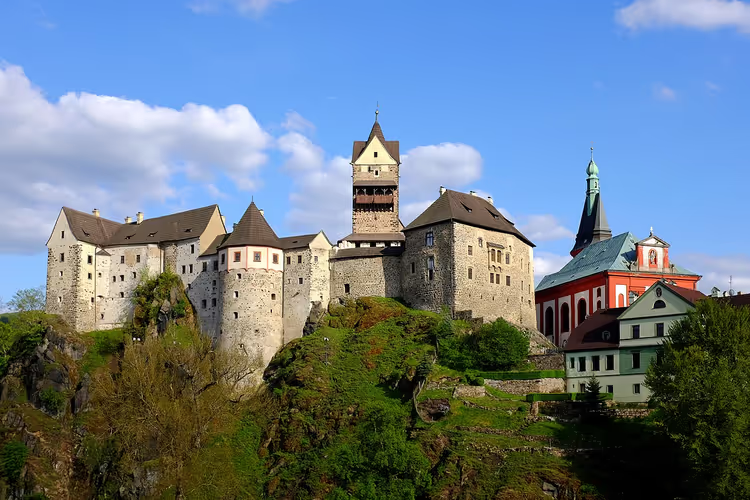 © Lubor Ferenc · CC BY-SAPhoto: Lubor Ferenc, CC BY-SA (https://creativecommons.org/licenses/by-sa/4.0), Wikimedia Commons
Loket was founded in the early 12th century, and the name comes from the word "elbow." The bend of the Ohře River here really does resemble a bent arm. It started as a Romanesque fortress, then was rebuilt into a Gothic castle.
The fortress protected a trade route and later became an administrative center. Charles IV was fond of it, and legend credits him with discovering a mineral spring in the area. During the Hussite Wars, Loket was never taken, and for a time it was considered impregnable.
In the 18th century it was turned into a prison, and only in the 1990s did the castle become a museum. Today you can see the margrave's house, prison cells, a torture chamber, and a weapons collection. The Romanesque tower offers a great view. The castle is closed on Mondays, check dates on the official website.
- Getting there: 15 km from Karlovy Vary, about 20 minutes by car.
- Cost: adult admission in the low range, family tickets are cheaper.
- Who it's for: families with kids, there are cells, towers, and a dragon.
- The catch: steep climb from the parking lot, slippery in winter.
4. Mariánské Lázně
 © LenkaSvasek · CC BY-SAPhoto: LenkaSvasek, CC BY-SA (https://creativecommons.org/licenses/by-sa/4.0), Wikimedia Commons
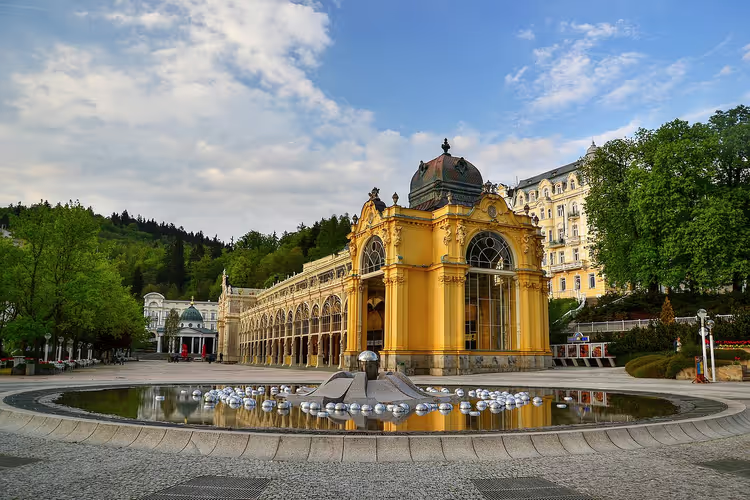
Around Mariánské Lázně, 140 mineral springs rise from the ground, and some of them are used for treatment. Which one tastes best is up to you: try water from several and compare. Each spring has its own composition and its own story.
Among the sights, check out the historic buildings, the Singing Fountain, Kynžvart Castle with its collection of ancient literature, and the local history museum. The Boheminium miniature park features famous Czech landmarks in reduced scale. Teplá Monastery is nearby.
- Getting there: 50 km from Karlovy Vary, about an hour on secondary roads.
- Cost: walks in the spa area are free, museums and the park charge admission.
- Who it's for: those who want to combine treatment with leisurely walks.
- The catch: the town is quiet, almost everything closes in the evening.
5. Plzeň
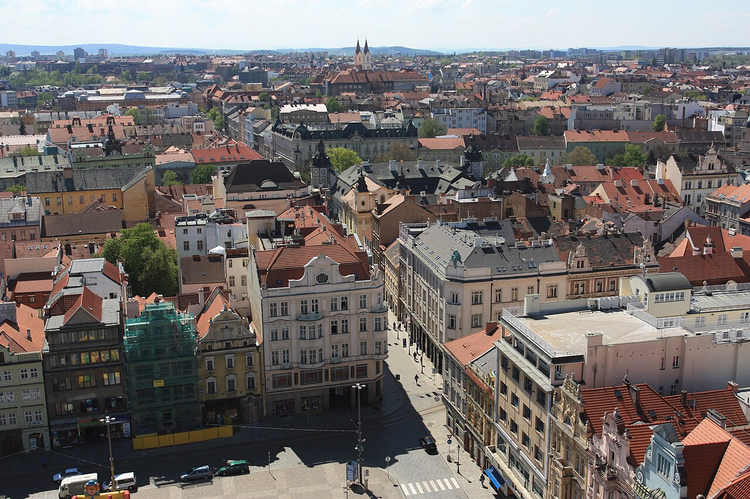
Plzeň was founded in the late 13th century and quickly became a major trading center. The first Czech book, the Trojan Chronicle, was printed here, and for about a year the city even served as the capital. Today it is also the capital of Czech beer.
 © Евгений Благодарный · CC BY-SAPhoto: Евгений Благодарный, CC BY-SA (https://creativecommons.org/licenses/by-sa/2.5), Wikimedia Commons
The main landmark is the Cathedral of St. Bartholomew on the central square, built in the 13th century. A network of tunnels and cellars runs beneath the city, and they helped residents through troubled times. Stop by the Brewery Museum, the Art Gallery, and the synagogue; festivals take place here in summer.
- Getting there: 90 km from Prague via the D5, about an hour's drive.
- Cost: a Brewery Museum ticket is in the low range, tasting included.
- Who it's for: those interested in beer history and underground spaces.
- The catch: the center is lively, but it empties out early in the evening.
6. Cesky Krumlov
 © Xth-Floor · CC BY-SAPhoto: Xth-Floor, CC BY-SA (https://creativecommons.org/licenses/by-sa/4.0), Wikimedia Commons
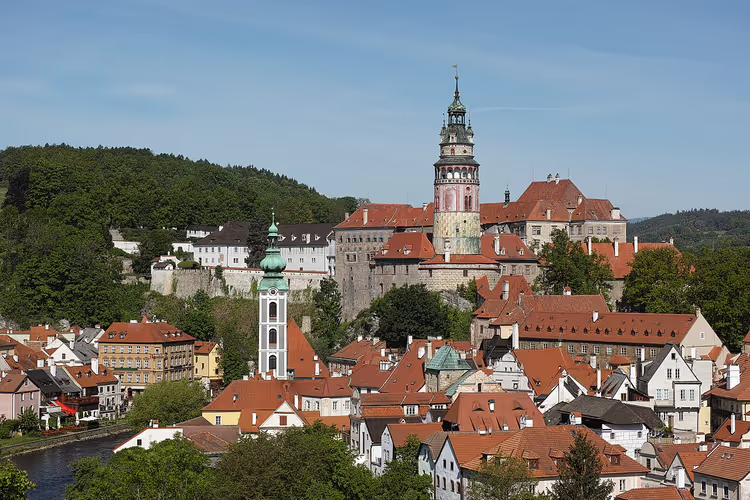
It's convenient to drive straight from Plzen to Krumlov, the trip takes no more than a couple of hours. The town sits on the Vltava River, and its name means "crooked meadow." That's the shape of the peninsula it grew up on.
More than three hundred old buildings survive here. You can walk the small town in one day, but if you also want to see Hluboka Castle, stay overnight. Krumlov was founded in the 13th century, and its patronage of the arts left behind a wealth of Gothic and Renaissance monuments.
The Five-Petaled Rose Festival takes place in June, and you can also catch the Jazz Festival. See the town hall, the plague column on Concord Square, and the Church of St. Vitus. Krumlov Castle operates seasonally; check hours and tours on the official website.
- Getting there: 150 km from Plzen, about 2 hours on secondary roads.
- Cost: entry to the castle courtyard is free, interior tours are paid.
- Who it's for: those looking for the atmosphere of an entire historic town.
- The catch: in summer the narrow streets are packed, park at P1.
7. Hluboka nad Vltavou Castle
 © Thomas Zimmermann ( THWZ ) · CC BY-SAPhoto: Thomas Zimmermann ( THWZ ), CC BY-SA (https://creativecommons.org/licenses/by-sa/3.0/de/deed.en), Wikimedia Commons
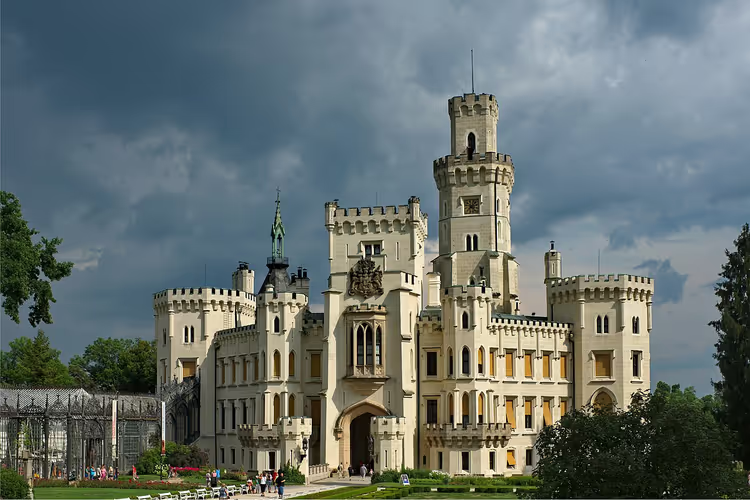
Hluboka is one of the most photogenic castles in the country. Nothing remains of the old 13th-century fortress, but the neo-Gothic version looks like something out of a fairy tale. The castle was set on a high hill, though it never actually had to defend itself.
For centuries Hluboka changed owners, and each new master rebuilt it. The Schwarzenbergs did the most. Johann Adolf II, an educated man, looked to English models and Windsor in particular.
After World War II the castle was nationalized, and restoration continues to this day. Tours go through the interior rooms, where you'll see collections of weapons and paintings, a huge library, and the kitchen. The tower offers a view of the park around the pond. We recommend booking a tour in advance, spots sell out quickly.
- Getting there: about 35 km from Krumlov, roughly 40 minutes by car.
- Cost: tickets by route, the family rate is a better deal.
- Who it's for: fans of palace interiors and parks.
- The catch: in high season you may not get in without a reservation, arrive at opening time.
8. Cervena Lhota Castle
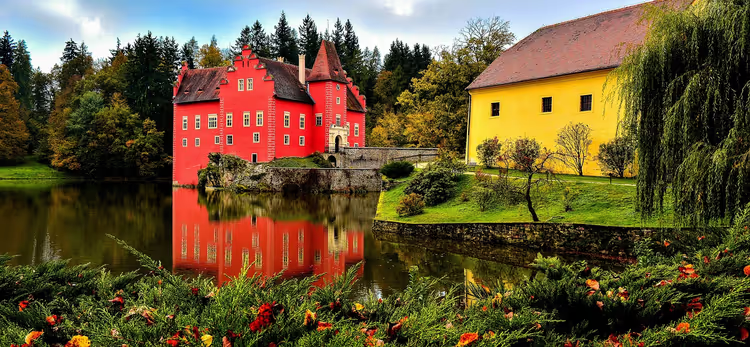
Cervena Lhota stands on a rocky island in the middle of a pond. "Cervena" means "red," and one of the owners had the walls painted that color. The nearby village was founded in the 13th century, and a fortress was later built for protection.
In the 16th century the land was bought by the knight Jan Koba, who replaced the citadel with a Renaissance castle. The architect raised the water level in the pond to reshape the surrounding landscape. In the late 16th century the owner became Vilem Rut, and it was under him that the castle was repainted red.
The building got its current neo-Gothic look in the mid-19th century under Heinrich Eduard of the Schonburg-Hartenstein family. Tours are in Czech, but you'll be given an audio guide. The visit takes about an hour, and you'll walk through the rooms and see the owners' furniture.
- Getting there: about 70 km from Krumlov.
- Cost: ticket with audio guide, a single rate applies across the entire site.
- Who it's for: those who want to see a castle on the water without the crowds.
- The catch: tours run less often than at Hluboka, check the schedule.
9. Jindrichuv Hradec
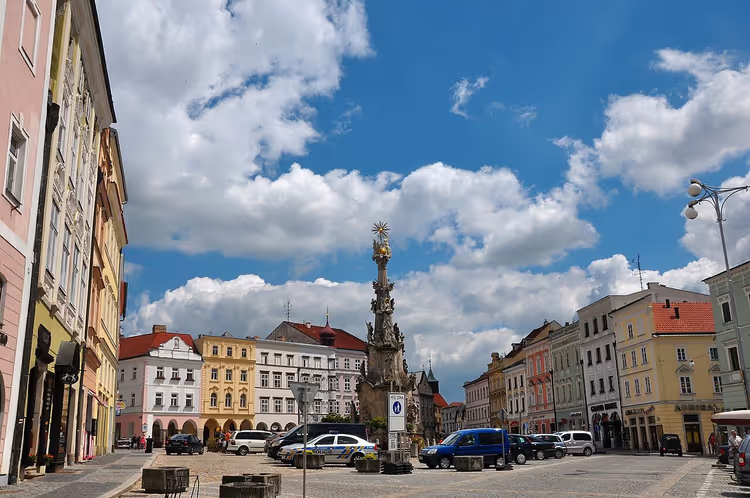 © Herbert Frank from Wien (Vienna), AT · CC BYPhoto: Herbert Frank from Wien (Vienna), AT, CC BY (https://creativecommons.org/licenses/by/2.0), Wikimedia Commons
This is a small town where a Slavic settlement with a Romanesque church stood in the 10th century. In the 12th century the place went to Jindrich Vitkovic. His four brothers received other towns, but they shared a coat of arms: a rose with five petals, one for each brother.
In the 13th century a Gothic castle was added to the fortress, and the Hussite Wars left the place untouched. The town flourished in the 16th century, when many Renaissance buildings appeared. Residents earned their living from trade and crafts, and sewing machines were also made here.
In the 17th century the castle belonged to Chancellor Vilem Slavata, under whom Hradec ranked second in Bohemia after Prague. Later the Czernin family owned it until nationalization in 1945. Today the castle is the town's main attraction.
On the tour you'll see rooms in different styles, state halls, a chapel, and paintings. The Black Tower and the Black Kitchen, the oldest structures, are of separate interest. At the Church of the Assumption of the Virgin Mary you can climb to an observation deck.
Many people come here for the narrow-gauge railway. The line has operated since the late 19th century, and both modern and heritage trains run on it. The town also has the Church of St. John the Baptist with Gothic frescoes and a Franciscan monastery.
Kids will enjoy the mechanical nativity scene. It's considered the largest in the world, with more than a thousand figures. A local craftsman made it in the 18th century and spent six decades on the work. The nativity scene is displayed in the town museum, which has other exhibits as well.
- Getting there: 130 km from Prague via the D1, about 1.5 hours.
- Cost: museums and the castle charge a modest fee, the narrow-gauge railway is paid separately.
- Who it's for: families and those who like small towns without tourists.
- The catch: getting there without a car is inconvenient, trains are infrequent.
10. Telc
 © xkomczax · CC BY-SAPhoto: xkomczax, CC BY-SA (https://creativecommons.org/licenses/by-sa/4.0), Wikimedia Commons
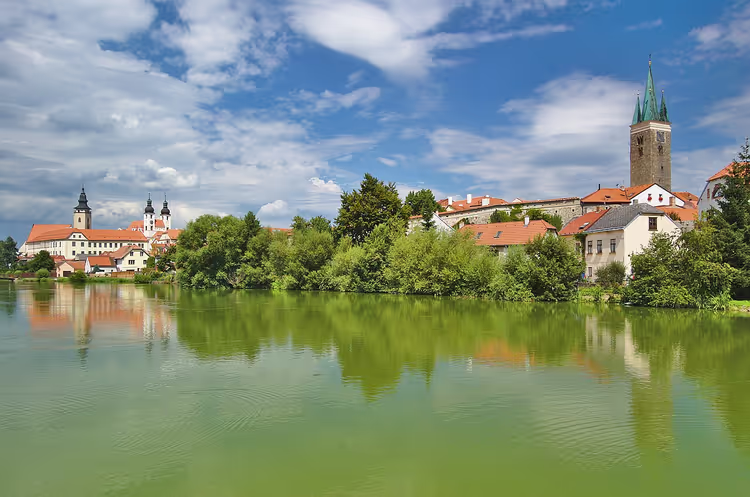
Telc looks like a postcard. Wooden houses once stood here, but they burned to the ground in a major fire. Since then the townspeople built in stone, and no two houses look alike.
Because of its artificial reservoirs and defensive canal, Telc is called the "Czech Venice." The main square is lined with buildings with stucco work and varied facades, each several centuries old. In the center of the square you'll see a plague column.
The main attraction is the old Renaissance castle. It's well preserved, with richly decorated halls, a picture gallery, and hunting trophies inside. Nearby stands the Chapel of All Saints, built by Italian architects, with Renaissance frescoes.
The oldest building in town is the Church of the Holy Spirit. The nearby Holy Trinity Tower has an observation deck with a view of the entire square. The town is small, and you can walk it in half a day.
- Getting there: 160 km from Prague, about 2 hours on secondary roads.
- Cost: the square is free to see, the castle and tower are paid.
- Who it's for: those who want to see a museum town without big crowds.
- The catch: parking is on the edges of the center, and in summer it fills up fast.
11. Kutna Hora
 © Laima Gūtmane (simka… · CC BY-SAPhoto: Laima Gūtmane (simka…, CC BY-SA (https://creativecommons.org/licenses/by-sa/3.0), Wikimedia Commons
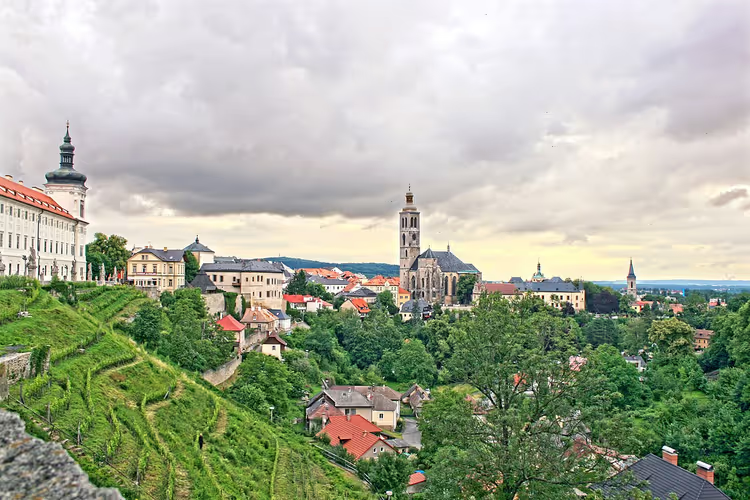
Kutna Hora grew up on silver. Deposits were found in the 13th century, and miners' settlements appeared near the mines. The current name means "old cowl": according to legend, a monk fell asleep on a hill and found silver where he had seen it in his dream.
Once mining got underway, people built not only homes but also taverns and shops. The settlements merged, and Kutna Hora became a royal town. The Cathedral of St. Barbara, the Church of St. James, the Jesuit college, and the old mint survive here.
Stop by the Silver Museum, which occupies an actual mine. It's easy to buy local souvenirs in town, and the central streets are lined with houses with Baroque and Gothic facades. In the evening the historic center is lit up.
- Getting there: 80 km from Prague via the D1, about an hour.
- Cost: a combined ticket covers the cathedral and church, the mine is paid separately.
- Who it's for: those interested in mining and Gothic architecture.
- The catch: the climb to the Cathedral of St. Barbara is long, and tough in the heat.
12. Český Šternberk
 © Evgeny L. · CC BY-SAPhoto: Evgeny L., CC BY-SA (https://creativecommons.org/licenses/by-sa/3.0), Wikimedia Commons
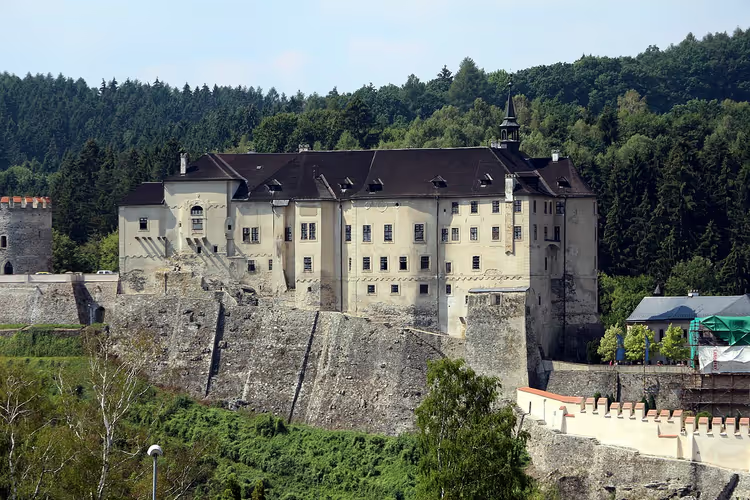
The castle's name consists of two words: "star" and "hill". The structure really does stand on a rock, and its former owners had a star on their coat of arms. A river flows below, and powerful walls and towers rise around it.
This terrain would have favored the defenders, so the castle was long considered impregnable. But during the Hussite Wars, Sternberk was still taken by the king's troops and looted. After that, additional fortifications were built here and the moat was deepened.
In the 18th century, the castle was partially rebuilt, gaining baroque features, stucco work and murals. The state rooms were decorated especially beautifully. A century later, the castle acquired romanticist features, and a park was laid out around it.
Today people come here on tours. You'll see paintings and engravings, collections of clocks and antique weapons. The furniture and tableware of the former owners deserve special attention.
- How to get there: 50 km from Prague via the D1, then 15 minutes on a local road.
- Cost: ticket per route, parking at the foot is free.
- Who it's for: those who want to see a castle above a river without a long queue.
- The catch: some rooms only open in season.
13. Sedlec Ossuary
 © Pedro Krtička · CC BYPhoto: Pedro Krtička, CC BY (https://creativecommons.org/licenses/by/3.0), Wikimedia Commons
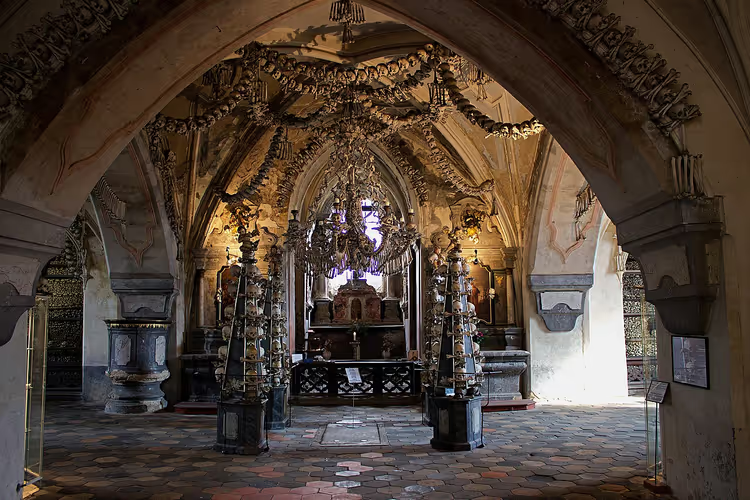
The ossuary in Sedlec is impossible to forget. In the 13th century, soil brought from Jerusalem was scattered over a small cemetery near Kutná Hora. Since then, many people asked in their wills to be buried here.
Epidemics and wars added to this. There was not enough space in the cemetery, so in the early 15th century it was decided to build a church with a charnel house. Old bones were moved there to free up space for new graves.
Later the church was rebuilt several times, and in the late 18th century the lands passed to the Schwarzenbergs. A woodcarver turned the ossuary into something special. Now a chandelier assembled from bones and other items made of the same material stand under the vaults.
The ossuary is open daily, in season from morning to evening (as of 09/2026, sedlec.info). One ticket includes both chapels and the Cathedral of the Assumption of Our Lady. Photography is allowed, but without a tripod or flash.
- How to get there: 3 km from the center of Kutná Hora, about 10 minutes by car.
- Cost: adult ticket around 3-4 €, reduced ticket cheaper (as of 09/2026, official ossuary website).
- Who it's for: those who want to see the most unusual place in Czechia.
- The catch: it will be hard for sensitive people and small children here.
14. Moravian Karst
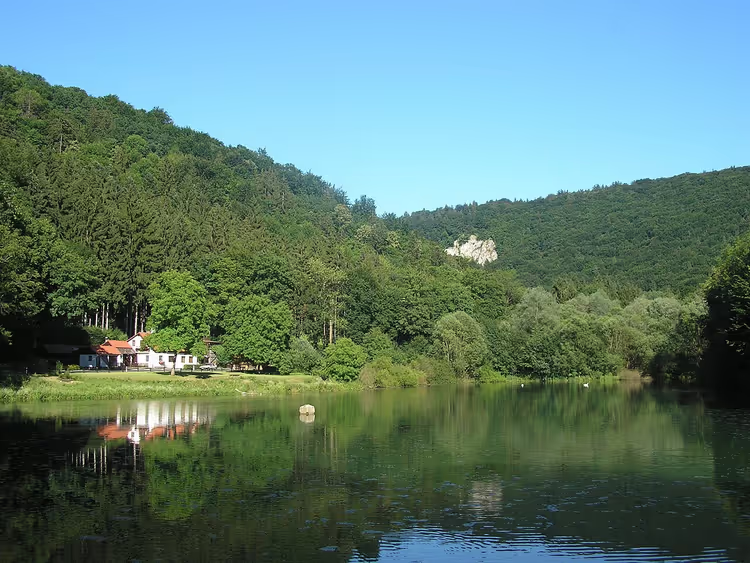
The Moravian Karst is a system of caves north of Brno, one of the largest in Europe. In total, the system includes over a thousand caves, but only five are open to tourists.
Inside, you'll encounter underground halls and corridors, lakes and a river, waterfalls of stalactites and even an underground factory. People began descending here as early as the 17th century, but speleologists only started studying it in the 20th.
Later the system was declared a state nature reserve and tourist routes were developed. They require no special preparation, so it's interesting for both adults and children. In season, it's better to buy tickets in advance (as of 09/2026, caves.cz).
- How to get there: 30 km from Brno, about 40 minutes by car to the Skalní mlýn parking lot.
- Cost: tickets per route, some are sold online.
- Who it's for: families and those who love nature and underground spaces.
- The catch: in peak season, most tours sell out in advance.
15. Macocha Abyss
 © 7oanna · CC BY-SAPhoto: 7oanna, CC BY-SA (https://creativecommons.org/licenses/by-sa/4.0), Wikimedia Commons
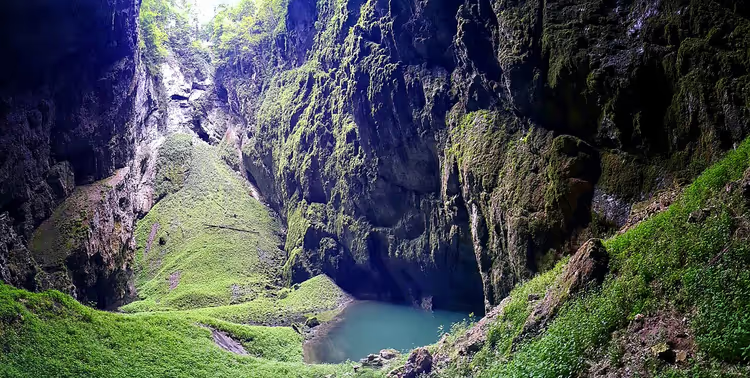
Macocha is the most interesting part of the Moravian Karst. The abyss was discovered in the early 18th century, but it was studied slowly and in fits and starts. The name "Macocha" means "stepmother": according to legend, an evil stepmother threw her stepson down, then jumped herself.
For many years the abyss was considered bottomless. Only in 1909 did a group of scientists descend to the very bottom. Today its depth is known precisely: 138 meters (as of 09/2026, caves.cz).
There are two ways to see Macocha. From the inside, you'll walk through the caves and boat part of the way along the underground Punkva River. From above, you can take a funicular up and step out onto a viewing platform to look down.
Below lie the Upper and Lower lakes, and a guest house is open near the abyss. If you want to stay longer in this area, it's easy to arrange. On cave tours you'll see unusual plants and animals.
- How to get there: an eco-train runs from the Skalní mlýn parking lot to the abyss.
- Cost: the viewing platform ride and the cave tour are paid separately.
- Who it's for: those who are not afraid of heights and want to see an underground river.
- The catch: in rain, viewing platforms are closed and the route is shortened.
16. Brno
 © Harold · CC BY-SAPhoto: Harold, CC BY-SA (https://creativecommons.org/licenses/by-sa/3.0), Wikimedia Commons
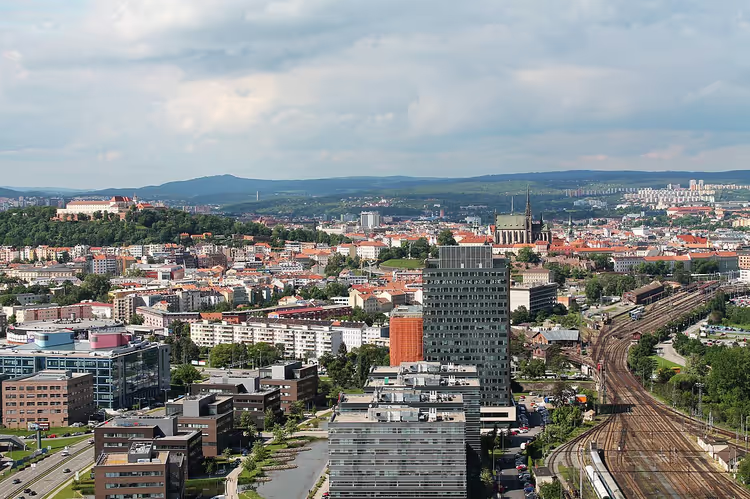
Brno is an ancient city in Moravia, over a thousand years old. Today about 400,000 people live here. Originally the city had defensive significance, and later it housed one of the country's largest prisons. Since the 16th century, Brno has been considered the center of Moravia.
In the 19th century, industry developed actively here, and a technical university was built. During World War II, the city suffered heavily from bombing. Modern Brno combines old quarters with lively student districts.
Tourists visit art galleries, the largest of which is the Moravian Gallery. The Moravian Museum also operates here, owning several historic buildings. There is also a Museum of Technology and a Museum of Romani Culture.
In summer, Brno hosts a fireworks parade and the international music festival "Špilberk". Sometimes you can also catch the Hot Air Balloon Festival. In the evening, it's worth climbing up to Špilberk Castle, which offers a view of the entire city.
- How to get there: 200 km from Prague via the D1, about 2 hours on the road.
- Cost: galleries charge a moderate fee, park entry is free.
- Who it's for: those who want to see Czechia's second capital and Moravia.
- The catch: central parking is paid, leave your car at the hotel.
17. Saxon Switzerland
 © Bernd Thaller from Graz, Austria · CC BYPhoto: Bernd Thaller from Graz, Austria, CC BY (https://creativecommons.org/licenses/by/2.0), Wikimedia Commons
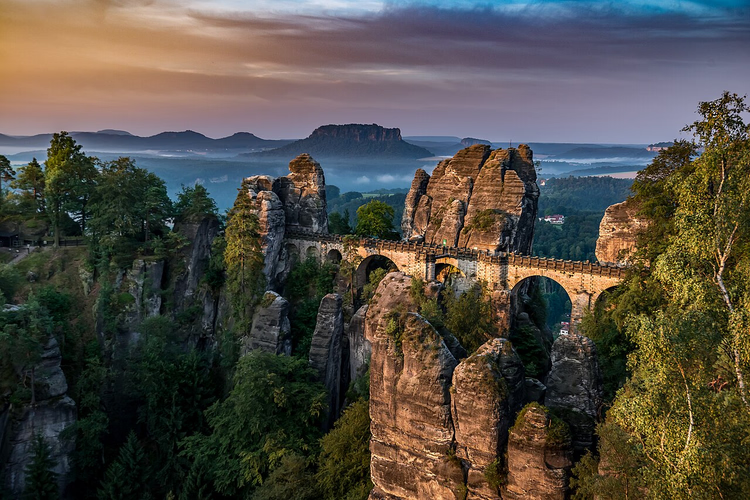
Saxon Switzerland is a very beautiful region with a rich history, and it already lies in Germany, near the Czech border. The name was coined by young artists who studied in Dresden. The mountains and rivers reminded them of their native Switzerland, and that is how the name came about.
In the 19th century, the landscapes were partly spoiled by mines, and the public was outraged. But the state began protecting the most scenic areas only in the mid-20th century. Now ecotourism is well developed here.
You will admire unusual rock formations of fantastic shapes, meadows, and rivers. Part of the reserve is closed to visitors so as not to disturb the animals. Königstein Fortress stands on a rock, with a museum inside. In another part of the park, the Bastei arch bridge spans the gorge, with viewing platforms.
- How to get there: 170 km from Prague, about 2.5 hours by car via the D8.
- Cost: parking at Bastei is paid, access to the bridge is free.
- Who it's for: those who want to add one day in Germany to their Czech trip.
- The catch: on weekends the viewing platforms are crowded.
Czech Republic road trip route on the map
We put all 17 points into a single route. The logic is simple: you do the western loop first, then the south and Moravia. Check the map to estimate distances and the order of stops.
Road trip route through the Czech Republic
Places on the map
- 1Prague Start of the route, Old Town Square and Prague Castle
- 2Karlovy Vary Spa town with the Vřídelní colonnade and the Vřídlo geyser
- 3Loket Castle Gothic castle on a bend of the Ohře river, a museum with a torture chamber
- 4Mariánské Lázně Spa town with 140 mineral springs and the Singing Fountain
- 5Plzeň Capital of Czech beer, the Church of St Bartholomew
- 6Český Krumlov Town on the Vltava with over three hundred old buildings
- 7Hluboká nad Vltavou Castle Neo-Gothic hilltop castle, inspired by Windsor
- 8Červená Lhota Castle Red castle on a rocky island in the middle of a pond
- 9Jindřichův Hradec Castle with the Black Tower and the largest mechanical nativity scene
- 10Telč Postcard town with a Renaissance chateau and a plague column
- 11Kutná Hora Silver town with St Barbara's Cathedral and the Silver Museum
- 12Český Šternberk Castle Castle on a cliff above the river, weapon and clock collections
- 13Sedlec Ossuary Sedlec ossuary with a chandelier made of bones
- 14Moravian Karst Cave system north of Brno, underground halls and a river
- 15Macocha Abyss 138-metre-deep abyss with the underground river Punkva
- 16Brno Centre of Moravia, Špilberk fortress with a viewpoint
- 17Saxon Switzerland Rocky region near the German border, Königstein Castle
If you are driving your own car, this route can be done in a week without rushing. Without a car, you will have to choose between Prague, Brno, and a couple of castles. That is why we recommend comparing rental terms in advance.
Find hotels
Compare prices across booking sites and filter for rooms with free cancellation.
Compare prices on Discover CarsThe widget loads once you give your consent.
⁉️🤔 Frequently asked questions
How many days should you allow for a road trip through Czechia?
A week is enough to cover 17 stops without rushing. The western loop with Prague, Karlovy Vary, and Loket takes two to three days. The south with Český Krumlov and Hluboká, plus Moravia with Brno and the Moravian Karst, adds another three to four days. If you have less time, skip the far-flung castles and focus on one region.
Do I need a vignette for driving in Czechia?
Yes, you need an electronic vignette for highway sections. Buy the vignette online in advance and keep the confirmation on your phone.
Where should I park in Prague?
Leave your car on the outskirts near a metro station or at a hotel with parking.
When is the best time to visit Český Krumlov?
The best months are May, June, and September: warm, but with fewer crowds than in peak summer. In June the town hosts the Five-Petaled Rose festival, which draws a lot of visitors. Krumlov Castle operates seasonally, so check tour times and dates on the official website in advance.
Can you see the Moravian Karst and Macocha in one day?
Yes, they are usually visited together. From the Skalní mlýn parking lot, an eco-train runs to the Macocha Abyss, and the caves are connected to it. Going down to the underground Punkva River and up to the viewing platform is doable in one day. In season, tour tickets sell out in advance, so buy online.
In short: what to book
A road trip through Czechia gives you freedom that bus tours don't. You decide how long to stay in Český Krumlov and when to head up to the Macocha Abyss. If you have a week: start in Prague, do the western loop, and finish in Moravia. If you only have three days: take Prague, Karlovy Vary, and Český Krumlov.
Start with the rental: find a car on Discover Cars. Book tours and tickets to popular castles in advance, in summer they sell out weeks ahead.

A small editorial team writing guides for independent travel. We travel ourselves, but we haven’t been everywhere, so we check prices, opening hours and how to get there against official sources.