

















Where to fly cheap: 10 European cities with low fares in 2026
The price of a ticket to Europe barely depends on distance. It depends on how many airlines compete for the same route.
Low-cost carriers fly to some cities dozens of times a day, while a single carrier serves others. For the same dates, the difference between such destinations can be as much as double. We've put together ten European cities with the highest route competition: Palermo, Venice, Helsinki, Rome, Athens, Paris, Madrid, Dublin, Milan, and Barcelona.
Inside, you'll find each city's airports, main carriers, ground costs, and the honest catch. The ranking is based on open airport data and 2025 industry statistics. Fares change quickly, so we give all benchmarks with a check date rather than as eternal truth.
Ad: this article contains affiliate links. We earn a commission if you book through them, at no extra cost to you.
What makes some airports cheaper than others
💡 In short:
- Ten cities with the highest route competition: from Barcelona and Milan to Palermo.
- Four things determine the ticket price: low-cost carriers, season, airport choice, and date flexibility.
- Ground costs matter as much as the ticket: southern Europe is cheaper than the north.
- Traffic and airport data: 09/2026, checked against the 2025 ACI Europe report.
European airports served a record 2.6 billion passengers in 2025, up 4.4% from the year before (as of 01/2026, ACI Europe). Record traffic means one simple thing: there are more routes, and the fight for passengers is tougher. For you, that's a chance to buy a ticket noticeably cheaper than the level that held a few years ago.
The price of a flight is not made up of kilometers but of the number of carriers on the route, airport fees, and the month of departure. Below are the four factors we considered in the ranking and how you can use each one.
Factor | What it changes | What you should do |
|---|---|---|
Low-cost carriers on the route | Ticket price on short-haul routes | Compare Ryanair, easyJet, Vueling, and Wizz Air for your dates |
Season | Fares in July, August, and over the Christmas holidays | Look at May, late September, and November |
Secondary airport | Airport fees and number of flights | Compare the city's main and secondary airports |
Flexible dates | Seat prices on a specific day | Choose Tuesday, Wednesday, or Saturday instead of Friday |
Airline competition
When three carriers operate on a route, prices stay low. When only one remains, it sets the fare itself. Low-cost carriers change the picture most of all: they fly from secondary airports and charge less for the flight itself. The European market runs on them, and the share of budget carriers has only grown in recent years.
That's exactly why our list includes cities with two and three airports: Rome, Paris, Milan. The more airports, the more carriers, the lower the starting price. For you, that means you should search for tickets not to one airport but to two or three at once.
Seasonality
Ticket prices to Europe depend more on the month than on distance. July and August, school holidays, and the Christmas weeks push fares up on all routes. Southern Europe holds high season almost year-round: in Barcelona, Athens, and Palermo, the warm season coincides with European vacations.
Shift your trip to the shoulder season and you'll pay less for the same thing. May and late September in Rome and Athens are still warm, but there are fewer lines and hotels are cheaper. November in Barcelona and Palermo works for walking around, and tickets in those months are at their lowest.
Departure airport and secondary hubs
Not all airports are the same. Major hubs offer more flights and competition, but their fees are also higher. Secondary airports often host low-cost carriers and keep low service charges, so a ticket from there can cost less.
That's why you should check all of a city's airports at once. In Paris, that's Orly and Beauvais; in Rome, Ciampino; in Milan, Bergamo and Linate; in Venice, Treviso. You'll spend an extra hour on the road, but the savings can be significant.
Flexible dates
If you don't have a fixed date, you save without any tricks. Monday and Friday are traditionally more expensive, airports are busy on weekends, and midweek is cheaper. Look at departures on Tuesday, Wednesday, or Saturday.
Don't put off buying until the last days. The fewer seats remain, the more expensive a ticket on a specific flight gets. Cities with a high number of flights give you more chances for a sudden price drop, and your list here is exactly those cities.
Below are the ten cities themselves: airports, carriers, on-the-ground costs, and who each city is for and not for.
10. Palermo
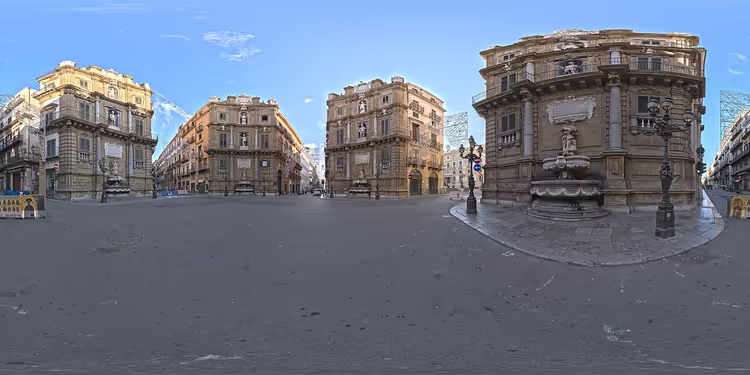
Palermo (PMO) has become Sicily's main air gateway. Low-cost carriers fly here year-round, so you can find a ticket even outside the season. The airport is small: you get through security quickly and reach the city almost immediately.
A train and a shuttle run from the airport to the center, so you don't necessarily need a car. In summer, Palermo is hot and crowded, but in May and September the city empties out and gets cheaper along with accommodation.
- Who it's for: if you want Sicily without big on-the-ground spending.
- Not for: if you can only travel in summer, when it's hot and crowded here.
- Ground costs: the lowest in this selection, food and tours at southern Italy levels.
- What to see: Palermo's markets, cathedrals, and catacombs; beyond that, you'll need a car or bus to explore the island.
- The catch: there's only one airport, and the choice of flights is narrower than in Rome or Milan.
- Hotels in Palermo on Trip.com
9. Venice
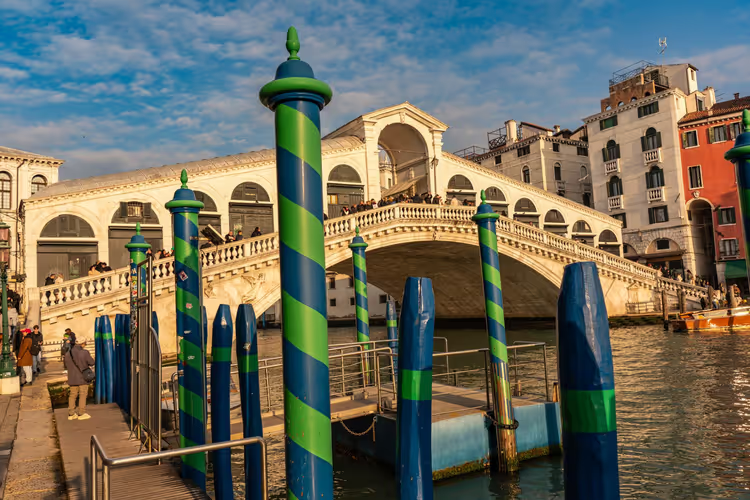
Venice (VCE) is smaller than Rome and Milan, and that's its advantage at the airport: shorter lines, faster access to the water. Marco Polo Airport is connected to other European cities by both full-service and low-cost carriers. Some budget flights arrive at Treviso, from where buses run to the city.
High-speed trains take you to Florence, Milan, and Verona, so Venice is convenient as the first stop on a route. You fly in, see the city, and head south or north without a return flight.
- Who it's for: if you want to see St. Mark's Basilica and the Doge's Palace and then continue your route by train.
- Not for: if you're looking for cheap accommodation in the historic center, it's more expensive here than almost anywhere.
- Ground costs: high; a hotel night and dinner in the center cost noticeably more than in Rome.
- What to see: St. Mark's Basilica, the Doge's Palace, a gondola ride or a walking tour.
- The catch: the season lasts a long time, and waterfront rooms get booked in advance.
- Hotel prices in Venice on Trip.com
8. Helsinki

Helsinki (HEL) is Finnair's home airport and one of the best northern hubs. The airport is consolidated into a single terminal, so transfers take minimal time and you can easily continue on to Scandinavia or the Baltics. It's also a transit point further to Asia.
Direct flights to Helsinki are available from major US cities, and within Europe the route is also served by low-cost carriers. The city itself is compact, so two days are enough to see it and you don't waste time on travel.
- Who it's for: if you want Northern Europe with a convenient transfer and don't mind high prices on the ground.
- Not for: if you count every euro on food and accommodation, prices here are among the highest on the list.
- Ground costs: high; food and hotels are more expensive than in southern Europe, so plan your budget in advance.
- What to see: the archipelago islands, design districts, and the city's museums.
- The catch: on-the-ground costs are higher than in any southern city in this selection.
- Hotels in Helsinki on Trip.com
7. Rome
 © Luigi Guerrieri4 · CC BY-SAPhoto: Luigi Guerrieri4, CC BY-SA (https://creativecommons.org/licenses/by-sa/4.0), Wikimedia Commons
Rome (FCO) has Italy's main airport and the widest choice of flights. Fiumicino handles full-service and low-cost carriers, while Ciampino picks up cheap flights within Europe. Together they offer low fares for connections to Naples, Florence, and Venice.
It's also cheap to fly from here to Ibiza, Mallorca, Malta, Croatia, and the Greek islands. The Leonardo Express train and regional trains get you to the center. Neither Fiumicino nor Ciampino has a metro connection.
- Who it's for: if you want history and cheap connections to the sea in one trip.
- Not for: if you're not ready for heat and lines in July, it's better to come in May or October.
- Ground costs: moderate, hotels in the center are cheaper than in Venice, food is on par with southern Italy.
- What to see: the Colosseum, the Vatican Museums, the Pantheon, and the Trevi Fountain.
- The catch: in summer the center is hot and crowded, and the ride from Ciampino to the city takes longer.
- Rome hotel prices on Trip.com
6. Athens
 © Alicembasli · CC BYPhoto: Alicembasli, CC BY (https://creativecommons.org/licenses/by/4.0), Wikimedia Commons
Athens (ATH) remains Greece's main gateway and the hub for Aegean Airlines within Star Alliance. From Eleftherios Venizelos Airport it's easy to continue your trip: short flights and ferries head to Santorini, Mykonos, and Crete. You see the city and then head to the islands without flying back home.
The city is cheaper than northern Europe but pricier than Palermo. Accommodation in the center is moderate, and the metro and airport buses run around the clock, so you probably won't need a taxi.
- Who it's for: if you want to combine the city and the islands in one trip.
- Not for: if you're looking for cool weather and quiet, Athens is very hot in July and August.
- Ground costs: moderate, hotels and food are cheaper than in Rome.
- What to see: the Acropolis, Plaka, and the city's archaeological museums.
- The catch: in summer there's heat and crowds at the Acropolis, so it's better to book tickets and tours in advance.
- Athens hotels on Trip.com
5. Paris
 © Yann Caradec from Paris, France · CC BY-SAPhoto: Yann Caradec from Paris, France, CC BY-SA (https://creativecommons.org/licenses/by-sa/2.0), Wikimedia Commons
Paris (CDG) is one of Europe's largest hubs, with flights here from almost anywhere in the world. Charles de Gaulle handles full-service and low-cost carriers, and for cheap tickets you should also check Orly and Beauvais, where budget airlines fly.
From Paris it's easy to continue onward: trains run to Belgium, Germany, and the Netherlands. That's why the city works well as the first stop on your route rather than a separate short layover.
- Who it's for: if you want to start a European trip from a major hub and continue by train.
- Not for: if you're counting every last euro, accommodation in Paris is among the most expensive on this list.
- Ground costs: high, hotels and dinners in the center are among the priciest in this selection.
- What to see: the Louvre, the Eiffel Tower, and the Seine embankments.
- The catch: accommodation is expensive year-round, and cheap flights often depart from Beauvais.
- Paris hotel prices on Trip.com
4. Madrid
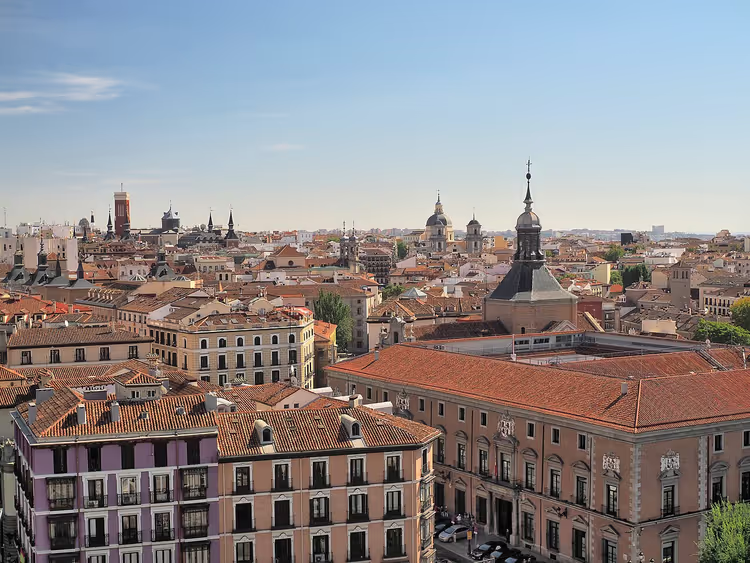 © Dmitry Dzhus from London · CC BYPhoto: Dmitry Dzhus from London, CC BY (https://creativecommons.org/licenses/by/2.0), Wikimedia Commons
Madrid (MAD) gives you access to more than 200 destinations worldwide, and Barajas handled 68.2 million passengers in 2025 (as of 01/2026, Aena). The city works well as a transfer hub: from here you can fly to Morocco and the Canary Islands or take trains across Spain.
Within Spain, high-speed trains are often faster than flying, especially if you're traveling with luggage. The airport is connected to the center by metro and commuter rail, so you don't spend money on taxis.
- Who it's for: if you want cheap flights around Europe and trains across Spain from one base.
- Not for: if you're going in July or August, Madrid's heat is harder to handle than the coast.
- Ground costs: average or below, food and hotels are cheaper than in Paris and Venice.
- What to see: the Prado Museum, Plaza Mayor, and the Royal Palace.
- The catch: the center is very hot in summer, and some destinations within Spain are easier to reach by train.
- Madrid hotels on Trip.com
3. Dublin
 © 瑞丽江的河水 · CC BY-SAPhoto: 瑞丽江的河水, CC BY-SA (https://creativecommons.org/licenses/by-sa/4.0), Wikimedia Commons
Dublin (DUB) is the headquarters of Aer Lingus and a Ryanair base, so there are plenty of cheap flights here. From the airport you can get to other cities in Ireland, to Britain, and to Western Europe. For flights to the US, pre-clearance is available here, so you don't stand in line at passport control on arrival.
The city is compact, and the center is walkable. However, accommodation in Dublin is expensive, and that's the first thing to factor into your budget.
- Who it's for: if you need cheap flights and want to get to Ireland and Britain.
- Not for: if you're looking for a warm sea, Dublin summers are cool and rainy.
- Ground costs: above average, hotels are more expensive than in Madrid and Athens.
- What to see: the old town, Trinity College, and the Guinness Storehouse.
- The catch: accommodation is expensive, and the weather often ruins plans for day trips outside the city.
- Dublin hotel prices on Trip.com
2. Milan
 © Steffen Schmitz · CC BY-SAPhoto: Steffen Schmitz, CC BY-SA (https://creativecommons.org/licenses/by-sa/4.0), Wikimedia Commons
Milan (MXP) has three airports, and that's its main advantage. Malpensa handles long-haul flights, while Linate and Bergamo serve Europe and the low-cost carriers Ryanair and Wizz Air. Competition between the airports is what keeps prices low.
From Milan, trains head to the Alps, Switzerland, and France, including overnight routes. If you're planning to go straight to the mountains or a lake, you save on both the ticket and the connection here.
- Who it's for: if you want a cheap ticket to Italy and a route to the Alps or the lakes.
- Not for: if you fly into Bergamo and out of Malpensa, the transfer will take up part of your day.
- Ground costs: average, accommodation is cheaper than in Venice and Paris.
- What to see: the cathedral, Galleria Vittorio Emanuele II, and Sforza Castle.
- The catch: there's no fast connection between the airports, so you need to plan transfers with extra time.
- Milan hotels on Trip.com
1. Barcelona
 © dronepicr · CC BYPhoto: dronepicr, CC BY (https://creativecommons.org/licenses/by/2.0), Wikimedia Commons
Barcelona (BCN) is the top city on the list. El Prat is one of the busiest airports in Europe: in 2025 it handled 57.5 million passengers (as of 01/2026, Spanish airport operator Aena). Low-cost carriers Vueling and LEVEL are based here, so there are many direct flights and prices are low.
From there you can take trains across Spain or into France, and you can reach the center by metro and commuter rail.
- Who it's for: if you want the sea, the city, and a cheap flight all in one place.
- Not for: if you don't like crowds, the center and beaches get very busy in summer.
- On-the-ground costs: average, food and hotels are cheaper than in Paris or Dublin.
- What to see: Sagrada Familia, the Gothic Quarter, and the waterfront.
- The catch: in high season, accommodation is the first on the list to get expensive, so it's better to book early.
- Hotel prices in Barcelona
Ten cities in one table
Before you decide, compare the cities by airports and cost level. That way you'll figure out faster which option works for you.
City | Airports | Main carriers | On-the-ground costs | Who it suits |
|---|---|---|---|---|
Barcelona | El Prat (BCN) | Vueling, LEVEL, and full-service carriers | Average | Sea, city, trains around Spain |
Milan | Malpensa (MXP), Linate (LIN), Bergamo (BGY) | Ryanair, Wizz Air | Average | Alps, lakes, short flights |
Dublin | Dublin (DUB) | Aer Lingus, Ryanair | Above average | Ireland and Britain |
Madrid | Barajas (MAD) | Iberia and low-cost carriers | Average and below | Spain, Morocco, Canary Islands |
Paris | Charles de Gaulle (CDG), Orly (ORY), Beauvais (BVA) | Full-service and low-cost carriers | High | Starting point for a Europe route |
Athens | Eleftherios Venizelos (ATH) | Aegean Airlines, Star Alliance | Average | City and islands |
Rome | Fiumicino (FCO), Ciampino (CIA) | Full-service and low-cost carriers | Average | History and connections to the sea |
Helsinki | Helsinki-Vantaa (HEL) | Finnair, Oneworld | High | Northern Europe and transit to Asia |
Venice | Marco Polo (VCE), Treviso (TSV) | Full-service and low-cost carriers | High | Venice and trains around northern Italy |
Palermo | Palermo (PMO) | Low-cost carriers year-round | Low | Sicily on a minimal budget |
Which European country has the cheapest flights
Spain, Italy, and Ireland lead in terms of flight prices. In Spain, two major hubs, Barcelona and Madrid, keep the competition going, and the main traffic is split between them. In Italy, cheap tickets come through Rome, Milan, and Venice, while Dublin wins thanks to Aer Lingus and Ryanair.
After that, it's simple: once you're there, you switch to low-cost carriers like easyJet, Vueling, or Ryanair, or you take a train. European railways connect major cities without flying, so you can build a multi-country route without extra plane tickets.
Spain deserves a special mention. The sheer volume of flights into Barajas and El Prat puts downward pressure on prices: there are plenty of seats, and carriers have to fight for passengers.
How far in advance to buy tickets to Europe
The best prices appear a few months before departure, not a year ahead and not in the last week. Buying too early gives you almost no advantage: schedules are already out, but carriers haven't yet opened low fares for distant dates. The last days before departure are almost always more expensive because few seats remain.
For holidays and school breaks, the window shifts earlier. If you're flying around Christmas or in the middle of summer, book ahead: during those weeks, cheap options are nearly gone.
How to catch cheap tickets to Europe
There are no secrets here, just habits. A few simple actions save more than any promo code.
Set up price alerts
Alerts show you when the fare on your route drops. You don't need to check websites every day: the notification comes to you, and you can buy the ticket before the price goes back up. Set them up for two or three cities at once.
Search with flexible dates
The price calendar shows which days are cheaper. Shifting your departure by a day forward or back often cuts the cost noticeably. If you have flexibility on dates, compare a whole week at once, not just one day.
Check alternative airports
Look at all the airports in a city, not just the main one. Sometimes it's cheaper to fly out of a neighboring city and get there by train.
Use miles and status
Loyalty programs offer more than just miles. Members get free baggage, priority boarding, and access to cheap fares that aren't available to the general public. Sign up for free in the program of the airline you fly most often.
Watch for mistake fares
Sometimes a carrier posts a ticket at an obviously underpriced rate and quickly fixes it. These offers last only a few hours. Keep your documents and card details ready so you can buy the ticket in time, and check the exchange conditions before paying.
Compare plane and train
On short routes, the train often wins. You don't need to get to the airport early, pay for baggage, or wait for your suitcase at the carousel. In Spain, Italy, and France, high-speed trains connect major cities faster than a flight plus the trip to the airport.
Buy tickets in one booking
If your route has a connection, take both segments from one carrier or in one booking. That way, if there's a delay, you'll be offered another flight. Separate tickets look cheaper on paper, but a connection at your own risk costs more when something goes wrong.
Mistakes that cost you dearly
Even with a low fare, you can overpay. Here are five mistakes we see most often.
Separate tickets for a connection. If you buy two separate tickets, the carrier isn't responsible for the connection. If the first flight is delayed, the second one is gone along with your money, and no one will refund you.
Forgotten baggage. With low-cost carriers, the base price includes only a small bag. A suitcase in the hold, a window seat, and a boarding pass printed at the airport all cost extra. Calculate the total, not the sticker price: sometimes a "cheap" ticket with a suitcase ends up more expensive than a regular fare.
The wrong airport. Beauvais, Treviso, and Bergamo are far from their namesake cities. The bus to the center takes a long time, and a late arrival can mean spending the night in the suburbs. Check which airport you're flying into before you buy the ticket.
Buying in the last week. Few seats remain, and the fare rises every day. If you have no reason to wait, buy right away: the price almost never drops in the final days before departure.
Bad dates. Christmas, Easter, school breaks, and late August are the most expensive. During those weeks, both airlines and hotels raise prices. Shift your trip by at least a couple of weeks, and your budget will drop noticeably.
After that, the question isn't about the ticket anymore, but about your budget on the ground. The rule here is simple: southern Europe is cheaper than the north, and a major tourist city is more expensive than a small one. Choose a city that fits your travel style, not just the flight price.
How we calculated this
We don't sell tickets and we don't collect our own price data. The ranking is built on public information: airport statistics, the ACI Europe report for 2025, data from Spanish and Italian airport operators, and carrier schedules. For each city, we looked at four things: how many airports it has, which carriers operate there, whether low-cost airlines are present, and how well the city is connected to its neighbors by train.
That's why the order in the list reflects the level of competition on routes, not the cost of a specific ticket on a specific date. Prices change every day and depend on your departure city. For on-the-ground costs, we give qualitative assessments without exact amounts, because they depend on the season and the exchange rate.
This also explains why the list has no fixed-price tickets. Any number would be outdated within a week, and what matters more to us is that you understand the logic. Check current fares before buying and always review the exchange conditions.
⁉️🤔 Frequently asked questions
Which European cities are cheapest to fly to?
In our selection, these are Barcelona, Milan, and Madrid: they have the most carriers and secondary airports. Dublin and Athens are close to them in price. Palermo wins not on the ticket, but on the lowest costs on the ground. Paris and Helsinki are the most expensive for tickets and accommodation, but you'll find low fares there too in the off-season.
When should you buy tickets to Europe?
The best prices appear a few months before departure. For holidays and school breaks, the window shifts earlier, so those dates need extra lead time.
Why are some airports cheaper than others?
It comes down to competition and fees. Where several low-cost carriers operate, fares are lower. Secondary airports keep fees low, but they're farther from the center, and you'll have to spend time getting to your hotel.
Is it worth flying to an airport farther from the city?
Sometimes yes. A ticket to Bergamo or Beauvais can cost noticeably less than to the city's main airport, and a bus to the center adds little expense. Calculate the total: ticket plus ground transport. If the difference is less than the bus fare, the option stops making sense.
Which city on the list has the lowest costs on the ground?
Palermo is the cheapest, followed by Athens, Madrid, and Barcelona. Helsinki and Paris are the most expensive: accommodation and food there are noticeably higher. If you're watching your budget, southern Europe almost always beats the north regardless of the ticket price.
How to get from the airport to the city?
In Rome, Barcelona, Madrid, Athens, and Milan, a train or metro runs to the center. In Venice and Dublin, buses operate; in Palermo, there's a train and a shuttle. Take a taxi if you arrive late at night; otherwise, public transport is cheaper and more predictable.
Should you take a connection if there are no direct flights?
Yes, a connection is often cheaper than a direct flight. Check the time between flights: at large airports, a short interval is enough, but in Milan, when changing airports, set aside part of the day for the transfer. Buy tickets in a single booking, so the carrier is responsible for the connection.
Which low-cost carriers fly to Europe?
Within Europe, you'll most often come across Ryanair, easyJet, Vueling, and Wizz Air. They all operate from secondary airports and charge extra for baggage. Keep in mind that their schedules are less frequent than those of major carriers, so leave a buffer when connecting to their flights.
How much time do you need for a city on the list?
Palermo, Athens, and Venice can be seen on a short trip. Paris, Rome, and Barcelona are better not rushed: they have many museums and neighborhoods, and on the run you'll only see the most famous sights. Milan and Helsinki work well as a two-day stop on the way further.
In short: what's worth booking
The takeaway is simple. You'll fly cheapest to Barcelona and Milan, and you'll spend the least on the ground in Palermo. Rome, Paris, and Barcelona offer the widest choice of flights, and for northern Europe, head to Helsinki. Look for tickets a few months out, check all the city's airports, and don't lock yourself into Fridays.
A selection matrix based on your situation:
- If you're on a minimal budget: Palermo, then Athens and Madrid.
- If you need a wide choice of flights and time: Barcelona, Rome, Paris.
- If you're going for the sea: Barcelona, Athens, Palermo.
- If you want mountains and trains: Milan, Madrid, Venice.
- If you're flying off-season: Helsinki and Dublin, where low-season months produce the cheapest tickets.
The booking order matters too. Start with the ticket: it sets the dates for the whole trip. Then accommodation, before prices for your chosen dates go up. Only then trains and tours, because early-booking discounts on those are almost nonexistent.
Remember that fares change every day. Check prices before buying, compare airports against each other, and keep one backup departure option in reserve. That way you won't overpay, even if plans shift.
For a first trip, Barcelona is the most convenient: the sea is nearby, the airport is close to the center, there are many flights, and low-price options are almost always available. Pick off-season dates, compare El Prat with airports in neighboring cities, and book accommodation in advance.

A small editorial team writing guides for independent travel. We travel ourselves, but we haven’t been everywhere, so we check prices, opening hours and how to get there against official sources.