







 AIIllustrative image: AI-generated
August in Europe: how to survive the heat and not lose a day
Travel guides write about southern Europe in August the same way they write about May. It is hot and unpleasant almost everywhere in August. But in a number of cities, a normal walk between noon and six in the evening is impossible. Monuments close, there is no shade, and by three o'clock your body gives up.
The summer of 2026 put everything in its place. June 2026 became the hottest June on record in Western Europe (as of Copernicus Climate Change Service, 09/2026). If you are traveling in August because that is when school holidays fall, you do not need admonitions, you need numbers and a workable daily schedule. Both are below.
What average figures hide
💡 In short:
- June 2026 in Western Europe turned out to be the warmest in the history of measurements (according to the Copernicus service, 09/2026).
- In Cordoba, Seville, Granada, Murcia and Nicosia, the average August high stays at 34-37 °C (as of Copernicus climate bulletin, 09/2026). Sightseeing there during the day is not done.
- Temperature data: 09/2026, checked against the Copernicus summary.
Climate tables give the average daily high calculated over thirty years. If the table says 36 °C, it means roughly half of August days will be higher, and a few days in the month will cross 40 °C. For any single day, that figure tells you nothing.
Three things make the real heat load higher than the table suggests. First: night. Tropical nights, when the air does not cool below 20 °C, rob you of recovery; in Athens, Seville and Palermo in August this is the norm, not the exception. Second: the city itself. Asphalt and stone store heat and release it at night, so the center can be four to six degrees warmer than the suburbs, while official stations sit at airfields outside the city and understate the picture. Third: humidity. A temperature of 34 °C in Seville with dry air is easier to bear than 30-31 °C in Palermo or Split at 65% humidity; sweat evaporates less effectively, and the body stops cooling down (see Copernicus climate summaries, 09/2026).
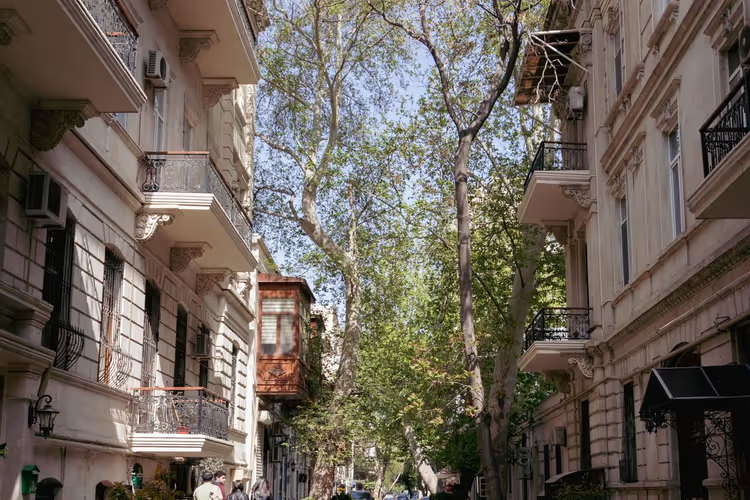
Average August heat: city comparison
Below are the average long-term daily August highs, rounded, according to national weather services (Copernicus summary, 09/2026).
City | Average August high | Assessment |
|---|---|---|
Cordoba | around 37 °C | unusable during the day |
Nicosia | around 37 °C | unusable during the day |
Seville | around 36 °C | unusable during the day |
Granada | around 35 °C | unusable during the day |
Murcia | around 34 °C | unusable during the day |
Athens | around 33 °C | only morning and evening |
Madrid | around 33 °C | only morning and evening |
Zaragoza | around 33 °C | only morning and evening |
Thessaloniki | around 32 °C | only morning and evening |
Skopje | around 32 °C | only morning and evening |
Rome | around 31 °C | with limitations |
Naples | around 31 °C | with limitations |
Palermo | around 30 °C, very humid | with limitations |
Valletta | around 31 °C, very humid | with limitations |
Split | around 31 °C, humid | with limitations |
Bucharest | around 30 °C | with limitations |
Belgrade | around 30 °C | with limitations |
Valencia | around 30 °C, humid | with limitations |
Barcelona | around 29 °C, humid | with limitations |
Marseille | around 29 °C | with limitations |
Sofia | around 29 °C | manageable |
Lisbon | around 28 °C | manageable |
Budapest | around 28 °C | manageable |
Lyon | around 28 °C | manageable |
Porto | around 25 °C | manageable |
The position of Lisbon and Porto stands out. The Atlantic keeps the Portuguese coast noticeably cooler in August than the Spanish interior: between Lisbon and Seville, which are about 400 km apart, the average difference is eight degrees (according to the European climate summary, 09/2026).
Five cities where the day is lost
Cordoba, Seville, Nicosia, Granada, and Murcia are not suitable for a city trip in August. In Cordoba, the Mezquita was built without shade, the walk from the station to the old town takes half an hour across open ground, and by midday the streets get so hot that even locals only go out under an umbrella. In Seville, there are answers to the heat: canopies over Calle Sierpes and green interior courtyards. But the gardens of the Reales Alcázares and Plaza de España remain open spaces, and there is nowhere to hide there.
Nicosia stands apart. It is the only major Mediterranean capital in the interior of an island, without a sea breeze. A trip to Cyprus is better scheduled for April or November.
Athens is holding on at the edge. You could tolerate an average of 33 °C if the city were not built so densely. In practice, Athens works from 7 to 11 in the morning and after 7 in the evening in August, and in between there remains a program of museums and cafes. Make it a rule to take the first entry slot at any site: in the morning the line is shorter and the sun is still gentle.
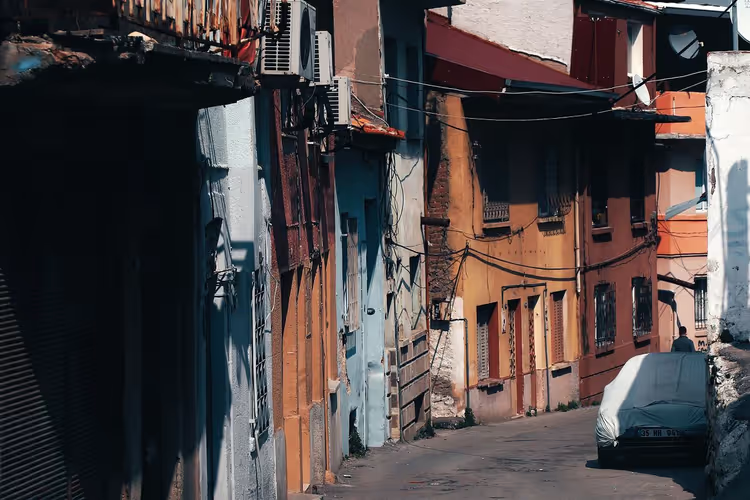
When the monuments themselves close
Greece was the first to respond systematically. In hot weather, the Ministry of Culture closes the Acropolis for the middle of the day, typically from 1 to 5 pm, for the safety of visitors and staff (as of: BBC citing the ministry, 09/2026). In parallel, the Ministry of Labor bans outdoor physical work from 12 to 5 pm in the most affected areas: this covers construction, agriculture, and motorcycle couriers.
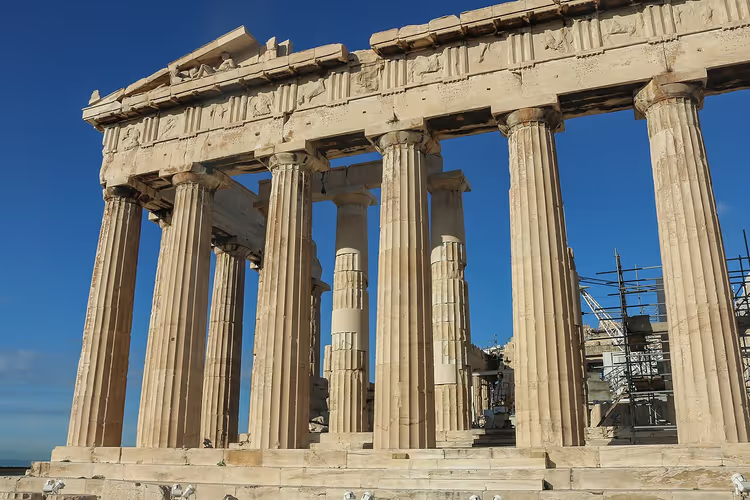 © HerrAdams · CC BY-SAPhoto: HerrAdams, CC BY-SA (https://creativecommons.org/licenses/by-sa/4.0), Wikimedia Commons
This matters for you when buying tickets. A ticket for 2 pm may turn out to be invalid. Such closures are usually announced a day or two in advance. Anyone who wants to see the Acropolis, Delphi, or Olympia in August takes the first morning entry. This is not a question of comfort, but the only workable option.
Similar rules exist in isolated cases in Italy and Spain, more often in the form of a shortened day at gardens and open-air sites. Enclosed, air-conditioned spaces generally remain open.
What actually works during the day
The usual advice goes like this: go out in the morning, have a siesta in the afternoon. It is correct but incomplete, because not all accommodation is available during the day and not all of it is properly cooled. A more reliable plan is one that relies on three resources between 12 and 6 pm.
The first resource: air-conditioned spaces where there is something to see. Large museums, churches with thick walls, covered markets, libraries, department stores. In Madrid, the Prado serves as a refuge in August; in Rome, the Vatican Museums with an afternoon ticket; in Athens, the Acropolis Museum.
The second resource, water, is not limited to the sea: city pools, river bathing spots, and lakes outside the city. In Bucharest, Lake Snagov is an hour away; in Belgrade, Ada Ciganlija is right within the city limits; in Lyon, there are recreation areas on the banks of the Rhone.
The third resource, altitude, gives you five to eight degrees less when you climb 800 to 1,200 meters. From Granada you can reach the Sierra Nevada in an hour, from Athens Parnitha, from Palermo Piano Battaglia in the Madonie mountains.
What does not work: open-top bus tours, walks through archaeological zones without shade, waiting in open-air lines. Anyone who arrives at Pompeii or Ostia Antica at 1 pm in August is making a mistake that no hat can fix.
Health: in short, without the drama
Heat exhaustion creeps up gradually: first a headache and loss of concentration, then nausea, then fainting. The risk group includes people over 65, young children, pregnant women, and anyone taking blood pressure medication or diuretics. If you are in this group, a trip to Andalusia or Cyprus in August is worth reconsidering. The scale is visible in the numbers: in the UK alone, the heat of May and June 2026 caused almost 2,900 additional deaths (as of: UKHSA report, 09/2026), and in Germany the count runs into the thousands.
A simple set of rules helps in practice. Drink two to three liters over the course of the day, not all at once when you feel thirsty. Do not avoid salt, because you lose electrolytes through sweat. Skip alcohol during the day. Wear light, loose clothing made of cotton or linen, not athletic fabrics. Keep a damp cloth on your neck: that is where evaporation cools you best. In a room without air conditioning, a fan only helps you below roughly 35 °C; above that it no longer saves you.
One point gets lost when booking. Not every property described as air-conditioned cools the entire apartment around the clock. In southern Europe, equipment in older buildings often runs on a schedule or is limited by central control. For an August trip, this is the main question to ask before booking.
Alternatives for the same dates
If you are tied to school holidays in August, you will find a reliable option in northwestern Europe. The Baltic capitals, Ireland, Scotland, Scandinavia, the Belgian and Dutch coasts, and Brittany stay around 20-24 °C during the day in August: summery, but without the risk of extreme heat (WMO forecast for 2026, 09/2026). Alpine cities also work: Innsbruck, Bolzano, and Ljubljana are hot, but each has elevation within half an hour's drive.
For the south, a simple rule applies: the coast instead of the interior. Cadiz instead of Seville, Nafplio instead of Athens, Trapani instead of Palermo, Porto instead of Madrid. The sea breeze regularly gives you five to ten degrees of relief.
In short: how to survive August in hot cities
If your dates are flexible, move the south to June or September. If not, choose cities in northwestern Europe, the coast instead of inland areas, and elevation instead of valleys.
The matrix is simple. If you are going to Andalusia or Cyprus, move your dates. If you are going to Athens or Rome, plan your first entry in the morning and museums for the afternoon. If you are traveling with children or older relatives, choose the Baltics, Ireland, or the Alps.
Book the first morning ticket as soon as sales open: in August, that is the only slot that will not be canceled due to heat.
⁉️🤔 Frequently asked questions
Which European cities are best avoided for daytime walking in August?
In Cordoba, Seville, Granada, Murcia, and Nicosia, the average August high stays at 34-37 °C (as of: Copernicus report, 09/2026). During the day, neither sightseeing nor a long walk works there. In Athens, Madrid, Zaragoza, and Thessaloniki, you are left with only early morning and late evening, and the rest of the time you spend in air-conditioned spaces.
Why do average temperatures in tables understate the heat?
The average is calculated over thirty years across all August days. Hidden behind that number are individual days above 40 °C, tropical nights, and a scorching city center that is several degrees hotter during the day than the official station outside the city. So plan your day for the worst-case scenario, not for the average figure from a reference book.
Does the Acropolis close during the day in hot weather?
Yes. In hot weather, the Greek Ministry of Culture closes the Acropolis in the middle of the day (as of: BBC, 09/2026). So take the first entry in the morning.
What should you do between 12 and 6 pm in a hot city?
Rely on three resources: air-conditioned spaces, water, and elevation. All of these work even where the street is unusable during the day.
Where to go in August if your vacation is tied to school holidays?
Look to northwestern Europe, where it is around 20-24 °C during the day in August (WMO forecast, 09/2026). In the south, stick to the coast rather than the interior.

A small editorial team writing guides for independent travel. We travel ourselves, but we haven’t been everywhere, so we check prices, opening hours and how to get there against official sources.