

















Childbirth abroad: where children get citizenship and parents get status
Giving birth in Argentina can cost you nothing. Giving birth in the US comes with a bill that, for many families, is the second largest expense after buying a home.
The rules change every year. In August 2026, the White House signed new executive orders on birthright citizenship and cracking down on "birth tourism," and on September 2, 2026, a court blocked them (Politico's coverage of the new orders).
Below is a comparison of three countries across five factors: the child's citizenship, the parents' status, visas, passport strength, and the cost of childbirth. All data was verified in September 2026.
Ad: this article contains affiliate links (we earn a commission if you book through them, at no extra cost to you).
Birthright citizenship
💡 In short:
- The US and Argentina grant a child citizenship simply for being born there.
- Chile requires parents to have legal resident status.
- Childbirth costs and immigration rules: 09/2026, verified using data from KFF and Chile's immigration service rules.
In the US, birthright citizenship is guaranteed by the 14th Amendment to the Constitution. The rule applies to all children born on American soil. The first attempt to restrict it was rejected by the Supreme Court in June 2026, and the second was blocked by a lower court in September (CFR, 09/2026). For you, this means the child will be issued a passport, but the issue will continue to be challenged.
In Argentina, birthright citizenship works without caveats. A child born on Argentine soil becomes Argentine regardless of the parents' status. You don't have to live in the country for this, but before the passport is issued, parents are advised to spend about six months in Argentina.
Chile is the only country of the three with a restriction. Children of foreigners who are in the country as transit passengers or employees of diplomatic missions do not receive citizenship at birth (SERMIG, 09/2026). At least one parent must have a residence permit or a pending application for one.
Permanent residency and citizenship for parents
Argentina gives parents the fastest path. A residence permit is issued immediately after the baby is born. The passport comes later: the process takes a year or more. You don't have to stay in the country the whole time, but it's worth spending about six months in Argentina.
Over time, parents can even bring distant relatives to the country as residents. The child's siblings receive citizenship after reaching adulthood.
Chile takes time. First a year of residency, then permanent residency, and only then applying for citizenship. There are two catches here. If you leave the country for more than a year, your resident status is revoked. The five-year period is counted from the moment you receive permanent residency, and the year of residency doesn't count toward it (according to SERMIG, 09/2026).
On the plus side, not only parents can apply, but also grandparents and the child's siblings.
The US has no such path. Permanent residency and citizenship for having a child are not provided for there. Family reunification only becomes possible when the child grows up and files a petition for the parents themselves. Until then, parents live on their own visas and statuses.
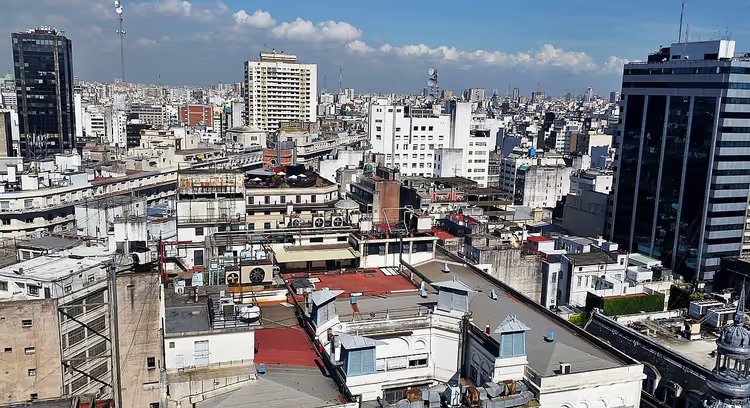 © Justraveling.com · CC BY-SAPhoto: Justraveling.com, CC BY-SA (https://creativecommons.org/licenses/by-sa/4.0), Wikimedia Commons
Birth visa: entry rules
There is no dedicated "birth visa" in any of the three countries. You use what is available: visa-free tourist entry or a visitor visa.
Argentina is open for short trips. Citizens of most CIS and EU countries do not need a visa. Argentine law has no separate status for giving birth. State your purpose of travel honestly at passport control; a false statement is risky. For a long-term stay after discharge, you apply for a residence permit.
The US requires a B1/B2 visitor visa and an in-person interview. Getting an embassy appointment can sometimes take months. The consular officer looks at two things: whether you have enough money to pay for the birth and whether you have reasons to return home. Property, a job, and relatives back home work in your favor, while any suspicion that the birth is just a pretext to stay leads to a denial. In 2025-2026, Washington tightened the rules against "birth tourism," so gather your documents well in advance (court ruling on the executive orders).
Chile does not require a visa for short-term entry for most travelers, but a long-term status has to be arranged in advance. If at least one parent obtains a residence permit before the birth, the child's citizenship question is resolved smoothly. Coming to give birth on a tourist stamp and then asking for status is risky: residency requires a legal basis (according to the Chilean immigration authority, 09/2026).
Passport strength and tax obligations
The strongest passport of the three is the US one. Americans can enter almost every country in the world visa-free or with an electronic authorization (Henley Passport Index, 09/2026). The Chilean passport ranks a few positions lower, and the Argentine one brings up the rear: it will not get you into the US and Canada without a visa.
You should think about the tax side in advance. A US citizen files a return every year, no matter where they live or whether they have income in America. Argentina and Chile do not impose such obligations on their citizens abroad. There is no military conscription in any of the three countries.

Cost of giving birth in the three countries
The price depends on two things: a public hospital or a private clinic, and whether you have insurance.
Country | Public healthcare | Private clinic |
|---|---|---|
US | there is no free healthcare for foreign nationals | the full cycle of pregnancy, birth, and postpartum care costs about $20,400 on average, of which roughly $2,700 is paid by the patient herself (as of 09/2026, KFF report) |
Argentina | birth is free, you are not billed | the package costs several thousand dollars; the estimate is given after an examination |
Chile | at FONASA system rates, legal status required | several thousand dollars, European-level medical care |
In the US, bills grow with every additional test. A birth center with a midwife costs less than a hospital, but there is no intensive care unit there: if complications arise, you will be transferred to a hospital and billed a second time. A hospital has a full staff of doctors, a private room, and equipment for emergencies, which is why the total is higher.
In Argentina, public hospitals in Buenos Aires and Cordoba admit women giving birth free of charge, including foreigners. The quality of care in major clinics is high. Private centers charge money, but you get to choose your doctor and room.
In Chile, private clinics in Santiago are considered among the best in South America, and they are priced accordingly. The public system operates on insurance rates and requires legal status, which is worth arranging in advance.
The father's presence at the birth is allowed in all three countries.
The catch for each country:
The catch in the US: no status for parents and the highest medical bill.
The catch in Chile: birthright citizenship works only with a residence permit.
The catch in Argentina: the child's passport takes a year or longer to process.
Insurance rarely covers giving birth abroad. Policies for pregnant women are expensive, and some companies refuse to issue coverage late in pregnancy. Before traveling, it is worth comparing insurance terms and checking whether birth and prenatal care are included in the coverage.
What else to consider before the trip
Do not count only the medical bill. The budget includes flights, housing for a month or more, car rental, food, document translation, and baby supplies. Giving birth abroad is never cheap.
Buy tickets in advance and check the carrier's rules. In late pregnancy, airlines require a doctor's note or refuse boarding altogether. Dates and prices are easy to compare on Kiwi.com.
Look for accommodation near the clinic where you plan to give birth. In a big city, the trip to the maternity hospital at rush hour can take over an hour, and after discharge you will need an apartment with an elevator and a pharmacy within walking distance.
Bring your medical record, translated test results, and the contact details of the receiving clinic. Register with your country's consulate and save the emergency assistance number.
⁉️🤔 Frequently asked questions
Does every child born in America get US citizenship?
Yes. Under the 14th Amendment, a child acquires US citizenship at birth, even if the parents are foreigners. In 2025-2026, the White House tried to restrict the rule for children of temporary visitors, but courts blocked the orders (Politico article on the block). The debate is ongoing, so check the latest news before you travel.
Can you give birth in Argentina for free?
Yes. Public hospitals accept pregnant foreigners without payment and do not bill for the delivery. A private clinic will cost several thousand dollars, but it is easier to choose your doctor and a private room there. The child's documents and the parents' residence permit are handled after discharge.
What do the parents of a Chilean child get?
A residence permit, and then the right to citizenship. You can apply for citizenship after five years of permanent residence, and the first year of residency does not count toward that period. See the requirements on the Chilean immigration service website.
Do you need a separate visa to give birth abroad?
No. There is no separate visa status for childbirth. Most travelers enter Argentina and Chile visa-free; the US requires a B1/B2 visitor visa. Everywhere, you will need to prove that you have the money to pay for medical care and reasons to return home.
How much does it cost to give birth in the US without insurance?
The clinic provides the exact estimate, but the order of magnitude is known: the full childbirth cycle in the US costs about $20,400 on average (as of 09/2026, KFF analysis). A birth center is cheaper than a hospital, but complications add a hospital bill.
In short: what to book
If citizenship for the parents is your priority, choose Argentina: status is processed fastest there. If you want the strongest passport and are willing to pay, consider the US. Chile suits those who are ready to get a residence permit first and then plan the birth at their own pace.
If you have | Choose |
|---|---|
A limited budget | Argentina: childbirth in a public hospital is free |
Goal: status for the parents | Argentina: permanent residence immediately after the child is born |
A strong passport matters | US: birthright citizenship |
Willing to wait for residency | Chile: first residency, then permanent residence and citizenship |
Look for a month-long stay near the clinic on Trip.com, and compare policies for pregnant travelers for trip insurance.

A small editorial team writing guides for independent travel. We travel ourselves, but we haven’t been everywhere, so we check prices, opening hours and how to get there against official sources.