
















How many islands Greece has and why voting is mandatory here
Greece fits into thousands of islands, three seas, and one long mountain range. The country seems familiar from school textbooks, but half the facts about it surprise even seasoned travelers. By area it is comparable to the US state of Alabama, and more than thirty million tourists come here in a single year.
We have gathered facts about Greece's geography, history, and legends. You will find figures, dates, and specific places worth seeing with your own eyes. Everything related to statistics and numbers was checked against official websites, not retold from brochures.
Greece in numbers: area, people, and tourists
💡 In short:
- The country's area is comparable to the US state of Alabama.
- In 2024, about 36 million foreign visitors came here, a record for the entire period of observation (As of 09/2026, annual tourism review).
Greece's population slightly exceeds ten million people, which is almost twice as many as live in Alabama (according to the general overview of Greece). The natural conditions here are mild: a warm sea, a long summer, and a short rainy winter. It is the climate, together with history, that keeps the country on the list of Europe's most visited destinations.
 © kallerna · CC BY-SAPhoto: kallerna, CC BY-SA (https://creativecommons.org/licenses/by-sa/4.0), Wikimedia Commons
Tourism has long become a pillar of the economy. Without tourism, employment on the islands and along the coast would look completely different.
The airport network here is one of the densest in Europe. Even small islands receive regular domestic and international flights. From Germany and Austria there is almost always a direct flight to the major resorts, and once there you can easily transfer to a ferry.
Marble, olives, and the sea
Greek marble has been known since antiquity. The white, fine-grained stone is quarried in open pits and is used both for sculpture and for finishing work (according to the industry overview).
 © Zde · CC BY-SAPhoto: Zde, CC BY-SA (https://creativecommons.org/licenses/by-sa/4.0), Wikimedia Commons
Olives hold a special place in Greece. The country consistently ranks among the world's top three producers of olive oil (As of 09/2026, International Olive Council). On the islands you will find trees planted many centuries ago, and many of them still bear fruit.
The sea feeds the country literally. Greek shipowners control more than 61% of the European Union's merchant fleet tonnage (As of 09/2026, Union of Greek Shipowners). By tonnage, the Greeks also hold first place in the world, so you will see their merchant vessels in any major port.
Unusual facts about the country
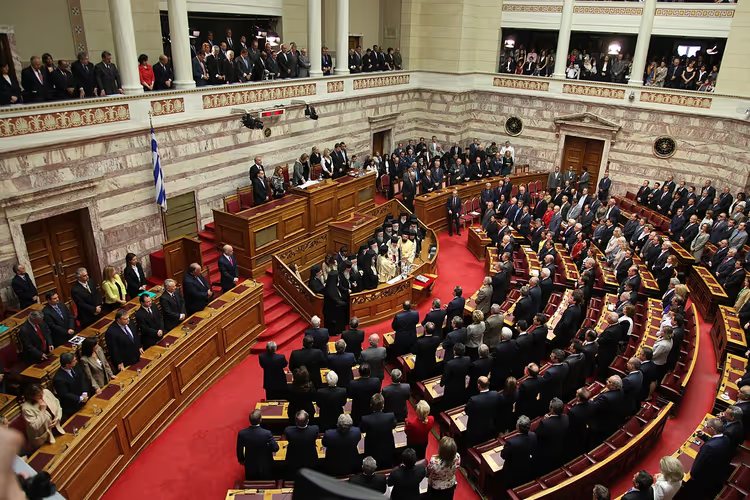
Voting in Greece is mandatory by law. Every citizen from the age of 17 is required to turn out for elections; this is written into the country's constitution (As of 09/2026, government services portal). The voting age was lowered to 17 in 2016. In practice there are no fines: sanctions for not voting were abolished, so turnout is driven by civic duty and party mobilization.
 © ΠΑΣΟΚ · CC BY-SAPhoto: ΠΑΣΟΚ, CC BY-SA (https://creativecommons.org/licenses/by-sa/2.0), Wikimedia Commons
The terrain here is rugged. Greece is crisscrossed by mountain ranges, which is why the country has no navigable rivers. Plains occupy only a small part of the territory; the rest rises into mountains. That is why roads go around the ridges, and between regions you will get there faster by plane or ferry.
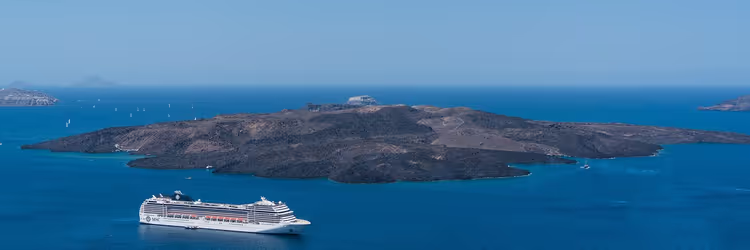
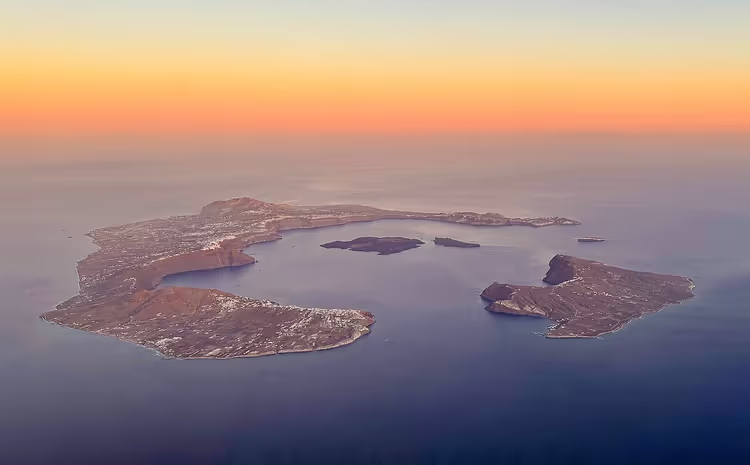
The country is not just the mainland. Greece owns about 6,000 islands, of which about 200 are inhabited (according to the official portal of Greece). The most famous islands are Crete, Rhodes, Santorini, Corfu, and Mykonos. Ferries run to the larger ones, while smaller ones are reached by boats and local planes.
In terms of education, Greece ranks among the European leaders. By the middle of the last century, most people here were already literate. Today, the vast majority of adults have completed their education (according to English-language Wikipedia). The Greek language has left its mark on half of European dictionaries: the words "theater," "music," "politics," and "philosophy" come from here, and you will understand them without a dictionary.
Legends and history
According to one legend, every Greek city had its own heavenly patron. The gods held entire contests for the right to watch over Athens. The dispute between Athena and Poseidon was settled by an olive tree: the goddess gave the city a tree, while her rival gave a spring of salt water. Victory went to Athena, and the olive became the symbol of the city.
There is another legend about the country itself. When God was creating the world, he sowed the earth through a sieve and threw the remaining handful of stones over his shoulder. That is supposedly how Greece appeared, with its rocks and islands.
 © A.Savin · CC BY-SAPhoto: A.Savin, CC BY-SA (https://creativecommons.org/licenses/by-sa/3.0), Wikimedia Commons
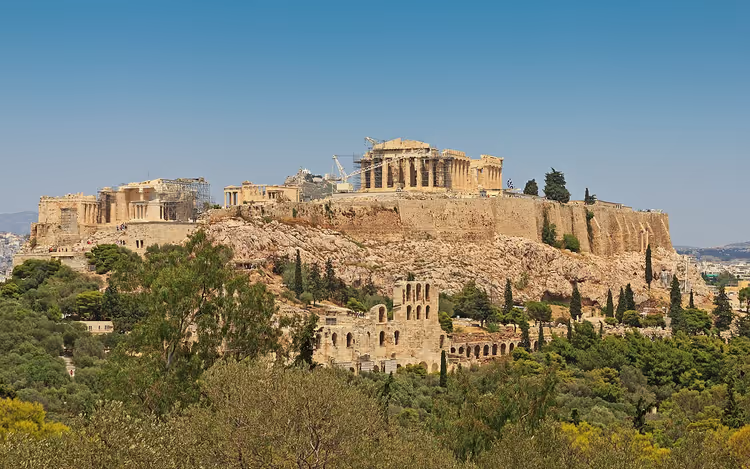
Athens is considered not only one of the oldest cities in the world but also the cradle of democracy. Politics, science, and philosophy were born here, and Greek thinkers made important discoveries in mathematics and physics. It is realistic to walk through these places in one day: we have already described a ready-made one-day Athens itinerary.
⁉️🤔 Frequently asked questions
What is the climate like in Greece and when should you go?
The climate here is Mediterranean: hot, dry summers and mild, rainy winters. For beaches, choose late spring or early fall, and April and October are good for visiting ancient cities (according to the Greek tourism office). At midday in summer, open excavation sites are very hot.
How many islands are there in Greece?
Greece has about 6,000 islands, of which about 200 are inhabited (according to the Visit Greece website). Crete, Rhodes, Santorini, Corfu, and Mykonos consistently rank among the most visited.
Is voting mandatory in Greece?
Formally yes: citizens can vote from age 17 (as of 09/2026, government portal). But there have long been no fines for not voting, so in practice nobody is punished.
Why is Greek marble so highly valued?
Stone from Greece stands out for its white background and fine grain, so it is easy to work and polish. Ancient craftsmen took blocks from the quarries of Penteli, Paros, and Naxos (according to an industry stone review). Today some of the output goes for export, and some for restoring monuments.
Is it true that Greece has the most airports in the world?
By the absolute number of airports, Greece trails the US and Brazil, so the "world record" is an exaggeration. But relative to its area and population, the country is covered by a very dense network of airfields (according to the Visit Greece portal). Dozens of islands receive regular domestic flights, and a flight between islands takes less than an hour.
In short: what to remember about Greece
In Greece, history lies literally underfoot, and geography dictates the route. There are many islands, so connections between points depend on ferries and the season. Plan your trip in advance and do not try to cover everything in one week.
- If ancient sites matter to you: allow several days for Athens.
- If you want a beach vacation: choose the islands in late spring or early fall.
- If myths interest you: read them in advance, then the ruins will tell you more.
For a ready-made plan for your first day in the capital, see the Athens guide.

A small editorial team writing guides for independent travel. We travel ourselves, but we haven’t been everywhere, so we check prices, opening hours and how to get there against official sources.