
















Israel by train: tickets, Shabbat and routes from the airport
Israel is small, and the train here is often faster than the bus. The Israel Railways network connects Ben Gurion Airport, Tel Aviv, Jerusalem, Haifa, Akko, and Nahariya. Tickets cost noticeably less than in Germany, and you spend just one or two hours en route. This guide explains how to buy a ticket, how the Rav Kav card differs from a paper ticket, what to do on Shabbat, and which sections are worth riding at least once.
Ad: this article contains affiliate links. We earn a commission if you book through them, at no extra cost to you.
By train across Israel: fast and affordable
💡 In short:
- Trains connect the airport, Tel Aviv, Jerusalem, Haifa, Akko, Nahariya, and Be'er Sheva.
- Tickets are bought at the station or loaded onto a Rav Kav card. There is no online seat reservation.
- From Friday evening to Saturday evening, trains do not run at all.
- Schedules, prices, and baggage rules: as of 09/2026, verified on the official Israel Railways schedule.
Israel Railways covers almost the entire country. Trains run from north to south along the Mediterranean coast and head inland to Jerusalem and Be'er Sheva. There is no branch line to the Dead Sea resorts, so you take a bus to get there. The same bus is needed on the way to Sinai.
Service here is frequent. On main routes, trains run every 15-30 minutes. Between Tel Aviv and Haifa the interval is even shorter, and at night service stops almost everywhere. Punctuality is considered the norm by the operator, so you will rarely encounter a delay of more than ten minutes.
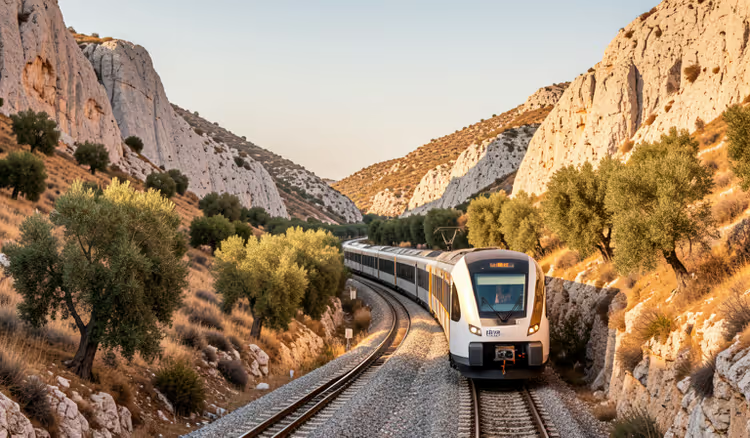
The ride itself doubles as a sightseeing tour. The old line to Jerusalem via Beit Shemesh and Malha station is especially scenic: the train leaves the coastal plain and slowly climbs into the mountains along a winding route. Jerusalem sits at an altitude of about 800 meters, so it is usually cooler there than on the coast (according to the trip planner, as of 09/2026).
Heading north, the train runs along the sea, and you see the water almost the entire time. The line ends in Nahariya, right at the border with Lebanon. Along the way you pass Binyamina, Caesarea, Haifa, and Akko, which is half of the country's main tourist destinations.
 AIIllustrative image: AI-generated
Next we will talk about the fleet, tickets, and specific routes. First, let's look at what you are actually riding on.
What trains run in Israel
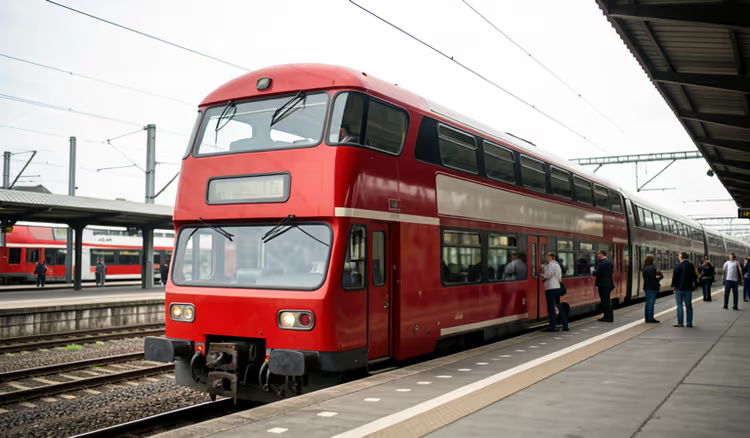
Three types of trainsets operate on the lines. These are blue single-deck cars, Danish IC3s, and red double-deck cars built at the Bombardier plant in Görlitz. All of them are clean and comfortable.
Traction comes from diesel locomotives that accelerate trains to 160 km/h. The network is gradually being converted to electric power. The first electrified section was the high-speed line from Tel Aviv to Jerusalem, opened in 2018. It is the fastest route in the country (according to the Israel Railways network, as of 09/2026).
 AIIllustrative image: AI-generated
Electrification is proceeding in stages, so diesel trainsets still operate on some lines. This does not affect comfort: the cars are equally well maintained along the entire route.
The Danish IC3s are easy to recognize. They have a sloped front end and a smooth, even ride. The red double-deck cars are taller than the others, so from the upper level you get a better view of the landscape. Blue single-deck trainsets are more common on older sections.
All three types run on the same tickets. There is no price difference between them, so you will not need to choose a trainset. If the view matters to you, sit by the window on the upper level of a double-deck car.
Trains are serviced at depots across the country, so the schedule remains stable. Breakdowns are rare, and on main lines you almost never encounter cancellations.
Seats on Israeli trains
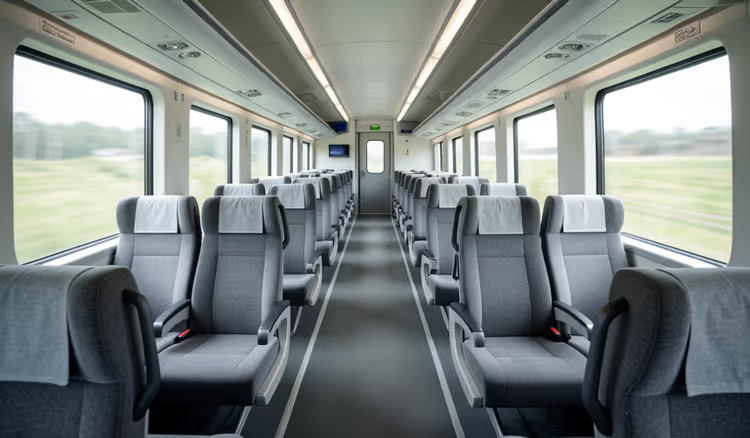
There is one class on the trains. The layout is 2+2, often with groups of four seats facing each other. The seats are comfortable, although they do not reach ICE level. It is more like the level of a regional RE train in Germany.
 AIIllustrative image: AI-generated
You usually do not need to reserve a seat. Each trainset has one car with reserved seats, but outside rush hour you can always find a free seat. A reservation only makes sense for a family or a large group. You can sit in any free seat.
During rush hour the cars fill up, especially on the coastal line between Tel Aviv and Haifa. Trains run frequently, so you can easily skip an overcrowded trainset and take the next one. You keep your luggage next to your seat: there are few luggage racks in the cars.
For a family, a group of four seats facing each other is more convenient. It fits backpacks and a stroller. A single window seat is better for a short trip when you are traveling light.
A reservation is worth making on the eve of major holidays, when the whole country travels to visit family. On a regular day, you save time at the ticket office and simply sit in any free seat.
Wi-Fi, outlets, and bringing a bicycle
There are outlets at the seats, the toilets are clean, and Wi-Fi is free. The internet does not work perfectly, but on Deutsche Bahn trains it is often worse. Domestic trips are short, so there is no dining car and no night trains here.
You bring your bicycle for free. A folding bike counts as regular hand luggage. A full-size bike goes on the rack by the door, where there are two or three spots. Bike transport hours depend on the day: from Sunday through Thursday, bicycles are allowed only from 9 to 15 and from 19 to 6 in the morning, on Friday you can ride with it all day, and on Saturday transport is prohibited (as of the bicycle transport rules, 09/2026).
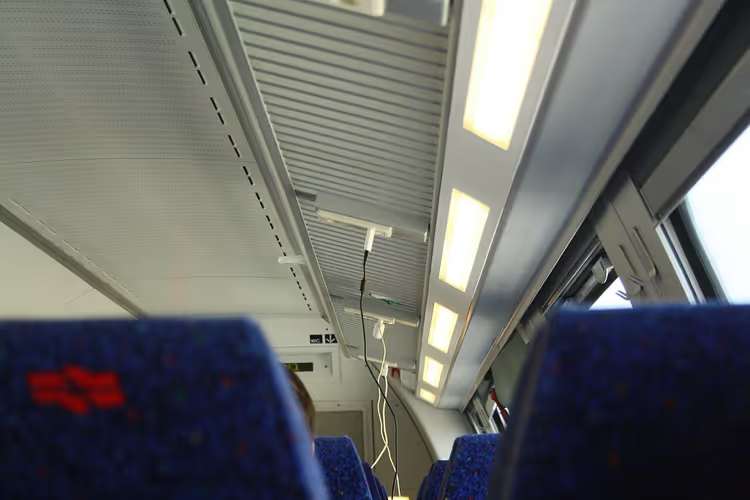 © Geogast · CC BYPhoto: Geogast, CC BY (https://creativecommons.org/licenses/by/4.0), Wikimedia Commons
In summer, trains resume service on Saturday evenings, so a cyclist should plan the trip for Sunday or a weekday.
Safety at stations and on trains
At the station entrance, you pass through a metal detector. A staff member briefly checks your backpack, and sometimes luggage is scanned. The check goes quickly and takes almost no time.
In the cars, you will see soldiers, often with weapons. This is not a sign of danger. They are traveling to or from service and use the train for free. Train travel in Israel itself is safe, so don't be put off by the military uniforms around you.
The screening at the entrance is not tied to any specific threats. It is standard procedure for Israeli transport, so take it in stride.
The weapons carried by soldiers are always unloaded and secured, so they are none of your concern. In the evening, stations are patrolled by staff, and you are never left alone on an empty platform.
Tickets: Rav Kav or a paper ticket
A ticket in Israel comes in two forms. It is either a regular paper ticket or the electronic Rav Kav card. Both work on the same trains, so the choice depends only on the length of your trip.
Rav Kav is a smart card that you load with money. At the station, you tap it on entry and exit, and the system automatically deducts the fare. The card gives discounts to seniors and students at Israeli universities.
Tourists can get the card without any issues. You can get a Rav Kav at the ticket offices at Savidor, HaShalom, and University stations in Tel Aviv. Bring your passport for registration (as of the Rav Kav card, 09/2026). You can top up the card at a machine at any station, so you stay in control of the balance.
If you are traveling in transit, a regular ticket is simpler. It requires no registration and leaves no balance on the card. For a single trip to Jerusalem or Haifa, a paper ticket fully covers the need.
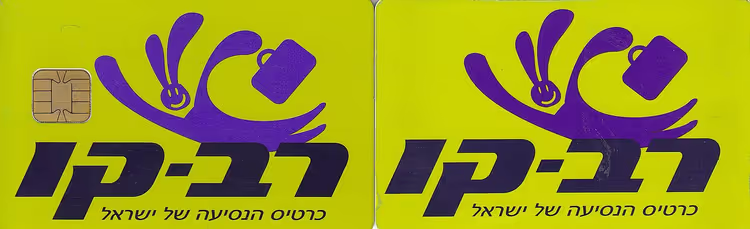 © Umclidet · CC BY-SAPhoto: Umclidet, CC BY-SA (https://creativecommons.org/licenses/by-sa/3.0), Wikimedia Commons
No train binding and fixed prices
The station has ticket gates. You scan your ticket before boarding, and at the destination station you scan it again. Sometimes a conductor checks tickets right in the carriage.
There is no binding to a specific train. You buy a ticket for a particular route, for example from Tel Aviv to Haifa, and board any suitable train. Prices on routes are fixed, so the local fare is closest to Deutsche Bahn's flexible Flexpreis fare.
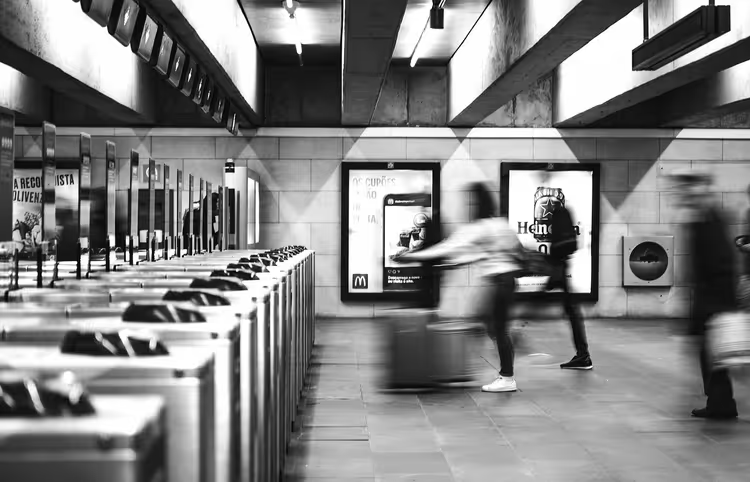
Travel within the country is inexpensive. You can find the exact price for your station pair on the fare calculator (as of 09/2026). Discounts are available for children, students, and seniors. A ticket for a long-distance route across the entire country costs about the same as what you would pay in Germany for a short trip.
Passenger rights apply in case of delays. A delay of 30 to 60 minutes entitles you to one free trip, and if the delay exceeds an hour, you receive two free tickets (the procedure is described on the Israeli government services portal, 09/2026). Claims are processed right at the station ticket office, and the voucher is issued on the spot.
Where to buy a ticket: ticket office or machine
The easiest way is to buy a ticket right at the station. You can do this at a ticket office or at a machine.
Ticket office staff speak English well, so it is easy to communicate. You can also return a ticket at the office if your plans change. This is convenient when you have not yet decided whether you will travel north today or tomorrow.
The machines also switch to English and work intuitively. First you choose your destination, for example from Tel Aviv to Akko. Then you specify who the ticket is for (adult or child) and what kind of trip you need: one-way "Single Ride" or round trip "Round Trip". The machine prints a separate ticket for each passenger. Do not forget to take it from the gate: you will need the ticket again at the exit.
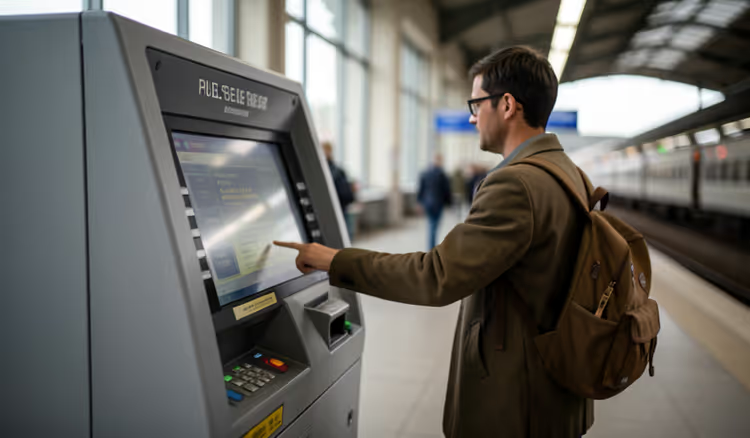 AIIllustrative image: AI-generated
You can pay in cash or by card, and contactless payment works in some places. There is also a combined ticket that includes a bus connection: it is cheaper than two separate tickets. You can also top up your Rav Kav at the machine.
Online: Israel Railways route planner
There is no convenient online ticket booking in Israel yet. Online, you can only load trips onto your Rav Kav. However, the carrier's website has a full overview of routes and prices, and you still pick up the ticket itself at the station.
The calculator works like a Journey Planner. You select the departure station, destination station, date, and time, then press search. The system shows available connections, the exact route, and transfer points. After selecting a connection, it shows the price and asks you to specify the type and number of tickets. You can print the total amount.
The planner is useful even before your trip. You can use it to check whether connections line up when transferring and how much time the journey will take. At the station, you can also pick up a printed mini schedule, which helps if the internet does not work during the trip.
Rail routes in Israel
The country has four main lines. The Coastal line connects Nahariya with Haifa, Tel Aviv, and Be'er Sheva. The High-speed line runs from Tel Aviv through Ben Gurion Airport and Modi'in to Jerusalem. The Valley line links Haifa with Afula and Beit She'an. Another line runs along the east of the country.
The lines have their own colors, but you shouldn't rely on them. Not all northbound trains stop in Hadera, for example: only the orange line does. Go by the train number, that way you'll find the right train on the departure board faster.
From Friday evening to Saturday evening, service comes to a halt. On Shabbat, neither trains nor state-run buses operate. To travel across the country during these hours, you switch to sheruts. That's the name for private minibuses: they run every day and are inexpensive. In larger cities they also replace night buses (see Shabbat schedule data, 09/2026).
On other days, intervals on the main routes are 15-30 minutes. Between Tel Aviv and Jerusalem, trains run frequently, with morning and evening peaks.
The Coastal line is the longest. The High-speed line is short, but it's the fastest and most modern. The Valley line heads into the green Galilee.
On holidays the schedule differs from the usual one, so check the planner in advance.
Tickets and train connections across the country are easy to check on the Trip.com trains page.
How to get from Ben Gurion Airport
The airport lies outside Tel Aviv, almost halfway to Jerusalem. The train from here is faster than a car, because the highway between the cities is often jammed.
To central Tel Aviv you ride for about 15 minutes. Trains leave roughly every 30 minutes, so you won't have to wait long. Get off at Savidor station if your destination is Tel Aviv: the central bus station is nearby. From there you can easily reach your hotel or Jaffa.
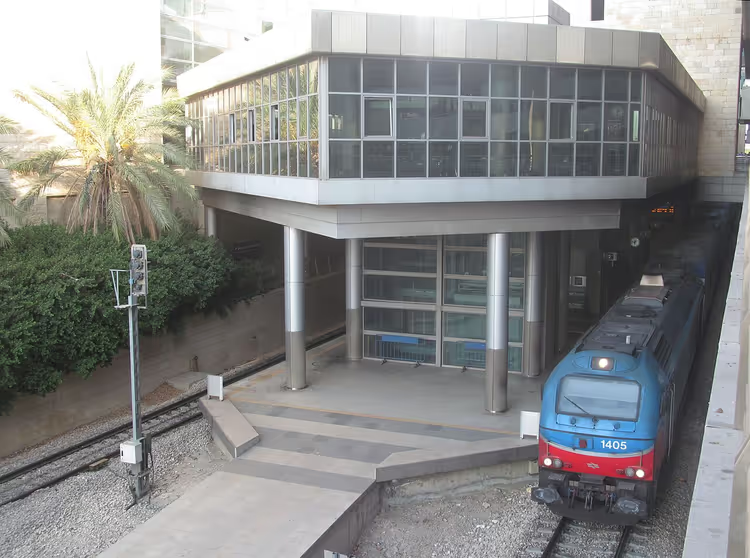
Getting to Jerusalem is simpler than five years ago. The High-speed line runs from the airport straight to Yitzhak Navon station. The trip takes about 26 minutes, and the train runs once an hour (according to station departure board data, 09/2026). A transfer in Tel Aviv is no longer necessary.
As soon as you leave the arrivals terminal, look for the yellow train signs. They lead straight to the station platform. Buy a ticket from a machine, then board a train heading toward Nahariya: it stops at all Tel Aviv stations. The board at the airport also shows departures in English.
At night, service is suspended. If your flight lands late, check the first train after Shabbat or a holiday. The station has ticket machines and a ticket office, and staff speak English.
Check the price in advance on the carrier's fare table (as of 09/2026). A taxi to the center will cost several times more, and the bus is slower than the train.
If your first stop is Tel Aviv hotels, it's worth comparing options in advance: you can easily check hotel prices in Tel Aviv before you even leave the terminal.
Train from Tel Aviv to Jerusalem
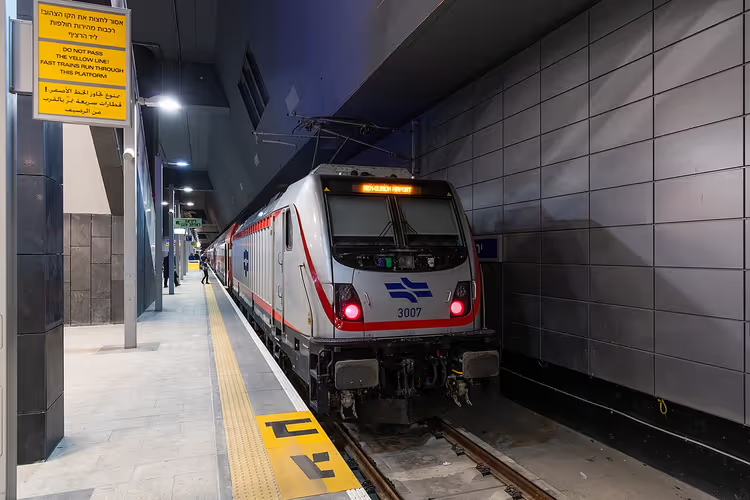
The most scenic section of the network is considered to be the old line to Jerusalem via Malha station. There the train climbs in switchbacks through the Judean Mountains. The city greets you at an altitude of about 800 meters, so it's cooler here than by the sea (according to the Jerusalem guide, 09/2026).
 © Ilya Varlamov · CC BY-SAPhoto: Ilya Varlamov, CC BY-SA (https://creativecommons.org/licenses/by-sa/3.0), Wikimedia Commons
The High-speed line has cut the trip to just over half an hour. It ends at the underground Yitzhak Navon station, which opened in 2018. From there you go down to the tram and reach the Old City in a couple of stops.
The old line still operates and arrives at Malha station on the outskirts. High-speed trains go to Yitzhak Navon, and that saves you a transfer. From the station to the Old City there's a tram, and the Mahane Yehuda market is an easy walk. For an overnight stay in the capital, choose an area near the tram line: Jerusalem hotels are best booked before your trip.
From Tel Aviv, the train departs from several stations. The most convenient starting point is Savidor station: it has the best connection to city transport. Near HaHagana station is the central bus station, where bus 41 leaves for the Jaffa clock tower. You board at University station if you're staying in the north of the city.
Beit Shemesh lies on the old line via Malha; high-speed trains don't pass through it. Arrive at the station early: you lose ten to fifteen minutes at the turnstiles and security check.
From Yitzhak Navon station to the Old City, the tram is the most convenient option. It approaches Jaffa Gate, from where you enter the maze of streets directly. The route to Damascus Gate goes through the central bus station.
The Mahane Yehuda market lies on the way from the station. If you arrive in the morning, it's worth stopping here right away: by midday it's already crowded. Locals and visitors alike come here for fresh produce and street food.
In the morning, trains from Tel Aviv run most frequently. An early start saves you half a day in the city, and in the evening you can comfortably return on the last train.
Trains to Haifa, Acre, and Nahariya
Northbound trains run along the coast to Nahariya. Binyamina, Caesarea, Haifa, and Acre flash past under the wheels. The scenery here is simpler than on the line to Jerusalem, but you see the sea for almost the entire journey.
The drive from Tel Aviv to Nahariya takes about 1 hour 45 minutes. Haifa and Akko lie along the way, so the trip to them is shorter (as of travel times on the carrier's website, 09/2026). Not all trains stop at every station, so sometimes a transfer is required.
Trains on this route run about every half hour. If you're going to Akko or Haifa, take a train that stops at both stations. These runs are more convenient for tourists and don't require transfers.
Haifa: an underrated city
Haifa sits on the slope of Mount Carmel and descends in terraces toward the port. Many tourists stop here for a couple of hours and leave after taking a photo at the Bahá'í Gardens. That's a mistake: the city deserves a full day.
Haifa's main attraction is the Shrine of the Báb and the terraced Bahá'í Gardens. They descend in nineteen levels and are open to visitors free of charge, but only during certain hours. Below lie the Templer houses, built in a southern German style. Biblical verses in old German can still be read above the entrances.
If you have time, take a look at the Arab neighborhood of Wadi Nisnas. Markets and small cafes operate there, and it's a completely different Haifa, nothing like the formal gardens.
HaShmona station stands next to Paris Square. From there you walk to the lower station of the funicular, which takes you up Mount Carmel. From the top, a panorama of the city and the Bahá'í Gardens opens up. Near the station stands a huge grain elevator, which also houses a museum inside.
The ascent up Mount Carmel takes a few minutes. From the top you see the entire bay, the port, and the garden terraces. In the evening the gardens are illuminated, so the walk to the upper terraces is worth saving for sunset.
A funicular runs between the lower city and the summit, which locals call the metro. It's short, but it noticeably saves energy on the climb. Walking up the steep streets is hard, especially in the heat.
If you have half a day, go down to the old port. Cafes and a market operate there, and nearby stand the restored quarters of the German Colony. It's a quiet corner away from the tourist trails.
Akko: the crusader city
Akko is one of the oldest cities on the coast. Its history spans several millennia, and the first written mentions date back to long before our era.
 © Dennis G. Jarvis · CC BY-SAPhoto: Dennis G. Jarvis, CC BY-SA (https://creativecommons.org/licenses/by-sa/2.0), Wikimedia Commons
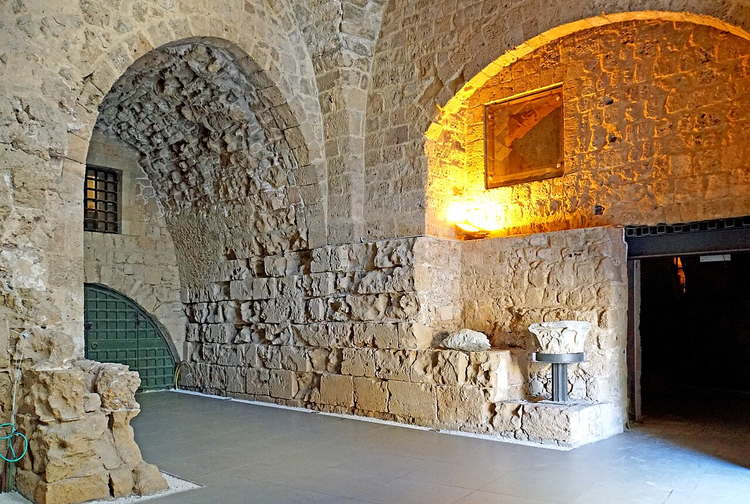
Akko is known primarily for the fortress structures of the Hospitaller order. They were discovered by accident during construction work, and today they are underground halls with very high vaulted ceilings. It is easy to imagine knights dining in these halls or spending the night in them. It is also worth walking through the Templar Tunnel: the underground passage leads straight to the harbor.
Akko station is about two kilometers from the Old City, on David Remez Street. The central bus station is nearby. You can walk to the sights in about half an hour or take bus number 3.
The Old City can be covered in half a day, and the underground halls are best visited in the morning, before tour groups arrive. The walls and towers face the sea directly, so bring water and a hat.
If Akko is on your itinerary, take a guided tour: Akko tours on GetYourGuide help you avoid getting lost in the underground halls.
Nahariya and Rosh HaNikra
Nahariya rarely makes it onto anyone's list of destinations. This city in the north of the country is primarily a transport hub. From here you travel to Rosh HaNikra, the northwesternmost point of Israel's Mediterranean coast.
 © Chadica from Jerusalem, Israel · CC BYPhoto: Chadica from Jerusalem, Israel, CC BY (https://creativecommons.org/licenses/by/2.0), Wikimedia Commons
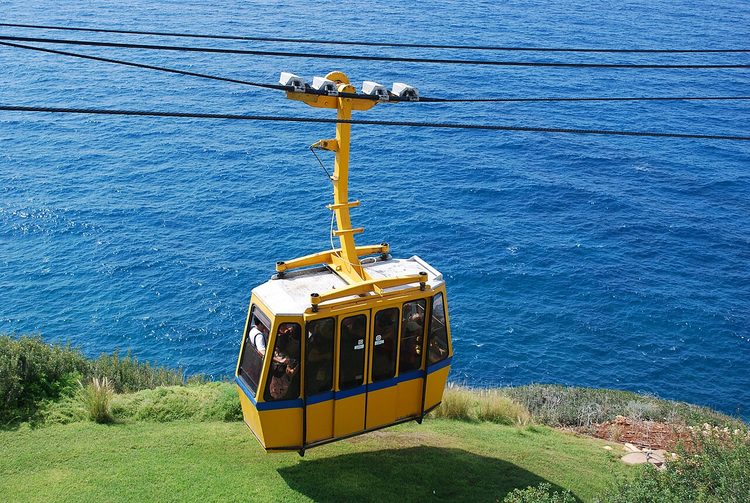
Rosh HaNikra sits right on the border with Lebanon. Crossing it is allowed only for UN peacekeepers, so you cannot go any further. But the grottoes and cliffs here are impressive: even Israeli couples come here for pre-wedding photos. A fairly steep cable car leads down to the grottoes.
Bus 31 runs from Nahariya station to the Rosh HaNikra parking lot, and the trip takes about 30 minutes. Keep in mind that the bus runs roughly once every 2.5 hours. If you miss it, you will have a long wait, so check the schedule in advance.
Trains to Afula and Beit She'an
In the fall of 2016, a line opened from Haifa through Afula to Beit She'an. During the day, trains run once an hour, and toward evening the interval shortens to 30 minutes. The ride from Haifa to Beit She'an takes 50 minutes.
Afula is convenient as a base for the Galilee. Buses leave from here to Tiberias on the Sea of Galilee: they run roughly every 40 minutes, and the trip takes an hour. Bus 365 goes to Nazareth, runs once an hour, and takes about 30 minutes. The stop is near the Church of the Annunciation.
There is also a shorter option for Nazareth. You take the train to Migdal haEmek station, and from there you get there by bus in under ten minutes.
⁉️🤔 Frequently asked questions
Do trains run on Shabbat?
No. From Friday evening until Saturday evening, service stops, and public buses do not run either. During those hours, the only option is a sherut, a private shared minibus that runs every day. Plan your transfer for Sunday or a weekday so you do not get stuck at the station.
Can I buy a ticket online?
There is no full online booking. Online you can only top up your Rav Kav card, while regular tickets are bought at the station. However, the carrier's website has a trip planner: it shows routes, transfers, and the price for the date you need.
Do I need to reserve a seat?
Usually not. Trains have a single class, and outside peak hours you can always find a free seat. Every train has a car with reserved seats, but you rarely need it. A reservation is worth getting for a large family or group when you want to sit together in the same car.
How much does a trip from the airport cost?
The price is calculated by the fare calculator on the Israel Railways website and depends on distance and zones. A trip to central Tel Aviv is inexpensive and noticeably cheaper than a taxi.
Can I bring a bicycle?
Yes, it is free. A folding bike counts as carry-on luggage at any time. A full-size bike goes on a rack by the door, where there are two or three spots. From Sunday through Thursday it is allowed from 9 to 15 and from 19 to 6 in the morning, on Friday all day, and on Saturday it is not allowed.
In short: what is worth booking
The train in Israel remains the easiest way to connect the airport, Tel Aviv, Jerusalem, Haifa, and Akko. Tickets are cheap, seat reservations are almost never needed, and the only service break is on Shabbat.
If you have three or four days: book a hotel in Tel Aviv and take the train north and to Jerusalem. If you are going for a week and want to see the Galilee: add a night in Haifa or Akko. It is convenient to compare accommodation in advance through hotel search on Trip.com.

A small editorial team writing guides for independent travel. We travel ourselves, but we haven’t been everywhere, so we check prices, opening hours and how to get there against official sources.