
















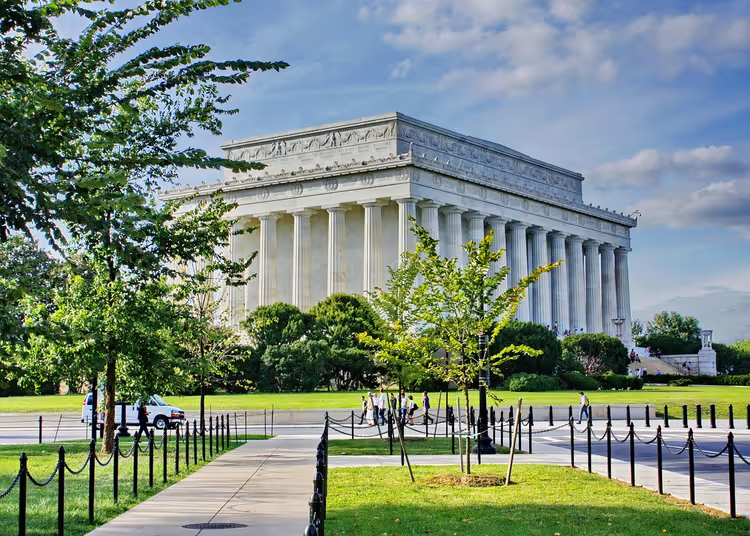
How to visit the Lincoln Memorial in Washington: entry, hours and key details
The Lincoln Memorial stands at the western end of the National Mall in Washington, D.C. The monument is open year-round. Abraham Lincoln sits in a marble chair, looking across the Reflecting Pool toward the Capitol. Millions of people come to these steps every year.
To see the memorial without rushing and crowds, you need three things: the right time to visit, a plan for what to see, and an understanding of what is fact here and what is legend. Below we have gathered the facts about the construction, the finishes, and the events that took place on these steps. Check dates and details on the official National Park Service website.
Ad: this article contains affiliate links. We earn a commission if you book through them, at no extra cost to you.
What the memorial is
💡 In short:
- Entry to the colonnade and the statue is free, no ticket required.
- Guided tours are paid separately; check the undercroft conditions on the NPS website.
- Plan for 40-60 minutes: the colonnade, the statue, and two tablets with speeches.
- Entry and hours: 09/2026, verified on the official NPS website
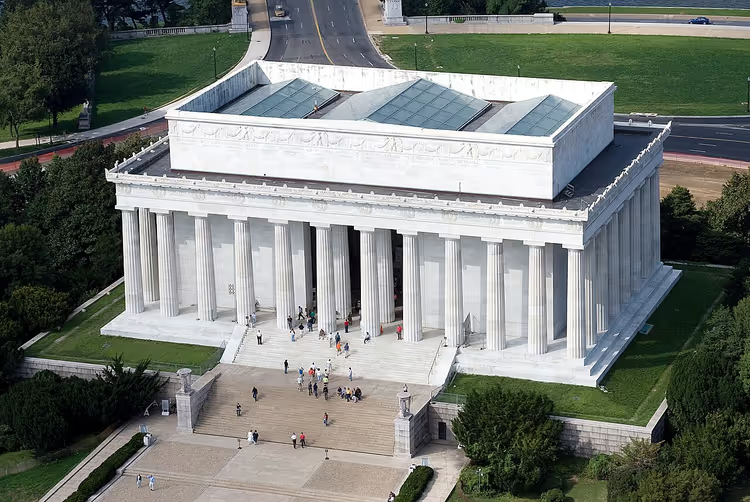
The Lincoln Memorial was built in the form of a Greek temple, with 36 marble columns around the perimeter, because that is exactly how many states were in the Union in 1865, when the president was killed (according to the National Park Service).
In the center of the hall sits Abraham Lincoln himself. The statue, nearly six meters tall, was assembled from 28 blocks of marble quarried in Georgia (according to the official memorial website). The seams between the blocks are fitted so precisely that you cannot see them from a few steps away.
The Gettysburg Address and the text of the second inaugural address are engraved on the interior walls. The names of the American states are carved on the outside, on the attic of the building. Many tourists walk past the tablets, yet they are exactly what explains why the building turned out so austere.
History of the memorial's construction
Immediately after the president's death, the U.S. authorities decided to build a memorial to him, and dozens of architects and sculptors submitted their designs to a closed competition. The winners were architect Henry Bacon and sculptor Daniel Chester French.
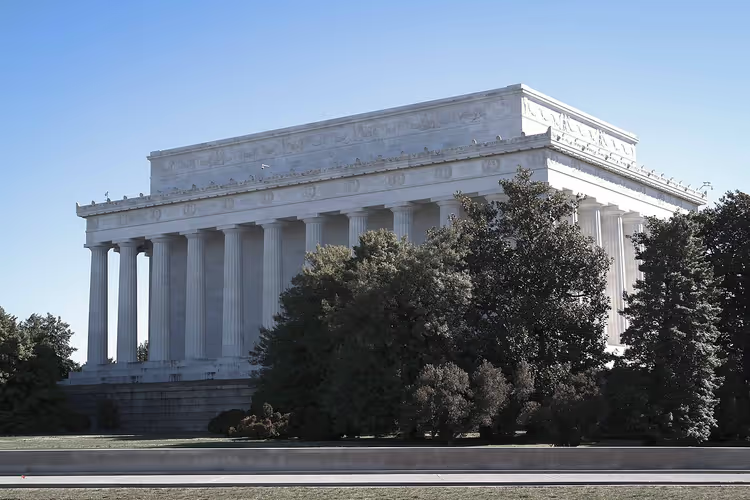 © Smash the Iron Cage · CC BY-SAPhoto: Smash the Iron Cage, CC BY-SA (https://creativecommons.org/licenses/by-sa/4.0), Wikimedia Commons
French created the statue, Bacon the building. Construction took eight years, from 1914 to 1922 (according to NPS). The idea was simple: to preserve the memory of the 16th president and to remind people of his belief in human freedom.
The dedication ceremony took place on May 30, 1922 (according to NPS). Tens of thousands of people came to the ceremony to hear speeches about Lincoln. That day the memorial became one of the key landmarks of the National Mall, and you can still see that role today.
Hours and admission
Entry to the colonnade and the hall itself is free, no ticket required (according to NPS). The memorial is open 24 hours a day, year-round, including holidays. There are no ticket offices or lines here, so you are not tied to a specific time.
Beneath the building is the undercroft, an underground section with the restored foundation. Check the memorial's official website for visiting conditions. If you are interested in engineering and underground structures, check them in advance. If you came for the statue, you can skip the undercroft.
The easiest way to get there is by metro. The nearest station is Foggy Bottom-GWU (according to NPS). The walk takes a noticeable amount of time, so pace yourself and bring water in summer.
Who it's for: those who want to see the main monument on the Mall without paying an entrance fee.
Not for: those looking for an interactive museum: inside there is only the statue, inscriptions, and columns.
If you want a guide to tell you the story of the statue and the steps, take a tour of the Mall.
Tours and tickets in Washington
Guided tours, skip-the-line tickets and activities — most offers can be cancelled free of charge.
See offers on GetYourGuideThe widget loads once you give your consent.
Interesting facts about the Lincoln Memorial
The most famous event happened here on August 28, 1963. On these steps, Martin Luther King Jr. delivered his "I Have a Dream" speech, heard by hundreds of thousands of people (according to NPS). Since then, the memorial has become a site for rallies and ceremonies, not just a tourist spot where people come for photos.
The second story comes from film. In the movie "Night at the Museum," the Lincoln statue comes to life right in the hall, and the viewer sees the familiar columns from inside. After the premiere, the memorial saw a noticeable increase in young visitors who come for a shot from the film.
City legends deserve a separate mention. One claims that on the back of the statue's head, the sculptor carved the face of General Robert E. Lee so that he would look toward his home in Arlington. This cannot be verified, and historians consider the story a fabrication.
The second legend concerns the hands. Supposedly Lincoln's left hand forms the letter "A" and his right hand the letter "L," his initials. It is reinforced by a rumor about the sculptor Daniel Chester French having a deaf son, but he had no son.
There is also a calendar detail. On February 12, Lincoln's birthday, Americans gather at the memorial and lay wreaths. If you happen to be here on that day, you will see a living ceremony, not just tourists with phones.
Other places in the US we have written about: Empire State Building, Brooklyn Bridge, and Times Square.
Lincoln Memorial on the map
The Lincoln Memorial closes the western end of the National Mall. It stands on the same axis as the Washington Monument and the Capitol, so it is convenient to visit at the end of a walk along the Mall. See the point for your navigator below.
⁉️🤔 Frequently asked questions
How much does it cost to enter the Lincoln Memorial?
Entry is free. Guided tours are paid separately. There are no ticket offices at the entrance, and you do not buy a ticket for the colonnade at all. Check the latest information about memorial hours on the official NPS website before your trip.
When is the best time to visit to avoid crowds?
Morning and late evening are calmer than daytime, when groups with guides move along the Mall. In summer there is little shade at the steps, so bring water and a hat during the day. In winter the memorial is open, but the wind from the river makes the walk colder than in the city center.
What should you definitely see inside?
Inside, two things deserve your attention: the statue made of 28 marble blocks and the Gettysburg Address on the wall. Outside, take in the proportions of the columns and the names of the states on the attic. All of this will take you 40-60 minutes at a leisurely pace.
Is it true that the face of Robert E. Lee is on the back of the statue's head?
No, there is no evidence of that. The story about the Confederate general looking toward his home in Arlington is considered an urban legend. There is a similar story about sign language, in which Lincoln supposedly shows his initials. Both tales should be taken as folklore, not fact.
How to get to the memorial from the metro?
The nearest station is Foggy Bottom-GWU. The landmark is simple: the white building on the shore of the Reflecting Pool. Save your energy for the walk back, as the Mall is long.
In short: what to book
The Lincoln Memorial is free, so what you should book is not entry but the experiences around it. If you have half a day: build your route along the National Mall and leave the memorial for the finale. If you have one evening: come at sunset for photos and do not waste time at a ticket office. If you are with children: shorten the route to the Capitol and the memorial so they do not get tired.
For those who want the story from a guide: National Mall tour on GetYourGuide.

A small editorial team writing guides for independent travel. We travel ourselves, but we haven’t been everywhere, so we check prices, opening hours and how to get there against official sources.