
















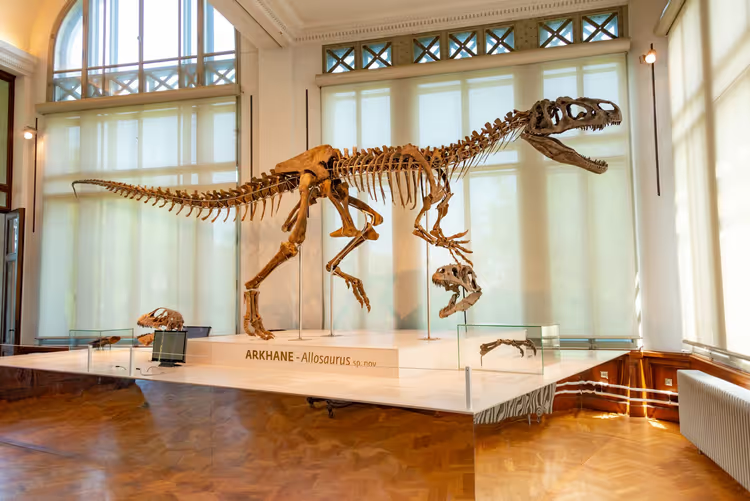
Dinosaur skeletons over the Grand Canal: why visit the Natural History Museum of Venice
Venice stands on water, and not all of its museums are devoted to art. On the Grand Canal, the Natural History Museum of Venice is open. Here you walk among dinosaur skeletons in a 13th-century palazzo.
The museum occupies the Fondaco dei Turchi palace in the Santa Croce district. According to the museum, it has operated here since 1923 and grew out of the city's old collections. Below is the practical information: what to see, how much admission costs, when the museum is closed, and how to get there from the train station.
Ad: this text contains affiliate links, we earn a commission from them, the price for you does not change.
Fondaco dei Turchi: the palace and the museum
💡 In short:
- The Natural History Museum of Venice occupies the 13th-century Fondaco dei Turchi palace on the Grand Canal.
- Main exhibits: the Ouranosaurus skeleton, the Sarcosuchus skull, and the Adriatic collections.
- Closed on Mondays; in summer the museum stays open later on Fridays and Saturdays.
- Prices and opening hours: 09/2026, verified on the official website.
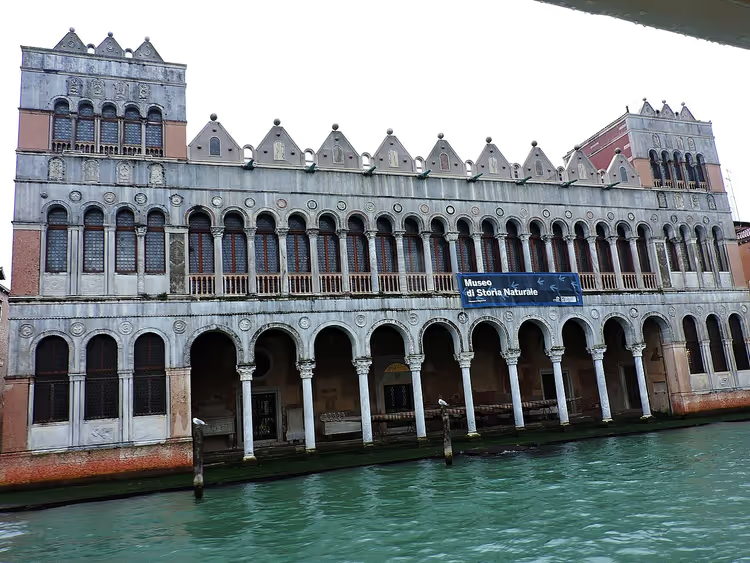 © Dimitris Kamaras from Athens, Greece · CC BYPhoto: Dimitris Kamaras from Athens, Greece, CC BY (https://creativecommons.org/licenses/by/2.0), Wikimedia Commons
The Fondaco dei Turchi was built in the 13th century for the Pesaro family. According to the museum's website, it is one of the oldest buildings in Venice. The palace stood right at the water's edge, so it also served as a trading house. At various times it hosted distinguished guests, including Pope Julius II and the Duke of Ferrara, Alfonso d'Este.
Later the palace changed owners several times. From the 17th century on, the name Fondaco dei Turchi stuck to it. In 1860 the city bought the building. After the 1880 restoration, the Correr Museum opened here, and it later moved to St. Mark's Square (museum page).
The vacated palazzo was given over to a natural history museum in 1923. The idea was simple: to show the nature of the region and the whole planet in one place. So skeletons, herbaria, and minerals took up residence within the walls of the old palace. Today it is a rare example of a museum that lives in an actual palace rather than a purpose-built structure.
What to see in the exhibition
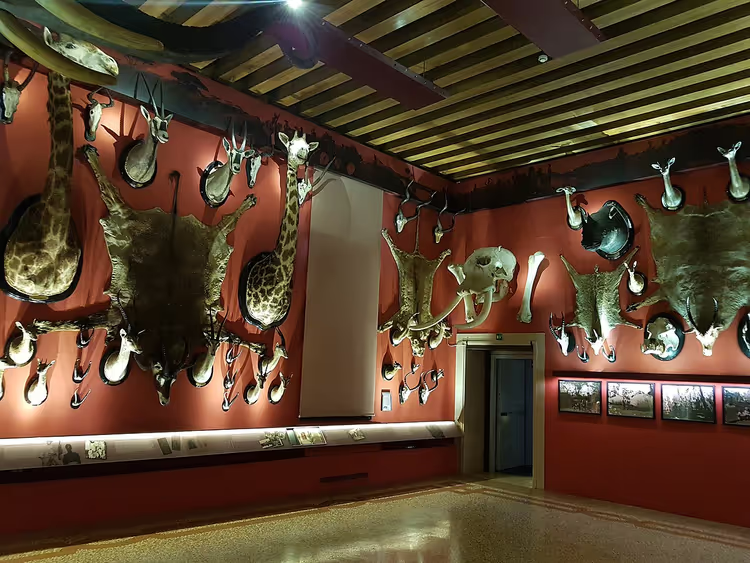 © Ricardalovesmonuments · CC BY-SAPhoto: Ricardalovesmonuments, CC BY-SA (https://creativecommons.org/licenses/by-sa/4.0), Wikimedia Commons
The exhibition covers the entire history of life on Earth, not a single topic. According to the museum, its holdings number millions of items, from skeletons of extinct animals to rare herbariums. The halls are divided by scientific field.
- Paleontology. Skeletons of dinosaurs and marine giants. Here you will find a Uranosaurus about 7 m long, discovered in 1973, and a Sarcosuchus skull. These finds are about 110 million years old (museum website).
- Botany. Herbariums and information about ancient plants that grew on the site of Venice long before the city existed.
- Zoology. Zoological collections on various topics, including a department of Adriatic marine fauna. In a large aquarium you will see invertebrates and fish of the local ecosystem.
- Anthropology. Visual materials on the skeletal and muscular systems of humans and animals. The development of life forms is shown through actual specimens.
- Mineralogy. Minerals, crystals, meteorite fragments, and gemstones. The planet's geological eras are presented in separate display cases.
- Ethnography. The culture and daily life of people, as well as a library that holds primary scientific sources.
In addition to the permanent halls, the museum hosts temporary exhibitions, seminars, and conferences. Some programs run in conjunction with city events. For those not traveling yet, there is a virtual format. But real skeletons and the aquarium are still more powerful than a picture on a screen, especially if you are traveling with children.
Tickets and opening hours
The museum is closed on Mondays. On other days it is open from morning until 5:00 PM, and in summer the schedule is extended. From May 1 to September 26, 2026, on Fridays and Saturdays the museum is open until 8:00 PM, with last entry at 7:00 PM (as of 09/2026, schedule page).
Parameter | Value |
|---|---|
Closed | Monday (official website) |
Standard hours | from morning until 5:00 PM, last entry one hour before closing (opening hours) |
Summer extension | Friday and Saturday until 8:00 PM, from May 1 to September 26, 2026 (schedule) |
Address | Santa Croce 1730, Salizzada del Fondaco dei Turchi (contacts) |
Ticket | better online, check the exact price on the museum website |
Admission is paid. Preschoolers enter free of charge, and a reduced rate applies to schoolchildren, students, and seniors. Check the exact prices on the museum website before your trip, because they are updated there. A ticket with a time slot is more convenient: you do not wait at the ticket office and enter at your chosen time.
Tickets and tours in Venice on Tiqets
Tours and tickets in Venice
Guided tours, skip-the-line tickets and activities — most offers can be cancelled free of charge.
See offers on TiqetsThe widget loads once you give your consent.
How to get there and where the entrance is
The museum is located in the Santa Croce district, on the Grand Canal. Address: Santa Croce 1730, Salizzada del Fondaco dei Turchi. From Santa Lucia station it is about 1.2 km, or a 15-20 minute walk (according to the map).
If you are traveling by water, get off at the San Stae vaporetto stop, line 1. This way you combine the trip with a ride along the city's main water artery. The palace rises straight out of the water, so you definitely will not miss the facade.
In front of the entrance there is a dock and a narrow street with cafes. You can walk there after exploring Santa Croce and then return the same way to the station. Bring water with you: in the heat, the road along the canal feels longer.
Venice natural history museum on the map
Check the museum's location on the map to plan your route from the station or from the dock.
⁉️🤔 Frequently asked questions
How much does a ticket to the Natural History Museum of Venice cost?
Admission is paid; check the exact price on the museum's website before your trip. Discounts and buying tips are collected in the "Tickets and opening hours" section.
What days is the museum closed?
The museum is closed on Mondays. For other hours and the summer schedule, see the "Tickets and opening hours" section (as of 09/2026, museum website).
How do I get to the museum from the train station?
From Santa Lucia station to the palace is about 1.2 km, a 15-20 minute walk (on the map). You can take vaporetto line 1 to the San Stae stop. The detailed route is described in the "How to get there and where the entrance is" section.
How much time should I allow for the visit?
The permanent galleries take about two hours. With children, allow more: they linger longer at the aquarium and the skeletons. If you are also going to a temporary exhibition, add about an hour. A weekday morning slot gives you a calmer visit without the crowds.
Is it worth going with children?
Yes, the museum is well suited for families. You can move between galleries and look at real dinosaur skeletons, not just pictures. The catch: some of the explanations are in small print, so young children will need you to retell them.
In short: what to book
If you have only half a day in Venice, put the museum in the morning: there are fewer people at opening, and you can view the paleontology galleries in peace. It is more convenient to buy your ticket online in advance, so you do not waste time at the ticket office.
With children, allow more time for the skeletons and the aquarium. Without children, a couple of hours is enough, and you will still have time for another museum the same day. Compare options and see tickets and tours in Venice on Tiqets.

A small editorial team writing guides for independent travel. We travel ourselves, but we haven’t been everywhere, so we check prices, opening hours and how to get there against official sources.