
















Olympic National Park: how much entry costs and where to see the rainforests
Olympic National Park lies in the northwest of the USA. It covers almost the entire Olympic Peninsula in Washington state, near the Canadian border.
Here, temperate rainforests, glaciers, alpine meadows, and the wild Pacific coast are all found in one place. The park is open year-round, and entrance fees and the seasonal schedule are collected in the section on entry and hours.
Below we have gathered practical details: how to get there from Seattle, where to pay for entry, how much a night in a campground costs, and what to see in different parts of the park.
Ad: this article contains affiliate links, we earn a commission if you book through them, at no extra cost to you.
Where Olympic National Park is located
💡 In short:
- The park is open 24 hours a day, year-round; the seasonal schedule is described in the section on entry and hours.
- Entry is paid; prices for a car, motorcycle, and pedestrian are collected in the table in the entry section.
- Prices and hours: 09/2026, verified on the official website
The park's history began with the proclamation of Mount Olympus National Monument in 1909. The area received national park status in 1938, under President Roosevelt (as of: 09/2026, NPS).
The Olympic Peninsula is cut off from the rest of the region by water and mountains. This isolation has made the local nature unlike that of neighboring states: plants and animals found nowhere else occur here. The Olympic, Coast, and Hurricane ranges run through the park, and they intercept moisture from the ocean.
The western slopes receive a great deal of precipitation, which is why the rainforests grow there. In area, Olympic is noticeably smaller than Yellowstone, but the landscape here changes every half hour of driving. The roads form a loop around the mountain massif, and you almost always return to Highway 101.
 © Wsiegmund · CC BYPhoto: Wsiegmund, CC BY (https://creativecommons.org/licenses/by/2.5), Wikimedia Commons
How to get to Olympic National Park
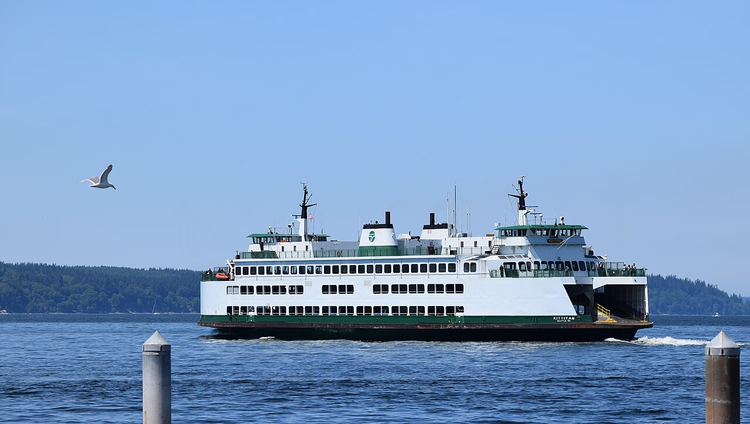
From Seattle, people travel to the park by car, by ferry across Puget Sound, or by plane. There is no public transportation between parts of the park, so a car remains the main option (as of: 09/2026, NPS).
The main entrance in the north is in Port Angeles: the road to Hurricane Ridge starts there. Farther west, near Forks, the routes to the Hoh Rainforest and the ocean coast begin. Driving between these points takes several hours, so allow a couple of days to see the park.
In winter and spring, some roads are closed because of snow, landslides, or repairs. The park publishes the latest update on its road conditions page, and a recorded weather message is updated daily at 360-565-3131.
Make your first stop at the visitor center in Port Angeles. There you can get a map, find out facility hours, and pick up the park newspaper with the ranger program schedule (as of: 09/2026, NPS).
 © Regan Fernbrook · CC BY-SAPhoto: Regan Fernbrook, CC BY-SA (https://creativecommons.org/licenses/by-sa/4.0), Wikimedia Commons
Entry, passes, and hours
Entry method | Price | Validity |
|---|---|---|
Private vehicle | $30 | 7 consecutive days |
Motorcycle | $25 | 7 consecutive days |
Pedestrian or cyclist age 16 and older | $15 | 7 consecutive days |
Olympic National Park annual pass | $55 | 12 months |
All prices verified in September 2026 (as of: official NPS price list). A vehicle pass covers everyone in the car, and children under 16 enter free. The park does not accept cash: pay by card at the entrance or in advance on Recreation.gov.
If you are visiting several national parks, America the Beautiful is a better deal. The pass costs $80 for US residents and $250 for international visitors, and there is a discounted option for citizens over 62 at $20 (as of: 09/2026, NPS).
In 2026, entry is free for US citizens and residents on holidays: February 16, May 25, June 14, July 3-5, August 25, September 17, October 27, and November 11 (as of: 09/2026, NPS). Free entry does not waive camping fees and permits, so plan your budget in advance.
The park itself is open 24 hours a day, but visitor centers and the Hurricane Ridge road are closed on Thanksgiving and Christmas. From October through May, some facilities operate on reduced schedules, so check hours by phone (as of: 09/2026, NPS).
Tours and tickets in Olympic National Park
Guided tours, skip-the-line tickets and activities — most offers can be cancelled free of charge.
See offers on GetYourGuideThe widget loads once you give your consent.
Rainforests, coastline, and glaciers
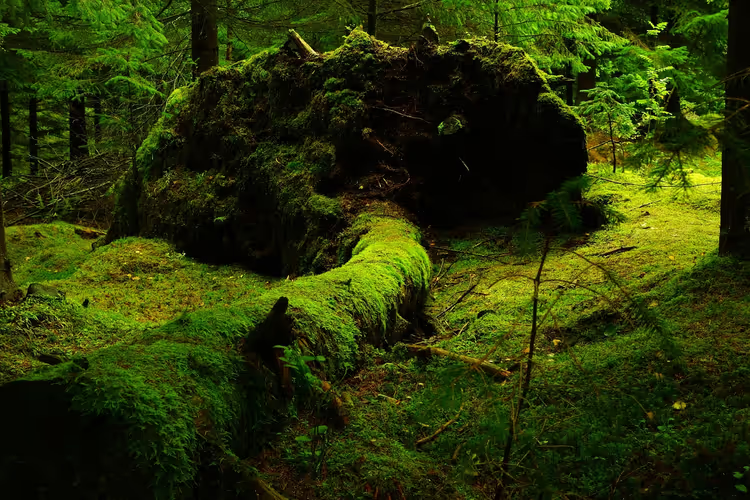
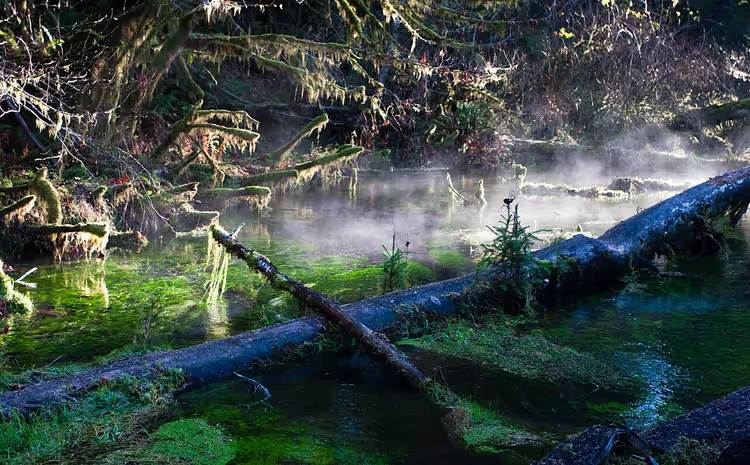
Temperate rainforests have become Olympic's signature feature. The tree species here are northern: Sitka spruce, hemlock, and bigleaf maple. High humidity on the western slopes gives the forest a tropical look: trunks are almost entirely covered in lichen and hanging mosses. A dense understory completes the picture. Allow extra time: you move through this kind of thick growth more slowly than you expect.
 © Reddit user PKThundr7 · CC BYPhoto: Reddit user PKThundr7, CC BY (https://creativecommons.org/licenses/by/4.0), Wikimedia Commons
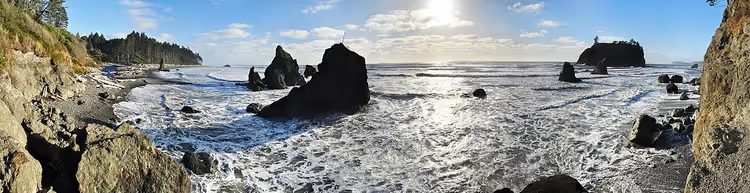
The park's coastline stretches along the Pacific Ocean in broad strips of beach. Do not expect golden sand here: rivers carry driftwood and plant debris onto the spits. Rangers deliberately leave the debris in place, because rotting logs sustain the beach ecosystem. A separate line of relief runs along the coast: sea stacks, striking rock formations in the tidal zone.
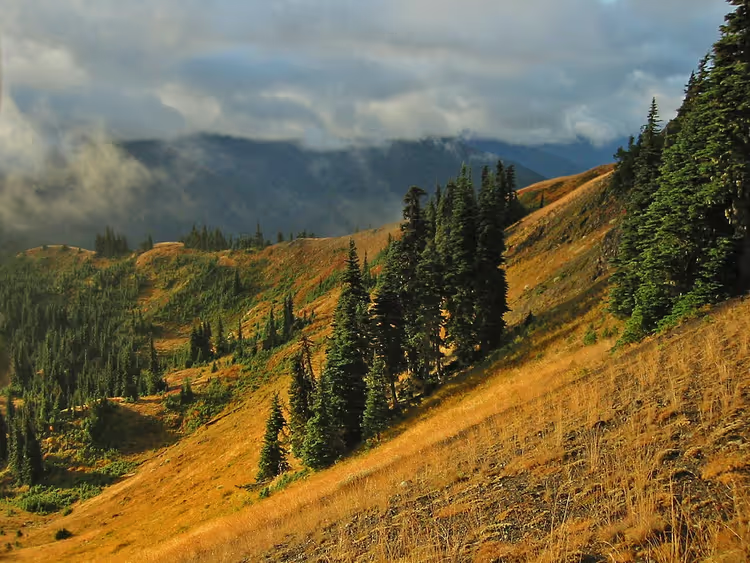
Higher up the slopes, the forest gives way to alpine meadows: trees thin out, then disappear and yield to grassy carpets. In July, mountain lupines bloom here. Glaciers lie in the upper reaches of the valleys: there are several dozen of them in the park, all small. Many feed rivers, which in turn drop over waterfalls. The most visited waterfall in the park is called Sol Duc Falls, and the largest river, the Hoh, flows through the most scenic of the rainforests.
Skiing at Hurricane Ridge
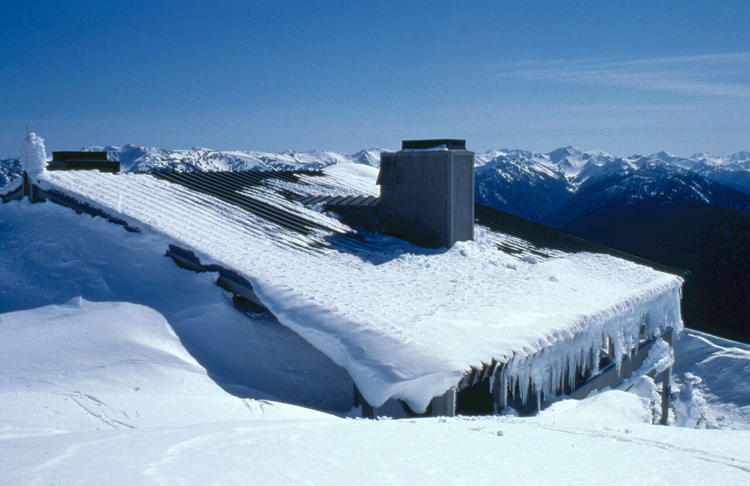
Winter in Olympic is long and snowy, and summer is short and cool. Hurricane Ridge has ski slopes with surface lifts, but the schedule depends on snow and weather: check the park report before heading out (as of: 09/2026, NPS).
In May 2023, the historic Day Lodge at Hurricane Ridge, built in 1952, burned down. The roughly 1,100 m² building has not yet been restored: a new lodge is in the design phase (as of: 09/2026, NPS).
- The catch: after the fire, there is no heated visitor center or cafe at the top, so bring a thermos and food with you (as of 09/2026, NPS).
In winter, look for lodging down below in Port Angeles: inside the park itself you can only stay overnight in campgrounds, and their seasonal schedule is described in the section on entry and hours (as of 09/2026, NPS). If you find yourself in Seattle in winter, set aside a day for Olympic under snow: the winter park deserves its own trip.
Summer activities: trekking, rafting, and camping
In summer, the park offers hiking routes of any length: from short walks through the rainforest to multi-day treks with overnight stays. Some trails lead out to the ocean coast, and you can walk along it for dozens of kilometers. This territory was once home to Native American tribes who were displaced by colonizers. You can learn about their culture at the museum and on trails that follow the old routes of the indigenous people.
 © Farwestern Photo by Gregg M. Erickson · CC BYPhoto: Farwestern Photo by Gregg M. Erickson, CC BY (https://creativecommons.org/licenses/by/3.0), Wikimedia Commons
For active recreation, the park offers rafting: floating down the river on an inflatable boat. The rapids here vary in difficulty, and the scenery changes quickly: mountain slopes give way to damp forest thickets.
The park's rivers and lakes are well suited for camping: from a picnic in a meadow to a multi-day trek out to the glaciers. A night in a developed campground costs from $15 to $24 depending on the location and season, and for backcountry overnight stays you need a wilderness permit at $8 per person plus $6 for the form itself (as of 09/2026, NPS).
⁉️🤔 Frequently asked questions
How much does it cost to enter Olympic National Park?
Prices for a car, motorcycle, and pedestrian are listed in the table in the entrance and passes section (as of 09/2026, NPS). A car ticket covers all passengers, so you don't need to pay per person. The park does not accept cash: keep your card handy.
When is the best time to visit Olympic?
Most visitors come from June through September: during these months, almost all roads and campgrounds are open (as of 09/2026, NPS). The park also operates in winter, and the seasonal schedule is described in the entrance and hours section. Rain falls here year-round, so a waterproof jacket is useful in any season.
How do I get there from Seattle without a car?
There is no public transportation between parts of the park, so without a car the trip becomes a chain of transfers (as of 09/2026, NPS). The easiest option is to rent a car in Seattle and take the ferry across Puget Sound to Port Angeles. Another option: a group tour from the city.
Where to stay in the park?
Developed campgrounds operate inside the park; their prices and the cost of a backcountry permit are listed in the summer activities section (as of 09/2026, NPS). Look for hotels and guesthouses outside the park, in Port Angeles or Forks.
What should I do if the road to Hurricane Ridge is closed?
Check road conditions before you leave: in winter and spring, the road is closed due to snow or repairs (as of 09/2026, NPS). On those days, head toward the western part of the park: trails run along the Hoh River and ocean beaches. Book lodging for those dates in Port Angeles or Forks.
In short: what's worth booking
You can't cover the entire park in one day: the roads are long, and distances between the north and west sides are measured in hours. If you only have one day, choose Hurricane Ridge or the Hoh Rain Forest, but not both.
If you're traveling with a tent, check campground operating dates: some are closed in winter, and summer spots get reserved well in advance. If you're planning several national parks in one trip, compare prices. America the Beautiful costs $80 only for US residents, while a foreign visitor pays $250. Entry to Olympic costs $30, so for a foreign visitor the pass only pays off on a long route through many fee-charging parks.
If you don't have your own car, check out day tours of the park on GetYourGuide.

A small editorial team writing guides for independent travel. We travel ourselves, but we haven’t been everywhere, so we check prices, opening hours and how to get there against official sources.