

















Rio de Janeiro in three days: 9 places, tickets and hours
Rio de Janeiro is not just about Carnival. The city stretches along Guanabara Bay between the ocean and the mountains, and in a single day you can see a beach, a peak, and the colonial center. We put together the places worth including in your trip, and added prices, hours, and honest catches for each one.
Over one and a half million people visit the Christ the Redeemer statue every year, so get there at opening time.
Ad: this article contains affiliate links. We earn a commission if you book through them, at no extra cost to you.
Christ the Redeemer statue
💡 In short:
- The statue stands on top of Corcovado inside Tijuca National Park.
- You can reach it by the Trem do Corcovado train, official minivans, or a hiking trail.
- Prices and hours: 09/2026, verified on the official Trem do Corcovado website
The Trem do Corcovado train runs along the oldest tourist railway in Brazil. It opened back in 1884 (according to the operator). The train climbs through the Atlantic Forest, and you get viewpoints along the way.
There are three ways to get up. The train departs from Cosme Velho station, minivans leave from the square nearby, and the hiking trail is free but requires preparation. From December to February, take a morning slot: after 11:00, bus tour groups arrive at the statue.
Attraction | Ticket | What to know |
|---|---|---|
Christ the Redeemer statue | R$ 134, train (as of 09/2026, source) | book your train slot in advance |
Sugarloaf Mountain | fares on the official website | two cable car stops |
Santa Teresa tram | fares at the station ticket office | tickets sold at Carioca station |
Botanical garden | tickets on the official website | thousands of plant species |
 © Andrew from New York, USA · CC BY-SAPhoto: Andrew from New York, USA, CC BY-SA (https://creativecommons.org/licenses/by-sa/2.0), Wikimedia Commons
The monument is regularly struck by lightning, so the Catholic Church always keeps a supply of stone for repairs. The summit itself opens up a panorama of the bay, the lake, and the surrounding mountains.
Below the statue lies Tijuca Park. It has the Dona Marta, Vista Chinesa, and Mesa do Imperador viewpoints, and a small waterfall rushes near the main entrance.
Sugarloaf Mountain
Sugarloaf Mountain (Portuguese: Pão de Açúcar) rises above the bay. The cable car has been operating since 1912, and its cabins were long ago replaced with modern ones (according to Parque Bondinho). The route has two stops.
 © Arne Müseler · CC BY-SAPhoto: Arne Müseler, CC BY-SA (https://creativecommons.org/licenses/by-sa/3.0/de/deed.en), Wikimedia Commons
First, the cable car takes you up to Urca Hill. At the top there is a walking area, local fast food, and plenty of monkeys. It is also worth going up to the helipad for a view of the bay.
The second stop leads to Sugarloaf itself. At the top there are several viewing platforms and a restaurant with a view of the entire city. Buy tickets in advance, otherwise on weekends you will stand in line at the ticket office for an hour: cable car tickets.
A helicopter tour over the bay is organized right at the foot of the mountain, but it is noticeably more expensive than the cable car.
Copacabana and Leblon beaches
After the peaks, head down to the water. Copacabana is considered the city's most famous beach and one of the busiest waterfronts in the world. It is always noisy and crowded here.

- The catch: Copacabana has a lot of pickpockets, so keep an eye on your bag.
Leblon is located in the safest neighborhood in the city and matches its neighbor in sand width. Families with children and locals after work come here.
 © Ermell · CC BY-SAPhoto: Ermell, CC BY-SA (https://creativecommons.org/licenses/by-sa/4.0), Wikimedia Commons
Historic center and the Cathedral of St. Sebastian
In Rio's historic center, you both see the city and keep an eye on your belongings. Here you will find the Municipal Theater on Floriano Square, the National Museum of Fine Arts, and the Tiradentes Palace. The Portuguese Royal Library deserves special attention.
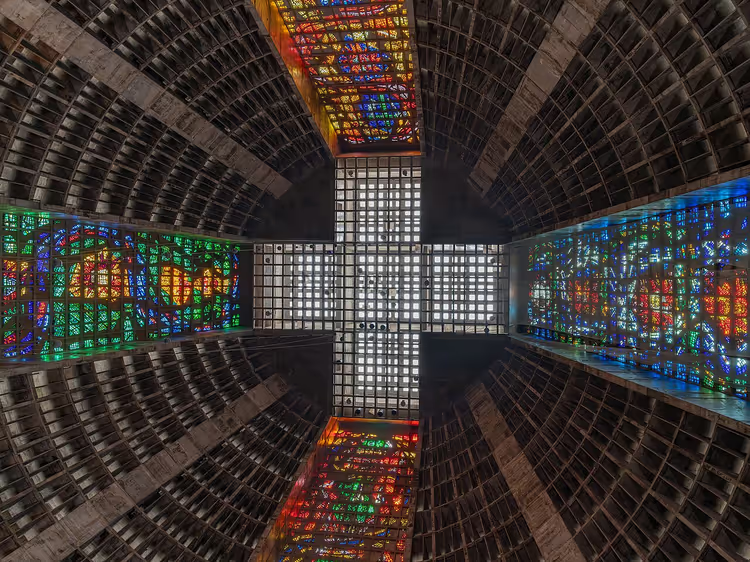 © Rjcastillo · CC BYPhoto: Rjcastillo, CC BY (https://creativecommons.org/licenses/by/4.0), Wikimedia Commons
The library opened in the first half of the 19th century and houses hundreds of thousands of volumes in halls with carved bookshelves. Further on you will see the Cathedral of St. Sebastian, which does not look like any other church.
The cathedral was built in the shape of a pyramid: architect Edgar Fonseca was inspired by Mayan temples. Four narrow windows from floor to ceiling flood the hall with colored light from stained glass. Admission is free, and it is worth stopping by even for half an hour.
Planning a day like this is easier with a guide: sightseeing tour of the historic center.
Santa Teresa tram
Not far from the cathedral is the station of the historic tram. The line was electrified more than a century ago, and it became the first electric tram line in South America. Tickets are sold at the Carioca station, and getting off there is mandatory. The tram runs from the center to the hilly neighborhood of Santa Teresa, and you can ride to the final stop or get off at any stop along the way.
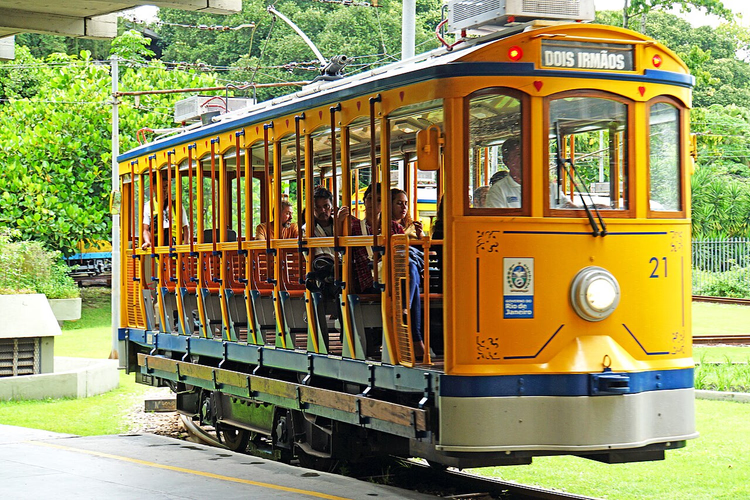 © Dennis G. Jarvis · CC BY-SAPhoto: Dennis G. Jarvis, CC BY-SA (https://creativecommons.org/licenses/by-sa/2.0), Wikimedia Commons
The Santa Teresa neighborhood itself looks like a postcard. There are bright graffiti, old houses, the smell of dinner from open windows, and a view of the mountains in the sunset light.
Selaron Steps
The Selaron Steps are called one of the most photographed staircases in the world. They were tiled with colored tiles by Chilean artist Jorge Selaron, and later travelers from all over the world brought mosaics from their countries here.
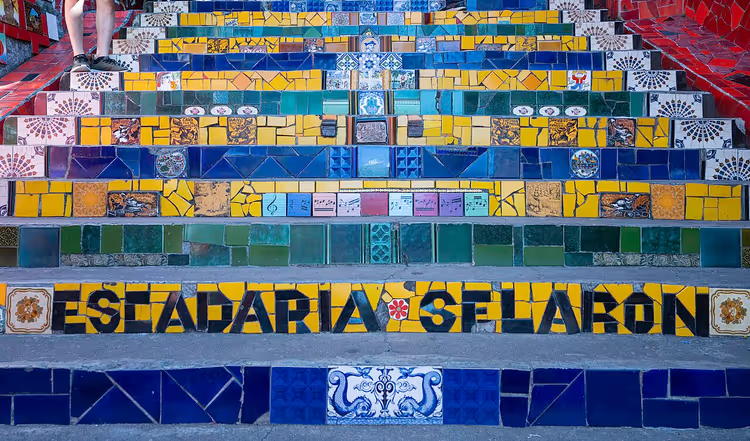
St. John the Baptist Cemetery
Among the unusual items on the itinerary is the St. John the Baptist Cemetery. People who made history in the country are buried here, and some of the gravestones have QR codes. By scanning the code, you can read the story of the person buried here.
 © Sturm · CC BY-SAPhoto: Sturm, CC BY-SA (https://creativecommons.org/licenses/by-sa/4.0), Wikimedia Commons
Rio Botanical Garden
After a packed itinerary, take a break in the Botanical Garden. Here you can combine a walk with viewing architectural landmarks and see thousands of plant species, some of them rare and endangered (according to the Jardim Botânico Institute).
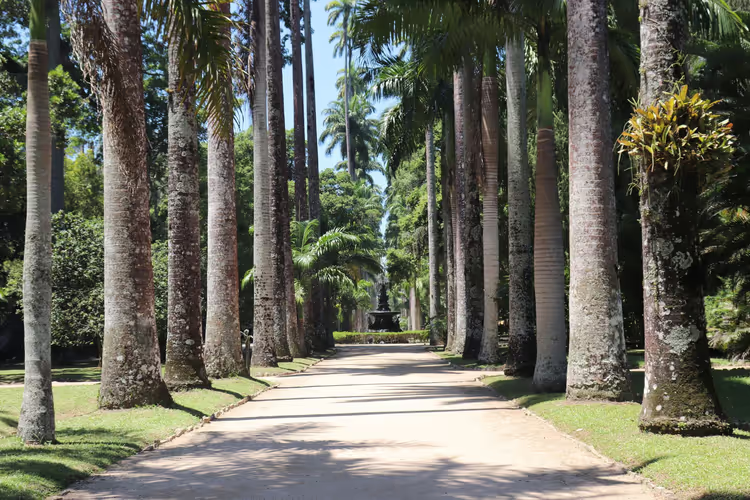
Rua dias ferreira street
The city's best food spots are gathered on Rua Dias Ferreira. Live music plays in almost every venue, and tables sit right out on the street.
 © Rafael Rabello de Barros · CC BY-SAPhoto: Rafael Rabello de Barros, CC BY-SA (https://creativecommons.org/licenses/by-sa/3.0), Wikimedia Commons
Stop by Boteco Boa Praça or Boteco Belmonte. The portions here are generous, and the bill is noticeably lower than at restaurants near Copacabana.
Be sure to try chopp. The drink is brewed without pasteurization. They will keep bringing you a new glass until you say no.
An evening like this is worth taking your time over: the street stays alive until late, and it is the best way to feel the city.
Tours and tickets in Rio
Guided tours, skip-the-line tickets and activities — most offers can be cancelled free of charge.
See offers on TiqetsThe widget loads once you give your consent.
⁉️🤔 Frequently asked questions
How much does it cost to go up to Christ the Redeemer?
An adult ticket for the Trem do Corcovado train costs R$ 134, a child ticket for ages 7-11 costs R$ 107 (as of 09/2026, official website). The hiking trail is free, but it takes more than two hours and requires good shoes.
Is it safe to walk around Copacabana?
During the day the waterfront is crowded and calm, but pickpockets work precisely in crowds. Do not take expensive jewelry or your phone to the beach unless necessary, and leave your belongings in the hotel safe. For a relaxed swim, head to Leblon instead.
Is it worth going to Rio if Carnival has already passed?
Yes. Carnival takes up only one week of the year, while the city lives around the clock. Christ the Redeemer, Sugarloaf Mountain, Santa Teresa, and the Selarón Steps are open in any month. From June to August there are fewer tourists and milder weather, so the lines are shorter.
How many days do you need for Rio's main sights?
Three days is enough for the main attractions. On the first day, go up to Corcovado and Sugarloaf Mountain; on the second, see the historic center and Santa Teresa; on the third, go to the beach and the Botanical Garden. For day trips to the surrounding area, add two more days.
Where can you eat cheaply in Rio?
Look for Rua Dias Ferreira. At places like Boteco Boa Praça or Boteco Belmonte you can get meat and draft chopp for reasonable money.
In short: what to book
- If you have two days: one trip to Corcovado and one to Sugarloaf Mountain.
- If you are going for photos: Santa Teresa and the Selarón Steps.
- If you are traveling with kids: Leblon and the Botanical Garden.
- If you are a foodie: Rua Dias Ferreira and a glass of chopp.
For overnight stays, choose a neighborhood that matches your itinerary. Rio de Janeiro hotels on Trip.com will show options near Copacabana and in the center, and book your airport transfer in advance through the transfer service.

A small editorial team writing guides for independent travel. We travel ourselves, but we haven’t been everywhere, so we check prices, opening hours and how to get there against official sources.