
















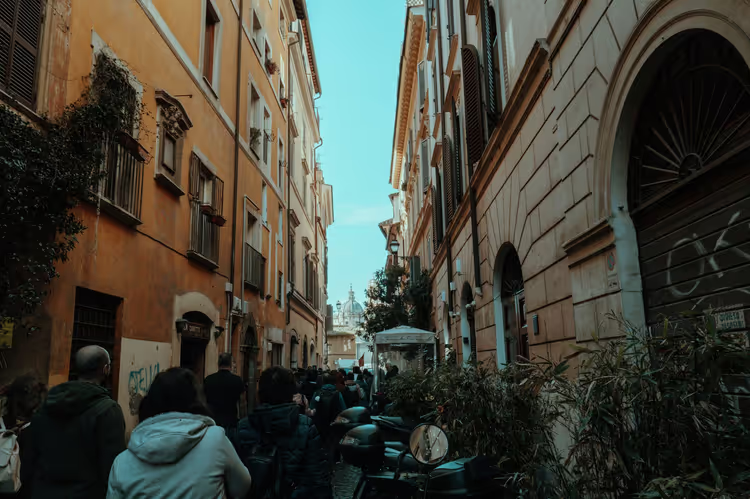
Langdon's six points in Rome: a walking route through the Illuminati sites
Robert Langdon's adventures can be experienced live in Rome. Six locations from the novel "Angels & Demons" are in the center and connected by a walking route. Only two of the six locations have paid entry.
The Pantheon, two churches, St. Peter's Square, Piazza Navona, and Castel Sant'Angelo are linked by the Illuminati clues from the book. Dan Brown mixed real facts with fiction, and the walk only benefits from that. Below is the order of the stops, the honest catches, and what you should know before leaving your hotel.
Ad: this article contains affiliate links, we earn a commission if you book through them, at no extra cost to you.
Step 1: The Pantheon and the false trail
💡 In short:
- The route is walkable in half a day, and the Pantheon is a convenient starting point.
- You only pay at the Pantheon and Castel Sant'Angelo; the churches and squares are free.
- The calmest time to start: a weekday morning before 10:00.
- Prices and hours: 09/2026, verified on the official Rome tourism website.
Stop | Main highlight | Entry |
|---|---|---|
1. Pantheon | Dome with oculus, Raphael's tomb | Paid |
2. Santa Maria del Popolo | Chigi Chapel, Caravaggio paintings | Free |
3. St. Peter's Square | Bernini's colonnades, obelisk | Free |
4. Santa Maria della Vittoria | Ecstasy of Saint Teresa | Free |
5. Piazza Navona | Fountain of the Four Rivers | Free |
6. Castel Sant'Angelo | Hadrian's mausoleum, Bridge of Angels | Paid |
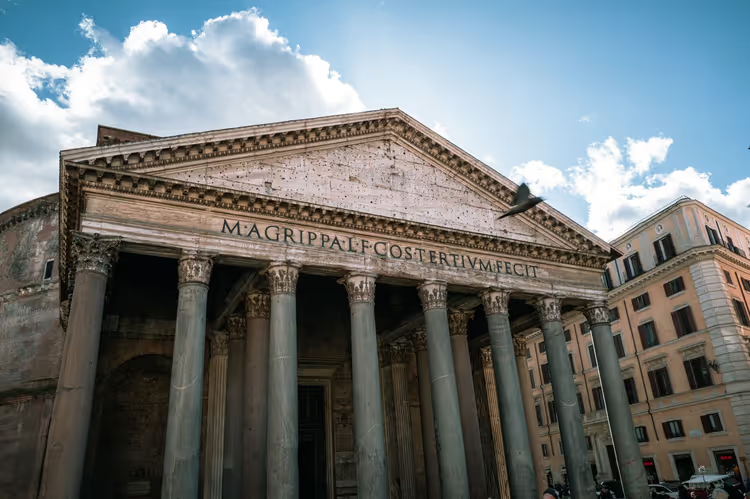
The first clue in the book goes like this: "Find the tomb of Santi with the devil's hole." Langdon got it wrong, but an attentive tourist understands: it's about Raphael Santi. His tomb is in the Pantheon, the temple of all gods, and that's where you go first.
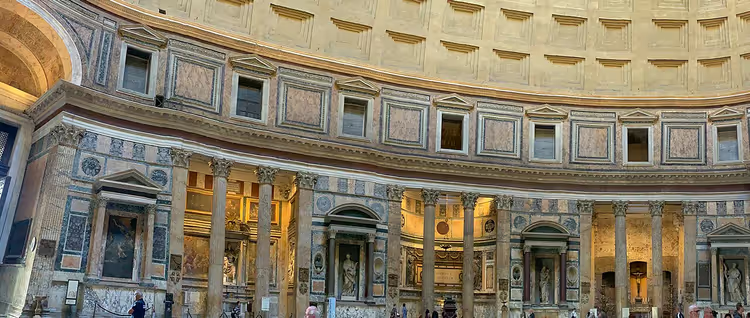 © Nicholas Hartmann · CC BY-SAPhoto: Nicholas Hartmann, CC BY-SA (https://creativecommons.org/licenses/by-sa/4.0), Wikimedia Commons
The Pantheon was built in 128 AD as a pagan sanctuary. Since the 7th century it has served as a Christian church, but its pagan past is immediately visible. The massive composition, strict earthly forms, and the mysterious hole in the center of the dome recall the ancient temple. That hole is what draws tourists with its otherworldly look.
In reality, the architects had a simple task. The oculus was designed so that the sun spent autumn and winter in the upper hemisphere of the building, and after the spring equinox the beam passed through the doorway. This gave the structure the meaning of the world's axis. Nobody summoned demons through that hole.
Inside the Pantheon are buried artists, thinkers, and members of the royal family of Italy, including Raphael. Here lies the answer to the false trail. In the novel, the artist's tomb was supposedly moved to the Pantheon later. In reality, Raphael was buried here immediately, in 1520. The hero's mistake becomes your first stop.
There is always a crowd at the Pantheon. The crowd, not the interiors, will take up most of your photos. Arrive at opening time while other tourists are still asleep: on weekdays and Saturdays the temple is open from 9:00 to 19:00, on Sundays from 9:00 to 18:00 (as of 09/2026, Turismo Roma).
- Cost: 7 €, for young people 18-25: 2 € (as of 09/2026, Rome tourism office portal).
- The catch: by midday the line stretches across the square in front of the temple.
Step 2: Santa Maria del Popolo
After realizing the mistake along with the professor, you head to Piazza del Popolo, which means "People's Square." According to the novel's plot, the church of the same name is the true starting point of the Illuminati path. In Dan Brown's version, Raphael was originally buried here. This is where the book's geography begins.
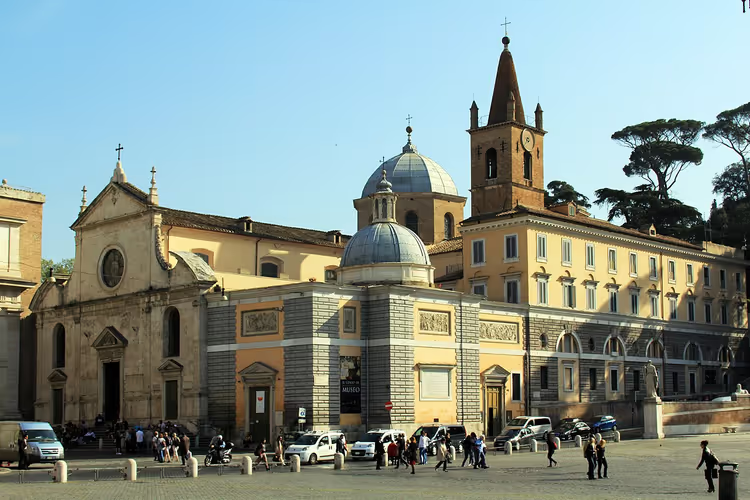
Why here specifically? Raphael is known as a painter, but he sometimes worked as an architect too. The church's exterior owes its look to Bernini, but the Chigi Chapel was designed by Raphael. In the book it is called the "Chapel of Earth," and the name points to a connection with one of the natural elements.
Santa Maria del Popolo is considered one of the darkest churches in Rome. Brown marble gives the interior an earthy tone. Skeletons peer out from the floor and walls, and the sarcophagi are decorated with two pyramidal obelisks, ancient symbols of eternity.
Don't rush away from the main altar. To its left hang two Caravaggio paintings: "The Conversion of Saint Paul" and "The Crucifixion of Saint Peter." Above the altar is "The Assumption of the Virgin" by Annibale Carracci. These are some of the most famous paintings in the Eternal City, and viewing them is free.
The route then leads to the Chigi Chapel. In the center of the mosaic floor lies a round medallion with a winged skeleton and the inscription "Mors.aD.CaeLos," meaning "Death from Heaven." This is the "devil's hole." Nearby stands the sculpture "Habakkuk and the Angel": the prophet points southwest, and that's where you go for the next clue.
- Cost: free entry.
- The catch: the church is sometimes closed to visitors.
In practice: check the opening hours before your visit. If you want to do the whole route with a guide, there are ready-made Illuminati-themed tours on GetYourGuide.
Step 3: St. Peter's Square
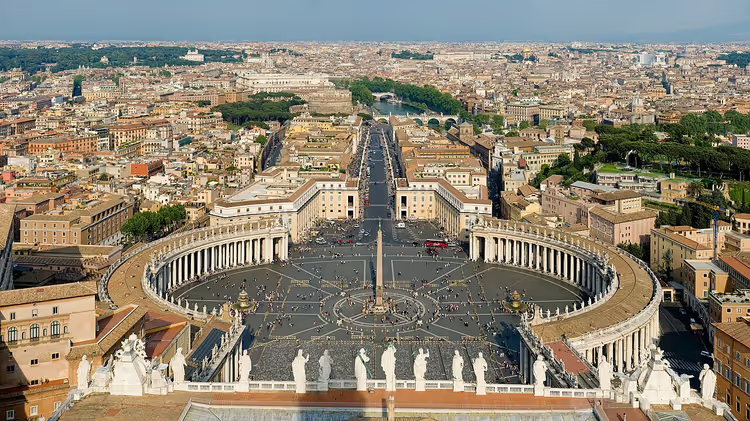
Rome is inseparable from the Vatican, the smallest state in the world. You won't miss St. Peter's Square, even if you're not looking for the Illuminati. Millions of tourists come here every year, and you'll blend into that crowd any day of the week.
 © Diliff · CC BY-SAPhoto: Diliff, CC BY-SA (http://creativecommons.org/licenses/by-sa/3.0/), Wikimedia Commons
It is not only people that keep you from watching your step, but the architecture itself. Bernini's genius shows again in the square: the oval part is framed by semicircular colonnades. The columns stand in four rows and support the band of the vault, above which statues of religious figures are lined up.
Bernini intended to close the colonnades, leaving two small passages, and turn the square into an isolated "island of prayer." He never completed the plan. The effect did not suffer for it: the colonnades seem to embrace people and guide them toward the entrance to St. Peter's Basilica.
The basilica is striking in its scale. It is the largest Christian church in the world, and by an unwritten rule no building in Rome rises above its dome. The height of the basilica sets the line for the entire city. Entry to the basilica itself is free; you pay only to climb the dome.
The next clue is hidden in the center of the square. Here stands an Egyptian obelisk, erected back in the 1st century by Emperor Caligula. Walk around it and look under your feet for a relief of a blowing angel with the inscription West Ponente, meaning "West Wind." This is the second element and your next point.
Tickets to the Vatican Museums and for the dome climb are best booked in advance: in summer there are almost no morning slots left. Timed online tickets are available on Tiqets.
- Cost: the square and basilica are free, the dome climb is paid.
- The catch: by midday the lines for the basilica stretch along the colonnade.
In practice: there are two marble disks on the square inscribed Centro del Colonnato. Stand on one and look at the colonnade: the three back rows of columns will disappear from view. The quietest time for the basilica is around 4:00 PM, when the line is shortest.
Step 4: Santa Maria della Vittoria
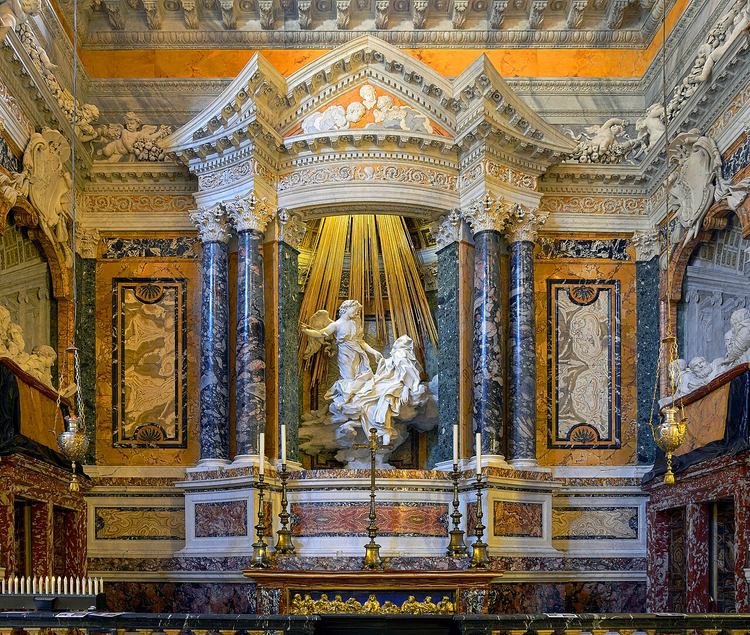
Santa Maria della Vittoria is a small church in the center of Rome and one of the finest examples of Italian Baroque. Among Rome's huge monuments it is easy to miss. This is where the next clue on the path of enlightenment is hidden.
 © Livioandronico2013 · CC BY-SAPhoto: Livioandronico2013, CC BY-SA (https://creativecommons.org/licenses/by-sa/4.0), Wikimedia Commons
The church's main work is hidden inside. It is Bernini's sculptural composition "The Ecstasy of Saint Teresa." The clergy allowed a very sensual image to be placed in the church. Dan Brown described Teresa as "bent in a paroxysm of passion," but that is Bernini's strength: he made a mystical vision almost tangible.
Look for the clue directly above the saint. Against a background of golden flames hovers an angel with a pointed fiery spear. The tip of the spear points the way forward. You do not have to tear yourself away from Teresa herself: the composition reads from below and from any point in the chapel. The church is open in the morning and in the second half of the day, with a break in the middle of the day (as of 09/2026, Turismo Roma).
- Cost: admission is free.
- The catch: the church may be closed during midday prayer.
Step 5: Piazza Navona and the Fountain of the Four Rivers
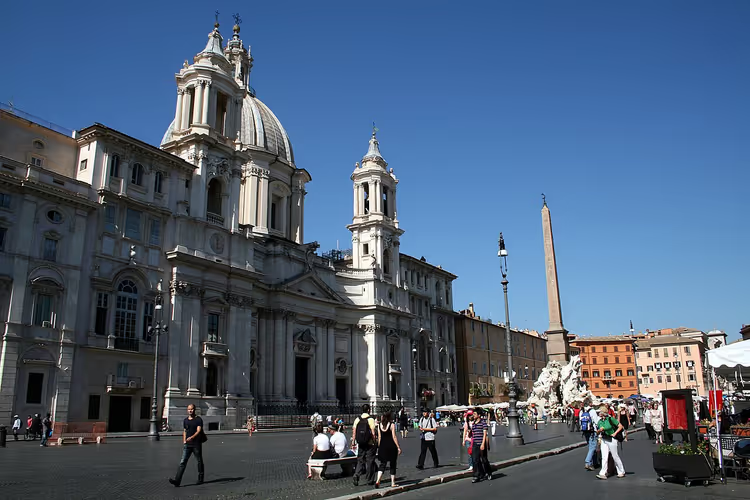
"Water, Langdon thought, was the final marker." It is hard to argue when you are standing at the Fountain of the Four Rivers in Piazza Navona. In the book, water is what completes the path, and the square is perfectly suited for that role.
 © Jean-Pol GRANDMONT · CC BYPhoto: Jean-Pol GRANDMONT, CC BY (https://creativecommons.org/licenses/by/4.0), Wikimedia Commons
The square's history goes back to the Roman Empire. It has been an ancient forum, a stadium, a marketplace, and a huge public bath. In the 17th and 18th centuries, on August weekends, the fountains were deliberately overflowed. The square would flood, and that was how the locals escaped the summer heat.
The fountains are the point. The Fountain of the Moor and the Fountain of Neptune are beautiful, but the one you need is the one Bernini built. It is topped by an Egyptian obelisk as tall as a five-story building. This is the Fountain of the Four Rivers, and the statues around it have nothing to do with Christian imagery.
The four figures symbolize the great rivers of the known continents: the Nile, the Ganges, the Danube, and the Rio de la Plata. The leading Christian sculptor skillfully wove pagan imagery into a work commissioned and paid for by the Catholic Church. At the top of the fountain sits a dove with a palm branch in its beak. In paganism, the dove was an angel of peace, and in Christianity it is a symbol of the Holy Spirit.
- Cost: the square and the fountains are free.
- The catch: during the day, there is almost always a crowd at the Fountain of the Four Rivers.
In practice: the best time for Piazza Navona is early morning or late evening. In the evening, the water in the fountain is lit up, and in the morning you can get shots without people.
Step 6: Castel Sant'Angelo
The book offers a clue: "And the angels shall guide you through Rome." The bronze dove on the fountain looks toward the Tiber. Across the river stands a bridge lined with a gallery of snow-white angels created by Bernini's workshop.
 © DiegoBonacina1997 · CC BY-SAPhoto: DiegoBonacina1997, CC BY-SA (https://creativecommons.org/licenses/by-sa/4.0), Wikimedia Commons
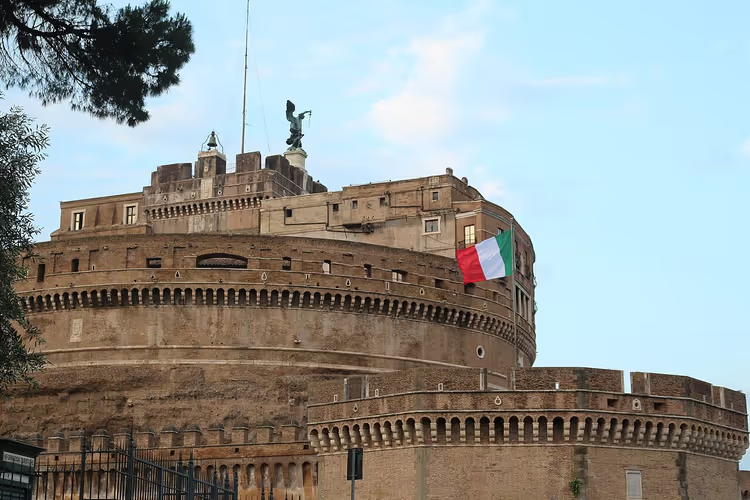
The bridge leads to the darkest place in Rome. Castel Sant'Angelo is also called the Mausoleum of Hadrian. It was built as a tomb for Emperor Hadrian and his family, and the last person buried there was Caracalla.
A legend is tied to the name. In 590, during a plague epidemic, Pope Gregory the Great saw the Archangel Michael on top of the fortress, sheathing his sword. This signaled the end of the disaster, and the fortress was named after the Holy Angel. Over its history, the castle has played many roles: mausoleum, fortress, and papal residence.
The interior layout bluntly reflects the era of the Inquisition. Lavish papal apartments sit next to a prison where Giordano Bruno spent six years. Prisoners lived literally next door to their enemies, and in the novel the Illuminati repeated that trick.
- Cost: museum admission is paid, with discounts for young people.
- The catch: the castle is closed on Mondays.
The castle museum is open Tuesday through Sunday until the evening, with Monday as the day off; check exact hours before your visit. Arrive at opening time or after 4:00 PM, and there will be almost no line at the entrance.
That is where the fairy tale ends, and it is worth admitting: Dan Brown took some creative liberties. Scholars know almost nothing about Italian Illuminati. The most famous members of the cult of the enlightened lived in Bavaria in the 18th century, a century after Bernini and Galileo. There is only one way to verify this: walk the entire route yourself.
Tours and tickets in Rome
Guided tours, skip-the-line tickets and activities — most offers can be cancelled free of charge.
See offers on GetYourGuideThe widget loads once you give your consent.
⁉️🤔 Frequently asked questions
How long does the route take?
Set aside half a day for the walk so you can see all the stops at a relaxed pace. The Pantheon, the churches, St. Peter's Square, and the castle are all in the center, so the walks between them are short. Starting in the morning works best.
Do I need to buy tickets in advance?
You only need a ticket for the Pantheon and the Castel Sant'Angelo museum. In summer, it is best to arrive at the Pantheon at opening time or buy a ticket online. The churches and squares on the route are free and do not require advance time slots.
Can I do the route without a guide?
Yes, the entire route is doable on your own. The stops are close to each other, and the clues from the book are easy to find from the descriptions. If you want context and stories, book an Illuminati-themed tour. That will also cut down the time spent searching.
When is the best time to go to avoid crowds?
The quietest hours are early morning and after 4:00 PM. By midday, St. Peter's Square and the Pantheon draw the largest crowds. Churches open in the morning, and at that moment they are almost empty inside.
What in the book is true and what is fiction?
The real places and artists are described accurately, but Dan Brown invented the Illuminati plot. That said, the churches, fountains, and castle listed in the novel really are connected by the clues from the story.
In short: what to book
The Langdon route can be walked in half a day, but two things are worth preparing in advance. Get your Pantheon ticket and Castel Sant'Angelo ticket online, especially in high season. Choose a guided tour if you want stories instead of searching on your own. You may also find this two-day Rome itinerary useful if you have more than one plan.
- If this is your first time in Rome: start at the Pantheon at 9:00 AM, before the crowds arrive.
- If you are a fan of the book: take a guided tour; it covers the same stops.
- If you are staying for several days: pick a hotel in central Rome on Trip.com near the route.
The main thing: book tickets in advance and start the route in the morning.

A small editorial team writing guides for independent travel. We travel ourselves, but we haven’t been everywhere, so we check prices, opening hours and how to get there against official sources.