
















What to see in Baku: 35 places from the Old City to Gobustan
Baku can’t be seen in one day. The city’s thirty-five main sights are scattered from the fortress walls of Icherisheher to the mud volcanoes of Gobustan, and without a plan you’ll spend half a day just getting around.
The capital of Azerbaijan sits on the Caspian coast and changes faster than old guidebooks can keep up. Some prices have gone up, some opening hours have shifted, and a number of addresses from older articles are long outdated.
In short: below are 35 sights with descriptions, photos, and practical entry details. The Old City and the Maiden Tower give you history, the boulevard and "Little Venice" give you a seaside stroll, and Gobustan and Ateshgah take you out of town.
Ad: this article contains affiliate links, we earn a commission if you book through them, at no extra cost to you.
What to see in Baku first
💡 In short:
- Start with Icherisheher and the Maiden Tower: the center is compact, but set aside a full day for it.
- Look for lunch and coffee on Fountain Square and in the lanes of the Old City.
- Save one evening for the Seaside Boulevard and the illuminated Flame Towers.
- Plan Gobustan for a day trip: mud volcanoes, petroglyphs, and a drive out of town.
- Prices and opening hours: 09/2026, verified on the official website of the Icherisheher reserve.
1. Seaside Boulevard
The Seaside Boulevard runs along the Caspian Sea for almost 16 km, and you can’t walk the whole thing on foot (according to the Seaside Boulevard Administration, 09/2026). It’s a convenient place to start getting to know the city: the sea on your left, parks and cafes on your right. In the evening, a musical fountain is switched on, and nearby there’s a children’s theater and a Ferris wheel.
The boulevard was laid out in 1909, and its development took about twenty years. In the 2000s it was reconstructed, ornamental plants were added, and part of the waterfront became a garden. Kids enjoy the "Bulsur" amusement park, while adults like the long row of cafes serving Azerbaijani cuisine. The catch: the distances are long, and you won’t cover the whole boulevard in one go.
- How to get there: Icherisheher or Sahil metro station, then walk along the sea.
2. Old City Icherisheher
 © Ludvig14 · CC BY-SAPhoto: Ludvig14, CC BY-SA (https://creativecommons.org/licenses/by-sa/4.0), Wikimedia Commons
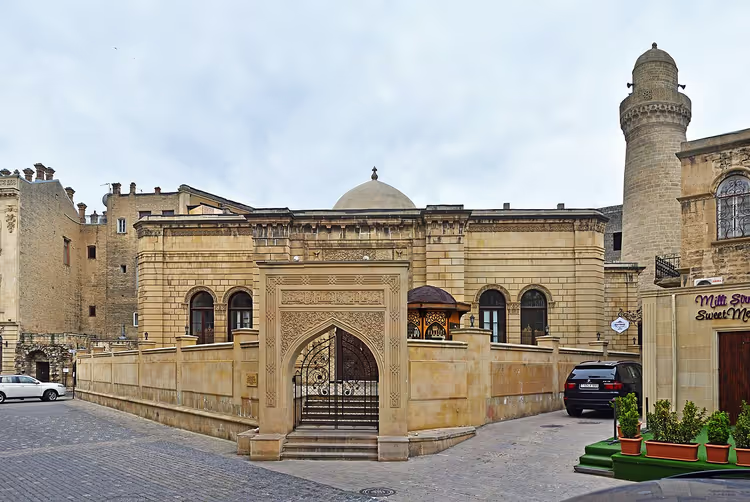
The Old City, or Icherisheher, stands on a hill inside a ring of fortress walls over 8 m high (according to the Icherisheher museum portal, 09/2026). The streets are narrow, the walls are high, and getting lost is easy. Phone maps don’t work well in the lanes, so download an offline version in advance.
Wear comfortable shoes: the cobblestones are uneven and the climbs are steep. Over a day of walking you’ll cover several kilometers, so leave the heels at the hotel.
Entry to the Old City is free; you only pay for museums. People have lived on this hill since ancient times: ships were mooring here as early as the first centuries AD, trade and crafts later grew, and the ruler Shirvanshah established his residence here. Today you’ll see caravanserais, mosques, old bathhouses, and the Market Square. The main sights, the Palace of the Shirvanshahs and the Maiden Tower, are on the UNESCO list. Set aside a full day to explore.
3. Maiden Tower
 © Ludvig14 · CC BY-SAPhoto: Ludvig14, CC BY-SA (https://creativecommons.org/licenses/by-sa/4.0), Wikimedia Commons
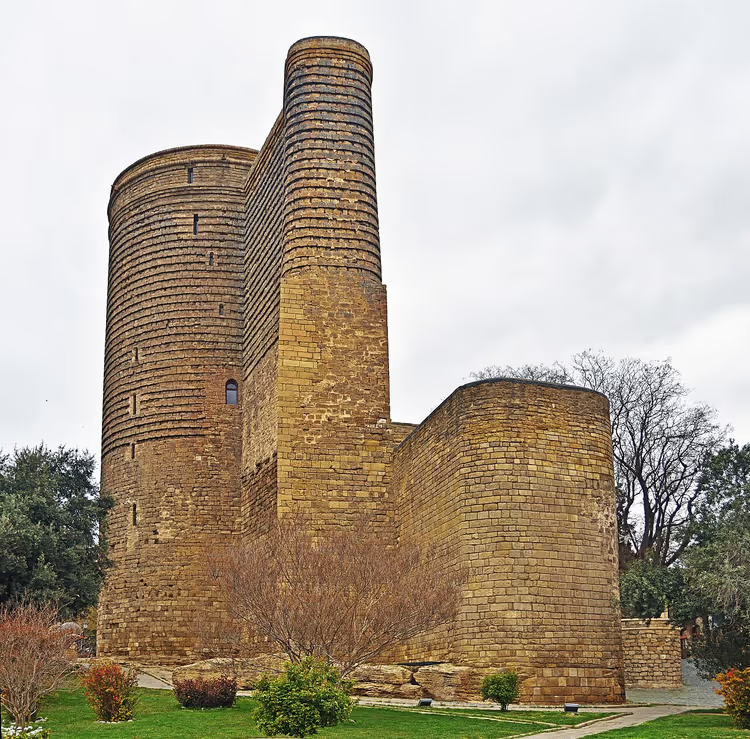
Scholars still haven’t determined the age of the Maiden Tower: estimates range from the first centuries to the late Middle Ages. The structure is 28 m high, 16 m in diameter, with walls up to 5 m thick, eight tiers inside, and a well (according to the archive of the Icherisheher State Reserve, 09/2026). There’s also no consensus on the building’s purpose. In the evening the tower is illuminated, and it’s visible from almost any point on the boulevard.
Some researchers consider the tower a religious structure. Supporting this view is the fact that on the winter solstice, the rising sun casts its rays into the central window. In the Middle Ages the tower served as a fortress and later became a lighthouse. Today it houses a museum with archaeological finds and virtual books, and an observation deck is open at the very top. The catch: no one can tell you the exact date of construction.
4. Little Venice Park
 © Nigar2nigarnigar · CC BY-SAPhoto: Nigar2nigarnigar, CC BY-SA (https://creativecommons.org/licenses/by-sa/4.0), Wikimedia Commons
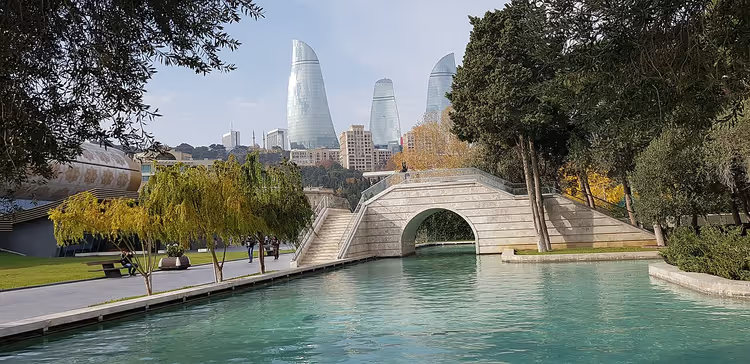
Little Venice Park is part of the Seaside National Park, and people come here for romance. The complex occupies three large islands and several small ones, with bridges and canals between them. The gondolas were brought from Italy, and they’re operated by gondoliers from Baku. A canal ride is fun for kids: the boat moves slowly, and the low bridges are amusing. If you don’t want to ride, just stroll along the water; restaurants serving Azerbaijani and European cuisine line the shore. You don’t need a separate trip here: the park is right on the boulevard, and you’ll pass through it on the way to the Ferris wheel. Allow an hour for a walk, and in the evening it’s especially beautiful thanks to the illuminated fountains and bridges.
5. Upland Park
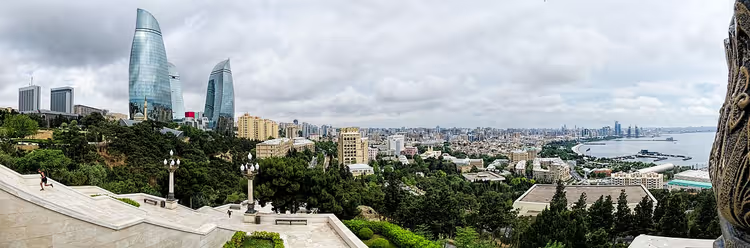 © Dan Lundberg · CC BY-SAPhoto: Dan Lundberg, CC BY-SA (https://creativecommons.org/licenses/by-sa/2.0), Wikimedia Commons
Nagorny Park rises above Primorsky Boulevard and is considered the city's best viewpoint. From here you can see the Caspian Sea, the Flame Towers, and the entire city center. Green walkways, benches in the shade, several observation decks: in the evening locals come here to stroll with their families.
The history of this place is complicated. English soldiers who died in Baku at the end of World War I were once buried here, and today only a memorial stone remains. Another boulder is still shrouded in legend: it is believed to help women become mothers. Under Soviet rule, new features appeared in the park: a monument to Sergey Kirov, a funicular, and the Green Theater, which was renovated in the 2000s.
At the end of the last century, the Alley of Martyrs appeared in the park. Entertainment venues were removed, but the park did not become a place of mourning. The Gulustan Palace stands on its grounds. Tourists and residents still walk along its shady paths. Allow an hour for a stroll, and the best time to photograph the city is around sunset, when the lights are already on.
- How to get there: take the funicular from Neftchilar Avenue or walk up from Primorsky Boulevard.
6. Khagani Garden
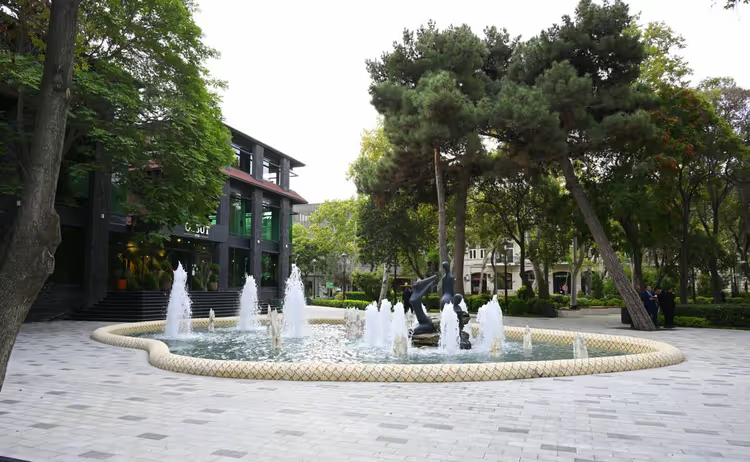 © Press Service of the President of the Republic of Azerbaijan · CC BYPhoto: Press Service of the President of the Republic of Azerbaijan, CC BY (https://creativecommons.org/licenses/by/4.0), Wikimedia Commons
Khagani Garden is one of the city's oldest parks, and it is small in size: less than a hectare. The name recalls the Persian poet, and the garden's main decoration is a pool with the sculptural group "Three Graces." Trees, shrubs, and flower beds make it look festive almost all year round.
The park was laid out in the century before last and was then called Mariinsky Garden. It was conceived as an oasis in an arid city, so new plantings appeared here regularly. During the Soviet years, the garden was renamed again and given a different name, and after World War II it had to be restored. The park received its current name after Azerbaijan gained independence.
Stop by here on your way from the boulevard to the Old City: the shade and water are a relief in the heat. The catch: the area is small, so don't count on a full-length walk.
7. Baku Crystal Hall
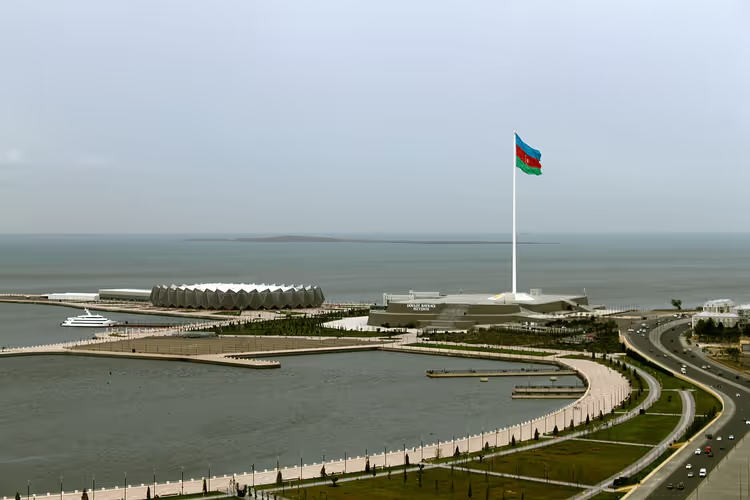 © Urek Meniashvili · CC BY-SAPhoto: Urek Meniashvili, CC BY-SA (https://creativecommons.org/licenses/by-sa/3.0), Wikimedia Commons
Baku Crystal Hall, or "Crystal Hall," was built specifically for Eurovision after Azerbaijani singers won the contest. The facade was designed in the shape of a faceted mineral, and thousands of LED lamps were built into the steel structures. At night the building shimmers, and spotlights on the roof trace bright beams across the sky.
The hall seats several tens of thousands of spectators. After the contest, famous artists performed here and major competitions took place. It is quite possible that a concert is scheduled at Crystal Hall during your trip. Check the schedule in advance: tickets for popular dates sell out quickly.
8. Haji Gayib Bathhouse
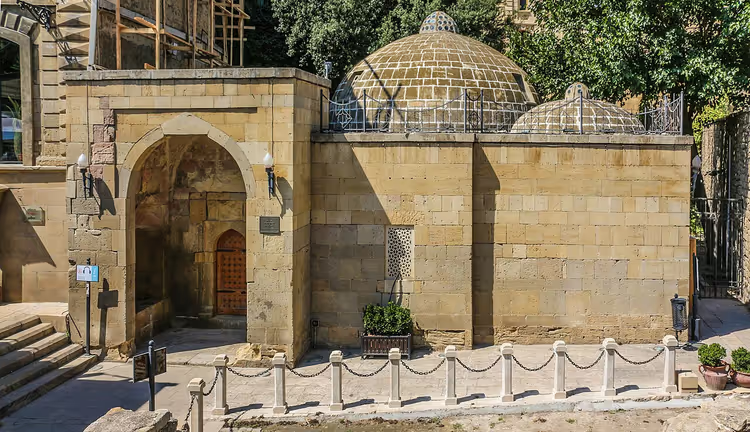 © Sefer azeri · CC BY-SAPhoto: Sefer azeri, CC BY-SA (https://creativecommons.org/licenses/by-sa/4.0), Wikimedia Commons
The Haji Gayib Bathhouse stands a stone's throw from the Maiden Tower, within the Icherisheher reserve (according to the official reserve website, 09/2026). Such baths, hammams, were more than just a place for washing in the East: people held unhurried conversations and closed deals here. The building was erected in the 15th century at the intersection of trade routes.
Over time, the building became buried in sand, and if not for archaeologists, the mid-20th-century discovery would have remained underground. Today the bathhouse is not operational, but you can go inside and look around. The interior has three rooms: an entrance portal, a changing room, and an octagonal bathing hall. The pools had hot and cold water, and the floors were heated by steam through channels under the tiles. Come in the evening: the lighting makes the bathhouse especially striking.
9. Baku Ferris wheel
 © Tofiq005(Tofiq Vəliyev) · CC BY-SAPhoto: Tofiq005(Tofiq Vəliyev), CC BY-SA (https://creativecommons.org/licenses/by-sa/4.0), Wikimedia Commons
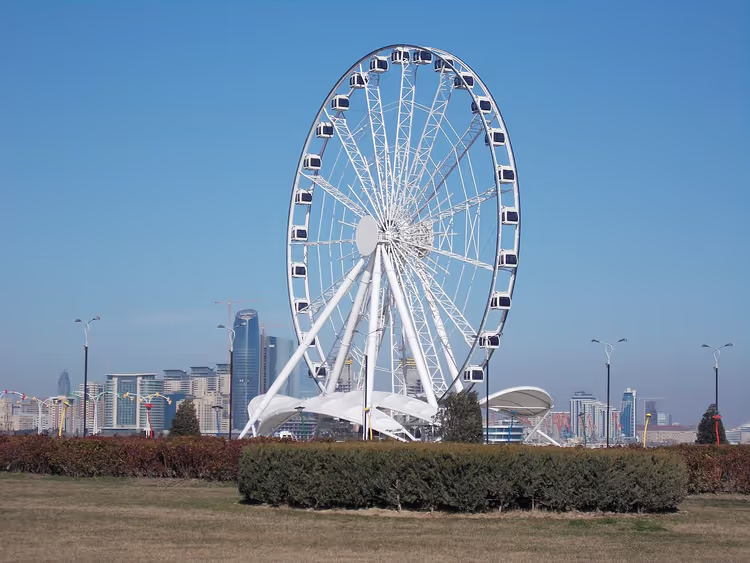
Locals call the Ferris wheel the "Eye of Baku," and it stands on the Seaside Boulevard (according to the Boulevard Administration, 09/2026). From an enclosed, air-conditioned cabin you rise 60 m and see the Carpet Museum, the remains of an ancient fortress, houses, and parks. You can ride in any weather; neither heat nor rain will get in the way.
The wheel has 30 gondolas in total, each seating up to 8 people, and a full rotation takes up to 30 minutes. The project was designed by the Dutch firm Dutch Wheels, and the attraction was launched before the first European Games. Children under six ride for free.
10. Palace of the Shirvanshahs
 © Bruno Girin · CC BY-SAPhoto: Bruno Girin, CC BY-SA (https://creativecommons.org/licenses/by-sa/2.0), Wikimedia Commons
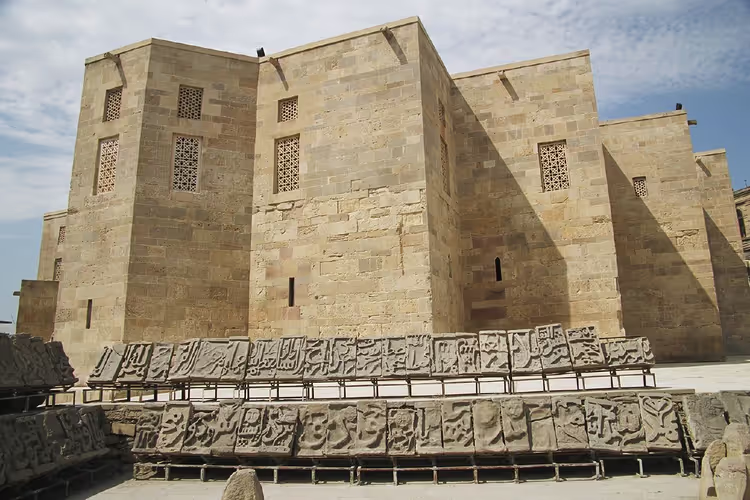
The Palace of the Shirvanshahs is not a single building but a whole complex in the upper part of the Old City. It includes the Divan-khane courtyard, a tomb, a mosque, a bathhouse, and the mausoleum of a court scholar. Construction spanned three centuries, from the 13th to the 16th century, yet the ensemble turned out remarkably cohesive (according to the palace section on the reserve's website, 09/2026). The architects treated their predecessors' work with care, so buildings from different eras do not clash with one another.
The octagonal ceremonial hall, spiral staircases, and more than 50 rooms have survived. Inside, archaeological finds are on display: weapons and tableware, jewelry and household items, musical instruments and coins. Even Shamakhi carpets have been preserved, and there are plenty of cafes near the complex for a bite between sights (according to the Palace of the Shirvanshahs page, 09/2026).
The Divan-khane is a small enclosed courtyard with an octagonal pavilion whose vault is supported by columns. The purpose of the rotunda is still debated: a mausoleum, a court, or a place for negotiations. Most likely, state affairs were conducted here, since you cannot approach the pavilion unnoticed or eavesdrop. Today there are only stone slabs underfoot.
But imagine what the courtyard used to be like: handmade carpets, silent servants with tea and sweets. Another part of the complex, the mausoleum of Seyid Yahya Bakuvi, is called the "Dervish Mausoleum." The tomb was built in the second half of the 15th century (according to the reserve's historical note, 09/2026). The descent to it is steep and the steps are worn, so walk carefully and hold the railing. The marble gravestones and vault paintings make a strong impression, and the courtyard is quiet.
Bakuvi was a philosopher, physician, and court astrologer, and without his "approval of the stars" no important matter was decided at court. Inside the mausoleum there is an unusual interior and vault paintings: speak loudly and you will hear your own echo. An arched passage once led to the mosque, but it burned down in a fire. Noble people were buried on the grounds, and many gravestones have survived to this day.
Allow at least two hours for the whole complex: the halls follow one after another, and you will want to linger in the Divan-khane courtyard. If you are in the Old City for one day, start with the palace in the morning before tour groups arrive, and leave the Maiden Tower for the afternoon.
- Cost: paid entry, tickets are sold on site (as of 09/2026, official Icherisheher website).
- How to get there: upper part of Icherisheher, about a five-minute walk from the Maiden Tower.
11. Mukhtarov Palace
 © Urek Meniashvili · CC BY-SAPhoto: Urek Meniashvili, CC BY-SA (https://creativecommons.org/licenses/by-sa/3.0), Wikimedia Commons
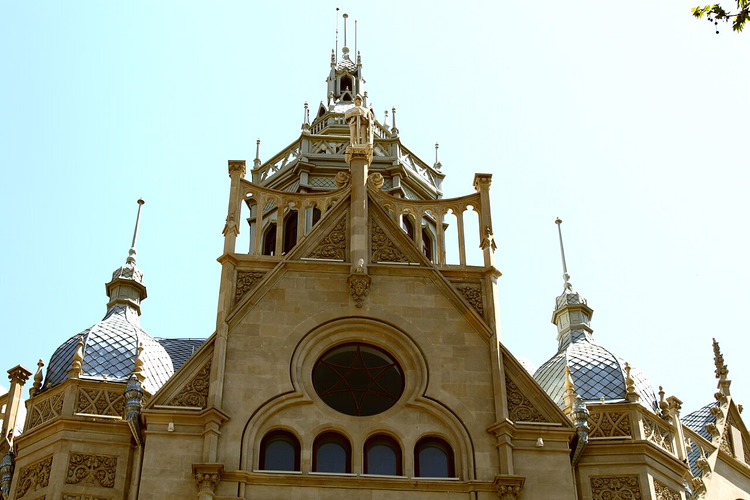
Mukhtarov Palace is built in the Gothic style, and today it houses a registry office. Locals call the building the "Palace of Happiness." A romantic story is tied to the house: oil magnate Murtuza Mukhtarov married Liza Tuganova from a noble Ossetian family.
In Vladikavkaz, Liza's hometown, Mukhtarov built a mosque as a gift for his bride, and after a honeymoon trip where his wife took a liking to one of Venice's mansions, he gave her a similar house in Baku. Architect Iosif Ploshko executed it more in the French than the Italian style, so you will not immediately notice the resemblance to the Venetian prototype.
The Mukhtarovs were heavily involved in charity, helping tuberculosis patients and children from poor families; they had no children of their own. After the revolution, Liza left, and her trail was lost in Marseille, while Mukhtarov himself refused to leave his native city. The palace first housed a club, then a museum-reserve, and later the Wedding Palace. You can view the building from outside at any time; getting inside is only possible on the day of a ceremony.
12. Azerbaijan Carpet Museum
 © Marco Monelli · CC BY-SAPhoto: Marco Monelli, CC BY-SA (https://creativecommons.org/licenses/by-sa/3.0), Wikimedia Commons
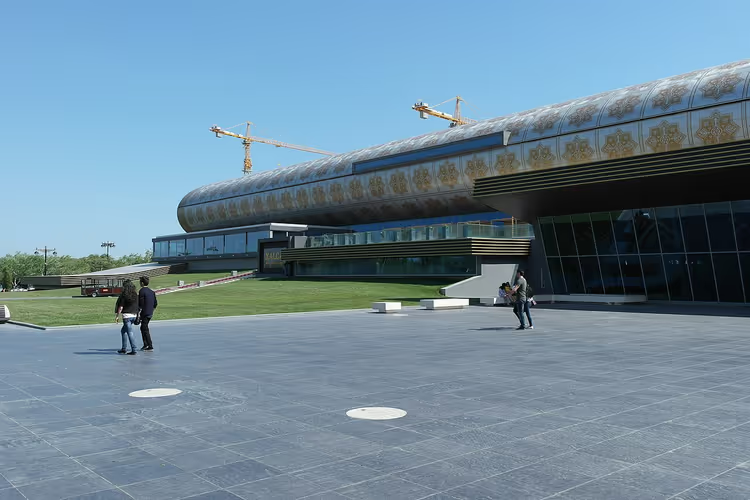
The Azerbaijan Carpet Museum opened in 1967 in the Juma Mosque, and in 2008 construction began on a separate building for it on the boulevard (according to the museum's background note, 09/2026). The exterior of the building echoes the shape of a rolled-up carpet, so it is impossible to mistake it for anything else.
The foundation holds over 14,000 exhibits, including unique carpets from the 17th and 18th centuries (according to the same reference, 09/2026). There are also archaeological finds: weapons, tableware, jewelry, embroidery, clothing, and footwear from the Bronze Age to the 19th century. The museum's collections have traveled to dozens of countries, and the building itself houses a training center and hosts research work.
13. Museum of Azerbaijani literature
 © Interfase · CC BY-SAPhoto: Interfase, CC BY-SA (https://creativecommons.org/licenses/by-sa/4.0), Wikimedia Commons
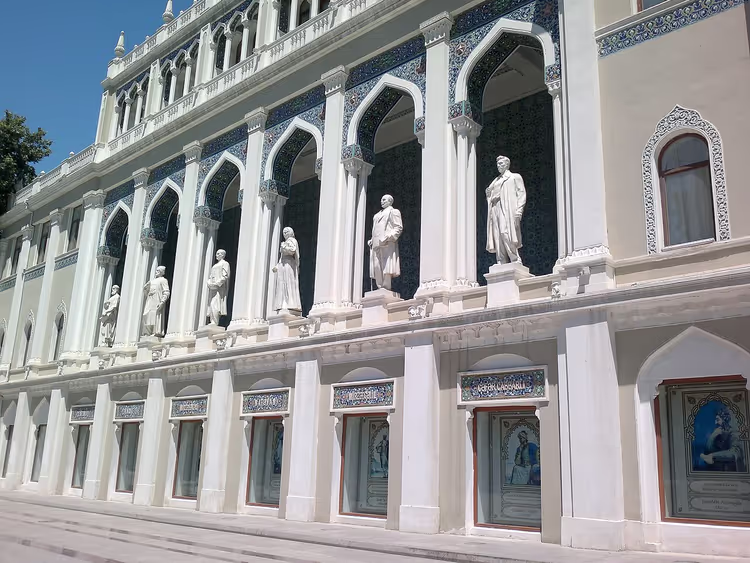
The Museum of Azerbaijani Literature was founded just before World War II and named after the classic Persian poet Nizami Ganjavi. It stands in the center, next to Fountain Square, in a historic building. The opening was timed to coincide with the poet's anniversary, and the museum was initially a memorial one. The facade is decorated with sculptures of writers and poets, so you know where you are before you even step inside.
Today the exhibition includes tens of thousands of items, and the storage collections hold several times more: manuscripts, rare printed editions, illustrations, and miniatures. Among the most valuable exhibits is the manuscript of Nizami's poem "Iskander-nameh." The museum has a bookshop that sells books in Azerbaijani, Russian, and English.
14. National art museum of Azerbaijan
 © Urek Meniashvili · CC BY-SAPhoto: Urek Meniashvili, CC BY-SA (https://creativecommons.org/licenses/by-sa/3.0), Wikimedia Commons
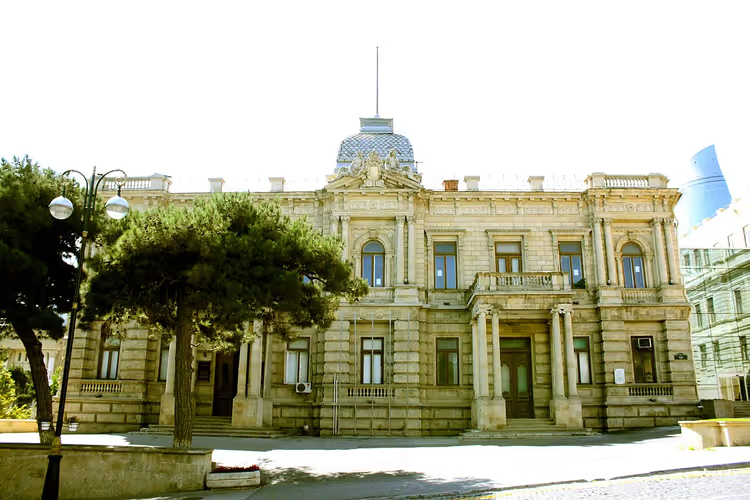
The National Art Museum is named after the theater artist Rustam Mustafayev and holds tens of thousands of works. The exhibits did not fit in one building: the museum was given a historic mansion, and a second wing was opened later. It became a separate cultural institution in the 1930s.
Today the museum has sixty halls. In addition to paintings, you will see clothing from past centuries, handmade carpets, jewelry, metalwork and tableware, as well as sculptures from antiquity. The museum displays canvases by Rokotov, Aivazovsky, Levitan, and Polenov, and there is also a collection of Italian artists. Set aside several hours for your visit.
15. National museum of history of Azerbaijan
 © Urek Meniashvili · CC BY-SAPhoto: Urek Meniashvili, CC BY-SA (https://creativecommons.org/licenses/by-sa/3.0), Wikimedia Commons
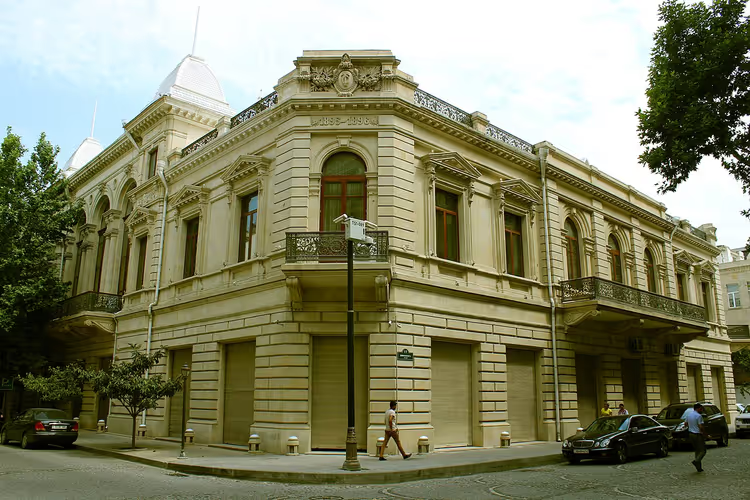
The National Museum of History occupies the mansion of the industrialist Taghiyev, whom Azerbaijanis themselves call "the father of the nation." Here you will get to know the country's history from ancient times: one hundred and fifty thousand coins, thousands of archaeological finds, samples of weapons, and unique gold objects more than four thousand years old.
The halls progress from Stone Age communities through antiquity and the Middle Ages to modern history. Special attention is given to the economy, education, and culture, and the memory of old customs is carefully preserved. There is also a memorial museum of Taghiyev: the interior of his apartment has been recreated.
16. Museum of Modern Art
 © Woland de Ades · CC BY-SAPhoto: Woland de Ades, CC BY-SA (https://creativecommons.org/licenses/by-sa/4.0), Wikimedia Commons
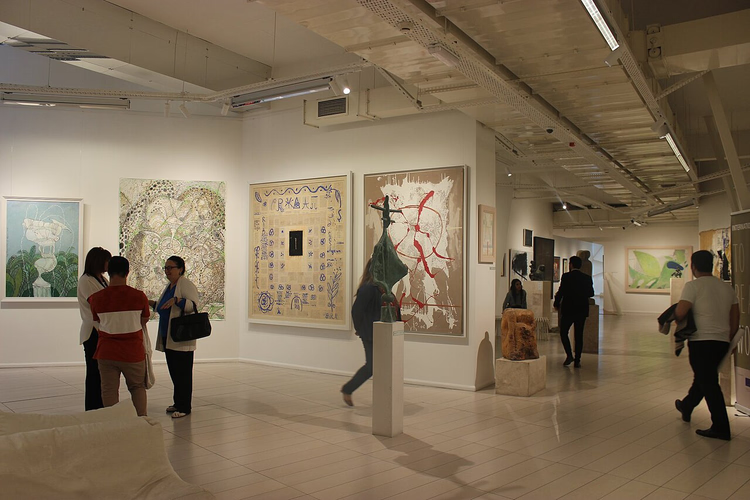
The Museum of Modern Art was created with the support of the Heydar Aliyev Foundation, and everything inside looks unconventional: halls without corners, slanted walls, open passages, and metal beams. The structures seem to be moving. The author of the memorable design is Altay Sadikh-Zadeh.
The museum exhibits artists who were out of favor with the Soviet authorities and could have simply disappeared, works by innovative artists of the 1960s and 1970s, as well as contemporary painters. There are also canvases by Salvador Dali, Marc Chagall, and Pablo Picasso. If you get tired, there is a restaurant, a cafe, a library, and a bookshop at your service.
17. Museum of Miniature Books
 © Babək Akifoğlu · CC BY-SAPhoto: Babək Akifoğlu, CC BY-SA (https://creativecommons.org/licenses/by-sa/4.0), Wikimedia Commons
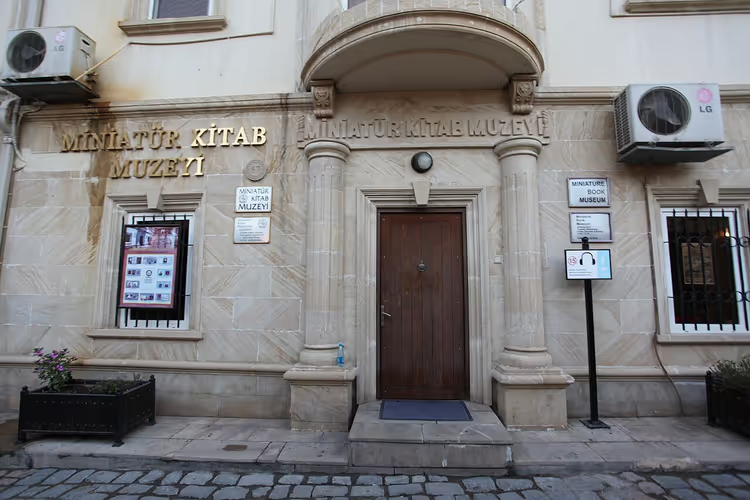
The Museum of Miniature Books occupies just one room on Pervy Zamkovy Lane, and admission is free. For several years it was listed in the Guinness Book of Records as the largest collection of miniature books in the world. All the exhibits belong to Zarifa Salakhova.
The collection began with Krylov's Fables from the 1830s. It includes books gifted by prominent cultural figures and even micro-books smaller than a centimeter. In total, the collection holds several thousand miniature editions, and the museum has welcomed hundreds of thousands of visitors.
18. Ali Shamsi's Workshop
 © shankar s. · CC BYPhoto: shankar s., CC BY (https://creativecommons.org/licenses/by/2.0/), Flickr
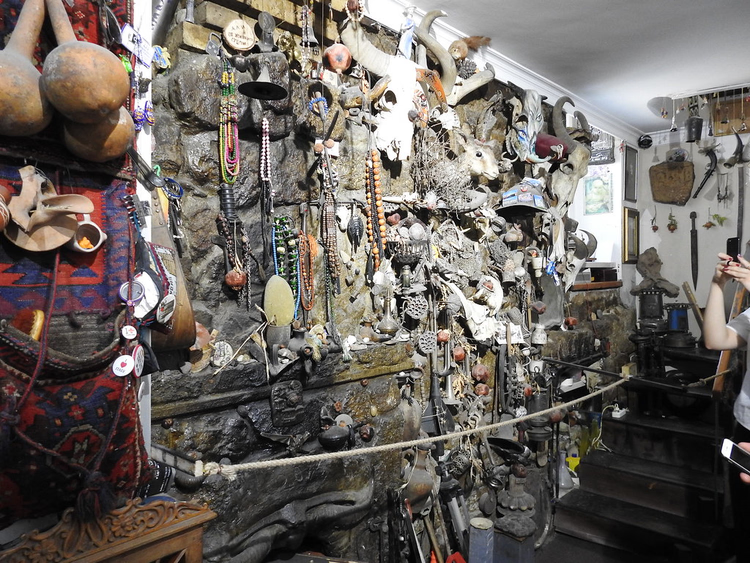
On Kichik Gala Street there is a tree that is over ninety years old. It was already withering, but artist Ali Shamsi painted three women's faces on its trunk. People started coming up, hugging the tree and taking photos, and it unexpectedly turned green again. The master himself explains it simply: you have to share good energy with each other.
You can step into the workshop and talk with the artist; he welcomes guests. Over the years, a lot has accumulated here: souvenirs from distant countries, finds from the ruins of old buildings. There are days when hundreds of people come through in a single day. Guests have included foreign actors, musicians and even a cosmonaut. Every object in the workshop holds warmth and a story.
Come during the day and do not touch the exhibits. The master loves guests, but not everyone is careful: someone will stick a hand in paint and then wipe it on a painting. The catch: the workshop is small, and in a noisy group you will find it hard to talk comfortably with the owner.
19. Funicular
Tourists see the Baku funicular as entertainment, while locals see it as transport. It departs from the square on Neftchilar Avenue; the station looks like a small glass pavilion. At the upper stop you come out to the Flame Towers and the observation deck in Highland Park.
The view opens up even during the ride: from the cars you can see both the city and the Caspian Sea. The funicular opened in the 1960s and was modernized in the 2000s, after which the ride became quieter. The catch: at peak hours the line to the pavilion can be long, so come at opening time.
20. Flame Towers
 © Francisco Anzola · CC BYPhoto: Francisco Anzola, CC BY (https://creativecommons.org/licenses/by/3.0), Wikimedia Commons
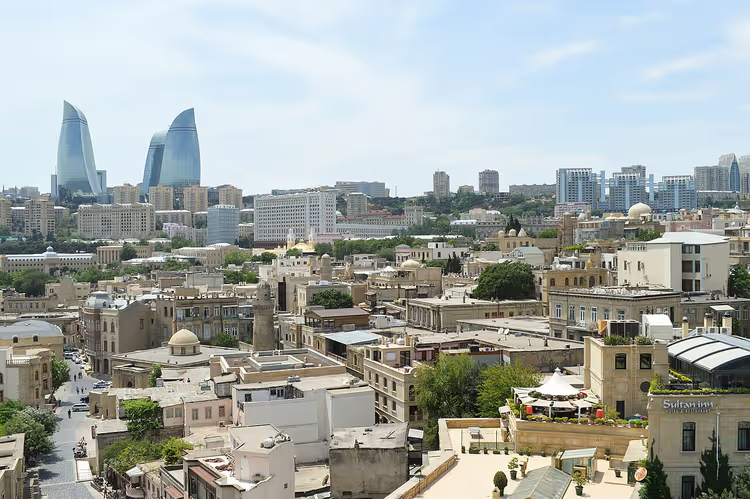
The Flame Towers have become a symbol of the city and are reminiscent of the skyscrapers of the UAE. The "three tongues of flame" are visible from anywhere in Baku. In the evening the facades are lit up, and the buildings look like a burning bonfire: the screens show flashes of fire. The lighting concept was recognized as the best in the world. The towers of varying heights house a hotel, offices and apartments.
21. Bibi-Heybat Mosque
 © Небати · CC BY-SAPhoto: Небати, CC BY-SA (https://creativecommons.org/licenses/by-sa/3.0), Wikimedia Commons
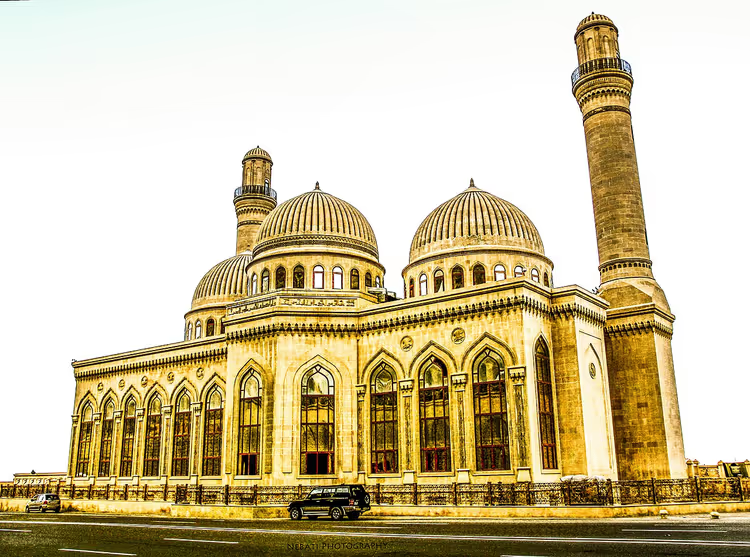
The Bibi-Heybat Mosque is hard to classify as either ancient or modern. The first building was constructed in the Middle Ages, and in the 1930s it was destroyed during the campaign against religion. Using surviving sketches, the mosque was rebuilt in the late 1990s, and it turned out larger than the original. The same type of limestone was used as in the old days.
Two minarets and three domes follow the traditions of the Shirvan school, the emerald and white colors give it elegance, and the walls are decorated with calligraphic inscriptions. Mirrored windows protect from the sun, and beautiful stained glass is visible inside. Come here in the morning, when there is the most light in the windows.
22. Taza Pir Mosque
 © Sefer azeri · CC BY-SAPhoto: Sefer azeri, CC BY-SA (https://creativecommons.org/licenses/by-sa/4.0), Wikimedia Commons
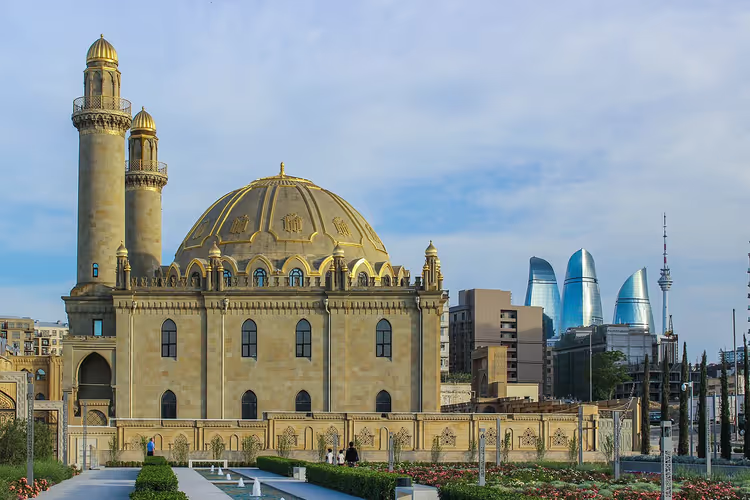
The Taza Pir Mosque stands not far from the boulevard. The previous modest building was replaced with a new one in the early 20th century, designed by Zivar bey Ahmadbeyov, with construction funded by the philanthropist Nabat Khanum Ashurbeyova.
Under Soviet rule the mosque was closed: it was used as a warehouse, then a cinema. The building was returned to worshippers only during World War II. Today Taza Pir is not only a place of prayer; it also houses the Caucasus Muslims Board. The decoration is lavish: paintings by artists, marble and gold, and the floor in the hall is heated.
23. Juma Mosque
 © Urek Meniashvili · CC BY-SAPhoto: Urek Meniashvili, CC BY-SA (https://creativecommons.org/licenses/by-sa/3.0), Wikimedia Commons
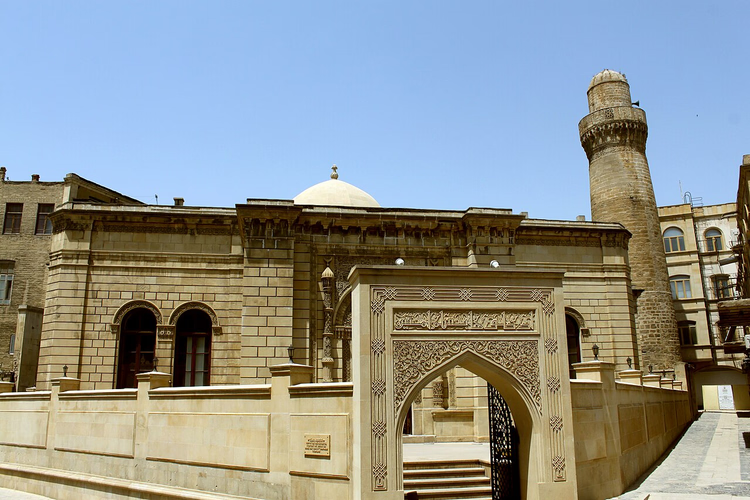
The Juma Mosque stands in Icherisheher, and on Friday at noon you cannot get in: that is when members of the Shia community pray. At other times you can calmly appreciate the historic monument. The mosque itself dates to the 12th century, and the minaret to the 15th (according to the guide to Icherisheher monuments, 09/2026). A visit takes little time, and nearby begin the most picturesque lanes of the Old City.
The style follows medieval Persian architecture, although pagans once performed rituals on this site. The mosque suffered from wars and natural disasters and was restored. In the 19th century, repairs were funded by the merchant Haji Dadashov, and after his death he was buried on the mosque grounds.
The Juma Mosque has a hexagonal shape, the facade is decorated with fine patterns, the door is carved, and rare materials were used in the interior. On the minaret's masonry there is a preserved inscription about the levies that residents once paid.
24. Turkish Mosque
 © Bernard Gagnon · CC BYPhoto: Bernard Gagnon, CC BY (https://creativecommons.org/licenses/by/4.0), Wikimedia Commons
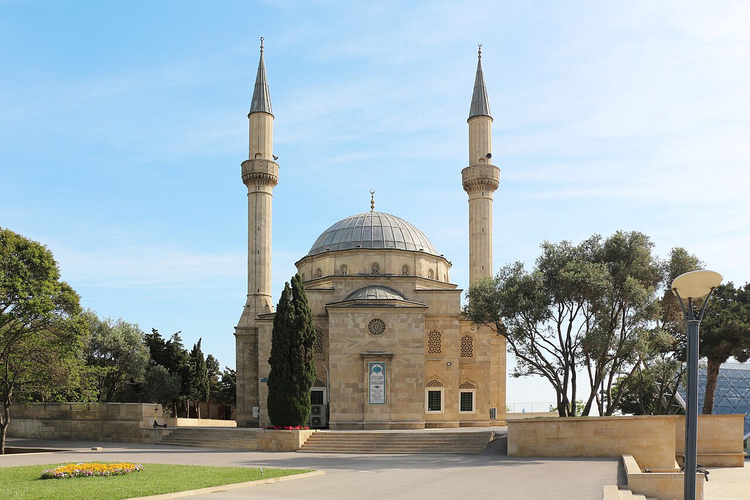
The Turkish Mosque, or "Shahidlar," appeared in the 1990s with the support of Muslims from Turkey. It stands on Martyrs' Lane. The mosque is visible from afar and forms a single complex with the lane.
City residents hold the memory of their heroes in deep reverence. There is a project to turn the mosque into a museum of the history of the struggle for independence. Visit it together with Martyrs' Lane; seeing the mosque separately is inconvenient, as the entrance is the same.
25. TV Tower
 © Bernard Gagnon · CC BYPhoto: Bernard Gagnon, CC BY (https://creativecommons.org/licenses/by/4.0), Wikimedia Commons
The TV Tower rises above all the buildings in the city, so you will definitely notice it. Construction began in the late 1970s, commissioned by the Ministry of Communications, but work was interrupted and resumed only in the early 1990s. Reconstruction was carried out in the 2000s.
Today tourists go up to the observation deck, where a revolving restaurant operates. From here you can see the whole city and the Caspian, and the panorama changes right during dinner. Book a table for the evening in advance; window seats are not available to everyone.
26. Heydar Aliyev Center
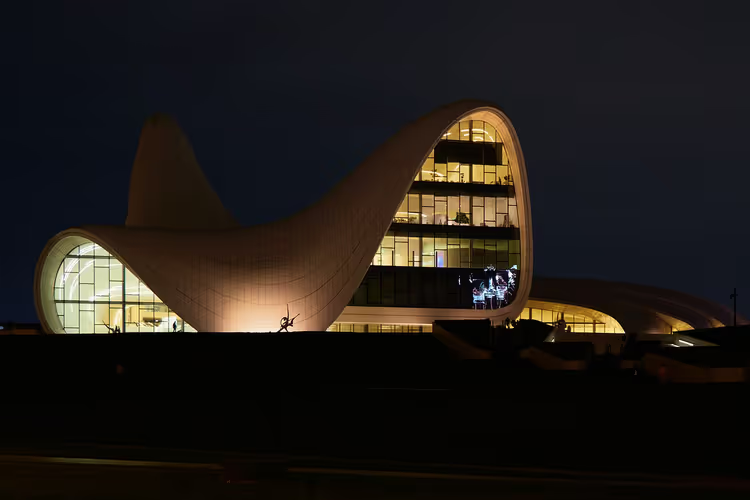
The Heydar Aliyev Center brings together a congress center, a museum, exhibition halls, and offices under one roof. The project was designed by architect Zaha Hadid, and it opened in 2012, coinciding with Heydar Aliyev's birthday. Two years later, the center was named the best building in the world (according to the center's official website, 09/2026).
The building's shape resembles a wave and has almost no straight lines. According to the architect's vision, this form symbolizes infinity, while the lines represent the connection between past and future. The white color also carries meaning: it speaks of a bright tomorrow. The complex is not limited to a single building; a park surrounds it, underground parking is available, and decorative ponds and a lake sparkle near the entrance.
Inside, start at the information kiosks: they will tell you where things are and which events are on today. Don't miss the "Masterpieces of Azerbaijan" exhibition with ancient drawings, coins, old books, national costumes, and musical instruments. The center has a restaurant and a cafe, so you can grab a bite without rushing. Allow at least two hours for your visit, and if you catch a temporary exhibition, time will fly by.
27. Fountain Square
 © Frokor · CC BY-SAPhoto: Frokor, CC BY-SA (https://creativecommons.org/licenses/by-sa/3.0), Wikimedia Commons
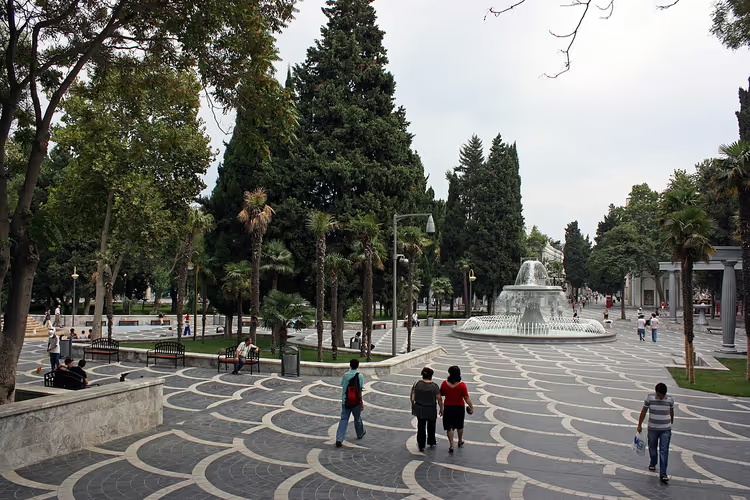
Fountain Square is still called Parapet by many people. The project was designed by Gasim bey Hajibababeyov in the second half of the century before last, and he also designed the buildings around it. At one point, a large Orthodox cathedral and a monument to Emperor Alexander II were planned here, but the cathedral lacked space, and the monument was delayed until the revolution.
For some time, the square bore the name of Karl Marx. It got its current look after the reconstruction of the 1980s: elegant paving slabs, greenery, and a large number of fountains appeared. Later, another full reconstruction took place, and now the square looks like a work of art. Both adults and children stroll here, and cafes and shops are concentrated around it.
28. State flag square
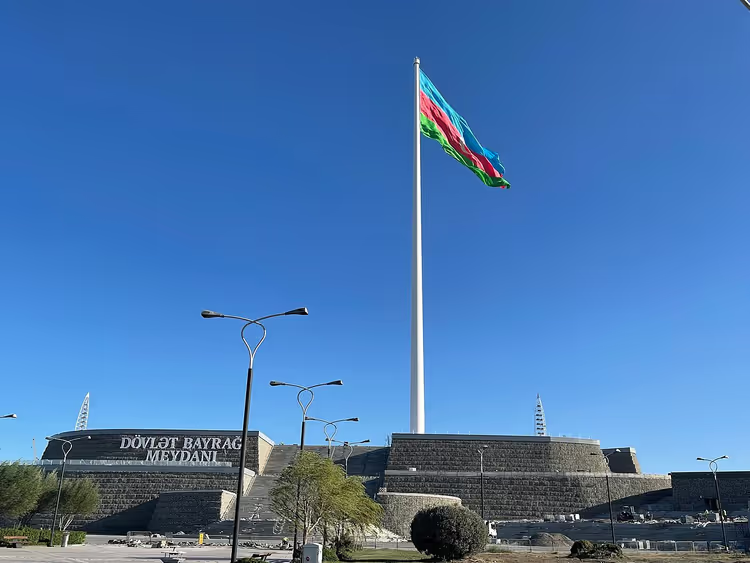
The State Flag Square surprises with its size: the flag is as long as a soccer field, and the flagpole is taller than any building in the city. Nearby is a Naval Forces base, and here you will also see the coat of arms and map of Azerbaijan and read the words of the national anthem.
The square opened in the early 2010s, and for some time the local flagpole was considered the tallest in the world. It lost the top spot a year later, when the flagpole in Dushanbe turned out to be taller. There were also incidents: once the huge flag was torn by the wind, and in another storm the flagpole swayed so much that residents of a neighboring building had to be evacuated. Since then, the flag is lowered on especially stormy days.
The State Flag Museum is also open, with exhibits about official symbols. Stop by for the bay panorama and a photo against the backdrop of the huge flag.
29. Martyrs' Lane
 © Urek Meniashvili · CC BY-SAPhoto: Urek Meniashvili, CC BY-SA (https://creativecommons.org/licenses/by-sa/3.0), Wikimedia Commons
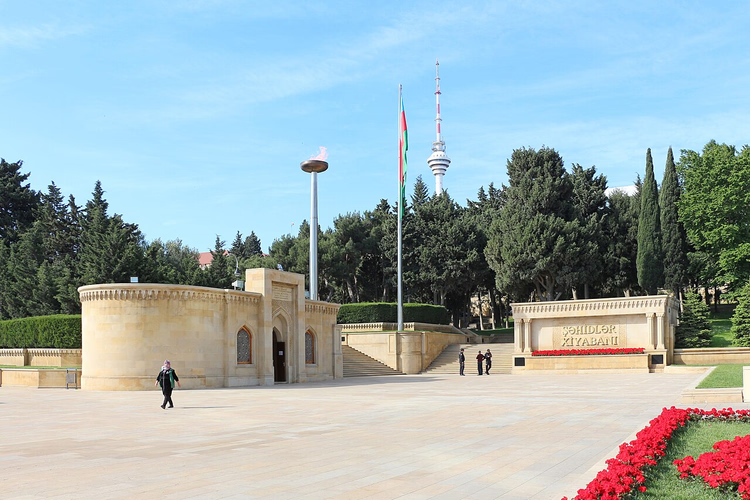
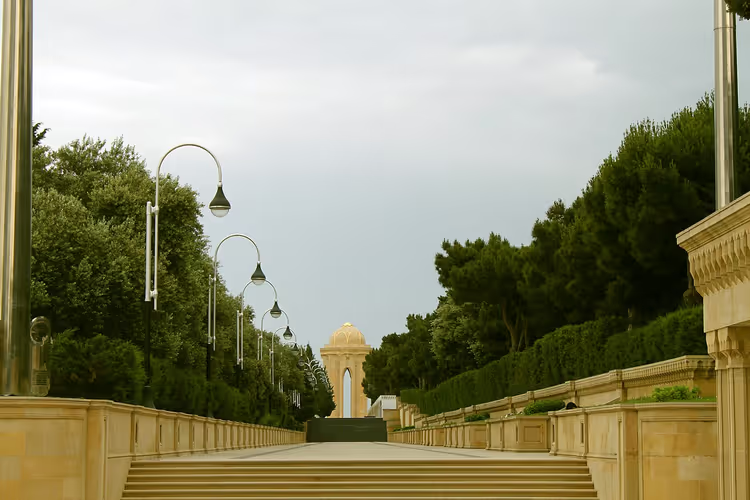
Martyrs' Lane serves as a place of remembrance and mourning, and the easiest way to get here is by funicular. The memorial cemetery was created in the 1990s: residents who died in clashes between Soviet troops and the Azerbaijani opposition are buried here. In total, the lane has more than a hundred graves.
Nearby lie Turkish soldiers who died in battles for the city in the early 20th century, there are monuments to other heroes, an eternal flame burns, and the Martyrs' Mosque stands here. Be quiet: for locals, this is a personal place.
30. Olympic Stadium
 © Press Service of the President of the Republic of Azerbaijan · CC BYPhoto: Press Service of the President of the Republic of Azerbaijan, CC BY (https://creativecommons.org/licenses/by/4.0), Wikimedia Commons
The Olympic Stadium took almost four years to build and opened in the mid-2010s. The design was based on a project by a Turkish firm, and the venue seats almost seventy thousand spectators and meets international standards. This is where the first European Games were held.
The complex includes parking lots, a boulevard, and a park, with a separate building for journalists. The stadium gave a push to cleaning up the neighboring Lake Boyukshor, which is heavily polluted with oil. You can't get inside outside of events, but from the outside you can see the scale. The catch: there are no other attractions nearby, so it's worth going only for the stadium.
31. Samad Vurgun Russian drama theater
The Samad Vurgun Russian Drama Theater was born shortly after the revolution, when several theater troupes disbanded and the actors created a new company. A few years later, the collective received the name Baku Workers' Theater, and many Russian actors came here.
A studio opened at the theater where "Meyerhold followers" taught their craft, and Faina Ranevskaya began her career here. From the 1930s, the theater bore the name Azerbaijan State Red Banner Russian Drama Theater, and it received its current name in the mid-20th century. In recent years, many young Azerbaijani actors have joined the troupe. Go see at least one performance.
32. M. F. Akhundov opera and ballet theater
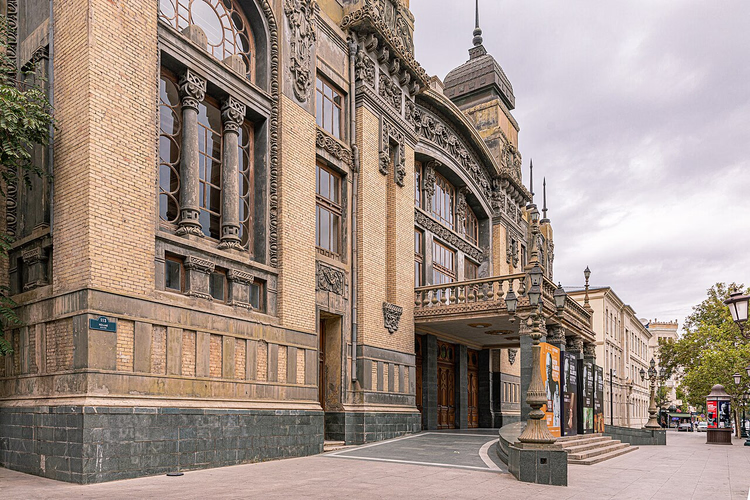
The Akhundov Opera and Ballet Theater was built in the early 20th century by the Mailov brothers, who gifted the building to the city. It had an orchestra section, numerous boxes for the nobility, a balcony, and galleries for the general public. The first performance was the opera "Boris Godunov," and after that the stage hosted opera, ballet, operetta, and drama in Russian and Azerbaijani.
 © Dmitry Karyshev · CC BYPhoto: Dmitry Karyshev, CC BY (https://creativecommons.org/licenses/by/2.0), Wikimedia Commons
Later the theater received state status and its current name. Fyodor Chaliapin, Maya Plisetskaya, and Montserrat Caballé performed on its stage. Today it stages both Azerbaijani classics and world productions for adults and children.
33. Baku Zoo
 © Stanislav Kozlovskiy · CC BY-SAPhoto: Stanislav Kozlovskiy, CC BY-SA (https://creativecommons.org/licenses/by-sa/4.0), Wikimedia Commons
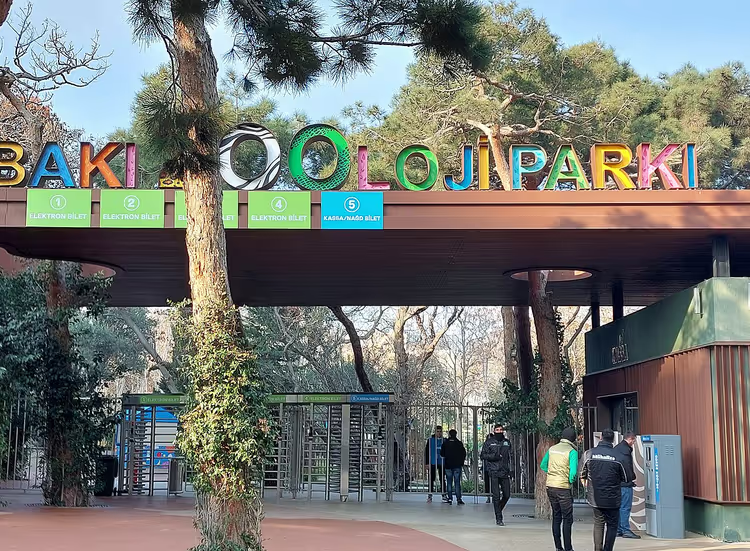
The Baku Zoo opened before World War II, and after the war everything had to start over: the new park was built around animals evacuated from Rostov. The zoo was relocated several times until a landslide from the mountains killed rare animals.
After that, a large new zoo was built and opened in the 1980s. The pink flamingo became the park's symbol: local veterinarians raised many of these birds. Today the zoo houses more than a thousand animals, and you should allow at least three hours for a visit. Come in the morning, before it gets hot and while the animals are active.
34. Ateshgah Temple
 © Jesper Ahlin Marceta · CC BY-SAPhoto: Jesper Ahlin Marceta, CC BY-SA (https://creativecommons.org/licenses/by-sa/4.0), Wikimedia Commons
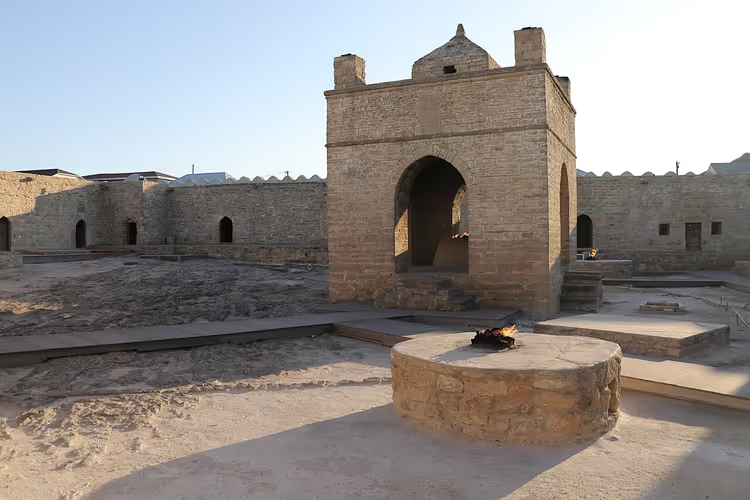
Ateshgah stands in the settlement of Surakhany, and the history of these places since the 19th century is tied to oil extraction: one of the first oil refineries was built here, with Dmitri Mendeleev as a consultant. Tourists come here for the Zoroastrian fire temple, built where combustible gas rises from the ground.
Locals call this fire eternal and believe it lights the way for those seeking spiritual truth. Scholars date the structure to the first centuries AD, and the temple's arches face the four cardinal directions. A foreign adult ticket costs 15 AZN, and a combined ticket with Yanar Dag costs 25 AZN (as of 09/2026, official temple website).
Pilgrims from different countries traveled here along the Great Silk Road, and even Alexandre Dumas visited the temple. In the mid-19th century, gas access to the surface was blocked, and pilgrims stopped coming; the temple reopened after restoration in the 1970s.
35. Gobustan Reserve
 © Fargana Gasimli · CC BY-SAPhoto: Fargana Gasimli, CC BY-SA (https://creativecommons.org/licenses/by-sa/4.0), Wikimedia Commons
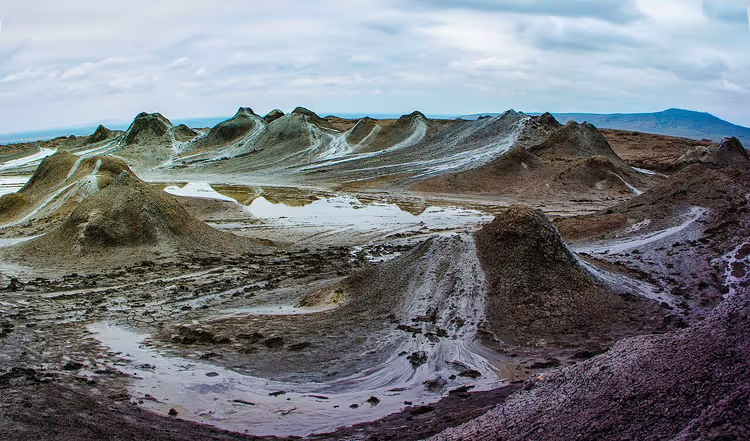
Gobustan deserves a separate trip: the reserve is 60 km from Baku, and the landscape seems Martian (according to the Azerbaijan Travel portal, 09/2026). The ground is cracked and lifeless, and the mud volcanoes constantly make sounds like gurgling.
The second reason to come is the rock carvings. There are several thousand petroglyphs here, created in different eras, from prehistoric times to the Middle Ages. There is also an inscription left by a Roman legionary in the first centuries AD. The catch: it's hard to get here without a car, so it's easier to book a tour in Baku.
Baku attractions on the map
All the places on the list are easy to see on one map. Save it to your phone and plan your route by day: that way you won't return to the same area twice.
Tickets and opening hours: what to book in advance
Paid sites in Icherisheher sell tickets at the entrance, and the Maiden Tower and the Palace of the Shirvanshahs have separate tickets (as of 09/2026, official reserve website). In summer and on weekends the lines get longer, so come at opening time.
Site | Ticket | What to keep in mind |
|---|---|---|
Palace of the Shirvanshahs | paid, at the entrance | the complex is large, allow one to two hours |
Maiden Tower | separate ticket | there is an observation deck at the top |
Ateshgah Temple | 15 AZN, combined 25 AZN (temple website) | the combined ticket also covers Yanar Dag |
Gobustan Reserve | paid, at the entrance (Azerbaijan Travel portal) | 60 km from the city, you need transport |
Tours and tickets in Baku
Guided tours, skip-the-line tickets and activities — most offers can be cancelled free of charge.
See offers on TiqetsThe widget loads once you give your consent.
⁉️🤔 Frequently asked questions
How many days do you need to cover the whole list?
A quick look will take at least a week, and for a comfortable pace allow about ten days. Give three to four days to Icherisheher, the boulevard and the museums in the center, and set aside a separate day for Gobustan and Ateshgah. Leave one more day for the distant mosques and the Olympic Stadium.
When is the best time to visit Baku?
Spring and early autumn are the most comfortable. In summer the waterfront is hot and stuffy, and in winter it is often windy. In the heat, the air-conditioned cabins of the Ferris wheel and the shady paths of Upland Park help. Plan walks for the morning and evening.
Can you get to Gobustan without a tour?
You can, but it is harder. The reserve is dozens of kilometers from the city, and there is no direct metro or tram there. It is more comfortable to take a tour or book a car for the day, in which case the route will include the mud volcanoes, petroglyphs and Ateshgah. On your own, you can get there by bus via the town of Gobustan.
What is free in Baku?
The Old City, Seaside Boulevard, Upland Park, Khagani Garden and Fountain Square are free. The Museum of Miniature Books also has free admission. You will have to pay for museums, the Palace of the Shirvanshahs, the Maiden Tower, the funicular and Ateshgah.
Where can you try Azerbaijani cuisine?
Look for cafes in Icherisheher, on Fountain Square and along Seaside Boulevard. They serve plov, dolma, kufta and tea with jam. Portions are large, so one hot dish and a salad are enough for lunch.
In short: what to book
Baku is easy to split into three blocks: the Old City with its palaces, the modern center with the boulevard and museums, and trips outside the city.
- If you have a couple of days: Icherisheher, the Maiden Tower, the Seaside Boulevard, and the Flame Towers.
- If you like museums: the National Art Museum, the Carpet Museum, and the Heydar Aliyev Center.
- If you're traveling with kids: the Ferris wheel, Little Venice, and the zoo.
- If you want to get out of the city: Ateshgah and the Gobustan Reserve.
Buy museum tickets and observation deck tickets in advance: in summer the lines get longer and schedules change.

A small editorial team writing guides for independent travel. We travel ourselves, but we haven’t been everywhere, so we check prices, opening hours and how to get there against official sources.