
















One day in Batumi: a walking route to 20 places with tickets and prices
One day in Batumi can realistically fit into a walking loop along the waterfront. The Old Town is compact, and the main sights line up along the boulevard.
Short answer for planning: start from the Argo cable car and by evening make your way to the 6 May Park. The distance between the two ends is about 5 km on the map, which is 1.5 to 2 hours on foot without stops.
Below, the editorial team has put together 20 stops along the route. You can skip any of them if you linger in a museum or park. Prices and opening hours were checked on official websites in September 2026.
Ad: this article contains affiliate links, we earn a commission if you book through them, at no extra cost to you.
Argo cable car
💡 In short:
- Start your route with the Argo cable car, from here you can see the whole city at once.
- The ride up takes about 10 minutes, and at the top you will find an observation deck, a church, and a cafe.
- Prices and opening hours: 09/2026, checked on the official website.
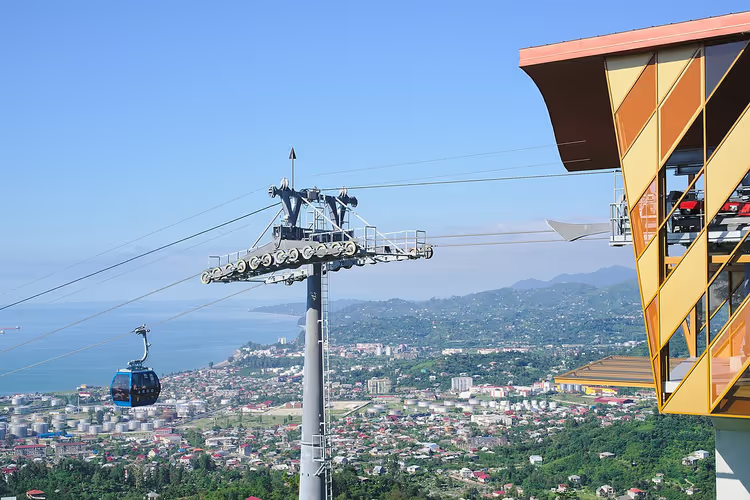
The name "Argo" refers to an ancient myth, but the cable car itself is young: it opened in 2013. The lower station is a couple of minutes from the Batumi Sea Port, right by the harbor. The ride up Mount Feria takes about 10 minutes, each glass cabin seats 6 people, and there are 9 cabins on the line. The doors open automatically, and passengers sit on soft benches. The cable car runs from 10:00 to midnight, a round-trip adult ticket costs 39 GEL, children aged 5 to 11 pay 9 GEL (as of 09/2026, argo-batumi.ge). A Quick Pass costs 20 GEL more and saves you time in line. At the top you will find an observation deck, a small church, a cafe, and souvenir shops. The catch: prices at the observation deck are higher than in the city, so bring your own water and snacks.
 © Mikhail Kryshen · CC BYPhoto: Mikhail Kryshen, CC BY (https://creativecommons.org/licenses/by/2.0), Wikimedia Commons
Orta Jame Mosque
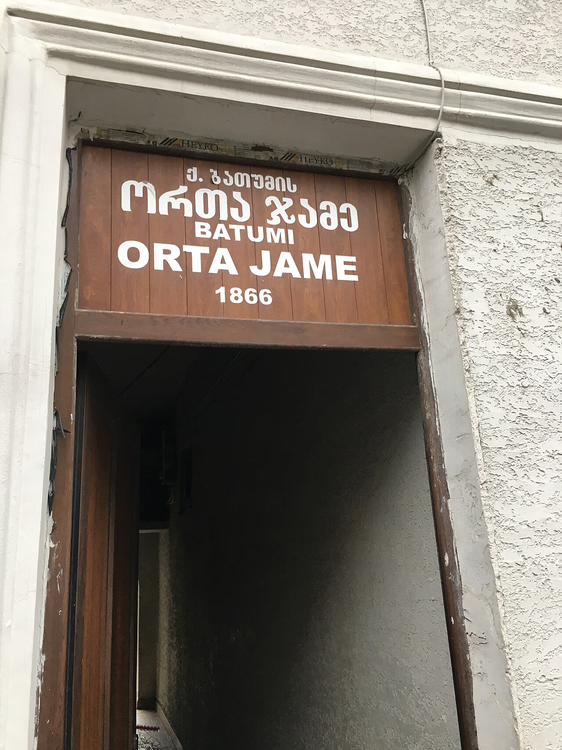
The active mosque stands in the city center, between the old quarters. The name "Orta" translates as "in the middle": the new mosque was built in 1886 between the Azize Jami and Ahmed Pasha Jami mosques. The Khimshiashvili family provided the funds for construction. Adjara has a sizable Muslim community, so the mosque remains an important part of the city, not just a monument. After the Soviet government came to power, the building was closed, like almost all of Batumi's places of worship, and it reopened in 1946. The minaret appeared in the late 20th century. Today you can enter freely during prayer times, but dress modestly and do not disturb worshippers. The interior with its oriental ornaments and the arched entrance are the most photographed features. The catch: the women's section is separate, and a headscarf is provided at the entrance.
 © Shahzadafzal · CC BY-SAPhoto: Shahzadafzal, CC BY-SA (https://creativecommons.org/licenses/by-sa/4.0), Wikimedia Commons
Piazza Square
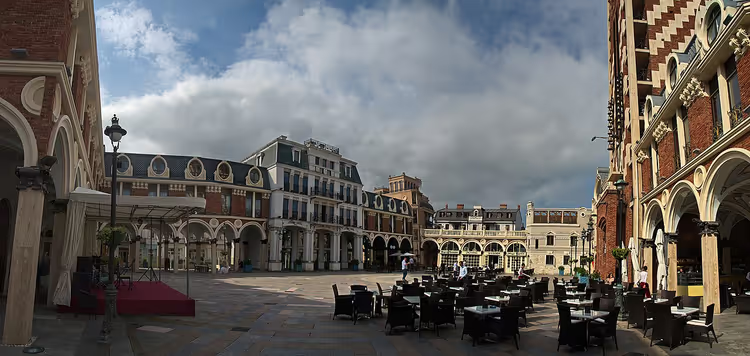
Piazza Square is designed as an Italian corner: the project's architect, Vazha Orbeladze, drew inspiration from Venice's St. Mark's Square. The exterior was completed in 2010, but the facades look much older. You will see stained glass, mosaics, and artistic wall paintings. Hotels, bars, clubs, and restaurants operate around the perimeter, so it gets noisy and crowded in the evening. Grab a coffee on a terrace and people-watch. On weekends, concerts and city festivals take place on the square, and tourists always photograph the arches and balconies. A car rental in Batumi will come in handy if you want to drive to Gonio Fortress or Kobuleti. The catch: the square has no parking of its own, so leave your car on the neighboring streets.
 © Uwe Brodrecht · CC BY-SAPhoto: Uwe Brodrecht, CC BY-SA (https://creativecommons.org/licenses/by-sa/2.0), Wikimedia Commons
St. Nicholas Church
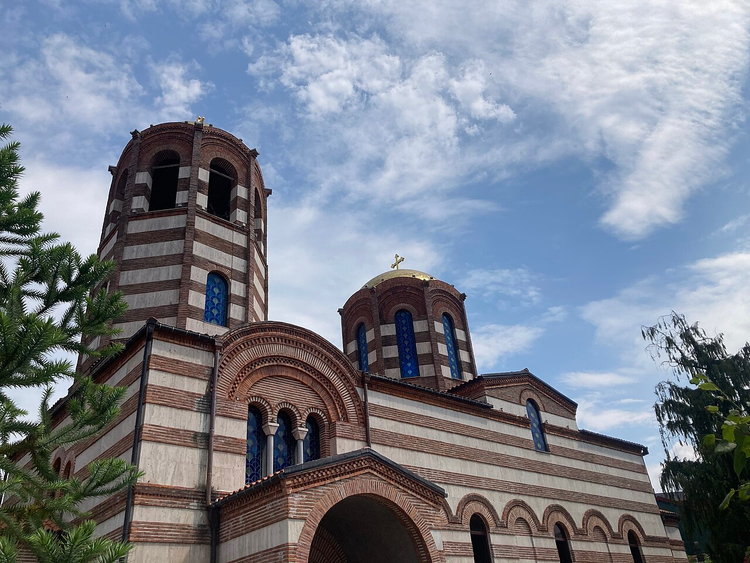
The church is over 150 years old: it was built in the mid-19th century through the efforts of local residents. The city governor, Ilya Efremidi, donated a plot of land, and funds were collected from the whole community. The parish's full life began in the 1890s, when the church ran boys' and girls' schools, and its choir was considered one of the best in Georgia. For a long time the church held cathedral status. During the Soviet years it was closed, then reopened in 1946. The most extensive restoration was carried out in 1998, funded by parishioners. Today it attracts not only believers but also pilgrims from other countries. You can enter freely, but services are held in the morning hours. The catch: there is no parking nearby, so it is easier to walk from the waterfront.
Batumi Sea Port
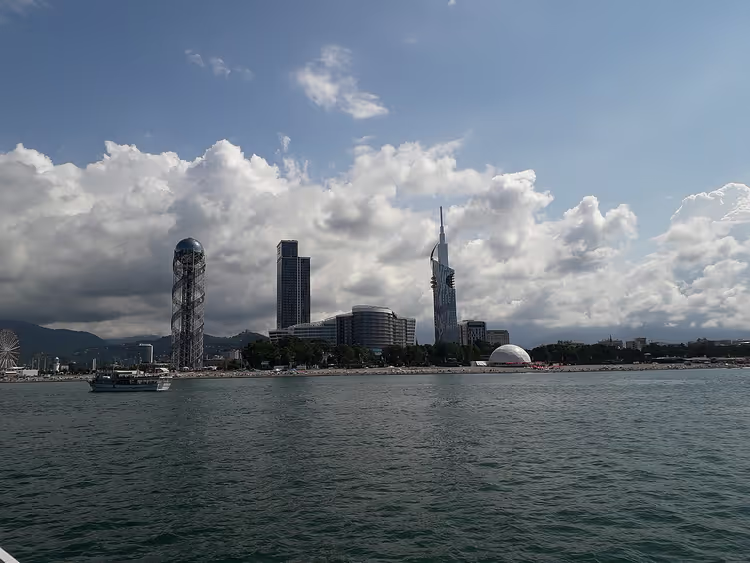
The sea port terminal was built in 1959-1962 to a design by architects Novakov and Kremlyakov. The facade is in the Stalinist Empire style: a spire, mosaics, and a deep blue color. By day the building looks elegant, and in the evening the lighting comes on and it transforms. Inside there is a navigation center, and outside there is a promenade area. Ships depart from here, and the boulevard also starts here. Many visitors arrive in Batumi by sea and this terminal is the first thing they see. You can walk here from Piazza Square in a few minutes. The catch: part of the pier is closed to the public.
 © 23artashes · CC BY-SAPhoto: 23artashes, CC BY-SA (https://creativecommons.org/licenses/by-sa/4.0), Wikimedia Commons
Chacha Tower
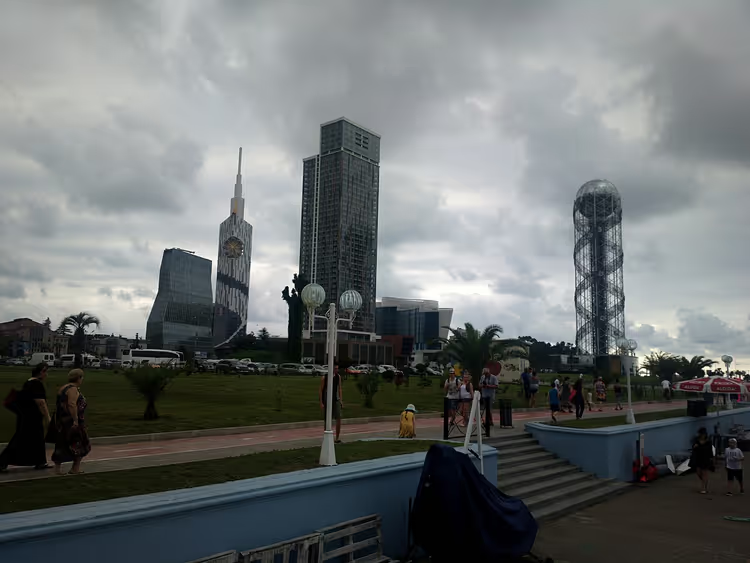
The Chacha Tower stands on the waterfront near the sea port terminal. It is 25 meters tall, and a clock is mounted at the 18-meter level, which is why locals call the structure "Chacha Tower." The tower was built in 2012, replicating a structure that stood here about a hundred years ago. Inside there is a fountain, and an urban legend says that once a week, for fifteen minutes, free chacha flows from it. There is no way to guess the timing, so do not count on a tasting, but people will happily tell you the legend. In the evening the tower is lit up and looks great in photos. The catch: you cannot go inside, the structure can only be viewed from the outside.
 © Soghomon Matevosyan · CC BY-SAPhoto: Soghomon Matevosyan, CC BY-SA (https://creativecommons.org/licenses/by-sa/4.0), Wikimedia Commons
Batumi Lighthouse
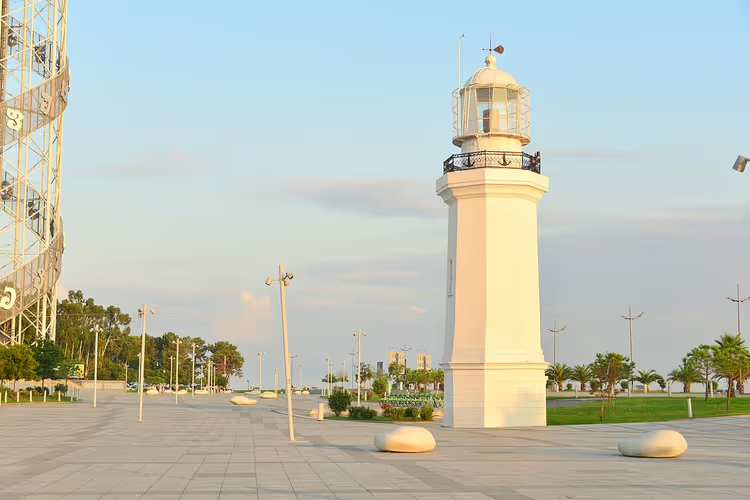
The first wooden lighthouse appeared here in 1863. It was later rebuilt by craftsmen brought in from Paris, and by the early 20th century its bright beam was reliably guiding ships. The light used to be white; now it is ruby red. The lighthouse keeper was Mikhail Stavraki, and his name is tied to a tragic page of history: he carried out the sentence against Lieutenant Schmidt, after which he remained working at the lighthouse. You should walk up to the base and examine the masonry up close. You cannot go inside, so the best view is from the waterfront in the evening twilight. The catch: the lighthouse itself is closed to visitors.
 © Андрей Бобровский · CC BYPhoto: Андрей Бобровский, CC BY (https://creativecommons.org/licenses/by/3.0), Wikimedia Commons
Ferris Wheel
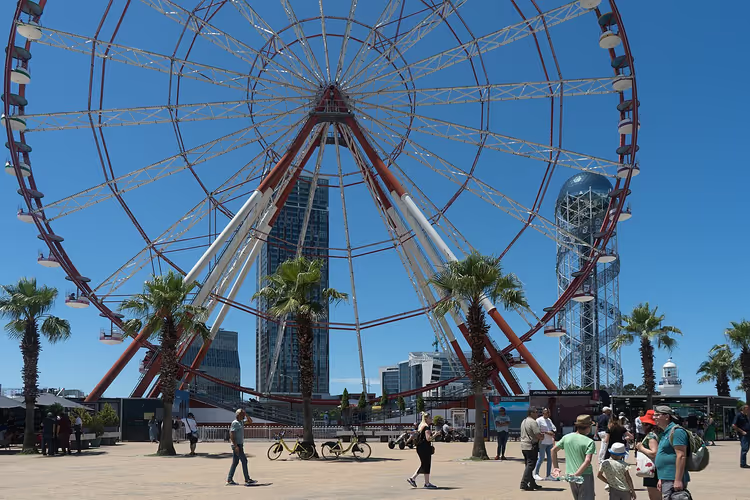
The Ferris wheel stands in Miracle Park and lifts visitors 55 meters above the ground. The ride lasts about 10 minutes, the cabins are open, and the wheel carries more than 200 people at a time. An Italian company handled the installation, and from the top you can see all of Batumi, the port, and the mountains beyond the city. Nearby you will find the Chacha Tower, the lighthouse, and the Ali and Nino statue. There are plenty of cafes and street stalls around, so you will not go hungry: from shashlik and salads to fast food. Tours and tickets in Batumi will help you skip the line in high season. The catch: in July and August a long line forms at the ticket booths by evening.
 © Alexey Komarov · CC BY-SAPhoto: Alexey Komarov, CC BY-SA (https://creativecommons.org/licenses/by-sa/4.0), Wikimedia Commons
Alphabet Tower
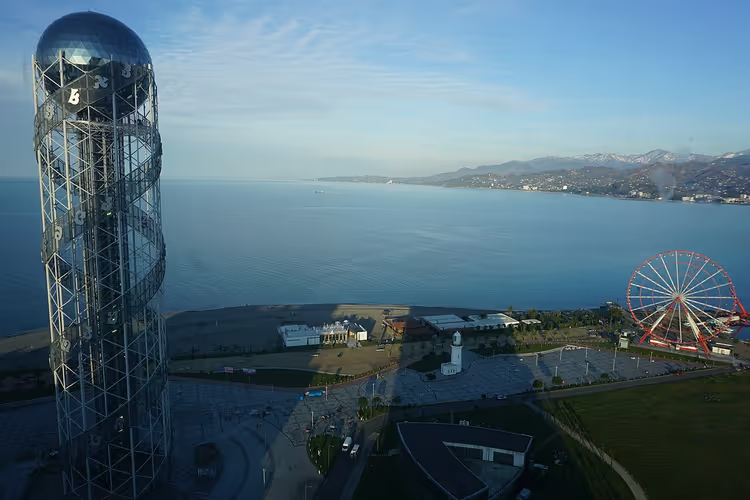
The Alphabet Tower is visible from almost anywhere along the boulevard. Spiral bands wrap around the frame, with letters of the Georgian alphabet made of aluminum set into them. The shape resembles a DNA helix: the alphabet unites a people the same way genes unite living organisms. The structure is 130 meters tall and 31 meters in diameter, and construction was completed in December 2011 (as of 09/2026, Visit Batumi). At the top there is a sphere with an observation deck and a revolving restaurant seating 125 people. The project was carried out by the Spanish firm CMD Ingenieros. Elevators take guests to different levels. In the evening the tower is lit up, and that is the best time for photos. The catch: access to the top is not always open, and the schedule changes by season.
 © Andrew Milligan sumo · CC BYPhoto: Andrew Milligan sumo, CC BY (https://creativecommons.org/licenses/by/2.0), Wikimedia Commons
Ali and Nino Statue
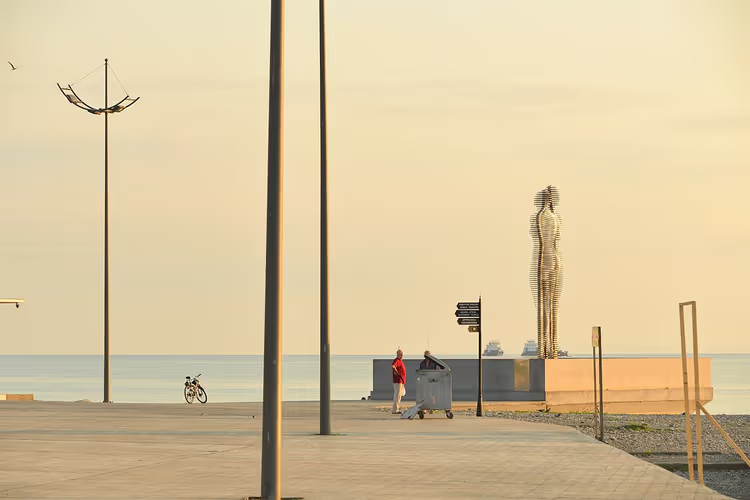
The statue stands in Miracle Park and is considered one of the city's main landmarks. The artist, sculptor Tamara Kvesitadze, now lives in the United States. The concept came from a 1937 novel about the love between a Muslim man and a Christian woman. In 2007 the sculpture was shown at the Venice Biennale and then in London, where it drew public interest. From 2011 to 2015 the figures stood on the waterfront, then they were moved closer to the Ferris wheel, away from the storms. The main thing here is movement: the figures, made of metal lattice, walk toward each other, merge and pass through one another, then move apart. The full cycle takes about 10 minutes. There are benches nearby, and you can watch the movement for a long time. In the evening the lighting makes the scene especially striking. The catch: there are always a lot of people around the statue, so a calm photo is only possible early in the morning.
 © Андрей Бобровский · CC BYPhoto: Андрей Бобровский, CC BY (https://creativecommons.org/licenses/by/3.0), Wikimedia Commons
Batumi Tower skyscraper
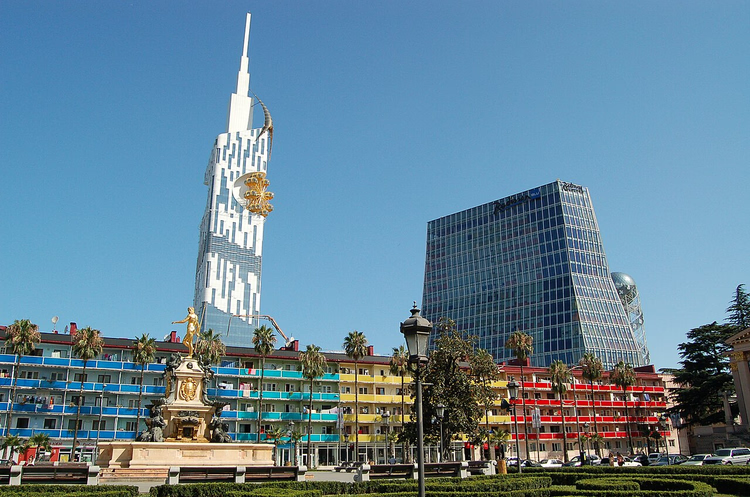
The 36-story, 200-meter skyscraper was designed by David Gogichaishvili. It was originally intended to house the Black Sea Technological University, but the building stood empty for several years. Its main feature is a mini Ferris wheel on the 27th floor: 8 cabins hold up to 40 people. In 2015, the complex was purchased by RED-Co, which carried out a renovation. Today it houses a 5-star hotel, a fitness center, restaurants, and the observation wheel. You can ride the attraction without staying at the hotel. You will see the sea, the port, and the boulevard from above, while also appreciating the tower's unusual architecture. The wheel on the facade looks strange and draws the eye from the embankment, so nearly every visitor ends up with a photo of the tower. The catch: some services are available only to hotel guests.
 © Halaston · CC BY-SAPhoto: Halaston, CC BY-SA (https://creativecommons.org/licenses/by-sa/3.0), Wikimedia Commons
Colonnades
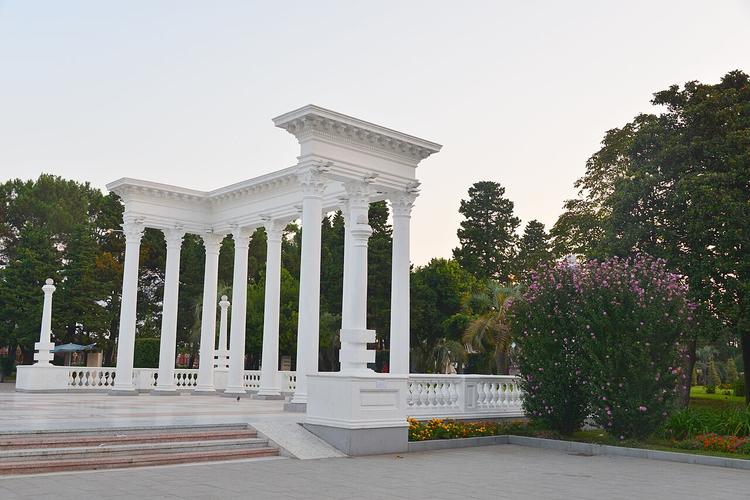
The colonnades serve as the ceremonial gateway to the embankment. They were built in 1934 based on an idea by physician Ivan Mchedlidze, who was inspired by a trip to Italy. The project was executed by architect Bogdan Kirakosyan. The snow-white columns surrounded by exotic trees and flowers have become the city's calling card: they appear on postcards, in films, and tourists always stop to take photos nearby. Other paths lead to the sea as well, but most visitors walk through here. In the morning the light is soft, and you can get the best shots without the crowds. The catch: during the day the area around the columns is busy, and you may have to wait for a good angle.
 © Андрей Бобровский · CC BYPhoto: Андрей Бобровский, CC BY (https://creativecommons.org/licenses/by/3.0), Wikimedia Commons
Pier by the singing fountains
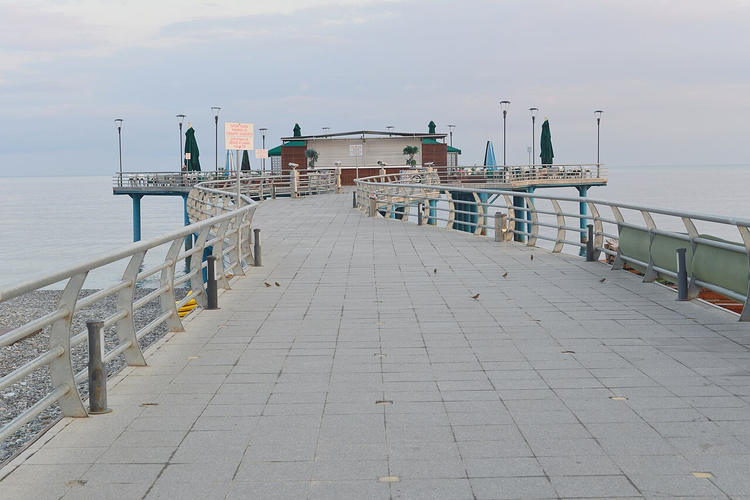
The pier by the singing fountains stretches from the embankment into the sea. Nearby are the Wedding Palace and the musical fountains. People arrange to meet here and stroll along the water. The pier has cafes, shops, currency exchange offices, and a disco bar, so visitors tend to linger. During the day it is pleasant to have coffee with a view of the Alphabet Tower, the embankment, and the mountains. In the evening the bar hosts parties where you can dance and smoke hookah. There is a play area for children, and the edge of the pier offers panoramic shots of the city. The Pier Batumi restaurant is open around the clock in summer: the menu includes breakfast combos, pizza, lasagna, Georgian dishes, and desserts. The catch: in season, prices on the pier are higher than the city average.
 © Андрей Бобровский · CC BYPhoto: Андрей Бобровский, CC BY (https://creativecommons.org/licenses/by/3.0), Wikimedia Commons
Rustaveli Avenue
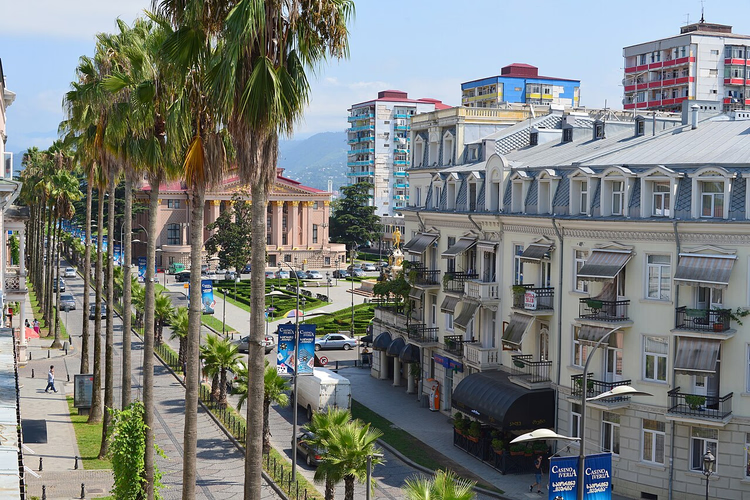
The old town has been heavily rebuilt, but efforts were made to preserve its historic character. Rustaveli Avenue starts almost at the embankment, and it is best to walk along it in the evening, when the buildings are lit up. Along the way, take note of the Batumi Drama Theater named after Ilia Chavchavadze. The theater building is built in the classical style, and next to it is a square that is always full of people. In the square's fountain you will see gilded figures of Neptune and sirens. A similar fountain, only larger, stands in Bologna, Italy. Houses from the 19th and early 20th centuries survive here, so the walk gives you a sense of the old architecture of Adjara. From here you can walk to May 6 Park with its lake. The catch: the sidewalks are narrow, and at rush hour cars and crowds get in the way.
 © Андрей Бобровский · CC BYPhoto: Андрей Бобровский, CC BY (https://creativecommons.org/licenses/by/3.0), Wikimedia Commons
Europe Square and the statue of Medea
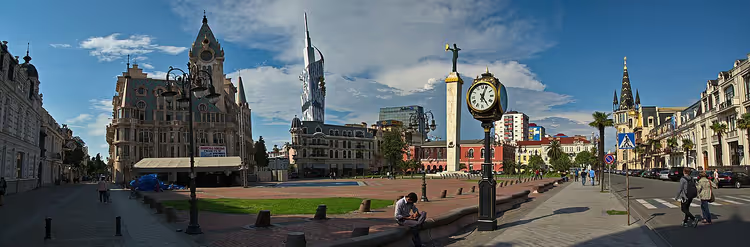
Europe Square lies in the center, not far from the Astronomical Clock. The main attraction here is the statue of Medea. According to legend, Medea was the daughter of the king of Colchis and helped Jason obtain the Golden Fleece. The sculptor depicted her with the fleece in her hand, and the heroine herself was considered a skilled healer. The prosperity of Colchis was linked specifically to the Golden Fleece, so the symbol carries a double meaning: love and the wealth of the region. The statue was erected on the initiative of former Georgian president Mikheil Saakashvili and was meant to show the country's connection to Europe. The square is well kept, concerts are held here in the evenings, and a large Christmas tree is put up for New Year. It is easier to photograph the statue at dusk, when the lighting comes on. The Sea Port and the start of the boulevard are near the square, so it is convenient to see it on the way to the port. The name "Europe" emphasizes the city's move toward Western standards: neat lawns, tidy paving, cleanliness. The catch: the square has almost no infrastructure of its own; look for cafes on the neighboring streets.
 © Uwe Brodrecht · CC BY-SAPhoto: Uwe Brodrecht, CC BY-SA (https://creativecommons.org/licenses/by-sa/2.0), Wikimedia Commons
Batumi Archaeological Museum
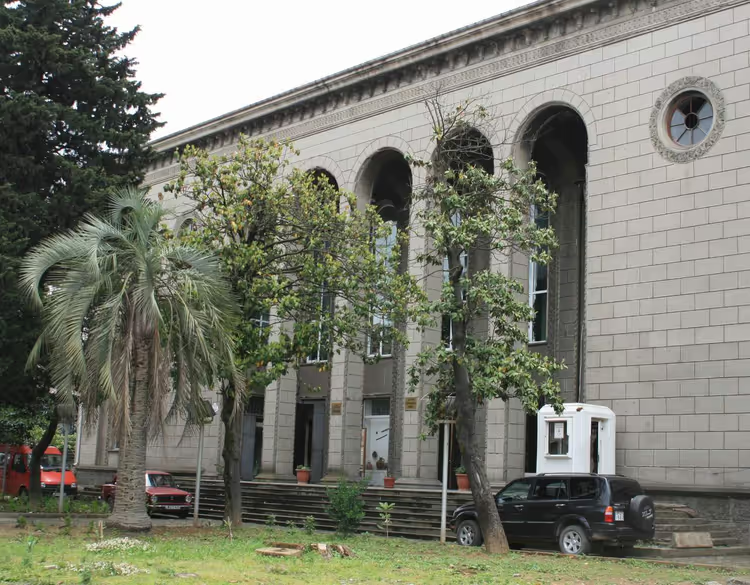
The museum occupies a beautiful mansion at 77 Chavchavadze Street. It is one of the oldest museums in Georgia, nearly a hundred years old, and its collection exceeds 22,000 items. It is best to view the exhibition chronologically: start on the second floor, where finds from the Stone and Iron Ages are displayed. Some objects are around 10,000 years old. The first floor houses ancient metal, glass, and ceramic artifacts, as well as medieval tableware, coins, tools, and jewelry. Of particular interest is a hoard from the Gonio-Apsaros fortress with cult figurines and vessels. The exhibits confirm the trade links between local residents and Arab merchants. You will spend about an hour on the visit. The exhibition covers the period from the Stone Age to the Middle Ages, so the halls make it easy to trace the region's history as a whole. The catch: almost all the labels in the halls are in Georgian; ask about an audio guide in advance.
 © Aleksey Muhranoff · CC BY-SAPhoto: Aleksey Muhranoff, CC BY-SA (https://creativecommons.org/licenses/by-sa/3.0), Wikimedia Commons
Cathedral
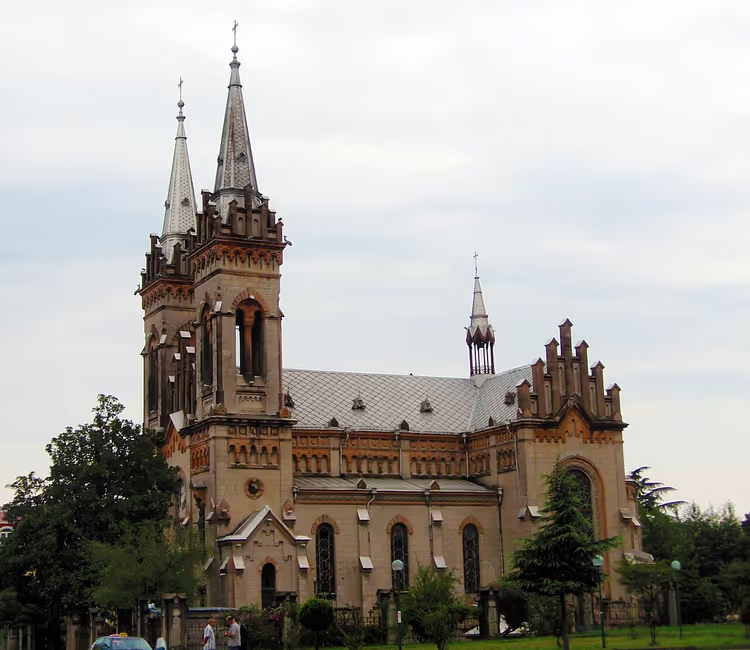
The Cathedral of the Nativity of the Blessed Virgin Mary was built in the early 20th century with money from oil industrialist Stefan Zubalashvili. It was originally a Catholic church, which his mother Elizaveta had dreamed of. The interior was painted by an artist brought in from Italy, and the building was consecrated in 1902. During the Soviet years there were plans to open a concert hall here, and the building was restored for that purpose, but in 1989 the church was handed over to the Orthodox Church. The cathedral is built of white stone that changes shade in different light. It has three domes, and the facade is decorated with red brick and ornamentation in gold and blue. Inside you will see frescoes, stained glass, and statues of Saint Nino and the Apostle Andrew the First-Called. Some of the icons are painted in the Russian style, while others were made by Georgian masters. Address: 51 Demetre Tavdadebuli Street. It is worth visiting even if you follow a different religion. Many people note the similarity of the interior to the Sistine Chapel in the Vatican, except that instead of Catholic frescoes there are Orthodox icons here. The catch: a dress code is enforced at the entrance; shorts and bare shoulders are not acceptable.
 © User:Ephraim Stillberg , User:Deu · CC BY-SAPhoto: User:Ephraim Stillberg , User:Deu, CC BY-SA (https://creativecommons.org/licenses/by-sa/3.0), Wikimedia Commons
May 6 Park
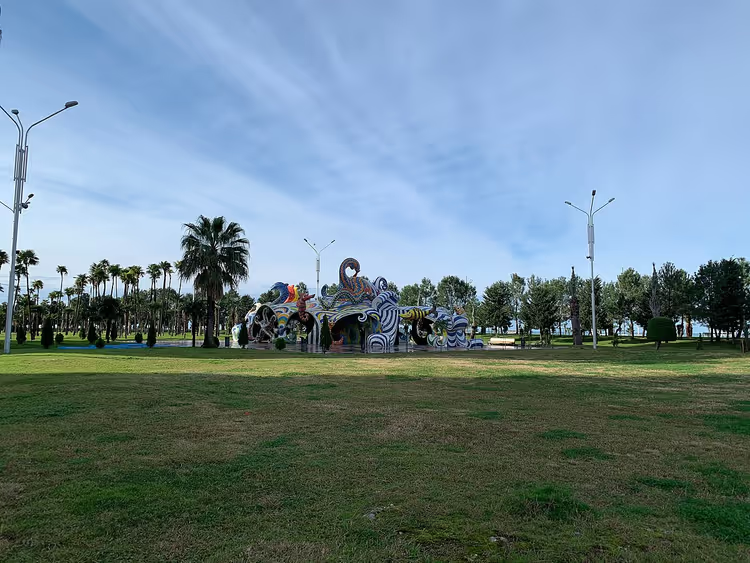
May 6 Park is a favorite of locals: it covers more than 150,000 square meters in the city center. Its history dates back to 1881, and German and French gardeners worked on its layout. Emperor Alexander III planted a magnolia here, and for a time the park was called Alexander Park. It received its current name in 2007, in honor of the resolution of the 2004 Adjara crisis. The park's main ornament is Lake Nurigeli. You can walk along its shores, or rent a catamaran or a boat with a canopy and a grill. A fountain shoots up in the center of the lake and is lit up in the evening. For children there are rides, a little train, and carousels, plus tree-top observation platforms and a sundial. In summer an open-air cinema opens. An unusual fountain shaped like a boulder attracts the attention of children and adults alike. The atmosphere here is calm: locals come with their families for the whole day, so the park is especially lively in the evening. The catch: on weekends there is a line at the boat rental station.
 © Robot8A · CC BY-SAPhoto: Robot8A, CC BY-SA (https://creativecommons.org/licenses/by-sa/4.0), Wikimedia Commons
Batumi Zoo
Batumi Zoo occupies part of May 6 Park. The area is small, but the animals are kept in good conditions: clean enclosures and greenery. Admission is charged only for the pavilion with birds and primates; the rest of the area can be viewed freely. You will see vultures, eagles, exotic parrots, and monkeys. Separate enclosures are set aside for zebras and kangaroos, which come close to the fence. Feeding the animals is prohibited, and staff keep an eye on things. The crowd favorite is a lemur, whose relatives live in Madagascar. With children, it is convenient to combine the zoo with a walk in the park and a boat ride. The catch: the pavilion with birds and primates has an admission fee.
Batumi Dolphinarium
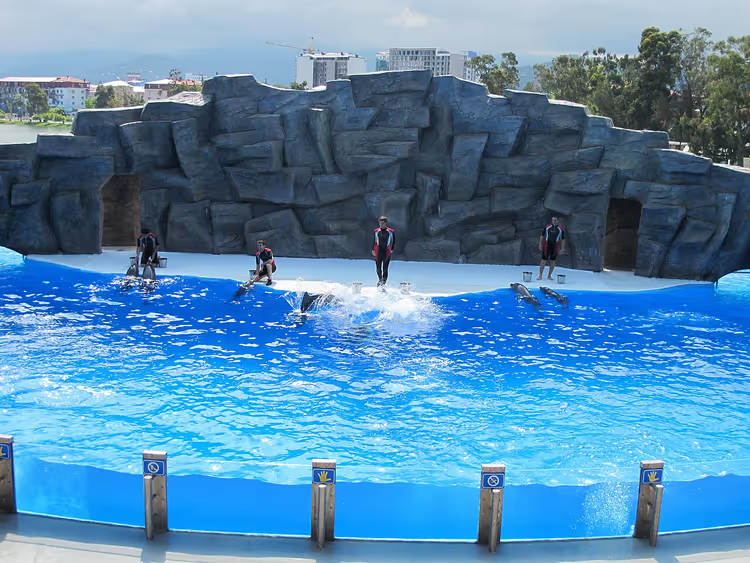
The Batumi Dolphinarium opened in 1975 and became the first one in the USSR. In the 90s, the complex fell into disrepair and was dismantled, and the animals moved to Cyprus. The new building was built with donations in the May 6 Park. Today there are three pools and a 700-seat amphitheater, with seating for guests with limited mobility. The show is presented in three languages, including Russian.
 © Андрей Романенко · CC BY-SAPhoto: Андрей Романенко, CC BY-SA (https://creativecommons.org/licenses/by-sa/3.0), Wikimedia Commons
The show runs every day except Monday, starting at 4:00 PM, lasting about 35 minutes. An adult ticket costs 30 GEL, children under 6 go free without a separate seat (as of 09/2026, dolphinarium.ge). The program features 8 dolphins and up to 30 acts: dancing, hoop work, and ball work. You can also book a dolphin swim separately, which is 15 minutes in the pool. In summer, a second show is added. You can order tickets in advance on the website or buy them at the ticket office by the entrance. The catch: in high season the hall fills up completely, and tickets sell out fast.
Tours and tickets in Batumi
Guided tours, skip-the-line tickets and activities — most offers can be cancelled free of charge.
See offers on GetYourGuideThe widget loads once you give your consent.
How to get from the airport to the center
Bus No. 10 runs from Batumi Airport to the center. The fare is 0.30 GEL, and the ride takes about 20 minutes (as of 09/2026, AirportNavi). The stop is to the right of the terminal exit, and you buy your ticket from the conductor or pay by card. Bus No. 9 goes along Bagrationi Street to the old town, but it runs less frequently.
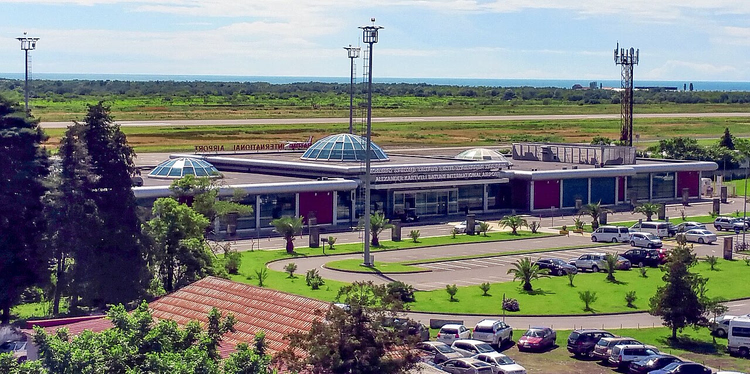 © Gaga.vaa · CC BY-SAPhoto: Gaga.vaa, CC BY-SA (https://creativecommons.org/licenses/by-sa/4.0), Wikimedia Commons
An official taxi will get you there in 10-15 minutes, while private drivers often inflate the price several times over. The distance to the center is short, so the ride takes little time even in season. If you arrive as a group or with luggage, it is better to book a transfer in advance: the driver will meet you in the arrivals hall. Walking from the airport is not a good idea, as there is no sidewalk for most of the way.
Tours and tickets in Batumi
Guided tours, skip-the-line tickets and activities — most offers can be cancelled free of charge.
See offers on KiwitaxiThe widget loads once you give your consent.
⁉️🤔 Frequently asked questions
How much time do you need to see Batumi in one day?
The route with 20 points takes 6-8 hours on foot. If you go to the museum and the dolphinarium, plan for a full day. Leave the cable car for the morning and May 6 Park for the evening. In winter, daylight hours are shorter, so trim the list or take taxis between areas.
Is the dolphinarium open on Monday?
The dolphinarium is closed on Mondays, and the show starts at 4:00 PM. An adult ticket costs 30 GEL (as of 09/2026, dolphinarium.ge). In summer, a second show is added. It is better to buy tickets in advance on the official website or at the ticket office by the entrance.
How much does the Argo cable car ride cost?
An adult round-trip ticket costs 39 GEL, a child aged 5-11 costs 9 GEL (as of 09/2026, argo-batumi.ge). You can pay by card or cash at the ticket office by the lower station. A Quick Pass is sold separately for 20 GEL and lets you skip the line. The cable car runs from 10:00 AM to midnight.
How do you get from the airport to the center?
The cheapest option is bus No. 10 for 0.30 GEL, and the ride takes about 20 minutes. The stop is to the right of the exit, and the conductor sells tickets. An official taxi will get you there in 10-15 minutes, but private drivers inflate the price several times over. For a family or a group, it is better to book an airport transfer in advance.
Can you cover all the sights on foot?
Yes, the main points are along the promenade and in the center. The distance between the farthest points is about 5 km on the map, which is 1.5-2 hours without stops. With children or in the heat, add breaks and bring water. Farther sights like May 6 Park are better to visit at sunset.
In short: what to book
One day in Batumi comes down to a walk along the promenade and the center. Buy cable car and dolphinarium tickets in advance so you do not stand in line. Choose a hotel along the boulevard: then you can walk the entire route.
If you have a couple of days, add the botanical garden and Gonio Fortress. If you are traveling with children, plan for the dolphinarium and the zoo in May 6 Park. If you do not have a car, stay in the center and use bus No. 10 from the airport.
- Hotels in Batumi on Trip.com will help you book a night near the boulevard.
- Compare insurance options before your trip.

A small editorial team writing guides for independent travel. We travel ourselves, but we haven’t been everywhere, so we check prices, opening hours and how to get there against official sources.