
















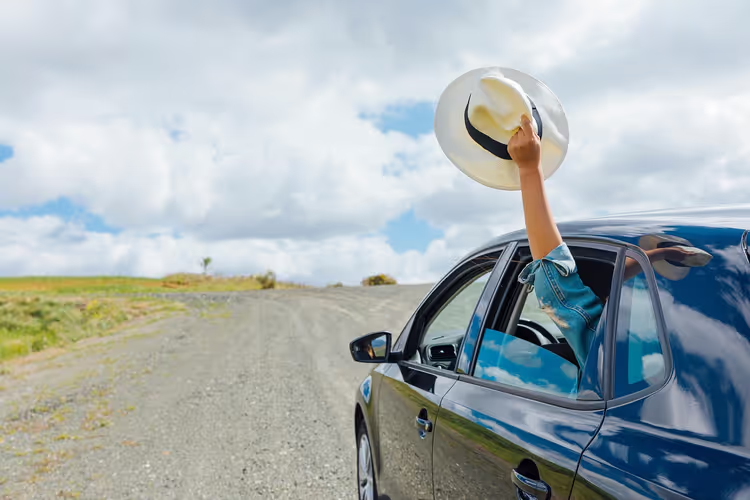
Italy by car: a 15-city route from Rome to Orvieto
Renting a car in Italy is easier than it seems. The cities here are close together, and between them lie Tuscany, Umbria, and Liguria. In one trip you can realistically see 5-6 cities, and with extra time, all 15. The maximum speed on highways is 130 km/h, in cities 50 km/h (as of 09/2026, ACI).
The main challenge isn't the roads, it's the city centers. Almost everywhere, the historic part is closed off by a ZTL zone, and entering without a permit is prohibited. The fine arrives on the rental company's card a few weeks after you return the car. Below is a route from Rome to Orvieto with 15 stops and parking tips.
Ad: this article contains affiliate links, we earn a commission if you book through them, at no extra cost to you.
Advantages of renting a car
💡 In short:
- A car gives you freedom: you decide where to stop and how long to stay.
- Highways in Italy are toll roads, payable by card or cash at the exit (as of 09/2026, highway operator Autostrade).
- ZTL zones apply in historic centers, entry without a permit is prohibited.
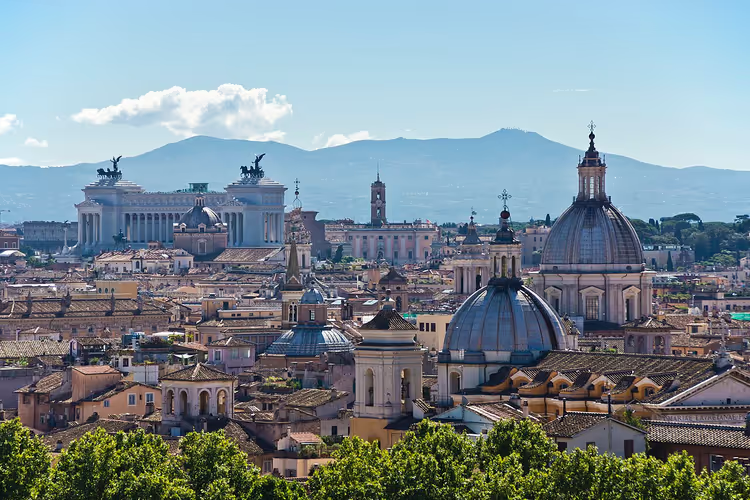 © Bert Kaufmann from Roermond, Netherlands · CC BY-SAPhoto: Bert Kaufmann from Roermond, Netherlands, CC BY-SA (https://creativecommons.org/licenses/by-sa/2.0), Wikimedia Commons
Italy is well suited for independent travel. The roads are smooth, the markings are clear, and the navigator takes you right to parking near the historic center. Outside peak season, rentals are cheaper, and you don't depend on train schedules.
To rent a car you need a passport, driver's license, a card in the driver's name, and a voucher with booking details. Rental companies restrict young drivers by age and charge an extra fee. Inspect the car together with a staff member and photograph any chips before you drive off.
For large cities with museums, allow two to three days; for small ones, one day is enough, and for San Marino and Arezzo, half a day will do. That way the route won't turn into a race, and you'll have time to look around.
1. Rome
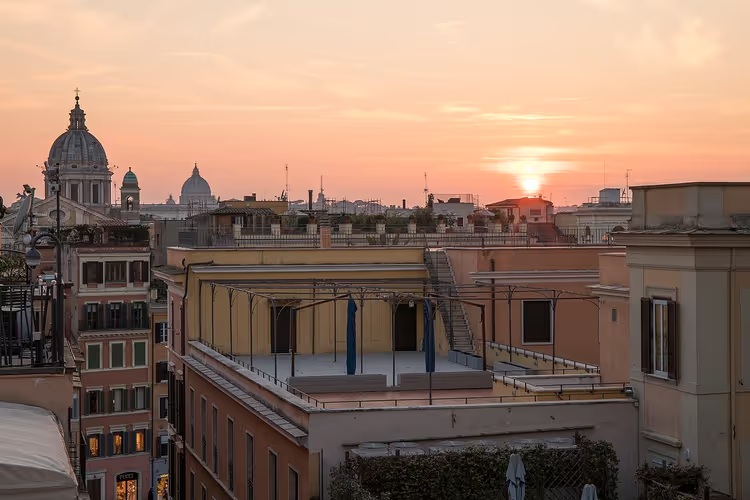 © Luigi Guerrieri4 · CC BY-SAPhoto: Luigi Guerrieri4, CC BY-SA (https://creativecommons.org/licenses/by-sa/4.0), Wikimedia Commons
Rome is a convenient starting and ending point for your trip. Sightseeing takes several days because there are more monuments here than in any other city in the country. The historic center is compact, and you'll cover part of the route on foot.
The essential minimum: the Colosseum, the Roman Forum, the Pantheon, the Trevi Fountain, the Spanish Steps, Castel Sant'Angelo, and the Vatican with the Sistine Chapel. The Borghese Gallery and Palatine Hill deserve a separate day. It's best to book Colosseum tickets with a time slot in advance; in summer they sell out weeks ahead.
- By car: entry to the historic center (Centro Storico) is closed by ZTL cameras; since 01/15/2026 a 30 km/h limit applies there (as of 09/2026, Rome tourist office).
- Parking: leave your car at park-and-ride lots near the metro; from there, the metro and bus are more convenient.
- Who it's for: those willing to walk a lot and combine antiquity with museums.
2. Naples
 © This Photo was taken by Wolfgang Moroder . Feel free to use my photos, but please mention me as the author and send me a · CC BY-SAPhoto: This Photo was taken by Wolfgang Moroder . Feel free to use my photos, but please mention me as the author and send me a, CC BY-SA (https://creativecommons.org/licenses/by-sa/3.0), Wikimedia Commons
Naples attracts both tourists and Italians themselves, and it has an enormous cultural heritage. The city is dense and noisy, but Vesuvius is nearby, and its last eruption happened in the mid-20th century. You can see the volcano right from the center if you climb up to Castel Sant'Elmo.
Pompeii and Herculaneum are close by, and a trail leads to the crater of Vesuvius. Tours to Vesuvius and Pompeii usually include a transfer from Naples, so having your own car is less useful here.
- By car: the center also has a ZTL, and parking is expensive. Leave the car at the hotel and walk.
- How much time: one day is enough for the city; take a second day for Vesuvius and Pompeii.
3. San Marino
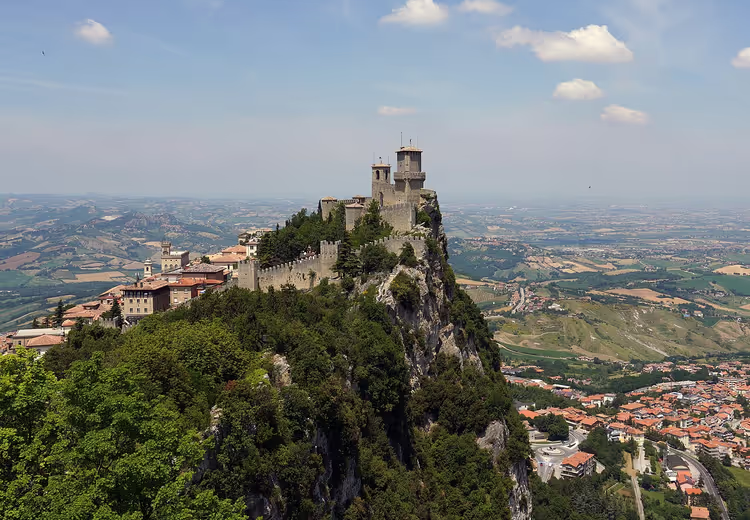 © Commonists · CC BY-SAPhoto: Commonists, CC BY-SA (https://creativecommons.org/licenses/by-sa/4.0), Wikimedia Commons
The capital of this microstate sits on top of Monte Titano. Here you can explore the old streets, houses, and three medieval towers: Guaita, Cesta, and Montale. Driving up is convenient, and there are parking lots near the walls of the old town.
San Marino has many museums, and the choice depends on your interests. The National Museum houses a collection of antiquities and medieval paintings, and the Wax Museum is a hit with kids. A sightseeing tour of San Marino takes a couple of hours and helps you not miss the highlights.
- Stop: half a day is enough if you are continuing north toward Rimini.
- The catch: the climb to the towers is steep, so if you have suitcases, it is better to leave your things in the car.
4. Rimini
 © karel291 · CC BYPhoto: karel291, CC BY (https://creativecommons.org/licenses/by/3.0), Wikimedia Commons
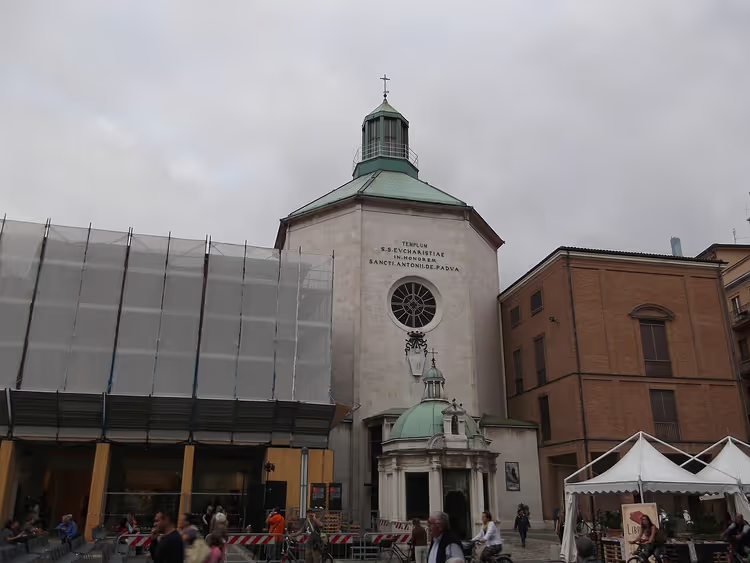
Rimini sits on the Adriatic, and many people come here for the sea. In the center you will find Piazza Tre Martiri, historic buildings, and a memorial column marking Caesar's crossing of the Rubicon, which flows nearby. The Italia in Miniatura park shows scale models of the country's main attractions.
- Stop: one night is enough if you are continuing north.
- By car: in July and August there are many vacationers by the sea, so look for parking in advance.
5. Bologna
 © Ввласенко · CC BY-SAPhoto: Ввласенко, CC BY-SA (https://creativecommons.org/licenses/by-sa/3.0), Wikimedia Commons
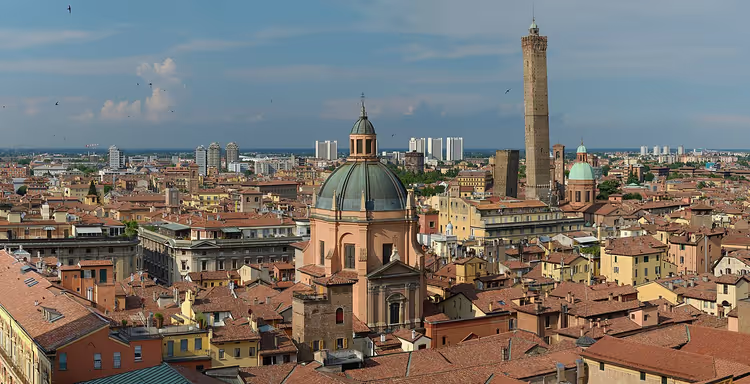
The city was founded by the Etruscans around 500 BC, and there is plenty to see. The main sights: the leaning Due Torri towers from the 12th to 14th centuries, Piazza Maggiore, and Piazza del Nettuno. Plan to spend a day or two exploring.
Bologna is called the gastronomic capital of Italy, and bolognese sauce was invented here. In the evening, pick a trattoria away from the main square and the bill will be lower.
- By car: the historic center is closed off by a ZTL, so leave the car in a parking lot near the station.
6. Venice
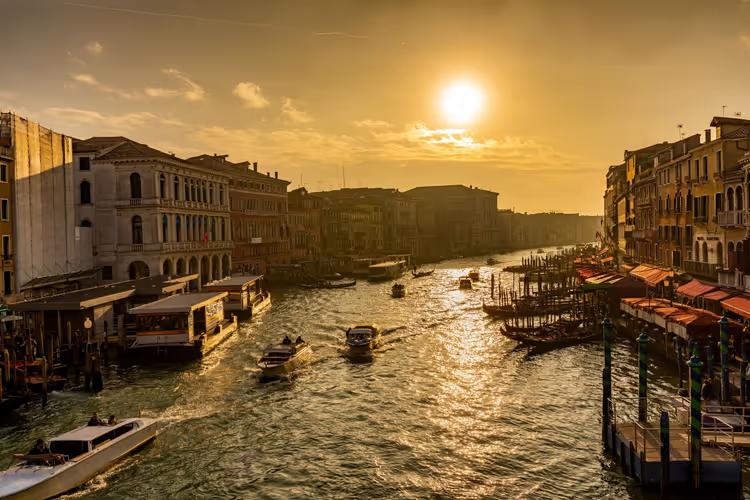
Venice is in the northeast of the country, and the historic part occupies islands in the lagoon. You leave the car on the mainland, and after that it is only walking and vaporetto. The route logic changes, so think about parking in advance.
Here you can stroll through Piazza San Marco and across the Rialto Bridge, ride a gondola, and buy carnival masks from artisans. The cuisine is built around seafood. Venice tours with a gondola often include entry to the Doge's Palace and the basilica.
- By car: driving into the city is not allowed, so the car stays in a parking lot in Mestre or near Piazzale Roma.
- How much time: two days is enough for the islands and the center.
7. Verona
 © Maurizio Moro5153 · CC BY-SAPhoto: Maurizio Moro5153, CC BY-SA (https://creativecommons.org/licenses/by-sa/4.0), Wikimedia Commons
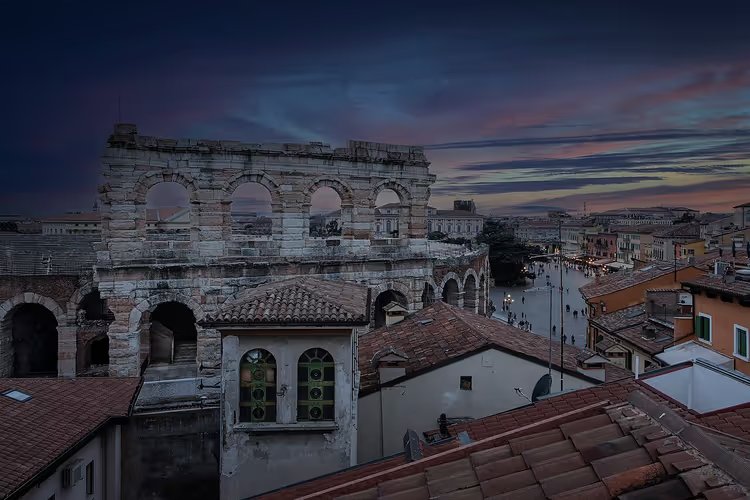
Verona is considered one of the most romantic cities in Europe, and Shakespeare set Romeo and Juliet here. Beyond its literary fame, the city has ancient and medieval monuments that you can see in a day.
- By car: the center is small, it's better not to drive into the historic part, leave your car near the train station.
- Tip: Verona tours are convenient to book for the evening, when the heat subsides.
8. Bergamo
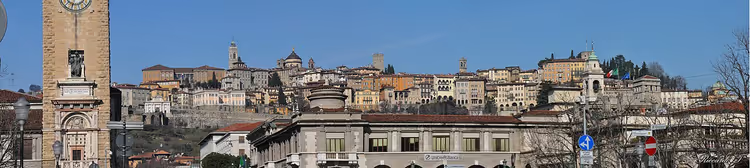 © RiccardoT · CC BYPhoto: RiccardoT, CC BY (https://creativecommons.org/licenses/by/3.0), Wikimedia Commons
Bergamo is divided into the lower and upper city, and the easiest way up to Città Alta is by funicular. Here you'll find gardens, parks, and monuments, and on the main square, Piazza Vecchia, stand the Old and New town halls. The 15th-century Cappella Colleoni is considered the city's masterpiece.
- Stop: half a day for the upper city, another couple of hours for the lower one.
9. Milan
 © Steffen Schmitz · CC BY-SAPhoto: Steffen Schmitz, CC BY-SA (https://creativecommons.org/licenses/by-sa/4.0), Wikimedia Commons
Milan is more than two thousand years old and is one of the country's main economic centers. In the center you'll see the Milan Cathedral, the Galleria Vittorio Emanuele II, and the La Scala theater museum. Seeing it all takes a day.
- By car: the center has a paid Area C zone, a fee is charged when you enter, so watch the signs.
- Who it's for: those who love shopping and opera.
10. Genoa
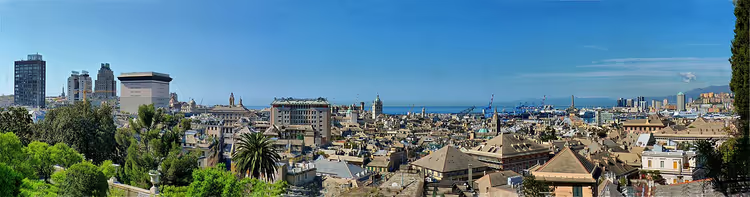 © patano · CC BY-SAPhoto: patano, CC BY-SA (https://creativecommons.org/licenses/by-sa/3.0), Wikimedia Commons
Genoa is a major port with a picturesque old town. There are many sights here, and in the Porto Antico area you'll see places where ships docked in the Middle Ages. A day is enough to see it.
- By car: the center is dense with narrow streets, leave your car in the parking lot near the port.
11. Pisa
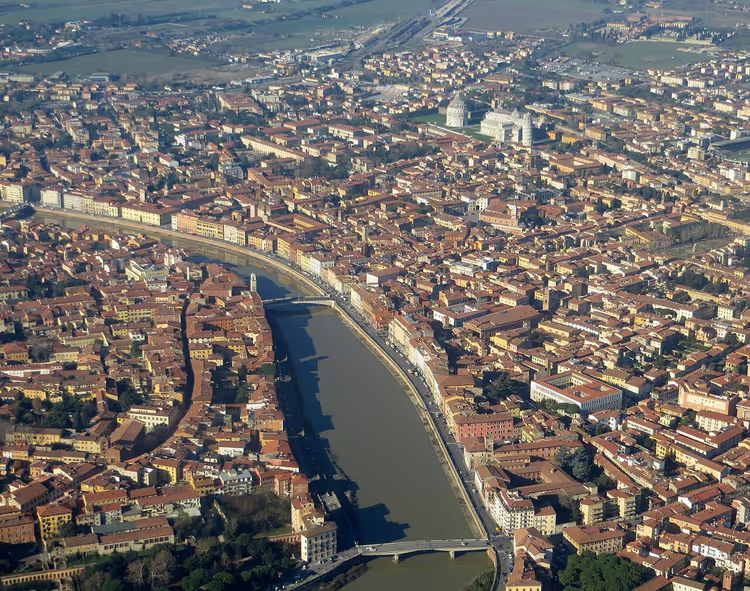 © Luca Aless · CC BY-SAPhoto: Luca Aless, CC BY-SA (https://creativecommons.org/licenses/by-sa/4.0), Wikimedia Commons
Pisa is known for the Leaning Tower, but the city isn't limited to a single monument. It's worth visiting the National Museum, whose building was first a monastery and later a king's palace. The Museum of Ancient Ships is also here.
- By car: parking near Piazza dei Miracoli is paid, but spots are available outside the morning rush.
- Tip: arrive at opening time, by midday there are lots of tour groups at the tower.
12. La Spezia
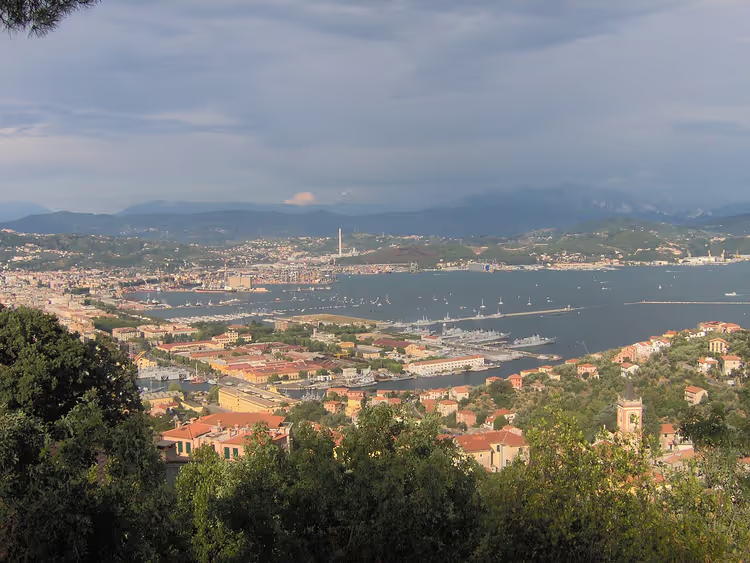 © William Domenichini · CC BY-SAPhoto: William Domenichini, CC BY-SA (http://creativecommons.org/licenses/by-sa/3.0/), Wikimedia Commons
La Spezia lies on the shore of the bay of the same name. The city is mentioned in documents from the 13th century and later became a major trading center. Today people come here for the mild climate, historic buildings, and local festivals.
- By car: it's convenient to visit Cinque Terre from here, but cars aren't allowed into the villages themselves, only train or boat.
13. Florence
 © Bely Medved · CC BY-SAPhoto: Bely Medved, CC BY-SA (https://creativecommons.org/licenses/by-sa/2.0), Wikimedia Commons
Florence deserves several days; in one day you will only see a small part of it. There are no fewer sights here than in Rome, and the streets have turned into an open-air museum.
The main ones: the Uffizi Gallery, the Cathedral of Santa Maria del Fiore, and the Ponte Vecchio. A Uffizi ticket costs €25, the museum is closed on Mondays, opening hours are 8:15 AM to 6:30 PM (as of 09/2026, official Uffizi Gallery website).
- By car: the city center is closed to traffic by ZTL, parking is expensive, so it's better to leave your car on the outskirts.
- Tip: book tours in Florence in the morning to skip the lines.
14. Arezzo
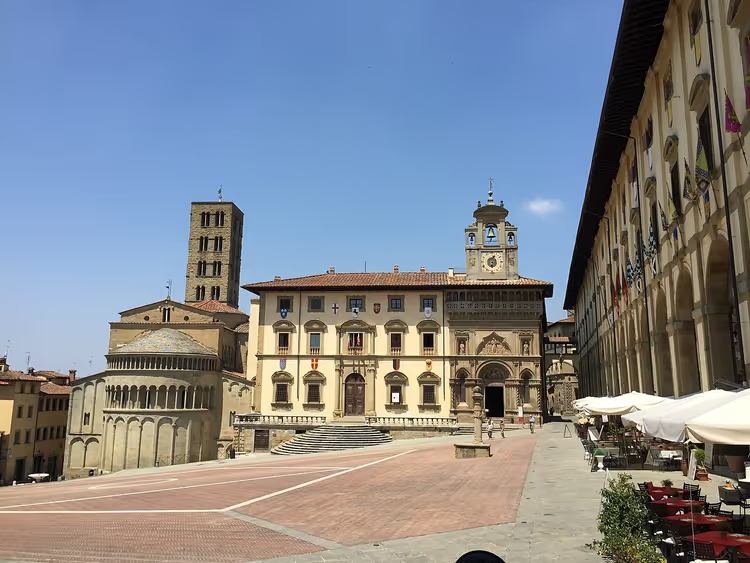 © Andrewrabbott · CC BY-SAPhoto: Andrewrabbott, CC BY-SA (https://creativecommons.org/licenses/by-sa/4.0), Wikimedia Commons
Arezzo is 80 km from Florence, on the same Arno River. The town is small and quiet, and you can stroll through its medieval streets without the crowds. Seeing it takes half a day.
- Stop: you can combine it with Florence in one day.
15. Orvieto
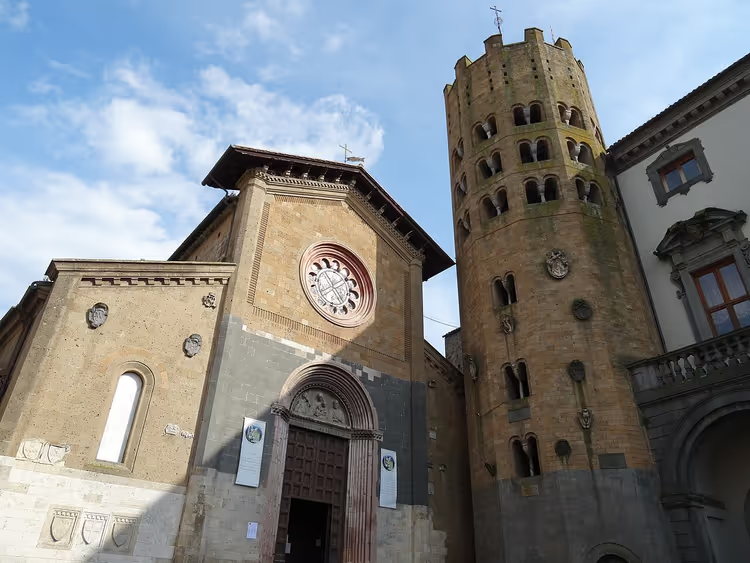 © Livioandronico2013 · CC BY-SAPhoto: Livioandronico2013, CC BY-SA (https://creativecommons.org/licenses/by-sa/3.0), Wikimedia Commons
Orvieto sits on a cliff, and here you will definitely step into the Middle Ages. The sights are compact, and you can realistically see them in one day. The Orvieto Cathedral (Duomo) with its mosaic facade deserves special attention.
From Orvieto it's convenient to return to Rome and close the route loop. Few people manage to see all the cities listed in one trip. Feel free to pick 5 or 6 of them and leave the rest for next time.
Italy road trip route on the map
Below is a map of the entire route: Rome, Naples, San Marino, Rimini, Bologna, Venice, Verona, Bergamo, Milan, Genoa, Pisa, La Spezia, Florence, Arezzo, and Orvieto. This loop adds up to about 2,000 km, so plan for at least two weeks.
Road trip route across Italy
Places on the map
- 1Rome Start and finish of the route, the Colosseum, the Forum and the Vatican
- 2Naples City by Vesuvius, with Pompeii and Herculaneum nearby
- 3San Marino Capital of the mini-state on Monte Titano with three towers
- 4Rimini Adriatic resort with the Italia in Miniatura park
- 5Bologna The gastronomic capital, with the Due Torri towers
- 6Venice Lagoon islands, Piazza San Marco and the Rialto Bridge
- 7Verona City of Romeo and Juliet with ancient monuments
- 8Bergamo Lower and upper town, the Colleoni Chapel
- 9Milan Milan Cathedral, the Vittorio Emanuele II gallery and La Scala
- 10Genoa Major port with an old town and the Porto Antico
- 11Pisa The Leaning Tower of Pisa and the National Museum
- 12La Spezia Bay-side city, the starting point for the Cinque Terre
- 13Florence The Uffizi Gallery, Santa Maria del Fiore Cathedral, Ponte Vecchio
- 14Arezzo Quiet town 80 km from Florence with medieval streets
- 15Orvieto Hilltop town with the Duomo, the final stop of the loop route
If you pick up the car at Fiumicino Airport, plan the return with extra time for washing and refueling. Book your car class in advance; during high season there are fewer available cars.
⁉️🤔 Frequently asked questions
Do I need an international driver's license to rent a car in Italy?
Drivers from the EU only need their national license, and an international permit is usually not required. Citizens of other countries should get one in advance, before the trip. The rental company checks driving experience and age, and young drivers pay a surcharge. Check the terms of your booking in the contract before signing.
What is ZTL and how do I avoid a fine?
ZTL (Zona a Traffico Limitato) marks a restricted traffic zone in the historic center. Cameras record unauthorized entry, and the fine arrives on the rental company's card a few weeks later. Park outside the zone boundary and walk. The zone boundaries are visible on your navigation system, and a sign reading ZTL stands at every entrance.
How much do gas and toll roads cost in Italy?
Fuel prices in Italy are above the European average, and gas stations on highways are more expensive than in the city. Toll sections are paid at the exit by card or cash (as of 09/2026, payment rules on the Autostrade website). Fill up before getting on the highway to avoid overpaying, and keep some cash on hand.
Can I see all of Italy in one trip?
In one vacation you can realistically cover 5 or 6 cities or a ready-made two-week loop. The country has so much cultural heritage that seeing it all takes years. Pick one region and don't chase quantity, otherwise the trip turns into constant moving. It's better to see fewer places without rushing.
Where can I park in central Rome or Florence?
In both cities the historic center is closed to cars. Leave your car at park-and-ride lots near the metro or on the outskirts, then get around on foot and by public transport. In Rome, parking near metro stations is convenient; in Florence, near Piazzale Michelangelo and Santa Maria Novella station.
Find hotels
Compare prices across booking sites and filter for rooms with free cancellation.
Compare prices on Discover CarsThe widget loads once you give your consent.
In short: what to book
If you have two weeks, take the full loop from Rome to Orvieto and close it back in Rome. If you have five days, cut the route down to Rome, Florence, and Venice. If you're traveling with kids, add Rimini and the Italia in Miniatura park. It's better to book your car in advance: book a car on DiscoverCars.

A small editorial team writing guides for independent travel. We travel ourselves, but we haven’t been everywhere, so we check prices, opening hours and how to get there against official sources.