
















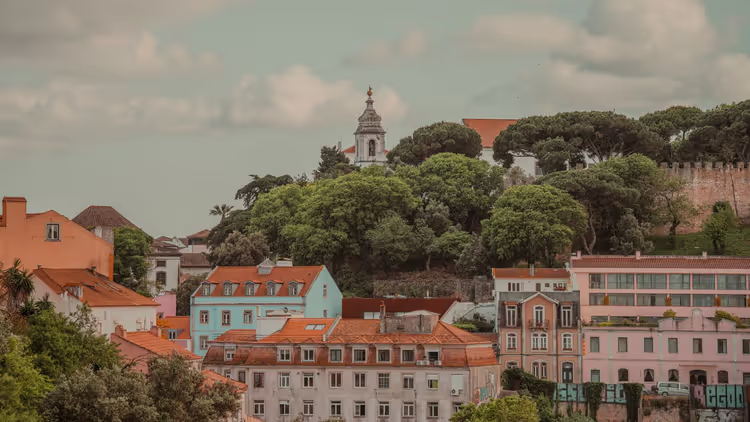
Lisbon in one day: old town, Belem and Alfama
Lisbon sits on seven hills. In one day it is easy to overestimate your stamina and miss the main things. We put together a one-day Lisbon route on our own: the old core of the city in the morning, the Belém district in the afternoon, Baixa and Alfama in the evening.
Short answer: in one day you can see both the old town and Belém. In the morning you ride the historic tram from Martim Moniz Square up to São Jorge Castle, in the afternoon you head to the Jerónimos Monastery and Belém Tower, and in the evening you walk through Baixa and finish in Alfama. Two short rides on public transport, the rest on foot.
Ad: this article contains affiliate links, we earn a commission if you book through them, at no extra cost to you.
One-day Lisbon route
💡 In short:
- In the morning, start at Martim Moniz Square and take the historic tram to the Santa Luzia viewpoint.
- Then go up to São Jorge Castle and walk down to Baixa.
- After lunch, head to Belém for the Jerónimos Monastery, Belém Tower and the Padrão dos Descobrimentos.
- Prices and opening hours: 09/2026, verified on the official São Jorge Castle website.
The route is designed so you almost never backtrack. In the morning it is the old town on the hill, in the afternoon Belém along the river, in the evening Baixa and Alfama. Part of the route you walk, part you ride by tram or train.
Site | Admission | Closed |
|---|---|---|
€17 (as of 09/2026, official castle website) | none | |
€18 and €15 (as of 09/2026, official website) | Monday | |
€15 (as of 09/2026, official museum website) | Monday |
Check prices before your trip. In high season ticket offices close earlier than the site itself, so get a ticket with a specific time slot.
A ride on the historic tram
 © Jorge Franganillo · CC BYPhoto: Jorge Franganillo, CC BY (https://creativecommons.org/licenses/by/2.0), Wikimedia Commons
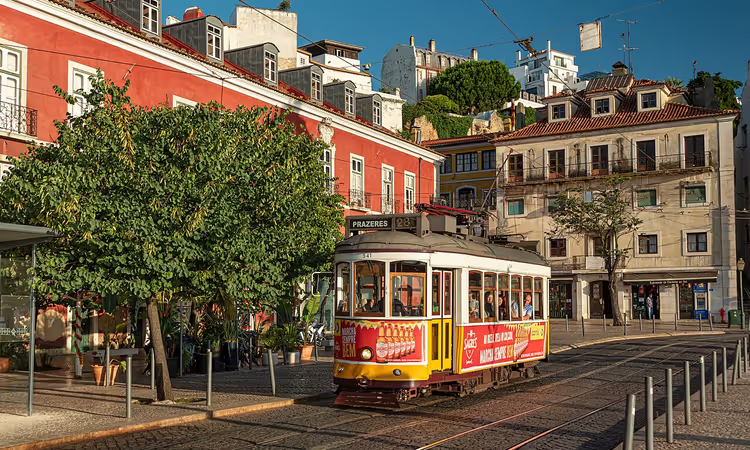
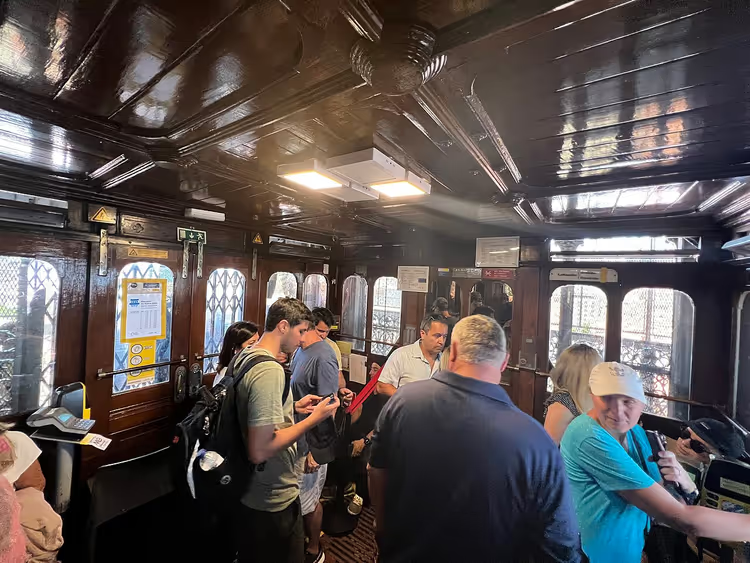
Tram 28 is the easiest way to see the old town from the window. The route runs from Martim Moniz Square through Graça, Alfama, and Baixa to Campo de Ourique. The cars are over a hundred years old, with wood and leather inside, and they are used not only by visitors but also by locals.
A ticket from the driver costs €3.30, while with a Viva Viagem card the ride costs €1.90 (as of 09/2026, Carris fares). You buy the card at a metro ticket office and load it with the number of trips you need. The tram remains regular city transport, not an attraction.
The best time to ride is early morning. By midday the cars are packed, and you can no longer get a window seat. Get off at the Santa Luzia viewpoint: from there you can see Alfama, the tiled roofs, and the Tagus River.
The catch: at rush hour so many people crowd into the car that the ride turns into a crush. Morning or late evening completely solves this problem. Keep your bag in front of you; in tight spaces this is not excessive caution.
St. George's Castle and viewpoint
 © Nan Palmero from San Antonio, TX, USA · CC BYPhoto: Nan Palmero from San Antonio, TX, USA, CC BY (https://creativecommons.org/licenses/by/2.0), Wikimedia Commons
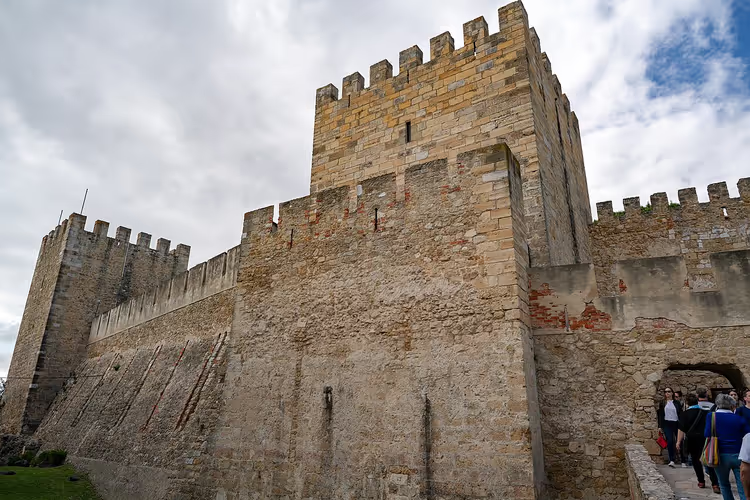
The castle stands on the city's highest hill, and from its walls you can see all of Lisbon. You can get there on foot from Baixa or by city bus uphill. The viewpoint is open to everyone who has bought admission.
An adult ticket costs €17, young people aged 13 to 25 pay €8.50, children under 12 enter free (as of 09/2026, official castle website). The Lisboa Card also gives entry at no extra charge. The castle has no closing day; it welcomes visitors every day.
What remains of the fortress are walls, towers, and an inner courtyard. Peacocks walk on the lawns and loudly protest when people get too close. In summer, visitors hide from the heat in the shade of olive trees, and on weekends there are knight performances and crossbow shooting.
From the viewpoint you will see the Tagus River, the Alfama district, and the Monastery of São Vicente de Fora. Bring water with you; the climb up the hill is long. Plan about two hours for the castle: there is nothing else to do on the hill.
Going down to Baixa is easier than going up. After that you need transport to Belém: the train to Belém station leaves from Cais do Sodré station, and the trip takes about ten minutes.
25 De Abril Bridge
 © Mike · CC BYPhoto: Mike, CC BY (https://creativecommons.org/licenses/by/3.0), Wikimedia Commons
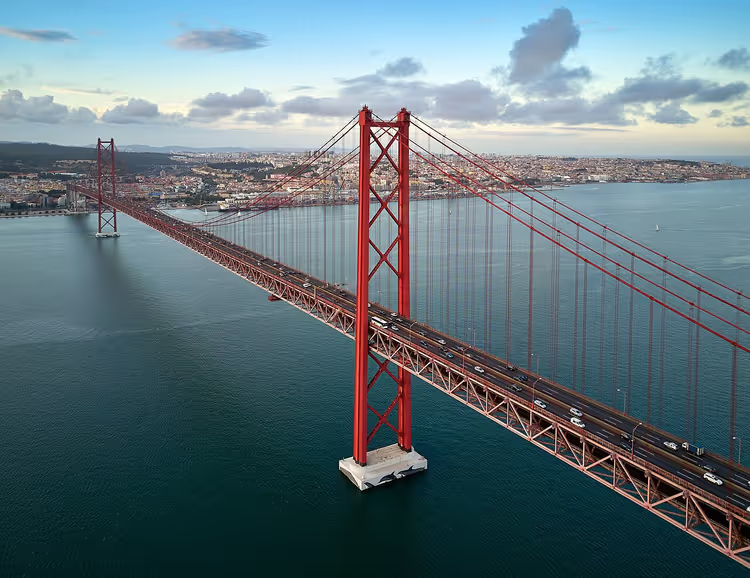
The road to Belém runs along the river, and the 25 de Abril Bridge rises up in the window. It is a suspension structure about two kilometers long that connects the north and south banks of the Tagus. Above the water, the deck rises almost seventy meters (according to the Lisbon tourist office, 09/2026).
The bridge opened in the 1960s and was first named after the dictator Salazar. After the revolution of 1974, it was renamed in honor of the day of the "Carnation Revolution." The bridge carries both road and rail traffic.
Jerónimos Monastery
 © Holger Uwe Schmitt · CC BY-SAPhoto: Holger Uwe Schmitt, CC BY-SA (https://creativecommons.org/licenses/by-sa/4.0), Wikimedia Commons
Jerónimos Monastery stands in Belém and is considered the main monument of the Age of Discovery. On this site there was once a chapel of Henry the Navigator, which Vasco da Gama himself visited. It was also here that King Manuel I greeted him after his return from India.
The facade of soft beige sandstone stretches for almost three hundred meters. Stone carving covers the walls, reliefs, and towers: there are coils of rope, shells, and sea creatures. Inside, the standout features are the vaulted ceiling with an openwork stone net and narrow stained-glass windows.
The basilica houses the sarcophagus of Vasco da Gama and the tombs of Portuguese kings. The entrance faces Praça do Império, with a tram and train stop nearby.
The monastery and Belém Tower are convenient to see with a single combo ticket, which is cheaper than two separate ones. The Belém Bundle combo ticket on Tiqets includes entry to both monuments.
Belém Tower
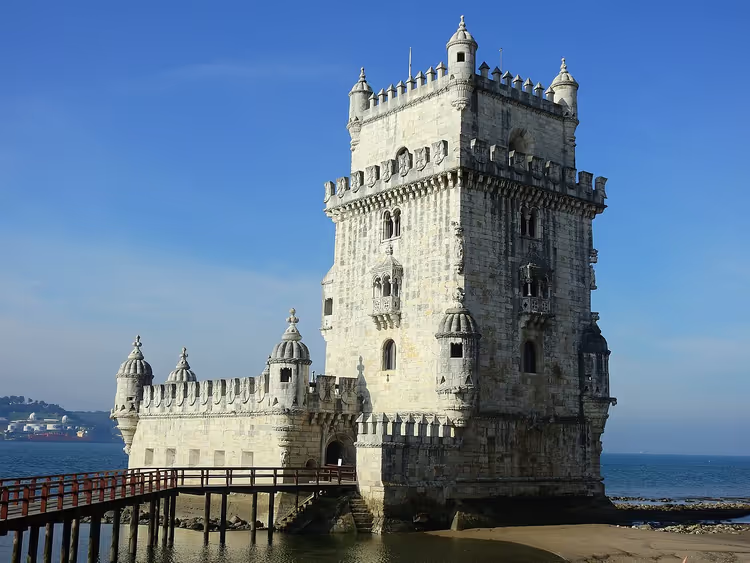 © Rehman Abubakr · CC BY-SAPhoto: Rehman Abubakr, CC BY-SA (https://creativecommons.org/licenses/by-sa/4.0), Wikimedia Commons
Belém Tower stands right in the water, on a basalt rock near the shore. The four-story structure was built in the early sixteenth century as a defensive fortress. Its appearance mixes Moorish elements and the Portuguese Manueline style.
The rectangular tower, about thirty-five meters high, is decorated with ribbed domes, crenellated walls, and openwork balconies. A massive bastion with an open terrace adjoins it. Behind the ceremonial facade lie the austere casemate halls with artillery pieces.
An adult ticket costs €15, and the site is closed on Mondays (as of 09/2026, official website). Arrive at opening time: the tower has narrow staircases, and it is easy to get stuck behind a group inside.
Belém Palace
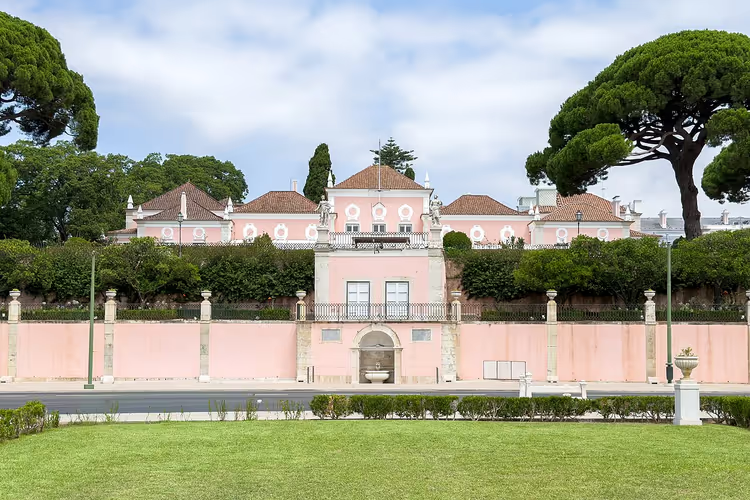 © Kent Wang · CC BYPhoto: Kent Wang, CC BY (https://creativecommons.org/licenses/by/4.0), Wikimedia Commons
Belém Palace is the official residence of the president of Portugal. The historic sixteenth-century building originally served as a guest house for the royal family. The complex consists of five connected wings painted pink.
The facades are decorated with snow-white stucco and azulejo tiles depicting mythological scenes. The side wings form a terrace with balustrades, and there is plenty of greenery around. Visitors are admitted during limited hours, so check the visiting status on site or on the presidential office website.
On the third Sunday of the month, a ceremonial changing of the honor guard takes place in the courtyard. Near the entrance, the "Waterworks Hall" is worth a look: the name comes from two drainage channels, the floor is laid out in black and white, and the walls are covered with multicolored azulejo.
Monument to the Discoveries
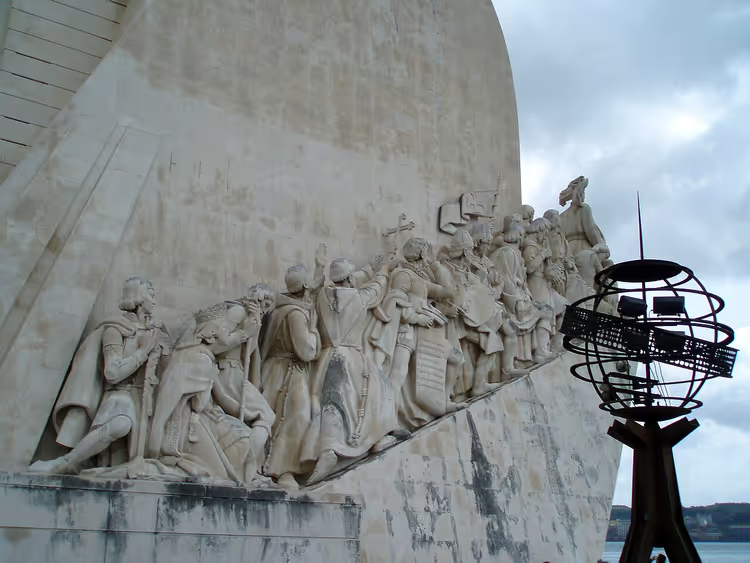 © Lee Cannon from Bayville aka West Fenwick, DE, USA · CC BY-SAPhoto: Lee Cannon from Bayville aka West Fenwick, DE, USA, CC BY-SA (https://creativecommons.org/licenses/by-sa/2.0), Wikimedia Commons
On the banks of the Tagus stands the Padrão, a monument honoring the navigators of the Age of Discovery. The sculptural group is shaped like a caravel with unfurled sails. The stylized stone ship rises more than fifty meters above the waterfront.
Along both sides of the deck runs a procession of figures: captains, cartographers, monarchs, writers, and missionaries. There are more than thirty statues in total, and the group is led by Henry the Navigator holding a model caravel in his hands. Each figure holds an object related to their trade.
At the foot of the monument lies a square with a "Compass Rose" mosaic about fifty meters in diameter. In the center of the panel is a world map showing the routes of Portuguese caravels. You can take an elevator inside the monument up to the observation deck.
National Coach Museum
The National Coach Museum houses a collection of antique carriages from the sixteenth through nineteenth centuries. Here you will find authentic Portuguese, Italian, French, and Austrian coaches that belonged to kings, nobles, and ambassadors.
 © Dguendel · CC BYPhoto: Dguendel, CC BY (https://creativecommons.org/licenses/by/4.0), Wikimedia Commons
A small part of the collection stands in the riding arena of the east wing of Belém Palace, built in the late eighteenth century. The museum's new building is within walking distance of the old one. The main hall, about fifty meters long, is covered by a frescoed ceiling and surrounded by an arched gallery with a balustrade.
The coaches with gilding, velvet, and fringe deserve special attention. A ticket costs €15, and the museum is closed on Mondays (as of 09/2026, official museum website). An hour and a half is enough for a visit.
Praça do Comércio
 © Jules Verne Times Two · CC BY-SAPhoto: Jules Verne Times Two, CC BY-SA (https://creativecommons.org/licenses/by-sa/4.0), Wikimedia Commons
Praça do Comércio is considered one of the most beautiful squares in the city and opens directly onto the river. Caravels once set sail from here on long voyages, and the marble quay received foreign ships carrying exotic goods.
Before the 1755 earthquake, the royal palace complex stood here. The disaster swept away the waterfront buildings, and after reconstruction, new administrative buildings were erected on the square for trade with Europe and the colonies.
The wide square is surrounded on three sides by symmetrical buildings with arcaded galleries. In the center, on a high pedestal, stands a bronze equestrian statue of King Joseph I. This is a convenient starting point for an evening walk through Baixa.
Rua Augusta Arch
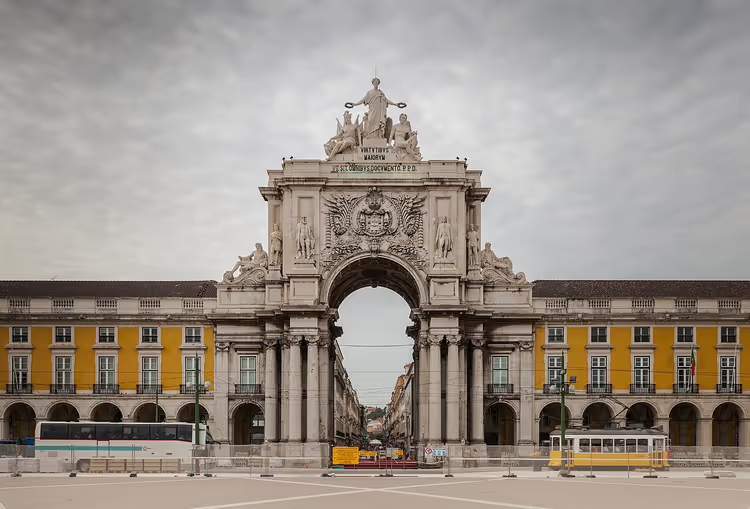 © Diego Delso · CC BY-SAPhoto: Diego Delso, CC BY-SA (https://creativecommons.org/licenses/by-sa/3.0), Wikimedia Commons
The triumphal arch closes off Praça do Comércio from the Rua Augusta side. Its foundation was laid in 1775, twenty years after the earthquake, but it was only completed in 1873 due to political turmoil. The sculptors wanted to show the resilience of the city's residents in the face of natural disaster.
The single-span arch, thirty meters high, is crowned by an allegorical group with figures of Glory, Genius, and Valor. The facade features marble statues of Portuguese figures, including Vasco da Gama, the Marquis of Pombal, and the knight Nuno Pereira. The arch is decorated with columns, bas-reliefs, and a clock.
In the evening, the lighting comes on and the arch looks completely different. Two narrow spiral staircases and an elevator lead to the top, where you get a view of the river and Baixa.
Next to the arch is Café Martinho da Arcada, open since 1782. Portuguese writers loved to sit here. Nearby, in the western part of the square, is the city's main tourist office, where you can pick up a map and buy souvenirs.
On weekends, street performers appear on the square, and double-decker sightseeing buses depart from the quay. One safety note: in the center, someone may approach you offering to sell drugs. This is illegal in Portugal, so just ignore the offer.
Santa Justa Lift
 © David Blaikie from Hampshire, UK · CC BYPhoto: David Blaikie from Hampshire, UK, CC BY (https://creativecommons.org/licenses/by/2.0), Wikimedia Commons
From Praça do Comércio, you head north into the Baixa district. There stands the Santa Justa Lift, a historic elevator that connects the waterfront Baixa with the higher neighborhoods. Lisbon's hilly terrain has always made getting around difficult, and in the early twentieth century this structure was built here.
The elegant steel tower rises forty-five meters. The facade is composed of neo-Gothic details, lacy arcades, and slender columns. Two cabins are finished with wooden panels and mirrors, and at the top a viewing platform awaits visitors.
The trick is that the lift is part of the city's public transport system. If you have a Viva Viagem ticket for a ride, you can use it here too (as of 09/2026, Carris). The line to go up can be long, so allow extra time for it.
Rossio Square
 © Bznein · CC BY-SAPhoto: Bznein, CC BY-SA (http://creativecommons.org/licenses/by-sa/3.0/), Wikimedia Commons
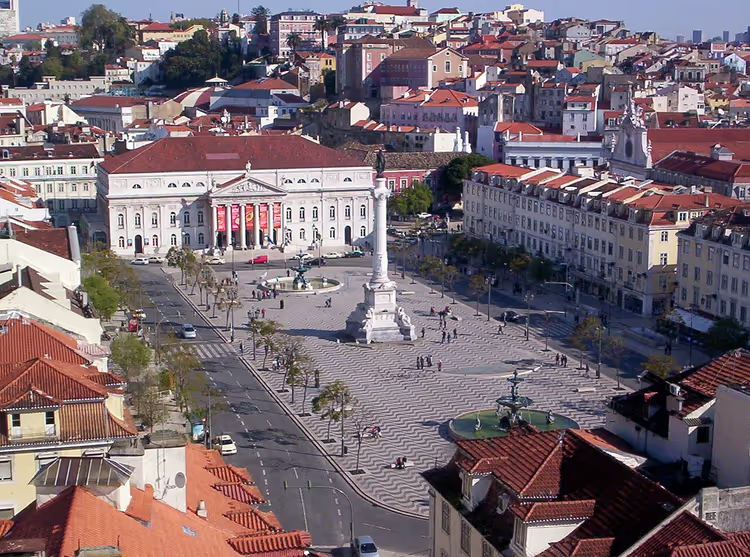
Rossio Square, also known as Praça de D. Pedro IV, has been known for more than five hundred years. In the Middle Ages, the Inquisition tribunal stood here and public executions took place. After the earthquake, Rossio was rebuilt as an ensemble in the Portuguese Renaissance style.
The square is paved with a wavy mosaic of black and white cobblestones. This paving was designed to help sailors regain their balance more quickly after being at sea. Around the perimeter stand old mansions that now house hotels, restaurants, and shops.
Among the buildings, the national theater with its six-column portico stands out. The train station is equally interesting: the central entrance is framed by horseshoe arches with stone lacework, the roof is supported by an ornate balustrade, and the walls are decorated with azulejo tiles. In the center stands a sculpture of King Pedro IV on a tall column, with marble female figures supporting the base of the pedestal. Two bronze fountains give the square a ceremonial look.
If you are hungry, climb the stairs to the west of the square. There you will find several places where you can have a quiet bite to eat. After that, Alfama is all that remains.
Alfama District
 © Miguel Vieira [2] · CC BYPhoto: Miguel Vieira [2], CC BY (https://creativecommons.org/licenses/by/2.0), Wikimedia Commons
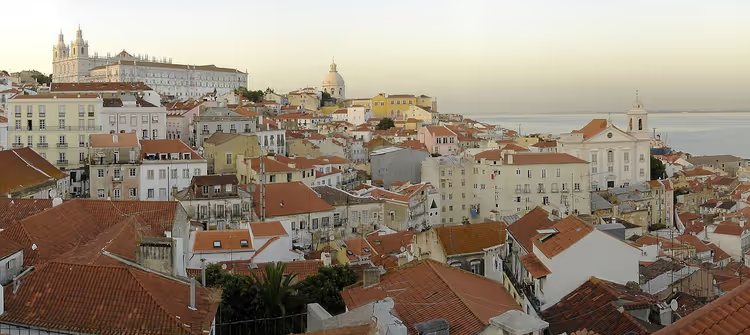
From Rossio Square, you head east and climb up to Alfama on foot or by tram 28. This is the city's oldest district, with narrow streets, laundry hanging from balconies, and views of the Tagus. In the morning you saw the district from the tram window, and in the evening you can stroll through it on foot at a leisurely pace.
You can spend the evening at a bar tasting ginjinha, a cherry liqueur. An evening walk through Alfama on GetYourGuide adds fado to the stroll. Having dinner with music is also convenient in neighboring Bairro Alto, a district of bars and restaurants.
Tours and tickets in Lisbon
Guided tours, skip-the-line tickets and activities — most offers can be cancelled free of charge.
See offers on TiqetsThe widget loads once you give your consent.
Where to stay in Lisbon
 © Nan Palmero from San Antonio, TX, USA · CC BYPhoto: Nan Palmero from San Antonio, TX, USA, CC BY (https://creativecommons.org/licenses/by/2.0), Wikimedia Commons
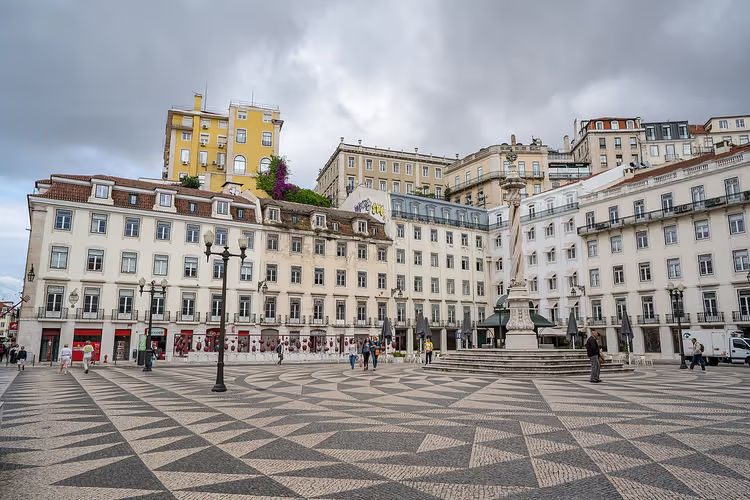
If you're staying more than one day, look for accommodation in Baixa, Chiado, or near Rossio: everything is within walking distance from there. Experienced travelers also recommend checking guesthouses, which rarely list their rooms on aggregator sites. The three options below differ in price and neighborhood.
- Alojamento Local Santo Tirso. A guesthouse right on Rossio Square, one of the most budget-friendly options in the center. check prices on Trip.com
- SANA Rex Hotel. A hotel in the center, with windows overlooking a park and historic buildings. prices at SANA Rex
- Hotel Metropole. An option for those who don't skimp on comfort and want to stay in the very center. prices at Hotel Metropole
Find hotels in Lisbon
Compare prices across booking sites and filter for rooms with free cancellation.
Compare prices on Trip.comThe widget loads once you give your consent.
Route on the map
Below is an interactive map of the entire day. The points are ordered from Martim Moniz to Alfama, so you can open it on your phone and follow the markers.
Lisbon route for 1 day
Places on the map
- 1Elétrico 28 Historic route from Martim Moniz through Graça, Alfama and Baixa
- 2Castelo de São Jorge Fortress on the highest hill, admission €17, open every day
- 3Ponte 25 de Abril Suspension bridge about two kilometers long over the Tagus, a train to Belém runs on it
- 4Mosteiro dos Jerónimos Main monument of the Age of Discovery, the basilica holds Vasco da Gama's tomb
- 5Torre de Belém 16th-century fortress on a basalt rock by the shore, ticket €15
- 6Palácio de Belém Pink presidential residence, changing of the guard on the third Sunday of the month
- 7Padrão dos Descobrimentos A caravel-shaped monument over fifty meters tall and the Wind Rose mosaic
- 8Museu Nacional dos Coches Royal carriages from the 16th-19th centuries, ticket €15, closed on Mondays
- 9Praça do Comércio Riverside square with an equestrian statue of José I and arcaded galleries
- 10Arco da Rua Augusta Thirty-meter-high arch on Rua Augusta, a lift leads to the top
- 11Elevador de Santa Justa A 45-meter lift between Baixa and the upper districts
- 12Praça do Rossio Wavy mosaic pavement, the national theater and the Pedro IV column
- 13Alfama The oldest district with narrow streets and views of the Tagus, fado in the evening
⁉️🤔 Frequently asked questions
How much does entry to São Jorge Castle cost?
An adult ticket costs €17 (as of 09/2026, official website). The castle has no closing day; it is open every day.
Can you see the old town and Belém in one day?
Yes, if you start in the morning. You walk through the old town and the castle, then around lunchtime you head to Belém by train from Cais do Sodré. Leave three to four hours for Belém: Jerónimos, Belém Tower, and the Padrão are close together.
What should you book in advance?
São Jorge Castle, Jerónimos, and Belém Tower. Lines are long in high season. A ticket with a specific time slot saves you an hour in line.
How do you get from Belém back to the center?
You return by train to Cais do Sodré or by tram along the river. Taxis and ride-hailing apps cost more during rush hour due to traffic.
Where should you have dinner in the evening?
In Alfama or Bairro Alto. In Alfama it's small family-run restaurants with fish and fado; in Bairro Alto there are more bars and lively spots. Order ginjinha, the cherry liqueur, at local bars.
In short: what to book
In one day you cover two of Lisbon's main districts: the old town on the hill and Belém along the river. If you love viewpoints, start with São Jorge Castle and leave time for Belém Tower. If museums are more your thing, add the National Coach Museum.
If you have one day: get a combo for Jerónimos and Belém Tower, and don't miss the castle in the old town. If you have several days: stay in Baixa or Chiado and schedule your outings for the morning. Whatever you choose, allow time for climbs and lines.
Plan your tickets in advance: Belém tickets on Tiqets, Lisbon hotels on Trip.com and Lisbon tours on GetYourGuide.

A small editorial team writing guides for independent travel. We travel ourselves, but we haven’t been everywhere, so we check prices, opening hours and how to get there against official sources.