
















Prague in one day: a walking route to 20 places with prices and tickets
One day in Prague can easily turn into rushing between crowds. The city is compact, but there are more points of interest than you can realistically cover on foot. So you don't spend the day at dozens of forks in the road, the editorial team has put together a one-day route through Prague's main sights.
We start at Strahov Monastery and finish at Vyšehrad. The walking part is about eight kilometers, so bring comfortable shoes and a power bank. A Prague Castle ticket on the main route costs about 450 CZK (as of 09/2026, official Prague Castle website). You'll see all the stops on the map at the end of the post.
The route is designed for a self-guided walk, with no guide and no taxis.
Ad: this article contains affiliate links, we earn a commission if you book through them, at no extra cost to you.
Strahov Monastery
💡 In short:
- Go from west to east: monastery, Loreta, Prague Castle, Charles Bridge, Old Town, Vyšehrad.
- Start at 8:30, then you'll cover the main sights before the tour groups arrive.
- Prices and opening hours: 09/2026, verified on the official Prague Castle website.
 © Matěj Baťha · CC BY-SAPhoto: Matěj Baťha, CC BY-SA (https://creativecommons.org/licenses/by-sa/2.0), Wikimedia Commons
Let's say you're staying overnight in the Břevnov area in Prague 6. Head to the nearest stop and take the tram to Pohořelec Square. Validate your ticket once when you board and keep it until the end of the ride.
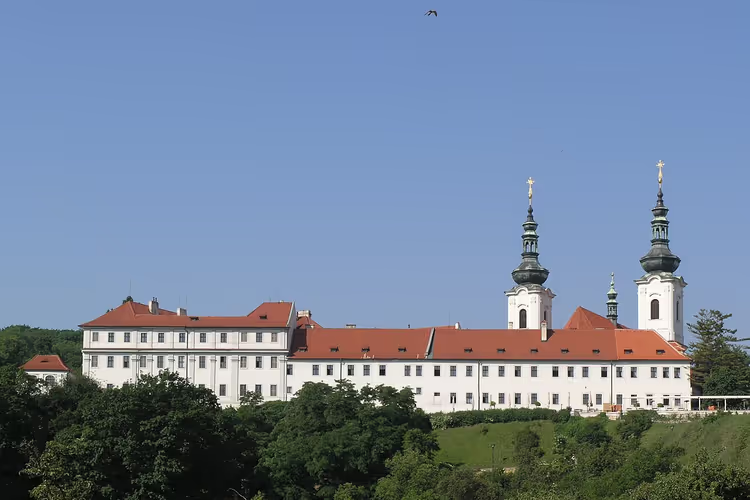
From the stop, walk back a little. Along the way you'll see the monument to astronomers Tycho Brahe and Johannes Kepler. Then enter the gates of Strahov Monastery, which belongs to the Premonstratensian order. The monastery is open daily from 9:00 to 17:00 (as of 09/2026, visitor page).
The first structure appeared here in the 12th century. Later the buildings were rebuilt in Baroque and Renaissance styles. Behind the gates begins the Strahov Garden, laid out in the 17th century. In the courtyard, stop at the stone column with the statue of Saint Norbert.
Nearby, the Basilica of the Assumption of Our Lady rises with its two towers. Inside, pay attention to the reliefs and side altars.
You can only visit the library halls with a guided tour. Tickets are sold at the Church of Saint Roch by the main gate or online. Groups are small, so come at opening time.
Tourists usually head to Strahovská obrazárna, the monastery's picture gallery. It houses more than a thousand works of European painting. The halls occupy the building of the former parliament in Romanesque style, and the walls and ceilings are decorated with murals.
The museum section displays the national literature collection and old books. The library holds more than one hundred thirty thousand volumes and about two and a half thousand manuscripts, early printed editions, and graphic sheets. A separate hall is dedicated to a cabinet of curiosities with unusual natural specimens and minerals. The exhibition tells about the life of the monks and how the monastery survived wars and fires.
The Klášterní pivovar Strahov brewery resumed operations at the end of the 20th century. The recipe for the dark St. Norbert was reconstructed from old monastery books. The beer is brewed on site, so you get a fresh drink with a soft caramel flavor in your glass. In summer, tables are set up in the courtyard; in winter, guests are seated inside. Czech snacks are served with the beer, but for a proper meal it's better to eat in the city.
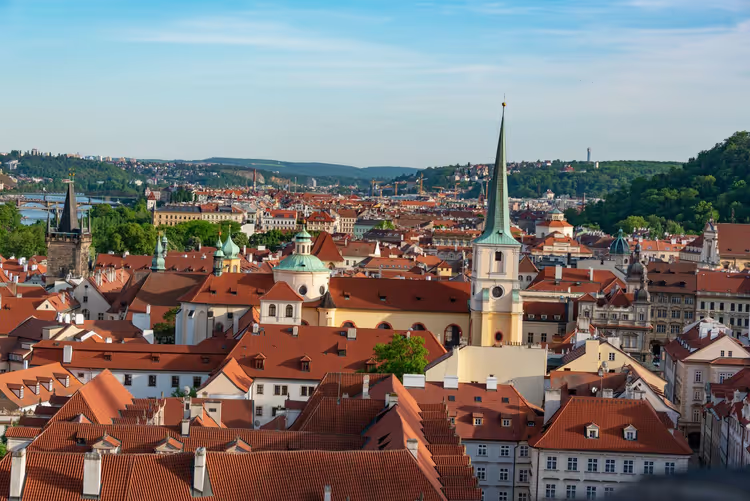
From the monastery garden you get a view of Hradčany and the rooftops of Malá Strana. Take a fifteen-minute break here; there will be fewer places to rest further along the route.
To see the whole city, don't stand with the group. Walk down the paved path about twenty meters. From there you get a panorama of Prague and the best shot of the day.
Return to the brewery and take a look at the brewing diagram on the napkins. After the break, head down to Pohořelec and continue on.
Prague Loreta
 © VitVit · CC BY-SAPhoto: VitVit, CC BY-SA (https://creativecommons.org/licenses/by-sa/4.0), Wikimedia Commons
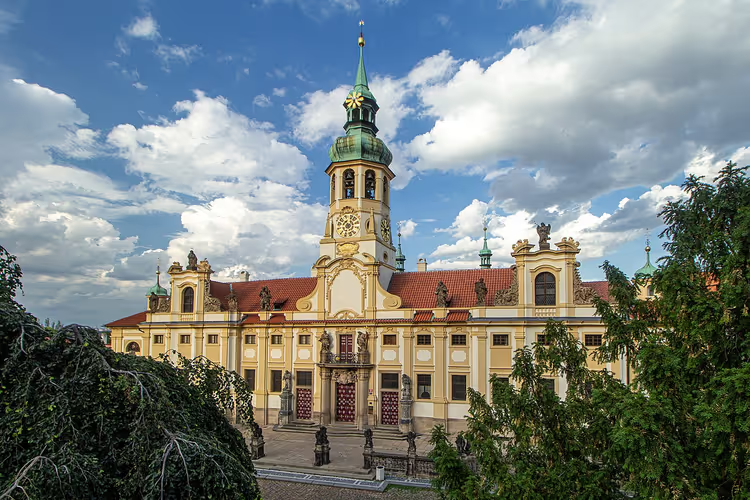
From the monastery you'll walk to the Prague Loreta (Pražská Loreta). In the 17th century, Baroness Lobkowicz ordered a replica of the Holy House of the Virgin Mary to be built. The original stands in the Italian town of Loreto. Italian architects carried out the construction, and the facade was decorated by the Dientzenhofers in the 18th century.
Inside, the walls are finished with stucco, and the frescoes are done in Rococo style. The treasury holds a 16th-century silver chalice and the "Prague Sun" monstrance with gemstones. Besides the Holy House, the complex includes six chapels, two fountains, and a tower with carillons.
The exhibition is small, so check the exact opening hours on site and come in the morning.
U Černého vola pub
 © Chabe01 · CC BY-SAPhoto: Chabe01, CC BY-SA (https://creativecommons.org/licenses/by-sa/4.0), Wikimedia Commons
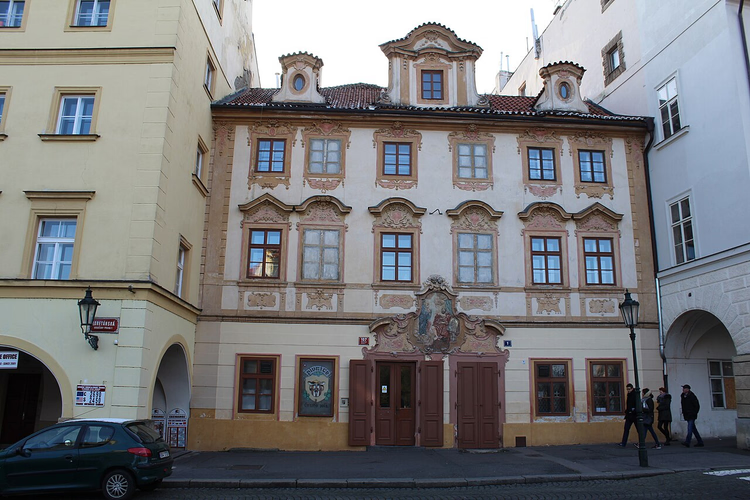
After the Loreta you'll come to the House of Saint Luke. Its facade has not changed since the 18th century: stucco work and a three-dimensional depiction of Saint Luke painting a portrait of the Virgin Mary. The U Černého vola pub has been operating in this building for several centuries.
The sign is modest and hidden in a false window, so passersby notice the building itself first. Back in the day, windows facing the street were taxed, so the owner simply painted them on. Take a closer look at the facade: there's a glass strip with the coat of arms of Saint Luke and the head of an ox.
Inside there are two small rooms with vaulted ceilings. The walls are covered with coats of arms and armor, and the furniture is simple: a long shared table and wooden benches. Order a Velkopopovický Kozel, sausages, and smažený sýr, a classic Czech beer snack.
The pub is small, and it gets crowded at lunchtime. Come at opening time or after 15:00, and you'll find a seat at the table.
Prague Castle
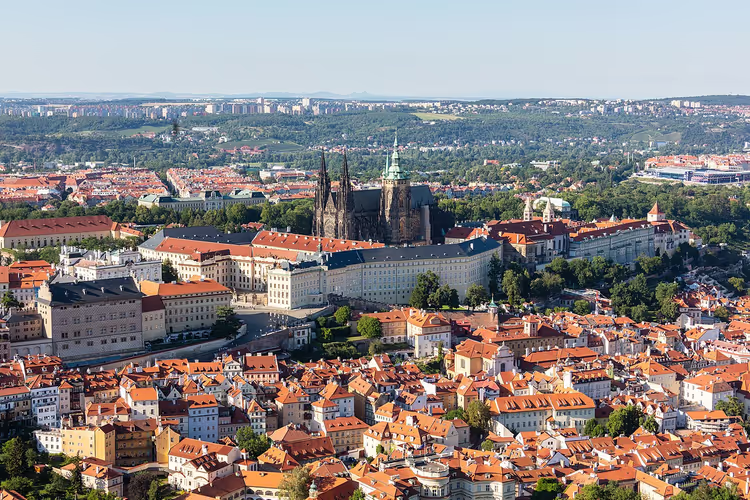 © Diego Delso · CC BY-SAPhoto: Diego Delso, CC BY-SA (https://creativecommons.org/licenses/by-sa/4.0), Wikimedia Commons
From the Loreta, walk across the square to Kapucínská Street, then to Hradčanská. You don't need to figure out which palace belonged to whom. Head straight to the gates of Prague Castle and, just before them, turn right to the viewing platform.
It's convenient to start your visit at Hradčany Square. Here you'll see the changing of the honor guard at the Giants' Gate. The changing takes place every hour from morning to evening (as of 09/2026, visitor information).
Passing through the gate, you'll enter the First, ceremonial courtyard. Here stands the Baroque Matthias Gate in the form of a triumphal arch. Through the left entrance you'll reach the Column Hall.
Passing the Matthias Gate, you'll find yourself in the Second Courtyard. The semicircular court Chapel of the Holy Cross with statues of the apostles Peter and Paul dates from the 18th century. Nearby is the Leopold Fountain, a replica of the fountain in the Vatican. The Basilica of Saint George with the tomb of Saint Ludmila stands further on, behind the cathedral.
In the Third Courtyard, you will find St. Vitus Cathedral. Climb the cathedral's south tower for a panorama of Old Prague. The square features an equestrian statue and the Presidential Palace.
Touring the palaces and cathedral takes three to four hours. The courtyards and the changing of the guard are free to see; a ticket is required for the historic buildings and towers. Tickets are sold at information centers inside the Castle and online (as of: 09/2026, tickets and routes). One ticket covers the Old Royal Palace, the cathedral, Golden Lane, and St. George's Basilica.
Inside the cathedral, spend some time at the Chapel of St. Wenceslas in the south transept. The chapel doors are decorated with reliefs depicting scenes from the saint's life. The royal tomb lies nearby. This is the most revered place in the cathedral.
The security line at the gate moves quickly, but bags are still checked.
Finish your visit in the Royal Garden. The garden is open only in the warm season, from April to October (as of: 09/2026, Prague Castle opening hours).
St. Vitus Cathedral
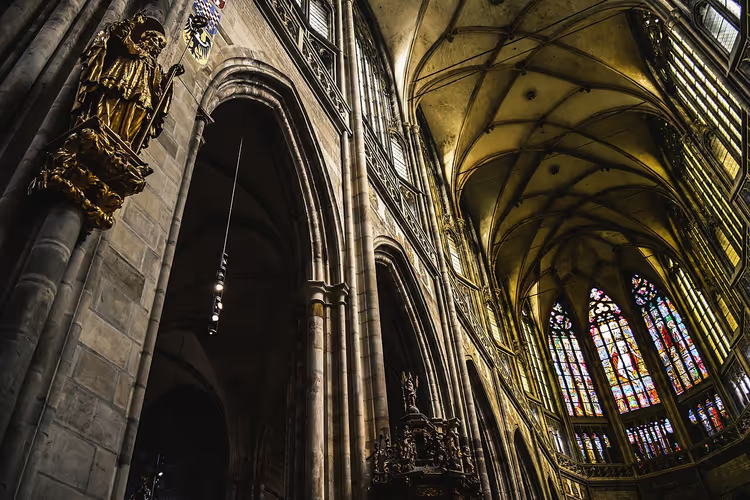
The Cathedral of St. Vitus, Wenceslaus, and Adalbert is considered the country's main church. It was built from the 14th to the 20th century, nearly six hundred years. Royal regalia were kept here and monarchs were crowned; today the cathedral holds the status of a cathedral church.
The main facade features a tall window with a decorative rose. The stained glass and sandstone figures of saints are worth viewing up close. Inside, you will see the tombs of Czech rulers and religious relics.
Golden Lane
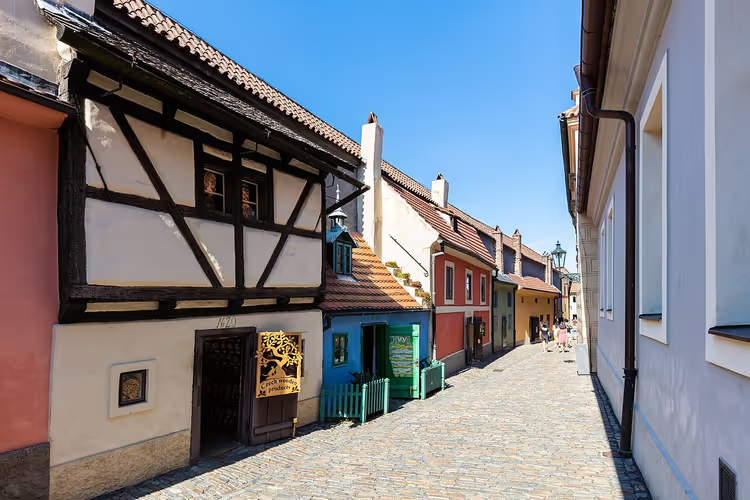 © Diego Delso · CC BY-SAPhoto: Diego Delso, CC BY-SA (https://creativecommons.org/licenses/by-sa/4.0), Wikimedia Commons
After walking down from Prague Castle, you will reach Golden Lane (Zlatá ulička). This is the castle's most famous pedestrian artery. The little houses are painted in different colors and look like toys.
The first houses here were built in the 16th century for jewelers and marksmen. That is where the lane's old nickname, Zlatnická, comes from. In the 20th century, the quarter was made famous by writers Franz Kafka, Jaroslav Seifert, and Vítězslav Nezval.
After reconstruction, nine buildings were opened to visitors: a tavern, a fortune teller's home, an herbalist's shop, and a jeweler's shop. Golden Lane is open daily, and you do not need a separate ticket. Admission is included in the general Prague Castle ticket.
The lane is included in both route A and route B. Come at 9:00: by midday the narrow passage gets crowded.
The one-person street
From the Castle, walk down Nerudova Street toward Malostranské Square. Along the way you will pass the narrowest street in Prague. The passage, about seventy centimeters wide, is controlled by a traffic light that lets one person through at a time.
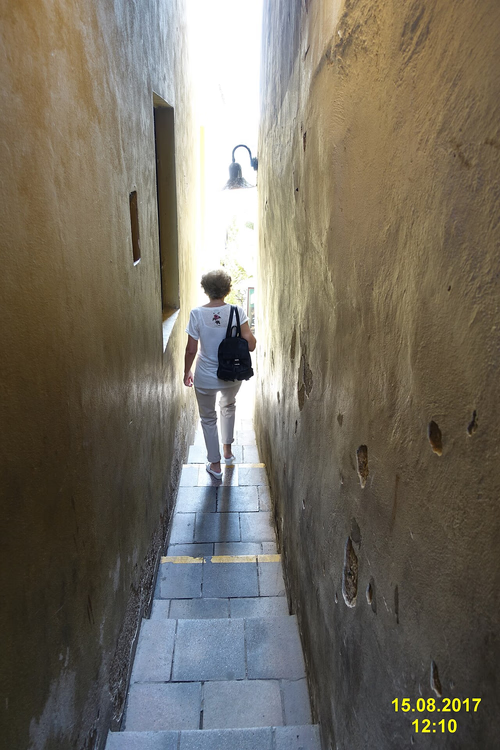 © David Short from Windsor, UK · CC BYPhoto: David Short from Windsor, UK, CC BY (https://creativecommons.org/licenses/by/2.0), Wikimedia Commons
Locals call it "the one-person street." Technically it is not a street but a fire access passage to a restaurant. The owners installed a traffic light and turned the passage into an attraction. Take a photo here if there is no line.
Next, turn onto Cihelná Street and look at the playful signs on the houses. Then continue to Malostranské Square.
On Malostranské Square you will see the Baroque Church of St. Nicholas. From there the crowd naturally leads you to Charles Bridge, which you will cross over the Vltava. Do not be tempted by the restaurant tables along the embankment, half the route is still ahead.
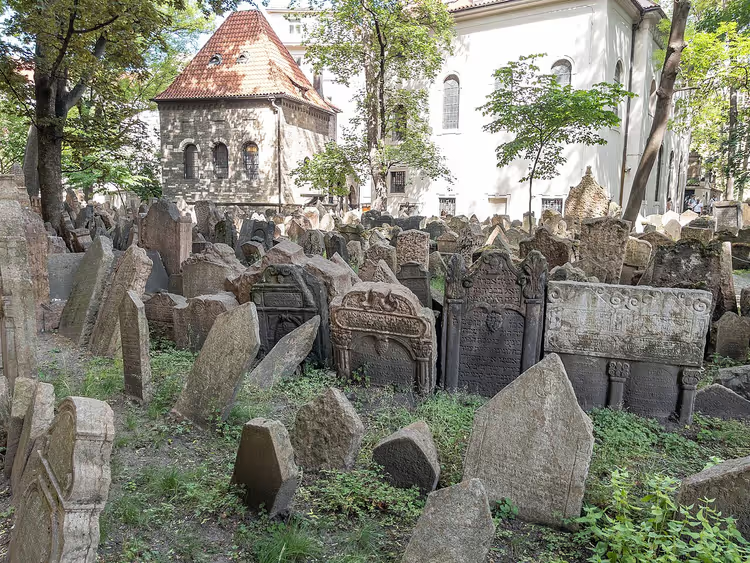
Jewish cemetery
 © Kent Wang from Barcelona, Spain · CC BY-SAPhoto: Kent Wang from Barcelona, Spain, CC BY-SA (https://creativecommons.org/licenses/by-sa/2.0), Wikimedia Commons
The Old Jewish Cemetery in the Josefov quarter is considered one of the oldest in Europe. The first burials here date back to the 15th century, and today around twelve thousand gravestones remain (as of 09/2026, Jewish Museum in Prague).
The stones are decorated with ornaments featuring plants, animals, the Star of David, and the symbol of blessing hands. The symbols on the stone reveal the name, profession, and origin of the deceased. Wealthy townspeople have a crown or a bunch of grapes, tailors have scissors, doctors have a lancet.
Stop by the ceremonial hall with an exhibition on Jewish burial customs. Next to the cemetery stand the Old New Synagogue and the Jewish Museum buildings. The visit is covered by a single museum ticket and takes about two hours.
After the cemetery, drop into the pub U Pivrnce on Maiselova Street. Sit in the basement, there are fewer tourists there. Order a Velkopopovický Kozel or Pilsner Urquell and old Czech cuisine. The walls are decorated with cartoons by Petr Urban.
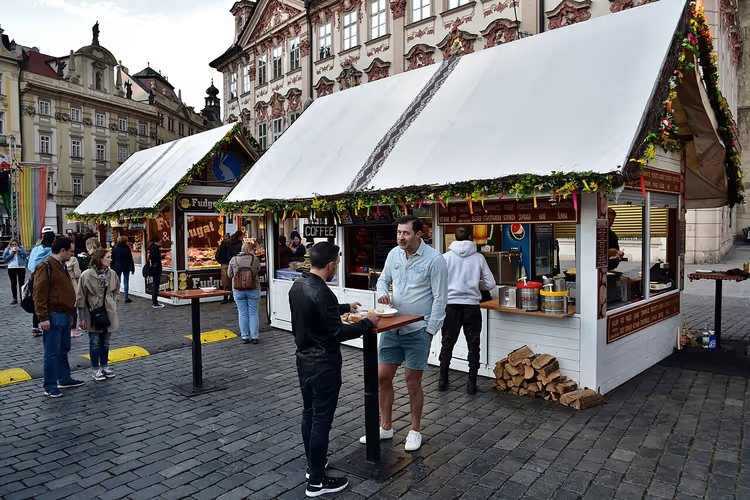
Old Town Square
 © Bahnfrend · CC BY-SAPhoto: Bahnfrend, CC BY-SA (https://creativecommons.org/licenses/by-sa/4.0), Wikimedia Commons
After a beer, stroll to Old Town Square, which Praguers simply call Staromák. Along the way you will pass the Franz Kafka monument and the Church of St. Nicholas.
The square's main building, the Old Town Hall, has stood since the 14th century. Its tower houses the astronomical clock Orloj. Every hour from morning until late evening, a show with figurines of the apostles plays on the tower (as of 09/2026, Prague City Tourism). A ticket to the observation deck costs 350 CZK, and the gallery offers the best view of the square (as of 09/2026, Prague City Tourism).
The Orloj clock shows not only the time but also the phases of the moon, the position of the sun, and the signs of the zodiac. The mechanism was assembled by master Mikuláš of Kadaň in the early 15th century. Every hour a crowd gathers in front of the tower, so it is better to watch the show from the side, near the Jan Hus monument. From the upper gallery you can see both the square and the towers of the Church of our lady before Týn.
The square is lined with building facades featuring Renaissance gables and arcades. During the day street musicians play here, and in the evening open-air restaurants open up. Stay away from the touts with menus in their hands, their prices are above average. It is calmer to eat in the alleys behind the town hall.
Before Christmas, the city's main Christmas tree is set up on the square and a market opens. The rest of the time the square serves as a meeting point for tours and a place to meet up.
In the center of the square stands the Jan Hus monument, and nearby you can rest on a bench. Behind you will be the Gothic Church of our lady before Týn, more on it below.
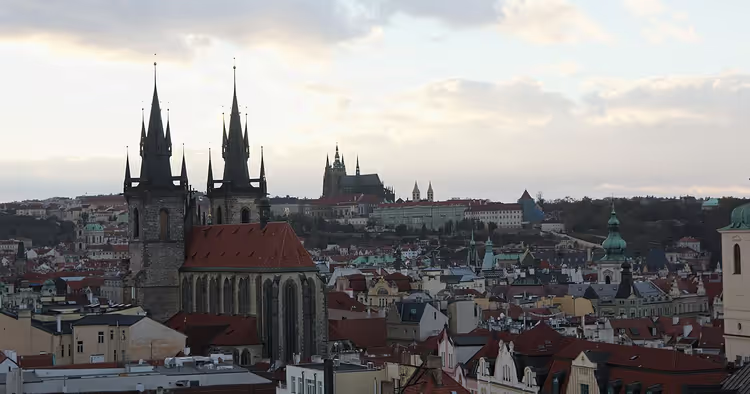
Church of our lady before Týn
 © Xosema · CC BY-SAPhoto: Xosema, CC BY-SA (https://creativecommons.org/licenses/by-sa/4.0), Wikimedia Commons
The Church of our lady before Týn was built between the 14th and 16th centuries. The architecture combines Gothic and Baroque, and renowned architects worked on the building. The two towers of the silhouette symbolize the biblical Adam and Eve.
Inside there is a collection of altars and paintings. The church served as a national necropolis: more than sixty notable Czechs are buried here, including the astronomer Tycho Brahe.
The church is open daily except Monday from 10:00 to 13:00 and from 15:00 to 17:00, on Sunday until 12:00. Admission is free, and there is a donation box at the gate. During the day groups often gather at the entrance, so come at opening time.
Artists Karel Škréta and František Čermák worked on the church's decoration. Inside there is a stone pulpit and a pewter baptismal font with reliefs of the apostles. The church towers differ slightly in height, which is noticeable from the square.
Walk around the church and look at the Gothic portal on the side facade. Many tourists walk past it, but this is where you get the best view of both towers. In the evening, the lighting makes their silhouette even more striking.
Behind the church begins the labyrinth of Old Town streets. It is easy to get stuck shopping for souvenirs here, so keep heading toward the Powder Tower. The landmark is simple: walk past the busy intersections and check the map from time to time.
Exit the church through the souvenir shop and you will find yourself in Týn Courtyard, also called Ungelt. This used to be a center of international trade. If you make it to the Church of St. James, look up: a human hand of a thief hangs under the arch.
From there you will not get lost in the three small streets and will come out at the Municipal House and the Powder Tower. If you have not eaten yet, now is the time. In the Obecní dům building there is a cafe serving coffee and cakes.
Walk under the Powder Tower and turn onto Ovocný trh square. Here you will find the House of the Black Madonna in Cubist style, the Estates Theatre, and the Carolinum. The Carolinum is open on open house days.
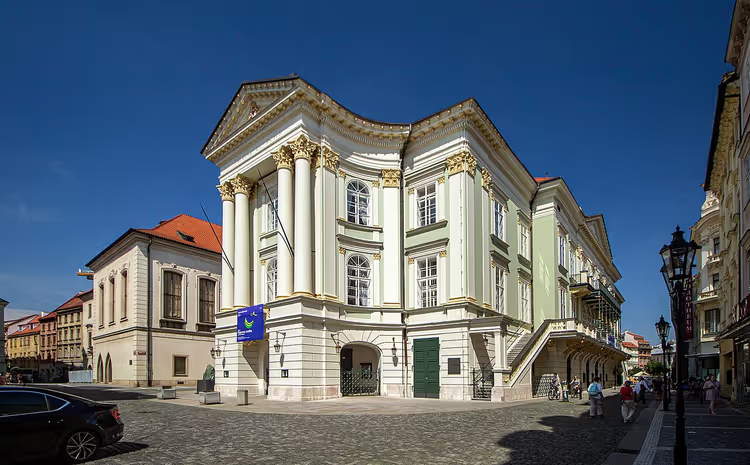
Estates Theatre
 © VitVit · CC BY-SAPhoto: VitVit, CC BY-SA (https://creativecommons.org/licenses/by-sa/4.0), Wikimedia Commons
Ovocný trh square is graced by the neoclassical building of the Estates Theatre (Stavovské divadlo). It was built in the late 18th century on the initiative of Count Franz Nostitz. The facade with Corinthian columns resembles an ancient temple, and the portico bears the inscription "To the Homeland and the Muses."
The theater is famous for Mozart having performed on its stage. The premiere of the opera Don Giovanni took place here, conducted by the composer himself. The building and interior have barely changed since then.
You can get inside on a guided tour or by attending a performance. It is best to buy tickets in advance, as evening productions are often sold out.
Church of our lady of the snows
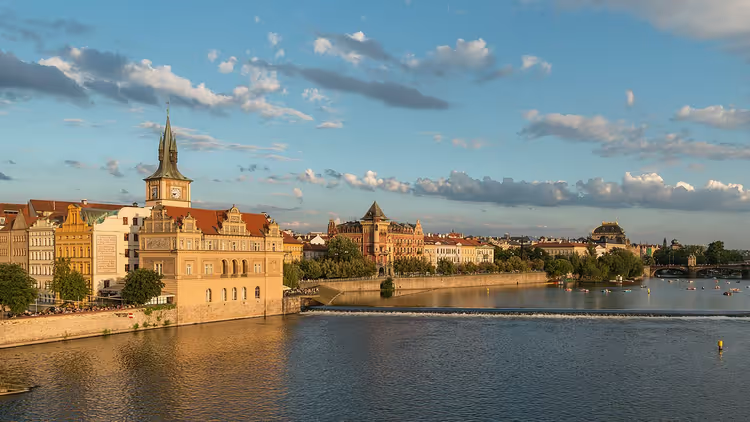
The Church of our lady of the snows was founded in the mid-14th century on the border between the Old Town and the New Town. Today it is the second-tallest religious building in Prague, with vaults rising to thirty-two meters. From the outside the church looks modest, and an icon of the Virgin Mary stands in a niche by the main entrance.
 © DXR · CC BY-SAPhoto: DXR, CC BY-SA (https://creativecommons.org/licenses/by-sa/4.0), Wikimedia Commons
Inside, you will be impressed by the early Baroque altar, twenty-nine meters high. Along the sides of the nave are four smaller altars in the late Baroque style. On the walls with paintings stand ten sculptures of Franciscan saints, and to the left of the entrance is the Chapel of St. Anthony.
Walk around the inner courtyard with its sculptures and two chapels. Nearby, you can proceed to the Franciscan monastery and stroll through the old garden. From here, head to Wenceslas Square, and then to Vyšehrad, where the route ends.
Charles Bridge
 © Jorge Franganillo · CC BYPhoto: Jorge Franganillo, CC BY (https://creativecommons.org/licenses/by/2.0), Wikimedia Commons
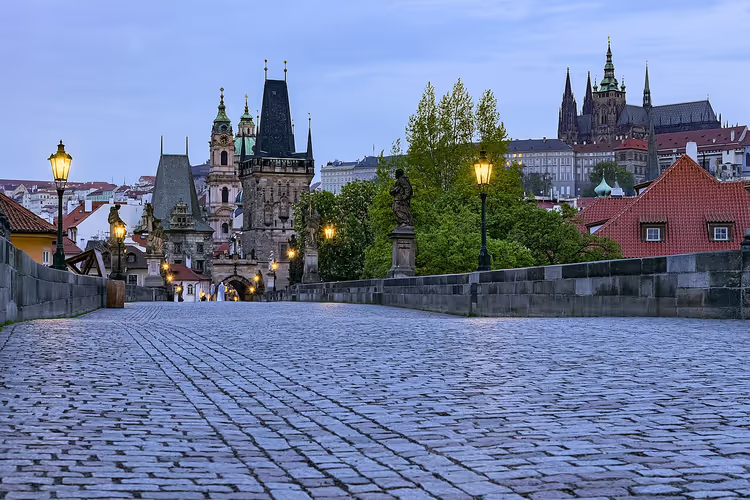
Charles Bridge connects Malá Strana and Old Town. The stone bridge, more than half a kilometer long, was founded in the late 14th century. The Royal Route once crossed it, the path Czech monarchs took to their coronation. The bridge is beautiful both by day and in the evening when it is lit up.
The bridge is decorated with statues tied to the country's history. On the Old Town side, pause at the Gothic Old Town Bridge Tower. Climbing it opens up a panorama of Prague and the Vltava. On the left stand the two Malá Strana towers, one tall and one low, connected by a wall with a gate.
Thirty sculptures stand on the bridge, most of them Baroque. Some originals have been replaced with copies to protect them from the weather. The group of John of Nepomuk stands out, with five stars shining above his head.
In summer the bridge is noisy and crowded from morning to evening. Come at dawn or late in the evening, and you will see the statues without the crowds and take unhurried photos. In winter the bridge is illuminated and looks especially festive.
From the bridge it is easy to walk down to Kampa Island and have lunch by the water. The Kampa Museum is also there, and a narrow street with a water wheel has been preserved.
There are two wishing spots on the bridge. At the statue of John of Nepomuk, touch the pedestal on the right, then on the left, and rub the relief of the dog. The second spot, a railing with five stars, marks the point where the saint was thrown into the river.
If you want to see the bridge and the Vltava from the water, take a short cruise to the Čertovka channel. For tickets and schedules, see Vltava river cruise on GetYourGuide.
Wenceslas Square
 © VitVit · CC BY-SAPhoto: VitVit, CC BY-SA (https://creativecommons.org/licenses/by-sa/4.0), Wikimedia Commons
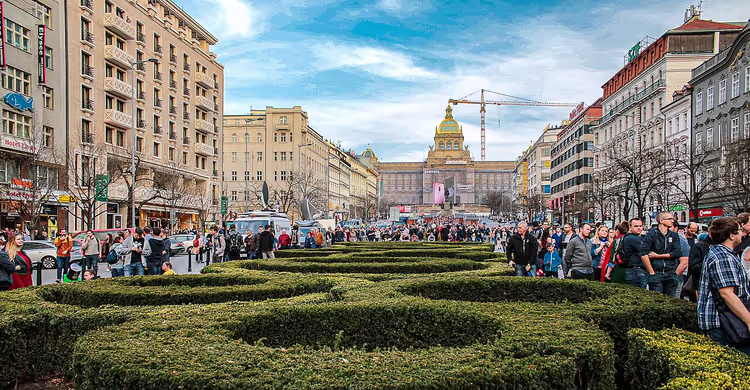
A favorite strolling spot for Praguers, Wenceslas Square begins at the National Museum. At the start of the 20th century, a monument to the patron saint of Bohemia was erected here. The sculptor Josef Myslbek depicted Duke Wenceslas surrounded by local saints: Adalbert, Procopius, Ludmila, and Agnes.
The square, about seven hundred meters long, resembles a boulevard more than a classic square. Dozens of 19th- and 20th-century buildings line its perimeter, many with passageways through their courtyards. The National Museum building is designed in the Neo-Renaissance style.
Start your second walk here if you have time left. In the evening the square is lit up, and it is a pleasant place for a stroll before dinner.
Vyšehrad Fortress
 © Raimond Spekking · CC BY-SAPhoto: Raimond Spekking, CC BY-SA (https://creativecommons.org/licenses/by-sa/4.0), Wikimedia Commons
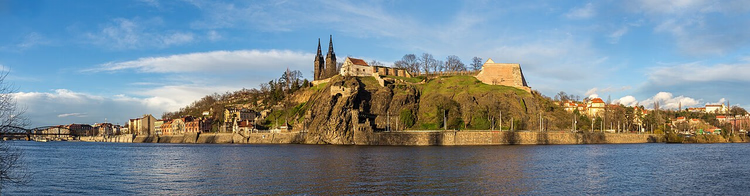
The rocky right bank of the Vltava is home to the historic district of Vyšehrad. You enter the fortress through the Baroque Tábor Gate. Behind the early Baroque Leopold Gate you will see the Rotunda of St. Martin, the city's oldest Romanesque building.
A plague column rises in front of the chapel. Farther along the left path from the rotunda you will reach the Charles Gardens with the Devil's Column. Nearby stands the Neo-Gothic Church of Saints Peter and Paul with stained glass windows and a 12th-century Romanesque sarcophagus.
Behind the church walls lies the Slavín pantheon. It holds about six hundred graves of famous Czechs, including the composers Bedřich Smetana and Antonín Dvořák. After the pantheon, take a walk through the Vyšehrad Garden with its sculptures and step out onto the viewing terrace by the fortress walls.
If you are interested in military history, walk down from the rotunda to the Vyšehrad casemates. Entry to the fortress grounds is free; a ticket is required only for individual sites.
Extra idea: Prague Zoo
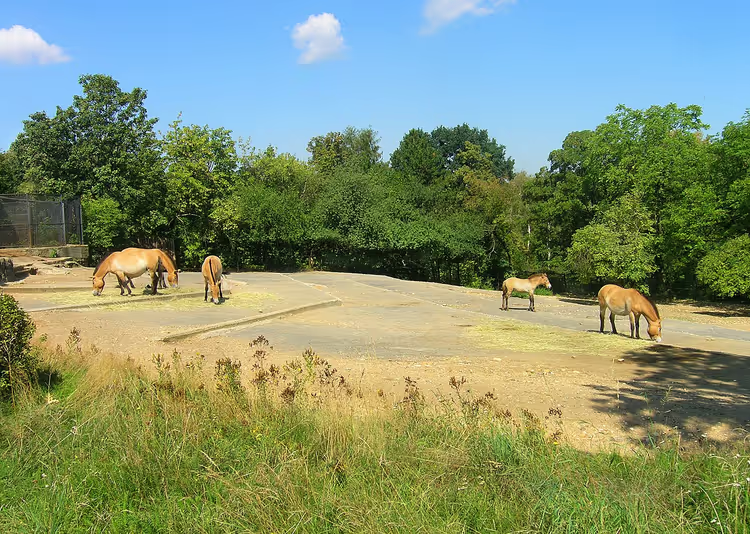 © Czech Wikipedia user Packa · CC BY-SAPhoto: Czech Wikipedia user Packa, CC BY-SA (https://creativecommons.org/licenses/by-sa/2.5), Wikimedia Commons
Prague Zoo spreads across sixty hectares and ranks among the top ten in the world. It houses more than six hundred animal species in conditions close to their natural habitats (as of 09/2026, zoo official website). The grounds are divided into two levels connected by a chairlift.
In the Indonesian Jungle pavilion you will see a waterfall, vines, and gibbons among orchids. The African pavilion features turtles, porcupines, and mongooses. The South America pavilion is home to llamas, monkeys, and rare species found nowhere else in Europe.
Separate enclosures are set up for tigers, bears, and penguins. The zoo is open daily from 9:00, with closing times varying by season (as of 09/2026, zoo opening hours). Allow half a day for a visit, which is why the zoo is not part of the one-day itinerary. Save it for your second day in Prague.
Dancing House
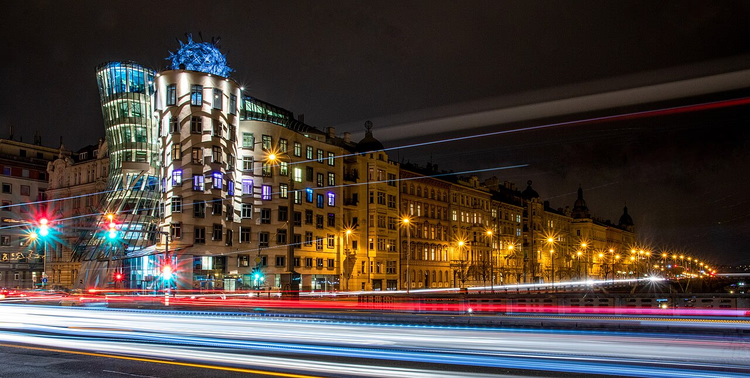 © MiroRosa · CC BY-SAPhoto: MiroRosa, CC BY-SA (https://creativecommons.org/licenses/by-sa/4.0), Wikimedia Commons
The Dancing House (Tančící dům) appeared on the embankment in the late 20th century. Its construction was initiated by President Václav Havel to beautify a vacant lot left after the war. Architects Vlado Milunić and Frank Gehry won the competition.
The building's two towers lean on each other like a pair of dancers. The structure became known as the Dancing House and Ginger and Fred. The straight tower represents Fred Astaire, the curved one his partner Ginger Rogers.
Today the building houses offices, a hotel, and a restaurant. A bar with a view of the Vltava is open on the roof; entry is free when you order a drink.
Žižkov Television Tower
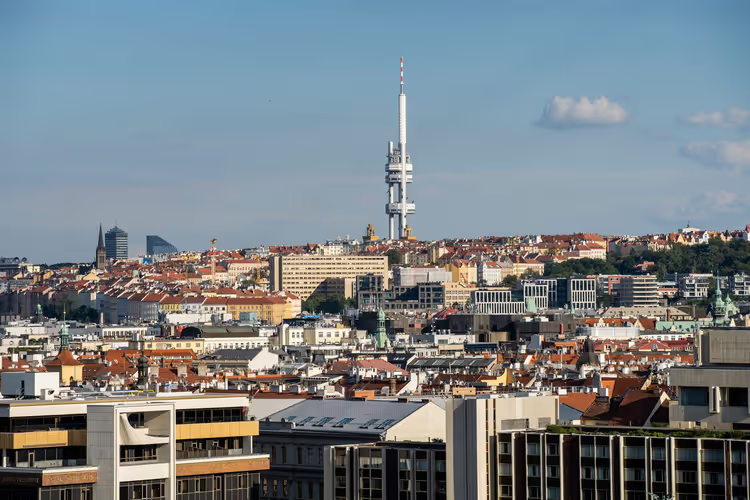
You can see Prague from above from the Žižkov Television Tower. It is one of the city's newest structures, designed by architect Václav Aulický. The three-pillar construction sparked controversy but became a recognizable symbol of the Žižkov district.
The tower's total height is more than two hundred meters. An elevator runs inside; a restaurant is located on the first level, and an observation deck is open on the second. Cellular antennas and a weather station stand at the top.
The tower has a luxury hotel room and an exhibition hall. The observation deck is open daily, and tickets are sold at the entrance. Come at sunset, and you will see the city in warm light.
Petřín Tower
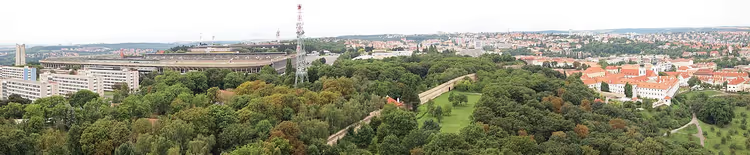 © Tiia Monto · CC BY-SAPhoto: Tiia Monto, CC BY-SA (https://creativecommons.org/licenses/by-sa/4.0), Wikimedia Commons
Petřín Lookout Tower stands on Petřín Hill and resembles a scaled-down Eiffel Tower. It was built in the late 19th century at the initiative of the Czech Tourist Club, and its height is five times less than the Paris original.
Two observation decks lead to the top, on the upper and lower tiers. They offer a panorama of the city, especially beautiful at sunset. The hill is easy to reach by funicular, which is included in the public transport pass.
Near the tower there is a mirror maze and an observatory. Tickets for the tower and the maze are sold together, and opening hours depend on the season (as of 09/2026, Prague tourist office). Keep in mind that a narrow spiral staircase leads to the upper deck.
Alfons Mucha Museum
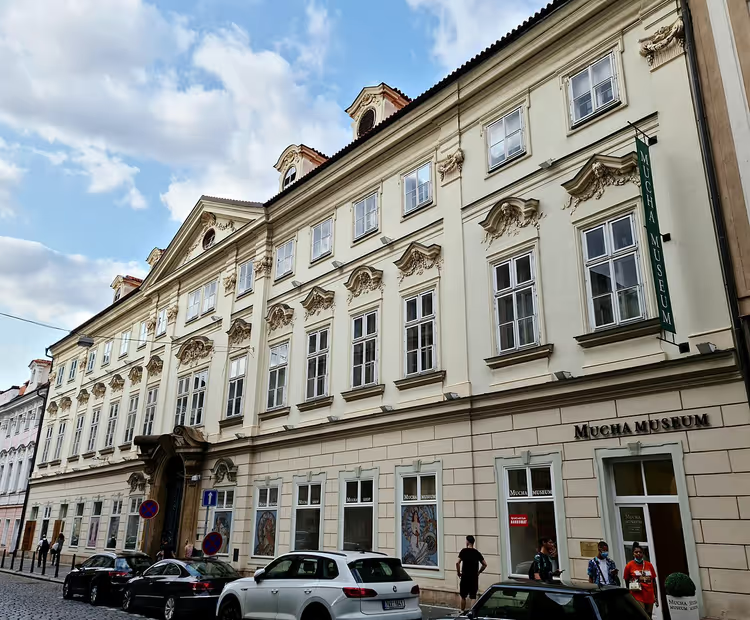 © Ricardalovesmonuments · CC BY-SAPhoto: Ricardalovesmonuments, CC BY-SA (https://creativecommons.org/licenses/by-sa/4.0), Wikimedia Commons
Czech artist Alfons Mucha went down in history as a prominent representative of the Art Nouveau style. His paintings are considered among the finest examples of Art Nouveau. In addition to paintings, Mucha created advertising posters, theater posters, and decorative objects.
The artist's descendants opened the museum in the late 20th century. The exhibition includes sketches, finished works, and the painter's personal belongings. The collection is housed at 7 Panská Street, in the Kaunický Palace.
The building was constructed in the early 18th century to a design by architect Giovanni Alliprandi. In the 1990s, the building was renovated to serve as a museum. The museum is open daily from 10:00 to 18:00 (as of 09/2026, official museum website).
The collection includes dozens of paintings, sketches, posters, and drawings. A separate room is dedicated to the Paris period and the artist's work on posters for actress Sarah Bernhardt. The audio guide explains how Mucha went from theater set decorator to Art Nouveau star.
The exhibition spans two floors and takes about an hour to view at a leisurely pace. Photography without flash is allowed, so getting photos for social media is easy.
If you want to understand the city more deeply, take a themed guided walk: Prague tours on GetYourGuide.
One-day Prague route on the map
The entire route from Strahov Monastery to Vyšehrad is collected on one map below. The points are arranged in order, from the first stop to the last. Open the route in advance and download the map so you can check the points without internet access. If you get lost, use the Vltava as your reference: the center is always near the river.
What to see in Prague in one day
Places on the map
- 1Pohořelec Tram stop where the route begins, near the monument to Brahe and Kepler
- 2Strahov Monastery 12th-century Premonstratensian abbey with a basilica, library and Curiosity Hall
- 3Strahov Monastery Brewery Dark St. Norbert beer made to a restored monastery recipe, tables in the courtyard
- 4U Černého vola Pub in the House of St. Luke, Velkopopovicky Kozel and fried cheese at a shared table
- 5Prague Castle Three courtyards, Matthias Gate, changing of the guard every hour, ticket about 450 CZK
- 6St. Vitus Cathedral The country's main cathedral, built over six centuries, burial place of Czech kings
- 7Golden Lane Colorful 16th-century houses inside the Castle, entry with the combined ticket
- 8Nerudova Street Descent from the Castle to Malostranské náměstí, near Prague's narrowest passage
- 9Malostranské náměstí The heart of Malá Strana, from here the tourist flow leads to Charles Bridge
- 10Church of St. Nicholas Baroque church on Malostranské náměstí
- 11Mánes Bridge The bridge offers a view of Charles Bridge and Kampa Island
- 12Old Jewish Cemetery The Josefov quarter, about twelve thousand gravestones from the 15th century
- 13U Pivrnce Pub on Maiselova street, old Czech cuisine and cartoons by Petr Urban
- 14Old Town Square Old Town Hall with the Orloj clock, the Jan Hus monument, viewing gallery for 350 CZK
- 15Church of Our Lady before Týn Gothic and baroque of the 14th-16th centuries, two towers and the grave of Tycho Brahe
- 16Church of St. James Behind the Týn courtyard Ungelt, a severed thief's hand hangs under the arch
- 17Municipal House Obecní dům next to the Powder Tower, a café with pastries inside
- 18Powder Tower City gate of the Old Town, passage to Ovocný trh square
- 19Ovocný trh Fruit market, a square with the Estates Theatre and the Carolinum
- 20House at the Black Madonna Cubist-style building on Ovocný trh square
- 21Estates Theatre 18th-century neoclassical building, where Mozart conducted the premiere of Don Giovanni
- 22Church of Our Lady of the Snows Vaults 32 meters high and an early-baroque altar 29 meters tall
- 23Charles Bridge 14th-century stone bridge with thirty statues and the Old Town Bridge Tower
- 24Wenceslas Square A boulevard about 700 meters long with the statue of St. Wenceslas by the National Museum
- 25Vyšehrad Fortress on a rocky bank of the Vltava, the Rotunda of St. Martin and the Slavín pantheon
- 26Prague Zoo Sixty hectares, over six hundred animal species and a chairlift
- 27Dancing House Two towers shaped like a dancing couple, a rooftop bar with a view of the Vltava
- 28Žižkov Television Tower Over two hundred meters, a panoramic deck on the second level and a restaurant on the first
- 29Petřín Tower A scaled-down copy of the Eiffel Tower on Petřín Hill, funicular ride up
- 30Mucha Museum Kaunický palác on Panská 7 street, sketches and posters made for Sarah Bernhardt
If you don't want to walk the entire route, part of it can be covered by tram. Another option is a short guided sightseeing tour of the center.
Tours and tickets in Prague
Guided tours, skip-the-line tickets and activities — most offers can be cancelled free of charge.
See offers on GetYourGuideThe widget loads once you give your consent.
⁉️🤔 Frequently asked questions
How much time do you need for Prague Castle?
Allow three to four hours for the palaces, the cathedral, and Golden Lane. If you only take circuit B, two hours is enough. Arrive by 9:00, and you will get through the Third Courtyard before the tour groups and up the cathedral's south tower without waiting in line.
Do you need Prague Castle tickets in advance?
In summer and on weekends the ticket office lines are long, so it is better to buy a ticket for the main circuit online (as of 09/2026, official website). In the low season you can buy one on site. Golden Lane is included in the same ticket.
Where can you eat cheaply in the center?
Away from Old Town Square, prices are lower. The pub U Černého vola near Loreta and U Pivrnce in Josefov serve Czech food at reasonable prices. Order the daily menu before 3:00 PM, it is cheaper than the evening menu. On Charles Bridge and on the square, you will pay one and a half times more for a table with a view.
How to get from the airport to the center?
From Václav Havel Airport, bus 119 goes to the Nádraží Veleslavín metro station, then take the metro to the center. With luggage, it is more convenient to book a transfer (Prague airport transfer).
Is the Prague Card worth buying?
The Prague Card pays off if you visit three or four paid museums in a day and use public transport a lot. On our route, it is cheaper to buy a regular transport ticket and pay for entry as you go.
In short: what to book
If you are visiting Prague for the first time, plan your day around Prague Castle and Old Town Square. For families with children, add Prague Zoo, it takes half a day. For a relaxed evening, Vyšehrad and Petřín remain, with a view of the sunset.
If you have only one night in the center, choose a hotel near Old Town Square:
Book your hotel and tickets in advance, so you do not waste time in lines in Prague.

A small editorial team writing guides for independent travel. We travel ourselves, but we haven’t been everywhere, so we check prices, opening hours and how to get there against official sources.