
















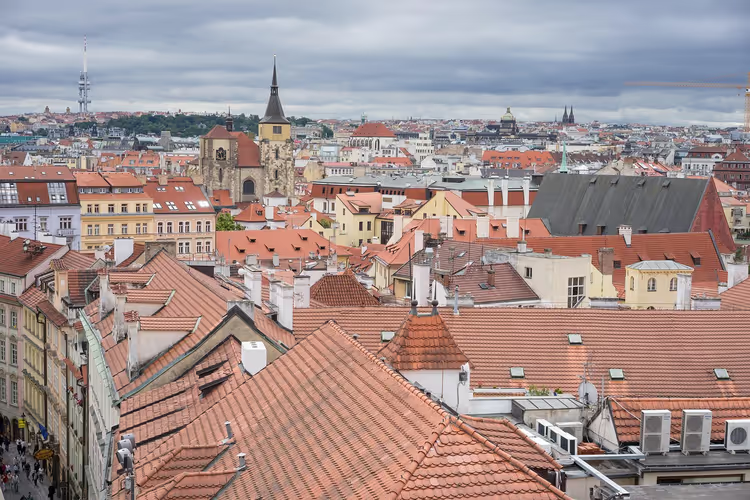
Prague in 2 days: a route along both banks with prices and opening hours
Prague is realistic to see in two days. You just need a plan that splits the city into two banks of the river and doesn't send you down the same streets twice.
On the first day you'll cover the royal part: Prague Castle, Hradčany, Petřín, Malá Strana, Charles Bridge and Old Town Square. The second day goes to the right bank: Vyšehrad, the Emmaus Monastery, Charles Square, the Vltava embankment and the Jewish Quarter.
You walk most of the route, and the tram, metro and funicular are only needed for the climbs. Prague Castle is open from 9:00 to 17:00, on Sundays from 12:00 (as of 09/2026, official website). We checked tickets and opening hours before publication, and where the price depends on the season, you'll find a direct link to the official website.
Ad: this article contains affiliate links, we earn a commission if you book through them, at no extra cost to you.
Day 1: Prague Castle and Malá Strana
💡 In short:
- Start your first day at Prague Castle: at opening time the security line is shorter than by midday.
- Then walk down through Hradčany, Petřín, and Nerudova Street to Malá Strana, and save the evening for Charles Bridge.
- Buy the main circuit ticket for Prague Castle and the Petřín Tower climb separately, ideally online.
- Prices and opening hours: 09/2026, verified on the official Prague Castle website
Prague Castle
Prague Castle covers seven hectares on the left bank of the Vltava and is considered the largest ancient residence in the world; it has been entered in the Guinness Book of Records. The complex dates back to the 9th century: three courtyards, palaces, churches, and Golden Lane inside the walls (as of 09/2026, official website).
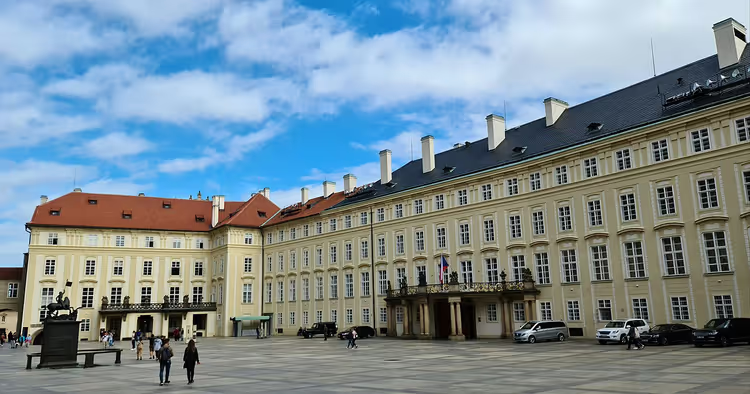 © Ricardalovesmonuments · CC BY-SAPhoto: Ricardalovesmonuments, CC BY-SA (https://creativecommons.org/licenses/by-sa/4.0), Wikimedia Commons
Start with St. Vitus Cathedral, where Czech kings were crowned. From there your route continues through St. George's Square to Golden Lane with its 16th-century houses, where alchemists are said to have worked. The palaces house a gallery and a toy museum, which require a separate ticket or extra time.
The castle courtyards open up in sequence. In the first courtyard you pass through the gate with sculptures of titans and reach the royal halls, including the Throne Room and the Spanish Hall. The second courtyard is known for the Chapel of the Holy Cross, the art gallery, and the Imperial Stables, while the third holds the main entrance to St. Vitus Cathedral. Golden Lane sits at the end of the route: nearby, in the burgrave's house, you'll find the toy museum and an exhibition hall. A leisurely tour of the entire complex takes half a day, so plan Prague Castle as the main stop of your first day.
- Opening hours: Monday to Saturday 9:00-17:00, Sunday 12:00-17:00; last entry to the cathedral is 16:40 (as of 09/2026, hrad.cz).
- Tickets: the main circuit costs 450 Kč, about €18, and includes the cathedral, the Old Royal Palace, St. George's Basilica, and Golden Lane (as of 09/2026, tickets on the official website).
- Getting there: the nearest metro station is Malostranská, a ten-minute uphill walk from there; the tram stops at the upper gate (see map).
- The catch: bag checks at the entrance and crowds at the ticket offices on weekends, so get an e-ticket in advance.
Hradčany Square
 © Natalia Semenova · CC BYPhoto: Natalia Semenova, CC BY (https://creativecommons.org/licenses/by/3.0), Wikimedia Commons
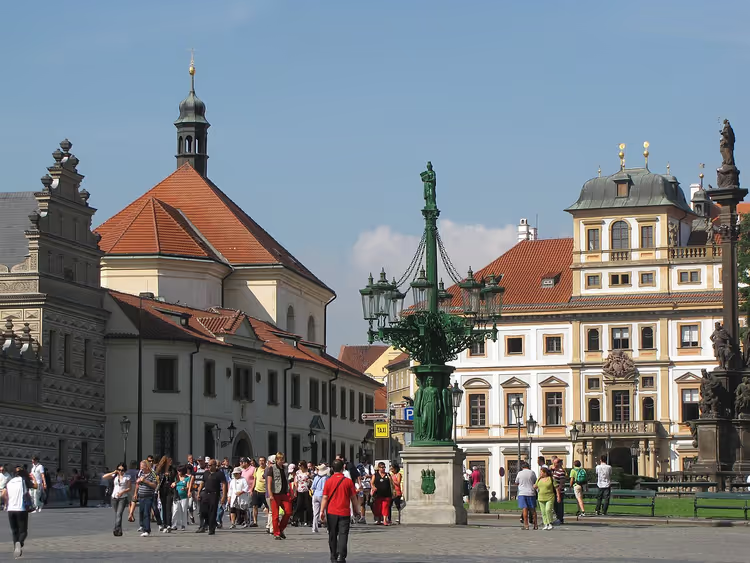
Hradčany Square greets you right outside the western gate of Prague Castle, and half an hour is enough for it. Palaces line the square, a plague column with figures of the apostles rises in the center, and lawns divide the square into a shady half and a sunny half.
Salm Palace is named after its founder and now displays 19th-century art. The 16th-century Schwarzenberg Palace is decorated with Renaissance sgraffito, and Tuscany Palace is crowned with seven allegorical sculptures of the "liberal arts." You can walk around the entire ensemble in fifteen minutes.
- Getting there: exit Prague Castle through the western gate, and the square is right in front of you.
- Who it's for: those who want to see palatial Prague without a ticket or lines.
Petřín Tower observation deck
 © Tiia Monto · CC BY-SAPhoto: Tiia Monto, CC BY-SA (https://creativecommons.org/licenses/by-sa/4.0), Wikimedia Commons
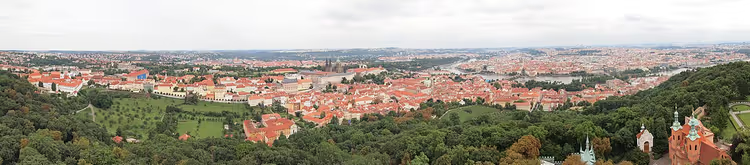
Petřín Tower was built in the late 19th century for the International Exhibition as a smaller replica of the Eiffel Tower and stands on Petřín Hill. According to legend, its top sits at the same elevation above sea level as the top of the Paris original. From the two observation decks you can see both banks of the Vltava, Prague Castle, and the entire historic center.
The upper deck is at a height of fifty-five meters, reached by nearly three hundred steps, with an elevator available for an extra fee. Nearby is a mirror maze with a separate ticket. In winter the observation decks close earlier than in summer.
- Cost: buy a tower ticket at the entrance or online; check prices and opening hours on the official tower website (as of 09/2026).
- Getting there: funicular from the Újezd stop; it requires a separate ticket, and short-term passes are not valid here.
- The catch: climbing the stairs is tough after a full day of walking.
Nerudova Street
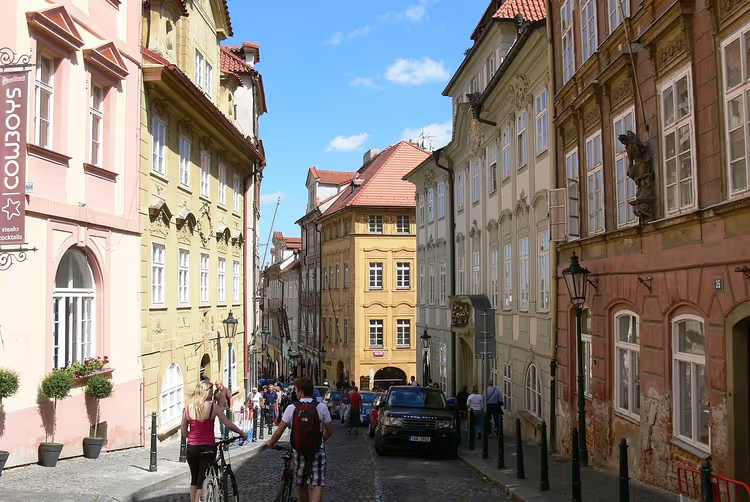 © Wolfgang Sauber · CC BY-SAPhoto: Wolfgang Sauber, CC BY-SA (https://creativecommons.org/licenses/by-sa/3.0), Wikimedia Commons
Nerudova Street connects Malostranské náměstí with Prague Castle and works as an open-air museum. The houses from the 15th to 17th centuries remember Gothic, Renaissance, and Baroque styles, the doors here are massive, and the handles and locks have unusual shapes.
House numbers were replaced by family coats of arms, so addresses were remembered by their signs. The House "At the Golden Chalice" belonged to a jeweler, the House "At the Two Suns" preserves the memory of the poet Jan Neruda, and the House "At the White Swan" got its name from the relief above the entrance. Take your time: half of the facades have plaques with their history.
- How to get there: on foot from the Castle gates, the street descends to Malostranské náměstí (see map).
- Who it's for: for those who appreciate architecture and are ready to walk downhill on cobblestones.
Church of St. Nicholas
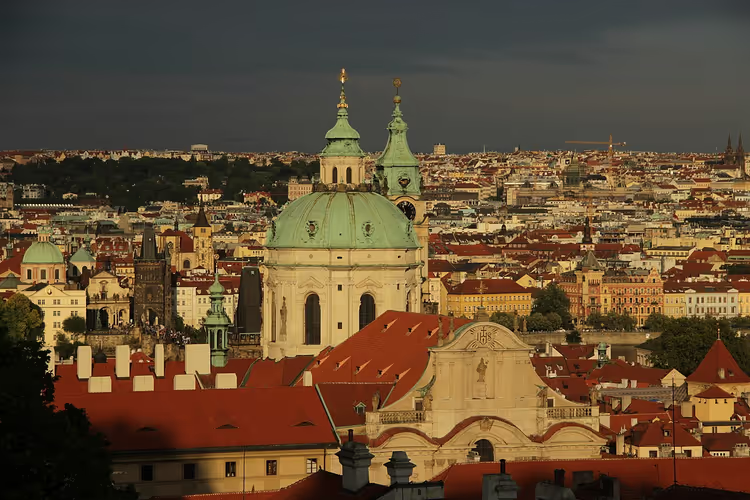 © Björn S... · CC BY-SAPhoto: Björn S..., CC BY-SA (https://creativecommons.org/licenses/by-sa/2.0), Wikimedia Commons
The Church of St. Nicholas on Malostranské náměstí is considered one of the best examples of Baroque architecture in Prague.
Inside you will see frescoes on the vaults and the altar. The acoustics here are exceptional: Mozart played the local organ and was pleased with it. Today the church hosts organ and classical concerts.
- Cost: admission is paid, tickets are sold at the entrance, concerts are booked separately.
- Who it's for: for those who want to hear an organ within historic walls.
- The catch: the schedule of evening concerts changes, check it on site.
Charles Bridge
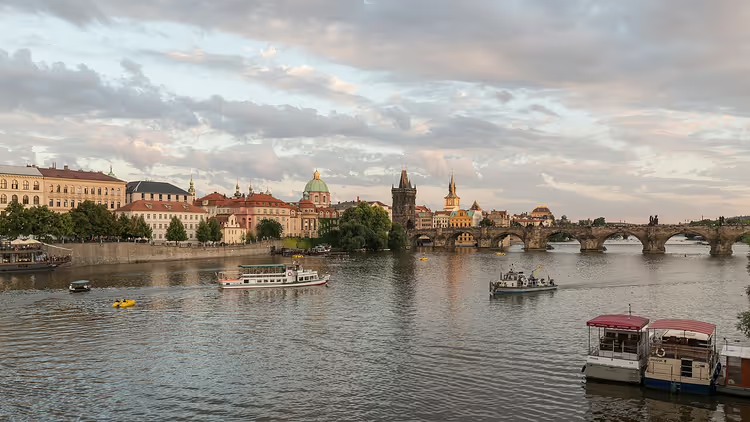 © DXR · CC BY-SAPhoto: DXR, CC BY-SA (https://creativecommons.org/licenses/by-sa/4.0), Wikimedia Commons
Charles Bridge has connected both banks of the Vltava since the 14th century. The crossing is more than half a kilometer long, thirty statues stand along the parapets, and traffic here is pedestrian only. During the day, a dense flow of people, musicians, and artists moves across the bridge.
The statues of Czech saints turn the crossing into an open-air museum. At the figure of John of Nepomuk, people traditionally make a wish, so the bronze relief at the pedestal is polished to a shine. Come in the morning or after sunset if you want to see the details, not just the backs of tourists.
The towers at both ends of the bridge are also open to visitors, and tickets for them are sold separately. From the Old Town Bridge Tower you can see the entire span and both banks of the Vltava. Musicians and artists work on the bridge constantly, and jewelry and paintings are sold here too, so part of the walk will go to browsing the stalls.
- How to get there: on foot from Old Town Square or from Malostranské náměstí.
- Cost: crossing is free, admission to the bridge towers is paid separately.
- The catch: by midday it is almost impossible to take a photo on the bridge without other people's heads in the frame.
Old Town Square
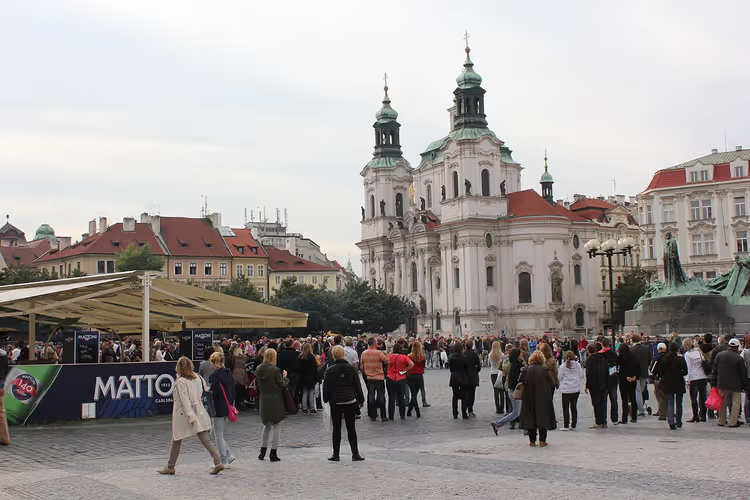
Old Town Square serves as the heart of the Old Town, and here you can easily lose an hour. In the center stands the monument to Jan Hus, erected for the five hundredth anniversary of his execution. Above the square rises the Old Town Hall tower, more than fifty meters high, with the astronomical clock installed on it.
Every hour the clock puts on a show, and a quarter of an hour before it strikes, a crowd gathers in front of the tower. On the pavement by the town hall, the names of the twenty-seven executed leaders of the Hussite uprising are carved. Nearby stand the Church of Our Lady before Týn and the Kinský Palace, where Bertha von Suttner was born.
- Tickets: the tower observation deck and the astronomical clock are visited with a single ticket, buy tickets at the town hall ticket office.
- How to get there: on foot from Charles Bridge, about five minutes (see map).
- The catch: at the hour when the clock strikes, you cannot squeeze through in front of the tower, come twenty minutes early and take a spot by the clock.
Powder Tower
 © Fred Romero from Paris, France · CC BYPhoto: Fred Romero from Paris, France, CC BY (https://creativecommons.org/licenses/by/2.0), Wikimedia Commons
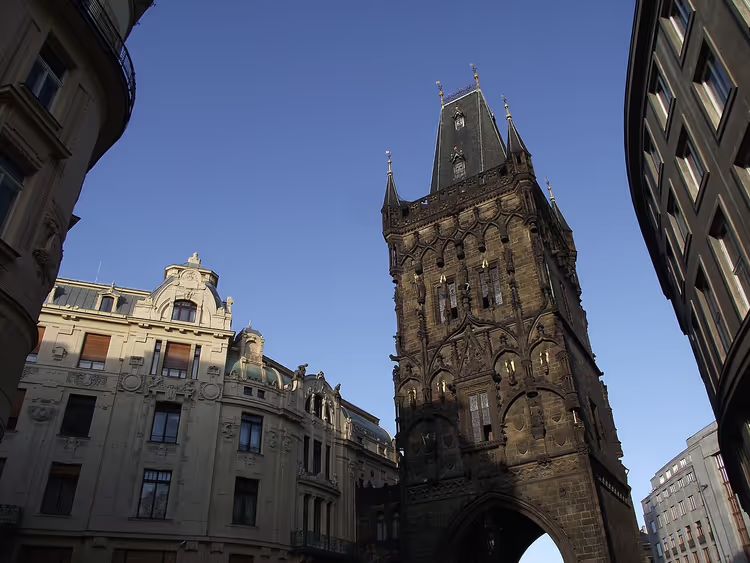
The Powder Tower stands on Republic Square and serves as the ceremonial entrance to the Old Town. Its construction began in the 15th century as the thirteenth city gate, it was not completed immediately, and gunpowder was stored in the tower under a temporary roof. The royal route began here, along which rulers rode to their coronation at St. Vitus Cathedral (as of 09/2026, Prague tourist office).
On the tower walls you will find sculptures of kings, saints, builders, and angels, and at the entrance stands a warrior with a battle axe. Inside, you climb a narrow spiral staircase of almost two hundred steps to the second-floor observation deck, which opens up a view of the center.
- Tickets: admission to the observation deck is paid, tickets are sold at the ticket office by the entrance.
- How to get there: Republic Square, between Old Town Square and Wenceslas Square (see map).
- The catch: the spiral staircase is narrow, and with oncoming traffic you have to wait.
Wenceslas Square
 © VitVit · CC BY-SAPhoto: VitVit, CC BY-SA (https://creativecommons.org/licenses/by-sa/4.0), Wikimedia Commons
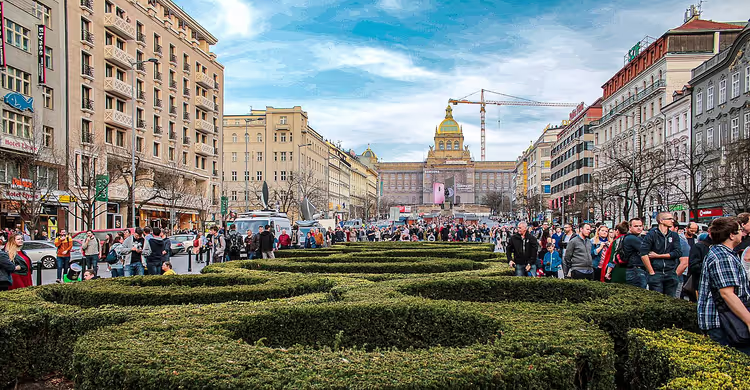
Wenceslas Square looks like a wide boulevard rather than a classic square. It is the former horse market of the New Town, where life bustles day and night. The boulevard starts at Můstek, and the equestrian statue of Saint Wenceslas stands at the upper end, by the National Museum.
Here you will see the Koruna Palace with its corner tower and glowing crown, the Europa and Astra palaces, the Ambassador Hotel, and the Peterka House in the style of Prague Art Nouveau. In the evening it is convenient to have dinner at one of the restaurants on the boulevard, and for budget eateries look in the side streets behind the square.
The boulevard stretches from Můstek to the National Museum, so it is convenient to walk along it on the way rather than as a separate route. The upper part of the square is occupied by shops and offices, while the lower part is more like a promenade with cafes. The National Museum is open to visitors, and inside you will get a sense of the scale of Czech history and nature. In the evening it is crowded here, but the light of shop windows and the illumination of facades make the walk pleasant even without plans.
- What to see: the National Museum, the statue of Saint Wenceslas, and the Estates Theatre on the way to the Powder Tower.
- Who it's for: for those who want to end the day with dinner and shop windows without rushing.
- The catch: it is noisy until midnight, and there are almost no cheap cafes on the square itself.
Day 2: Vyšehrad, new town and the jewish quarter
The second day moves at a more relaxed pace, but there are just as many places to see: you'll visit Vyšehrad, New Town and the Jewish Quarter, and the full loop takes an entire day.
Vyšehrad
 © Nan Palmero from San Antonio, TX, USA · CC BYPhoto: Nan Palmero from San Antonio, TX, USA, CC BY (https://creativecommons.org/licenses/by/2.0), Wikimedia Commons
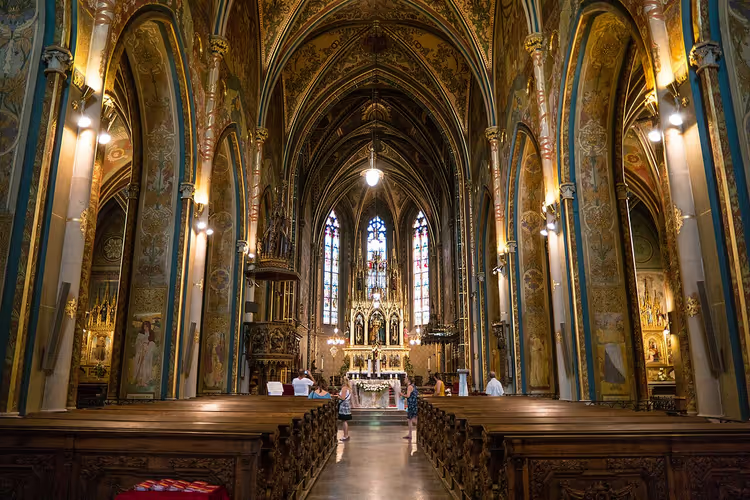
Vyšehrad grew out of a 10th-century fortress on a rocky hill above the Vltava and is considered the cradle of Czech statehood. The legendary Princess Libuše lived here, and later noble families built their residences on the hill. As you enter through the Vyšehrad Gate, you'll immediately see the towers of the Cathedral of Saints Peter and Paul.
The grounds include the Romanesque Rotunda of St. Martin and the Chapel of Our Lady, and nearby lies the Devil's Column, whose origins are the subject of various legends. Underground, the casemates await with corridors and sculptural installations, and at the Slavín Cemetery you'll find the graves of Smetana, Dvořák and Mucha.
- Tickets: entry to the underground and the exhibition is paid, tickets are sold at the info center; the park and cemetery are free (as of 09/2026, official Vyšehrad website).
- Getting there: metro to Vyšehrad station, then a ten-minute walk uphill (see map).
- The catch: the underground is accessible only with a guided tour, and groups are formed on a schedule.
Emmaus Monastery
 © Enfo · CC BY-SAPhoto: Enfo, CC BY-SA (https://creativecommons.org/licenses/by-sa/3.0), Wikimedia Commons
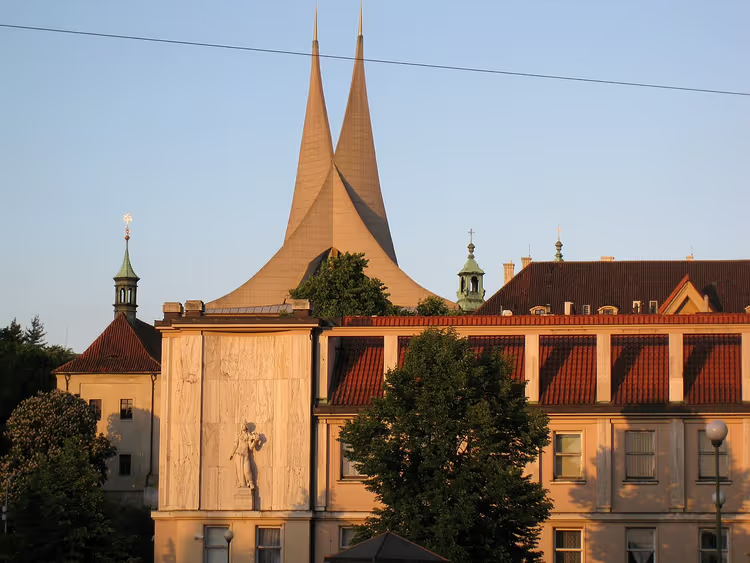
The Emmaus Monastery in the Prague 2 district was founded by Charles IV for the Benedictine order, on the spot where, according to tradition, Jesus preached to his disciples on the road to Emmaus. The monastery's second name, "Na Slovanech," recalls the mission of Cyril and Methodius: the Old Slavonic liturgy was maintained here.
The monastery is visible from afar thanks to its modernist spires. Inside the Church of Our Lady you'll see rare examples of Gothic painting with biblical scenes, and at the entrance stands the Chapel of Saints Cosmas and Damian.
- Getting there: a ten-minute walk from Karlovo náměstí metro station through New Town (see map).
- Opening hours: access is limited by services, check the exact schedule on site.
- Who it's for: those interested in the history of Slavic writing.
Charles Square
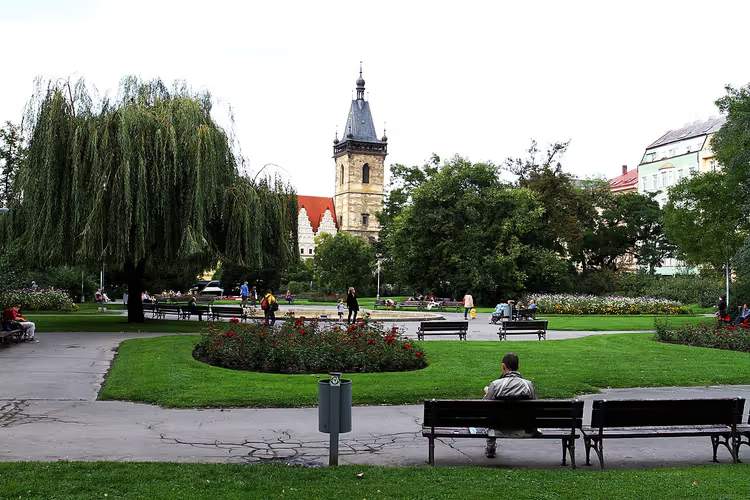 © Ondřej Kořínek · CC BY-SAPhoto: Ondřej Kořínek, CC BY-SA (https://creativecommons.org/licenses/by-sa/3.0), Wikimedia Commons
Charles Square was laid out by Charles IV on the site of a market and is considered the largest historic square in the city. Today it's a huge English-style park with sculptures of poets, writers and scholars along its perimeter.
In the center stands a fountain with a plague column and a statue of St. Joseph. The New Town Hall faces the square, and nearby stands Faust House, linked to legends about alchemists. The park is a convenient pause between the two halves of the day.
- Getting there: Karlovo náměstí metro station, the underpass brings you directly onto the square.
- Who it's for: those who want to rest in the shade and look at sculptures.
Pivovarský dům
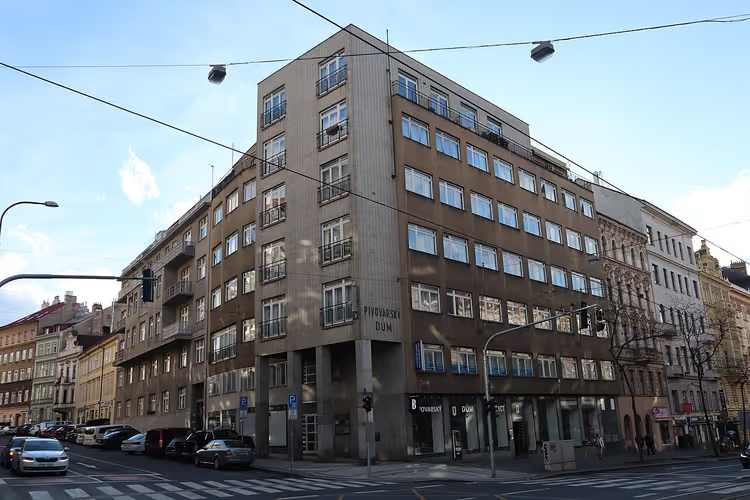 © Jklamo · CC BY-SAPhoto: Jklamo, CC BY-SA (https://creativecommons.org/licenses/by-sa/4.0), Wikimedia Commons
Pivovarský dům stands near Charles Square, at the intersection of Ječná and Lipová streets. The microbrewery on the ground floor of a seven-story building opened in the nineties and became one of the city's best-known beer halls.
Beer is served on a wooden carousel: the wheel holds eight glasses of different varieties at once. The menu includes dessert beer flavored with banana, cherry or coffee, served alongside national dishes and pork knuckle.
- What to order: the tasting carousel and pork knuckle, portions are large.
- Cost: average check is typical for central Prague, the menu is posted at the entrance.
- The catch: the place is popular with locals and tourists alike, so it's best to book a table in the evening.
Vltava Embankment

The Vltava embankments offer the best free route for the evening: palace and mansion facades reflect in the water, and eighteen bridges span the river. You won't cover all the embankments in one evening, so choose the stretch between the National Theatre and Charles Bridge.
The Dancing House (Tančící dům) on the corner of Resslova Street depicts a dancing couple with two cylindrical towers, and Praguers call the building "Ginger and Fred." Along the way you'll see the Rudolfinum and the Clementinum.
- Getting there: tram to the Národní divadlo stop, then walk along the water.
- Cost: the walk is free, a river cruise is paid separately: Vltava cruise tickets on GetYourGuide.
- The catch: the wind from the river is noticeable in the evening, a light jacket won't hurt.
Jewish Quarter
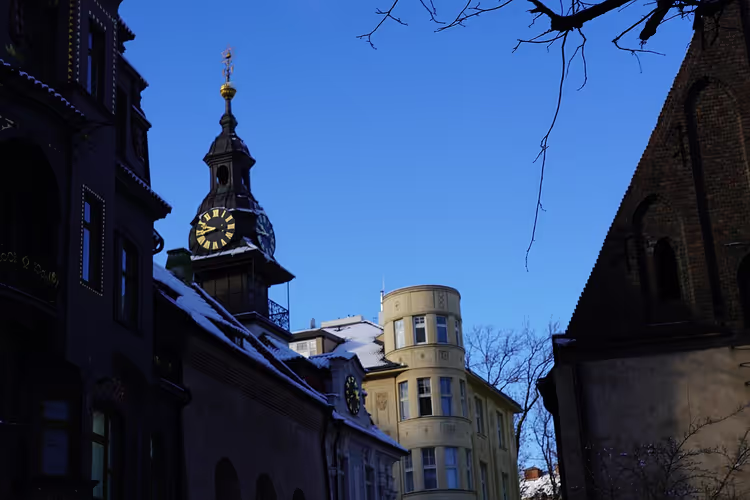 © Ray Swi-hymn from Sijhih-Taipei, Taiwan · CC BY-SAPhoto: Ray Swi-hymn from Sijhih-Taipei, Taiwan, CC BY-SA (https://creativecommons.org/licenses/by-sa/2.0), Wikimedia Commons
The Jewish Quarter, or Josefov, grew up in the 12th century, and today it's a museum complex of synagogues and an old cemetery. Turning off the embankment onto Pařížská Street, you'll come to the Spanish Synagogue in Moorish style, with a Kafka monument at its entrance.
Inside the synagogues and at the Old Jewish Cemetery you'll see old gravestones and a memorial to Holocaust victims. The Old New Synagogue preserves the memory of the Golem, and nearby stand the Jewish Town Hall and the Pinkas Synagogue.
- Tickets: a combined ticket includes four synagogues and the Old Jewish Cemetery, available online and at the ticket office (as of 09/2026, Jewish Museum in Prague).
- Opening hours: museums are closed on Saturdays and Jewish holidays, check the schedule before your visit.
- The catch: bag checks at the entrance, and on weekends there's also a line.
2-Day Prague route on the map
Below is the route map: points from both days are collected in a single layer, so you can open it on your phone and follow it in order. No registration is needed to view it, and you can save the route to your maps account.
What to see in Prague in 2 days
Places on the map
- Prague Castle The world's largest ancient residence: St Vitus Cathedral, Golden Lane, three courtyards
- Hradčany Square Palace square with the plague column, a walk around the whole ensemble in fifteen minutes
- Petřín Tower A scaled-down copy of the Eiffel Tower on Petřín Hill, two viewing platforms
- Nerudova Street 15th-17th century street with house signs, leading from Malá Strana Square to the Castle
- Church of St Nicholas Baroque church on Malá Strana Square, the organ Mozart once played
- Charles Bridge 14th-century pedestrian bridge with thirty statues of saints
- Old Town Square The heart of the Old Town, the town hall with the astronomical clock, the Jan Hus monument
- Powder Tower 15th-century ceremonial gate into the Old Town, a viewing platform on the second floor
- Wenceslas Square Former horse market, a boulevard from the St Wenceslas statue to the National Museum
- Vyšehrad 10th-century fortress on a rock above the Vltava, the Slavín cemetery with the graves of Smetana and Dvořák
- Emmaus Monastery Benedictine monastery of Charles IV with the Old Slavonic liturgy
- Charles Square The largest historic square in the city, an English-style park
- Pivovarský dům A mini-brewery near Wenceslas Square, beer on a wooden carousel
- Vltava Embankment The best free evening route, passing the Dancing House and the Rudolfinum
- Jewish Quarter (Pinkas Synagogue) Josefov Jewish Quarter, synagogues and the Old Jewish Cemetery
Tickets, transport and distance
Buy tickets in advance: in high season, lines at the Prague Castle ticket offices, the Petřín Tower and the Old Town Hall tower grow by the hour. An e-ticket saves you your morning.
Day | Highlights | Tickets in advance | On foot |
|---|---|---|---|
Day 1 | Prague Castle, Hradčany, Petřín, Lesser Town, Charles Bridge | Prague Castle, Petřín Tower | about six kilometers (see map) |
Day 2 | Vyšehrad, Emmaus Monastery, Charles Square, Jewish Quarter | Vyšehrad casemates, Jewish Museum | about five kilometers (see map) |
The center is easier to explore on foot, and for uphill routes and longer trips, buy tickets from the city's PID system. Starting January 1, 2026, Prague has a new fare structure, single tickets have gone up in price, so it's more cost-effective to buy a 24-hour pass or pay through the Lítačka app (As of 09/2026, pid.cz). Activate your ticket when boarding a tram or entering the metro, otherwise a fare inspection will result in a fine.
Regular short-term tickets are not valid on the Petřín funicular: buy a separate ticket or a 24-hour pass. If you're arriving in Prague by train, check train tickets across the Czech Republic on Trip.com.
Tours and tickets in Prague
Guided tours, skip-the-line tickets and activities — most offers can be cancelled free of charge.
See offers on TiqetsThe widget loads once you give your consent.
⁉️🤔 Frequently asked questions
How much time do you need for Prague Castle?
Allow three or four hours for the complex itself: St. Vitus Cathedral, the Old Royal Palace, St. George's Basilica, and Golden Lane. In high season, add time for bag checks and ticket office lines, so arrive at opening time. Check the schedule and last entry in advance (As of 09/2026, schedule on the official website).
How much do tickets cost for two days?
The main expenses are Prague Castle, Petřín Tower, the Old Town Hall observation deck, the Vyšehrad casemates, and the combined Jewish Museum ticket. Prices change every season, so check them on the official websites of each site. Some spots, including Charles Bridge, Hradčany Square, and the embankments, are free to visit.
How many kilometers do you walk per day?
The day one route covers about six kilometers with the climb up Petřín and the descent into Malá Strana (on the map). Day two is shorter, about five kilometers, but includes the climb up to Vyšehrad. Bring shoes with good cushioning, Prague has a lot of cobblestones.
Do you need the Prague Card?
The combined card is worth it if you plan to visit five or more paid attractions over two days. For our route, it doesn't always pay off: some spots are free, and Prague Castle and Vyšehrad sell their own tickets separately. Compare the list of attractions included in the card with your plan and do the math yourself.
When is the best time to visit Prague?
The fewest crowds are in April, May, and September, while July and August bring peak season with lines. In winter, the center is noticeably quieter, but daylight hours are short. Prague Castle is open year-round, but some gardens close in winter, so check the calendar on official websites.
In short: what's worth booking
Two days in Prague fit into a clear plan: give the first day to the left bank with Prague Castle and Malá Strana, and spend the second on the right bank at Vyšehrad and in the Jewish Quarter. Before heading out, check opening hours and buy tickets online, in season this saves you the morning.
If you only have one day: take Prague Castle, Charles Bridge, and Old Town Square. If you have two days: add Vyšehrad and the Jewish Quarter. If you're traveling with kids: go up the Petřín Tower and ride the funicular.
For hotels in the center, check Trip.com, for city tours GetYourGuide, and for flights Kiwi.com.

A small editorial team writing guides for independent travel. We travel ourselves, but we haven’t been everywhere, so we check prices, opening hours and how to get there against official sources.