
















10 Scariest places on the planet: what is open and what is closed to tourists
Some places in the world are not known for the view from a hotel window. They are remembered for a different reason: beneath Paris lie the bones of millions of people, under the American town of Centralia a coal seam has been burning for over sixty years, and at the foot of Mount Fuji grows a forest with a grim reputation. We gathered ten such spots across four continents and checked where tourists are allowed today and where entry is closed.
This is not a retelling of bedtime horror stories. For each place, we kept what is useful before a trip: what it is known for, where it is located, whether tickets are needed in advance, and how to get there. Some sites are open on a schedule, some are guarded, and some are considered life-threatening.
Ad: this article contains affiliate links, we earn a commission if you book through them, at no extra cost to you.
Our picks: ten places with a dark history
💡 In short:
- What it is: a selection of ten places with a grim reputation in Europe, Asia, Africa, and the US.
- Format: what the place is known for, how to get there, whether tickets are needed in advance, and whether there is a health risk.
- Where entry is completely closed: Poveglia Island in Italy and Cane Hill Hospital in England.
- Prices and hours: 09/2026, verified on the official website of the Paris Catacombs.
The order in the list is not about "scarier or weaker." The places are arranged by geography and by how realistic it is to get there: from the underground galleries of Paris to the heat of the Ethiopian desert. For comparison, here is a table.
# | Place | Where | Known for | Entry |
|---|---|---|---|---|
1 | Paris Catacombs | France | Ossuary with the remains of millions | Timed ticket |
2 | Manchac Swamp | Louisiana, US | "Ghost swamp," a curse | Boat tour only |
3 | Aokigahara Forest | Japan | Grim reputation near Mount Fuji | Open access |
4 | Cane Hill Hospital | England | Former psychiatric hospital | Closed |
5 | Centralia | Pennsylvania, US | Underground coal seam fire | Closed |
6 | Poveglia Island | Italy | Quarantine, plague, asylum | Closed, guarded |
7 | Mary King's Close | Edinburgh, Scotland | Underground street | Timed ticket |
8 | St. George's Church | Lukova, Czechia | Ghost figures in the church | Open access |
9 | Afar Depression | Ethiopia | Heat and acid vapors | Guided tours only |
10 | Hill of Crosses | Lithuania | Thousands of crosses near Šiauliai | Open access |
1. Paris Catacombs
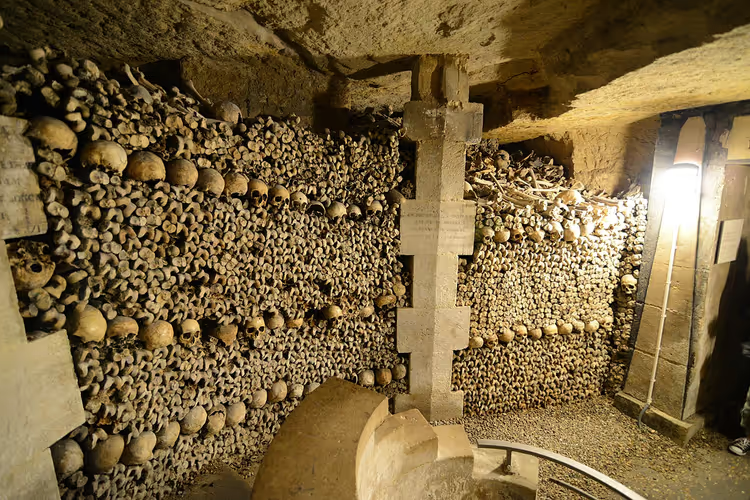
Beneath Paris stretches a network of tunnels known as the Catacombs. A 1.5 km section is open to visitors, and the walls of its galleries are lined with human bones (as of 09/2026, Catacombs website). The total tunnel system extends for hundreds of kilometers, but most of it is closed to people.
 © Jorge Láscar from Melbourne, Australia · CC BYPhoto: Jorge Láscar from Melbourne, Australia, CC BY (https://creativecommons.org/licenses/by/2.0), Wikimedia Commons
These were once ordinary quarries used to build the city. In the late 18th century, Paris cemeteries became overcrowded, and remains began to be moved underground. This is how the ossuary came to be, where, according to the official website, the remains of several million Parisians rest.
You can go down only with a timed ticket. The route is one-way and takes about 45 minutes; 131 steps lead down, and 112 steps lead back up. Inside, the temperature stays around 14°C year-round, and the floor is damp and uneven, so it is best to wear shoes without heels.
We covered the history of these tunnels separately in an article about the Paris Catacombs.
- Hours: Tuesday to Sunday 9:45-20:30, last entry 19:30 (as of 09/2026, current schedule).
- How to get there: Denfert-Rochereau metro station, entrance on Avenue du Colonel Henri Rol-Tanguy.
- The catch: even with a ticket, you will stand in line, and inside it is cramped and dim.
- Who it's for: those who are comfortable with darkness and enclosed spaces.
- Tickets: Paris Catacombs tickets on Tiqets.
2. Manchac Swamp in Louisiana
Manchac Swamp stretches across the state of Louisiana and has long been considered a cursed place. It is not a park with paths but a dense bog with twisted cypress trees and stagnant water, impossible to enter without a boat.
You have probably already heard the second name of this place. The "ghost swamp" got its name from a legend: over a century ago, a captive woman and voodoo follower supposedly cursed the land, and a storm then struck the villages. Historians found no confirmation, but the rumor lives on to this day.
Today people come here for boat rides and the oppressive atmosphere. Locals have their own stock of horror stories about werewolves and restless souls, but what matters more to you is this: the swamp lies about an hour's drive from New Orleans (on the map).
- How to get there: take I-55 from New Orleans, then continue with local boat operators (on the map).
- Cost: there is no free entry; you only pay for a boat tour with local guides.
- The catch: mosquitoes and high humidity; without repellent it is rough here.
- Who it's for: fans of boat routes and dark legends.
3. Aokigahara Forest in Japan
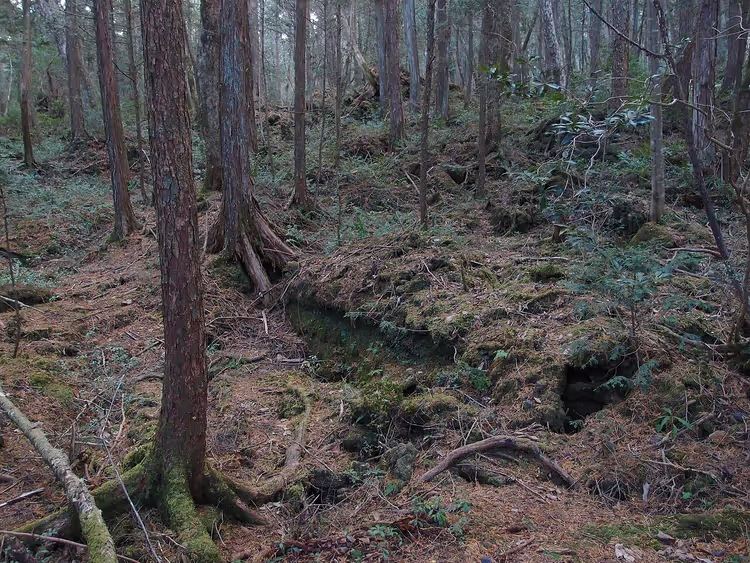
Aokigahara Forest lies at the foot of Mount Fuji and outwardly looks like an ordinary dense forest. Its fame comes not from nature but from a sad reputation as a place where people take their own lives.
 © Guilhem Vellut from Annecy, France · CC BYPhoto: Guilhem Vellut from Annecy, France, CC BY (https://creativecommons.org/licenses/by/2.0), Wikimedia Commons
Since ancient times, legends about spirits and demons have been tied to this place. In old Japanese tradition, the forest was mentioned as a place where the elderly and children were taken during years of famine. Today the police publish statistics irregularly, and local authorities do not encourage interest in this topic and ask visitors to be quiet.
Tourists come here for the view of Mount Fuji and walks along marked trails. Stay on the route: deep in the woods, cell service is poor, and the dense undergrowth easily disorients you. For you, this is simply a forest with a powerful history, and it should be treated with respect.
- How to get there: by bus from Kawaguchiko Station; check the schedule on site.
- Cost: entry to the forest is free.
- The catch: the topic is very heavy; the place is not suitable for a family outing.
- Who it's for: those interested in Japanese culture who want to see Mount Fuji from the forest.
4. Cane Hill Hospital in England
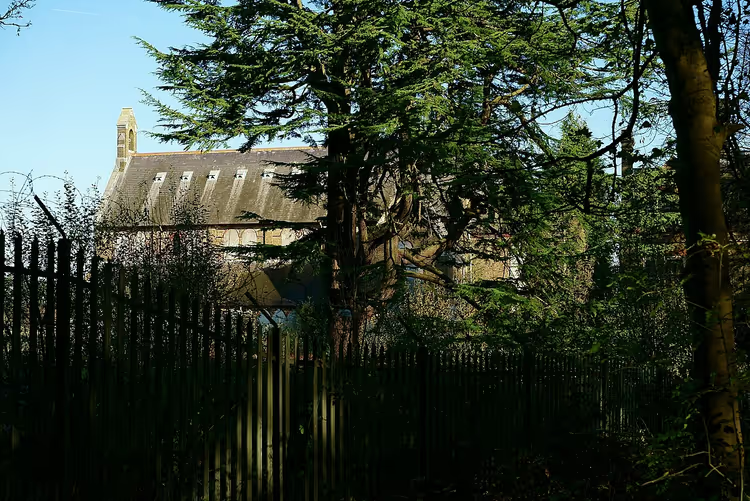
Cane Hill Hospital was an ordinary psychiatric institution in south London. There is no mysticism here; the fear comes from the empty buildings that doctors and patients once left behind.
 © Peter Trimming · CC BY-SAPhoto: Peter Trimming, CC BY-SA (https://creativecommons.org/licenses/by-sa/2.0), Wikimedia Commons
The hospital closed in 1991, and after that the buildings stood empty for a long time. Later most of the structures were demolished, and housing was built in their place.
- What it is: a former psychiatric hospital, not a museum or an attraction.
- Access: no organized tours, the site is closed to outsiders.
- The catch: almost nothing remains of the hospital, most of the buildings have been demolished.
- Who it's for: people who view such places from a distance and don't risk their health.
5. Centralia, Pennsylvania
A coal seam has been burning beneath the town of Centralia, Pennsylvania for more than sixty years. The fire started in May 1962, when workers decided to burn trash in an old mine, and the flames spread into the underground tunnels (as of 09/2026, timeline from the Pennsylvania Department of Environmental Protection).
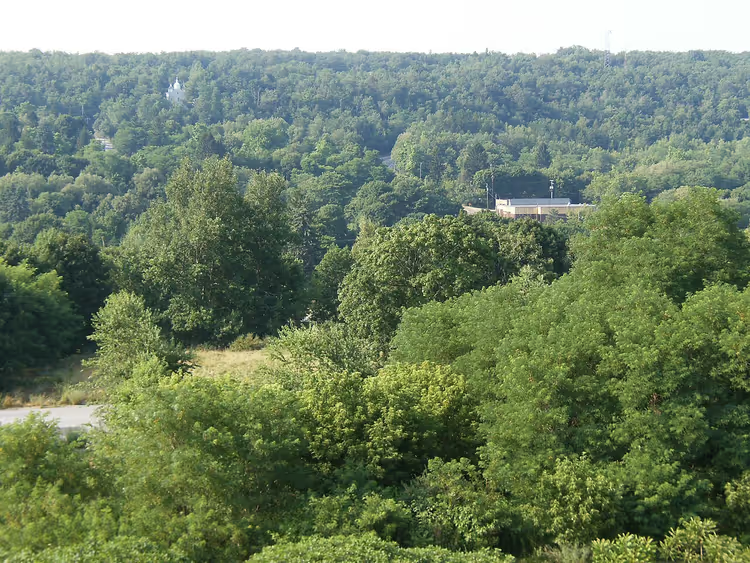
Because of the heat and toxic gases, residents were gradually relocated. Roads buckled, steam rises from cracks, and authorities declared parts of the town uninhabitable and closed them off. The underground fire was never extinguished, despite years of effort and millions of dollars spent.
Today Centralia is a nearly empty town with a few remaining houses. Access to the closed zone is restricted, but steam and ground subsidence are visible from the road.
- Where it is: Columbia County, Pennsylvania, about a two-hour drive from Philadelphia (on the map).
- Access: the closed zone is off-limits, it's only safe near the road.
- The catch: toxic gases and ground subsidence, entering the former neighborhoods is prohibited.
- Who it's for: people who only view the site from a distance.
6. Poveglia Island in Italy
Poveglia Island lies in the Venetian Lagoon, but you can't set foot on it. From the outside it's an overgrown patch of land with half-ruined buildings, and locals call its past one of the darkest in the region.
 © Unknown author · CC BY-SAPhoto: Unknown author, CC BY-SA (https://creativecommons.org/licenses/by-sa/3.0), Wikimedia Commons
At first the island served as a quarantine zone for arrivals: people coming from distant lands waited here for forty days. That changed during plague epidemics, when Poveglia became a place of exile for the sick and their relatives. According to legend, the soil here is half made of human ash that sometimes washes up on the shore.
Later a mental asylum opened here, where, according to stories, controversial experiments were conducted. The buildings have long been abandoned, and guards keep outsiders off the island.
- Where it is: Venetian Lagoon near Lido, Italy.
- Access: the island is closed, you can only see it from the water.
- The catch: private boats can get close, but landing on shore is prohibited.
- Who it's for: people studying the history of Venice, not those looking for a tour.
7. Mary King's Close in Edinburgh
Mary King's Close is an underground street in central Edinburgh, hidden beneath a newer part of the city. It was once full of life, but during the plague the sick were brought here, and the quarter turned into a quarantine zone.
 © generalising from Cambridge, UK · CC BY-SAPhoto: generalising from Cambridge, UK, CC BY-SA (https://creativecommons.org/licenses/by-sa/2.0), Wikimedia Commons
Over time an entire district was built over the old houses, and the street remained underground. Today guided tours come here and call the place "the city of the dead." For you, it's a chance to see what a Scottish street looked like several centuries ago.
You can only go down with a guide and at a booked time; independent entry is closed. Underground there are narrow passages and steps, so people who have difficulty with stairs will find it challenging.
- Hours and tickets: tours run from morning to evening, entry only at a booked time (as of 09/2026, official website).
- How to get there: High Street in Edinburgh's Old Town.
- The catch: it's cramped and chilly underground, and groups run on a schedule.
- Who it's for: people who want to see the city's hidden history, not just the facades.
- Tours: underground Edinburgh tours on GetYourGuide.
8. St. George's Church in Czechia
St. George's Church stands in the Czech village of Lukova and looks abandoned. No services have been held here for a long time, but inside sit dozens of white figures that look like ghosts.
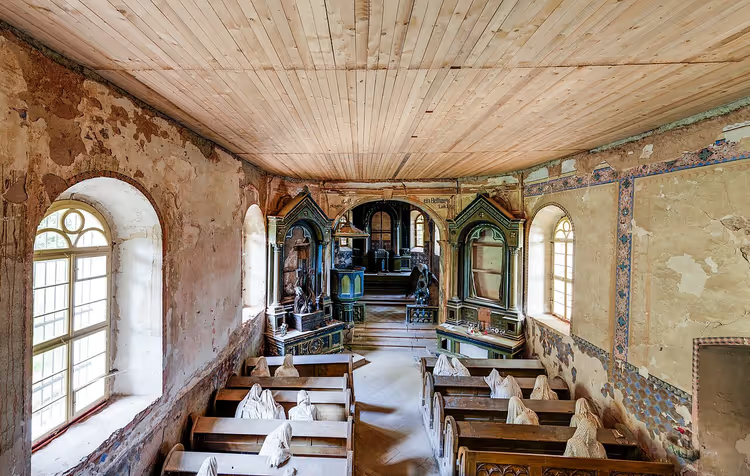 © MiroRosa · CC BY-SAPhoto: MiroRosa, CC BY-SA (https://creativecommons.org/licenses/by-sa/4.0), Wikimedia Commons
The figures were created by student sculptor Jakub Hadrava from Plzeň. With his installation he turned the empty church into an "eternal service," and after that the village became known far beyond Czechia (according to Radio Prague).
The sculptures sit on the pews like parishioners. It's a rare example of an abandoned church brought back to life through art. Visiting is free, and restoration of the church is supported by visitor donations.
- Where it is: the village of Lukova in the Plzeň Region, Czechia.
- Cost: free to visit, the church is maintained through donations.
- The catch: it's a monument, not an attraction, and you can't touch the sculptures.
- Who it's for: people driving through Czechia who want an unusual stop.
9. The Afar Depression in Ethiopia
The Afar Depression in Ethiopia is a place where heat and chemistry are more dangerous than any legend. You can't just get out of the car and go for a walk here: hydrogen sulfide, acid lakes, and sinkholes make walking around life-threatening.
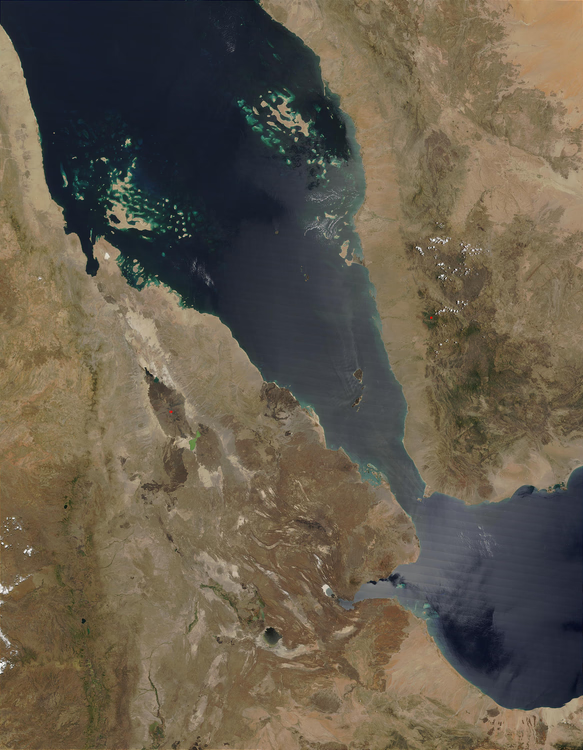
The depression consists of desert, a salt lake, and a river. Within it lies Dallol, one of the hottest places on the planet, where volcanic activity brings acidic water to the surface and geysers are active.
Afar sits at the junction of tectonic plates, so eruptions happen constantly here. Nobody goes without an escort: tours are only taken with a guide, security, and a supply of water.
- Where it is: the Afar Region in northeastern Ethiopia.
- How to get there: only as part of an organized expedition with a guide.
- The catch: high temperatures and toxic fumes; you can't go without water and protection.
- Who it's for: only prepared travelers as part of a tour.
10. The Hill of Crosses in Lithuania
The Hill of Crosses (Kryžių kalnas) is in Lithuania near Šiauliai. The name describes everything you'll see: thousands of wooden and metal crosses stand so densely that only one path remains free.
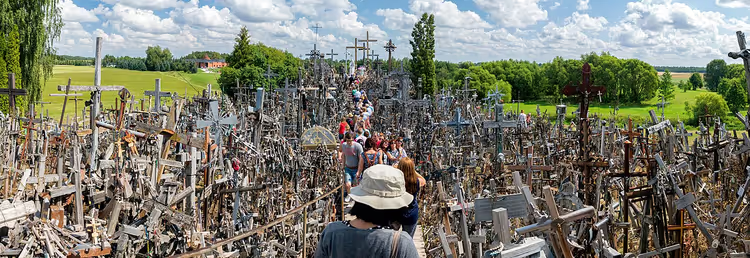 © Hans Brian Brandsberg Berg from Kalmar, SWEDEN · CC BYPhoto: Hans Brian Brandsberg Berg from Kalmar, SWEDEN, CC BY (https://creativecommons.org/licenses/by/2.0), Wikimedia Commons
This is not an old cemetery. According to legend, leaving a cross here brings good luck, so people keep leaving them again and again. Lithuanian cross crafting is inscribed on UNESCO's list of intangible cultural heritage (according to Wikipedia).
In 1993 Pope John Paul II visited the hill and called it a symbol of hope and peace (according to the encyclopedia on the Hill of Crosses). Entry is free during the day, but at night it's dark and deserted here.
- Where it is: about 12 km from Šiauliai (on the map), northern Lithuania.
- Cost: free entry.
- The catch: in summer there are lots of tour buses here, so it's better to come in the morning.
- Who it's for: people traveling through the Baltics by car.
Another selection for inspiration: 7 of the world's most party-focused cities.
⁉️🤔 Frequently asked questions
Do you need tickets to the Paris Catacombs in advance?
Yes, entry is only with fixed-time tickets, and in high season slots sell out quickly. The official website recommends booking in advance, and the number of visitors inside is limited. The descent and ascent are via stairs, so arrive 15 minutes before your time slot.
Why can't you visit Poveglia Island?
The island is completely abandoned and closed to visitors; security does not allow anyone ashore. From the water you can only see overgrown buildings and the ruins of the former asylum. It is private, guarded property, so a boat tour around the island is the most a tourist can do today.
Is the Hill of Crosses in Latvia or Lithuania?
In Lithuania. The Hill of Crosses is located near the Lithuanian city of Šiauliai, about 12 km north of the city (on the map). Old guidebooks sometimes mistakenly place it in Latvia, but the border runs further north. It is a pilgrimage site, not a cemetery.
What makes the Danakil Depression dangerous?
It combines extreme heat, hydrogen sulfide, and acidic waters. In Dallol, the air is so hot and toxic that without a mask and water a person quickly loses consciousness. People only go there on organized tours with a guide, security, and water supplies; going alone is out of the question.
Can you visit the abandoned Cane Hill Hospital?
No, it is not a museum or a tourist attraction. The hospital closed in 1991, and most of the buildings were later demolished. The site is now residential, and there are no organized tours here. The history of the place is easier to explore through photos and archival materials.
Tours and tickets in Catacombs
Guided tours, skip-the-line tickets and activities — most offers can be cancelled free of charge.
See offers on TiqetsThe widget loads once you give your consent.
In short: what's worth booking
You don't need to book everywhere in advance, and that's the main thing to remember. The Paris Catacombs and Mary King's Close only admit visitors by time slot, so get tickets before your trip. Poveglia Island and Cane Hill Hospital are completely closed: you can only see them from the water or the road. The Danakil Depression requires a guided tour, and the Manchac Swamps are only accessible by boat tour. The Hill of Crosses and Aokigahara Forest are open for independent visits.
If you're planning a long trip to these places, it's better to book your hotel in advance: find a hotel on Trip.com.

A small editorial team writing guides for independent travel. We travel ourselves, but we haven’t been everywhere, so we check prices, opening hours and how to get there against official sources.