
















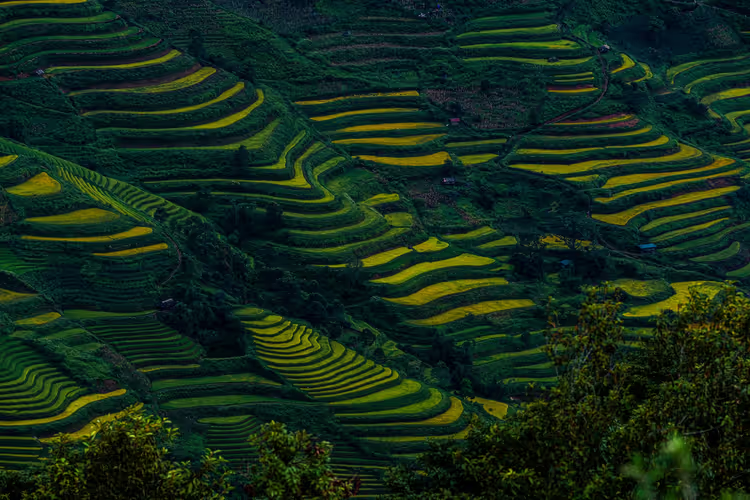
Rice terraces of Yunnan: when to go for reflections
China's Yunnan province lies right on the border with Myanmar, Laos, and Vietnam. On the slopes of the Ailao Mountains, farmers have carved thousands of steps into the earth for rice. This is not a museum or an amusement park: the fields are alive, flooded with water and harvested every year.
From November to April, the terraces turn into mirrors. The water in each step reflects the sky, and in the morning fog hangs over the valley. A view like this is worth planning your trip well in advance.
Let's go through it in order: what this place is, when to go, where to watch the sunrise and sunset, how much a ticket costs, and how to get there from Kunming.
Ad: this article contains affiliate links, we earn a commission if you book through them, at no extra cost to you.
Yunnan rice terraces: what they are
💡 In short:
- The Yunnan terraces were created by the Hani and Yi peoples more than 1,200 years ago (according to Wikipedia).
- The best months to visit: November through April, when the fields are flooded.
- A combined ticket costs about €13 (100 yuan) (as of 09/2026, according to the China Highlights travel guide).
A terrace here resembles a staircase step carved directly into the slope. There are tens of thousands of such steps, and all of them follow the contours of the mountain. It works simply. The forest at the top holds water, and channels carry it down from field to field.
Since 2013, these places have been on the UNESCO World Heritage list. A total of 16,603 hectares of terraces are protected, and they were built over centuries (as of 09/2026, UNESCO).
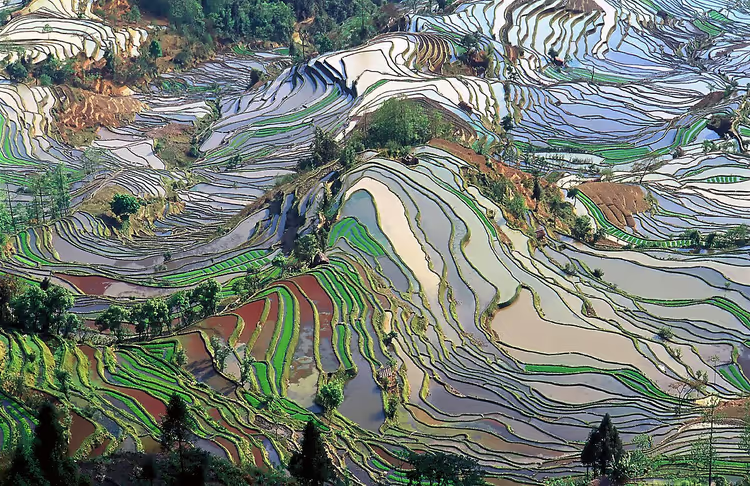 © Jialiang Gao , www.peace-on-earth.org · CC BY-SAPhoto: Jialiang Gao , www.peace-on-earth.org, CC BY-SA (http://creativecommons.org/licenses/by-sa/3.0/), Wikimedia Commons
The main crop here is red rice. It costs more than regular rice and is considered a local delicacy. The terraces rise from the valley high into the mountains, so in spring it is cool at the top even during the day. Bring a warm jacket.
Yunnan: climate and farming
Yunnan occupies southwestern China and borders three countries at once. Mountains cover most of the province, but to the south they give way to hills and valleys with fertile soil. The climate here is humid and warm, close to tropical.
That is why locals have long been engaged in agriculture. They grow red tea, tobacco, sugarcane, and rice here. The tea became so recognizable that it was named after the province. But it was rice that brought Yunnan its fame.
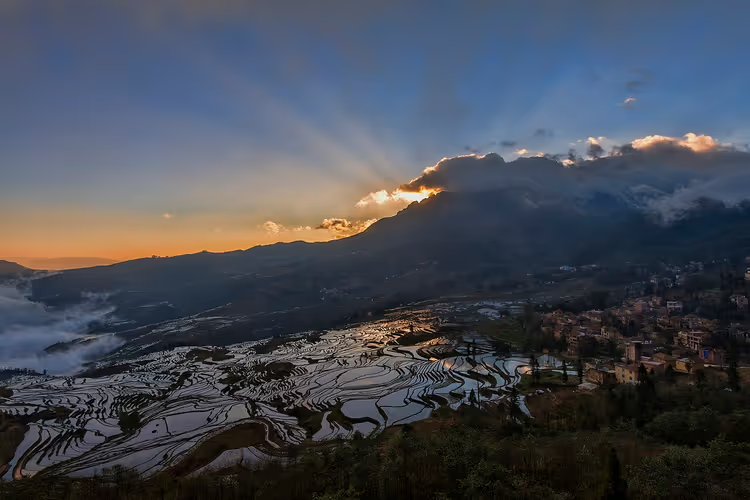 © chensiyuan · CC BY-SAPhoto: chensiyuan, CC BY-SA (https://creativecommons.org/licenses/by-sa/4.0), Wikimedia Commons
The terraces do more than feed the region. They set the rhythm for the whole valley. When the water recedes, farmers plant seedlings by hand. You will see this work with your own eyes if you come in May or June.
When to go: water season and harvest season
The main season here runs from November to April. During this time, the fields are flooded, and each step works like a mirror. The peak of reflections lasts from December to February, when there is almost no rain.
Mornings in these months are foggy. If you want to catch a clean shot, arrive at sunrise and wait for the fog to lift.
From September to October, the terraces turn golden. The rice ripens, and the slopes change color. In summer, the greenery is lush, but some days are covered by clouds and rain. Bring a raincoat, not an umbrella: the wind up top is strong.
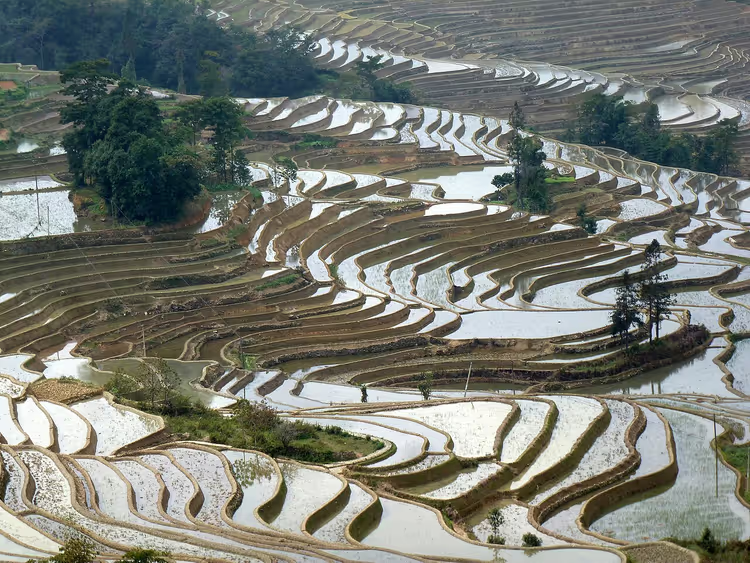 © Yulin Jia (U.S. Department of Agriculture: Dale Bumpers National Rice Research Center) · CC BYPhoto: Yulin Jia (U.S. Department of Agriculture: Dale Bumpers National Rice Research Center), CC BY (https://creativecommons.org/licenses/by/2.0), Wikimedia Commons
The elevation difference here is significant. It is cold at night and in the morning, warm during the day. Layers solve more than a single warm sweater.
Viewing platforms: sunrise and sunset
The best way to see the terraces is from designated platforms. There are several, and each has its own character.
Platform | Best time | What you see |
|---|---|---|
Duoyishu | sunrise | terraces in fog and first reflections |
Laohuzui | sunset | a wide panorama of curves by the river |
Bada | sunset | the largest elevation drop |
Longshuba | daytime | calm views without large groups |
Qingkou | daytime | terraces next to a Hani village |
Sunrise is watched at Duoyishu. Arrive an hour before sunrise, otherwise you will be left without a spot at the railing. Sunset is watched at Laohuzui and Bada. The platforms are spread across the valley, so you cannot cover both in one evening.
If you want fewer people, choose Longshuba. There are no large groups there, and you can set up a tripod in peace. Keep in mind that the trails between platforms are steep, so wear comfortable shoes.
Tickets and visiting rules
A combined ticket is required to enter the main zones. It costs about €13 (100 yuan) and is valid for several days (as of 09/2026, terraces guide). The price includes the Duoyishu, Bada, and Laohuzui platforms, as well as the village of Azheke.
Some viewing platforms are free. The ticket is easy to buy at the zone entrance or right at the platform. Keep it: it is checked again at different platforms.
Tours here usually depart from Kunming, and this is a convenient way to see several platforms in one day. You can browse routes and prices here: tours to the Yunnan terraces.
Tours and tickets in Yuanyang
Guided tours, skip-the-line tickets and activities — most offers can be cancelled free of charge.
See offers on GetYourGuideThe widget loads once you give your consent.
How to get there from Kunming
A direct bus from Kunming takes 6-7 hours and costs about €15 (110 yuan) (as of 09/2026, transport guide). This is the simplest route if you are traveling without a car.
The second option is more complicated but more interesting. First take a train to Mengzi or Jianshui, then a bus to the county center. The train is faster than the bus, but the transfer eats up time.
The nearest major airport is in Kunming. From there, you also get to the terraces by bus. Schedules change, so check them locally.
Train tickets across China are convenient to check in advance: Trip.com train schedules.
Where to stay and what to bring
Staying overnight near the platforms saves you the drive at sunrise. Many guesthouses are in the county center of Xinjie, others in the village of Duoyishu itself.
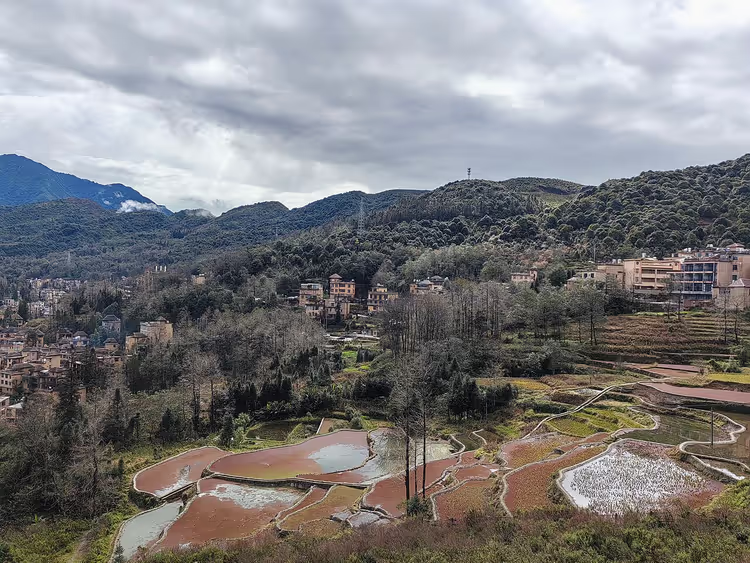 © Yumeto · CC BY-SAPhoto: Yumeto, CC BY-SA (https://creativecommons.org/licenses/by-sa/4.0), Wikimedia Commons
The service here is basic, but the views right from the window make up for it. Hotels near the terraces get booked up early in season, so reserve a month or more ahead: hotels in Yunnan on Trip.com.
What to bring. A warm jacket, a flashlight, spare batteries. Cash will come in handy in villages, cards are not accepted everywhere. Download an offline map at home, cell service in the mountains is weak.
⁉️🤔 Frequently asked questions
When is the best time to visit the Yunnan terraces?
The best months: November through April, when the fields are flooded. The peak of reflections lasts from December to February. In September and October you will catch the golden rice, and in summer you will see green terraces, but with rain and clouds.
How much does it cost to enter the terraces?
A combined ticket costs about €13 (100 yuan) and is valid for several days. It includes the Duoyishu, Bada, and Laohuzui platforms. Some viewing platforms are free.
How do I get there from Kunming?
A direct bus from Kunming takes 6-7 hours. You can take a train to Mengzi or Jianshui, then a bus. Without a car, the bus remains the most convenient option.
How many days do I need for the terraces?
Allow two to three days. In one day you will only see one platform and leave without a sunrise. In two days you can catch the sunrise at Duoyishu and the sunset at Laohuzui.
Where do I watch the sunrise and sunset?
Sunrise is watched at Duoyishu, sunset at Laohuzui and Bada. Arrive an hour before sunrise to get a spot at the railing. Longshuba has fewer people, and it is easier to set up a tripod there.
In short: what to book
The Yunnan terraces require a bit of preparation, but the impressions last a long time. First choose your season, then decide where to stay overnight.
- If you are going for the sunrise: stay in Duoyishu, so you save the drive to the platform.
- If the sunset matters more: base yourself in Xinjie and see Laohuzui and Bada.
Tickets and accommodation sell out quickly in season. For connectivity in the mountains, an eSIM will help: eSIM for China with local internet.

A small editorial team writing guides for independent travel. We travel ourselves, but we haven’t been everywhere, so we check prices, opening hours and how to get there against official sources.