
















China by train: night trains, 12306 tickets and main routes
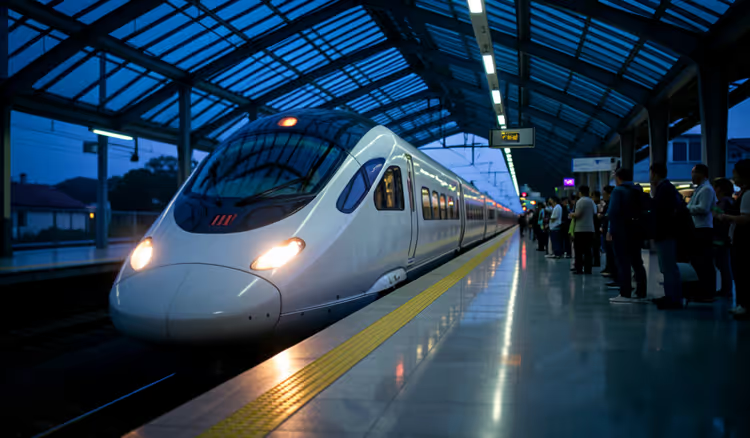
A train in China shows you the country from the window and saves your budget. The high-speed Beijing-Shanghai line, 1,318 km long, takes from 4.5 to 6 hours. Night trains run slower, but they replace a night in a hotel. Below we break down train types, carriage classes, and routes between major cities.
Ad: this article contains affiliate links, we earn a commission if you book through them, at no extra cost to you.
Why you should travel around China by train
💡 In short:
- A night train replaces a night in a hotel and saves a whole day of travel.
- High-speed lines connect all the country's major cities.
- Ticket sales open in advance, but on holidays the window shrinks sharply.
- Tickets and schedules: as of 09/2026, checked on the official 12306 website.
China's railway connects almost all the country's major cities. You board in Beijing in the morning and step off in Chengdu in the evening, without losing half a day getting to the airport. Trains run on schedule, and delays are rare here even on thousand-kilometer routes.
High-speed lines grow every year. By the end of 2024, China's railway network exceeded 160,000 km, of which about 48,000 km are high-speed lines (as of 09/2026, China State Railway). For comparison, the train between Beijing and Shanghai takes less than six hours.
A train trip also gives you what air passengers don't get: the landscape outside the window, hot tea from a thermos in the carriage, and conversations with fellow travelers. Even without Chinese, you can almost always make yourself understood with gestures.
- Who it's for: travelers with a flexible schedule and a small budget.
- Not for: those who fly to save time on routes longer than two thousand kilometers.
China's railway network
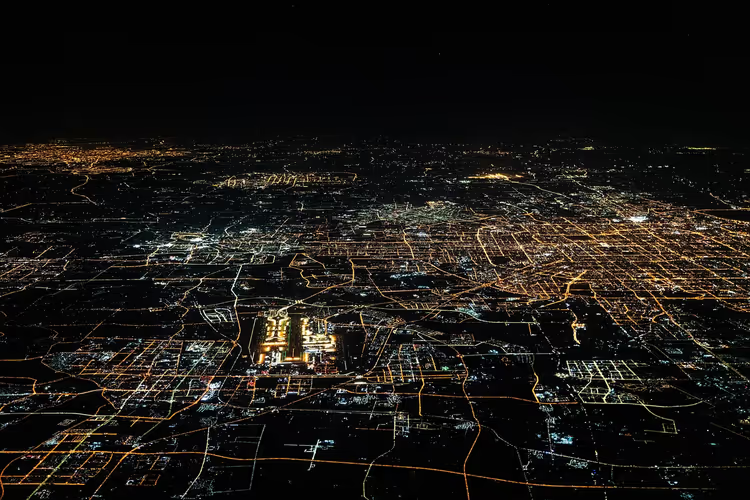
The network covers the country almost completely. More than 160,000 km of track connect Beijing with the south and west, and trains run to Guangzhou, Hong Kong, Chengdu, and Yunnan without transfers. The country's main railway hub is in Beijing: both high-speed and night trains depart from here.
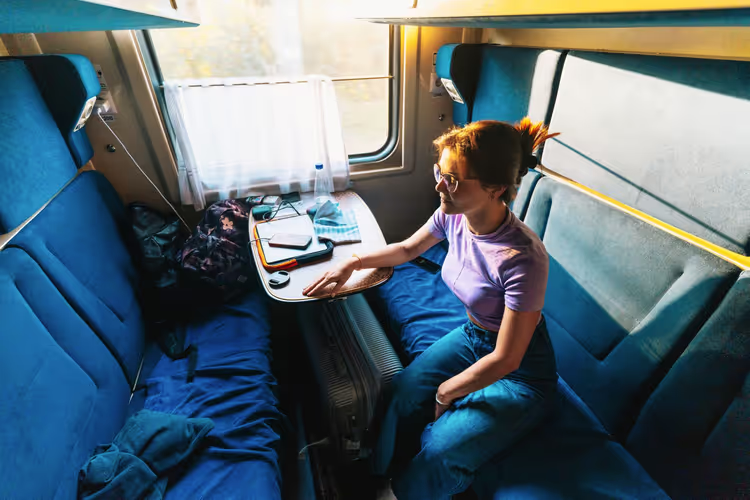
Night trains are especially convenient. You board in the evening, sleep in a compartment, and arrive in a new city in the morning without paying for a hotel. We recommend building your first long trip across the country around night routes: this way you get used to the rhythm and don't sacrifice a day.
High-speed lines keep growing. Trains run from Beijing to Shanghai, Xi'an, Guangzhou, Shenzhen, and Hong Kong, and the journey to Nanning in the south takes less than a day. Some routes to neighboring countries (Vietnam, Kazakhstan, North Korea) also start from Chinese stations, and we'll cover those separately.
What trains run in China
China has several types of trains, and each is marked with a letter. The letter in the schedule tells you the speed, the class of cars, and the ticket price. It is worth figuring it out once, because after that you choose a train by time and budget.
 AIIllustrative image: AI-generated
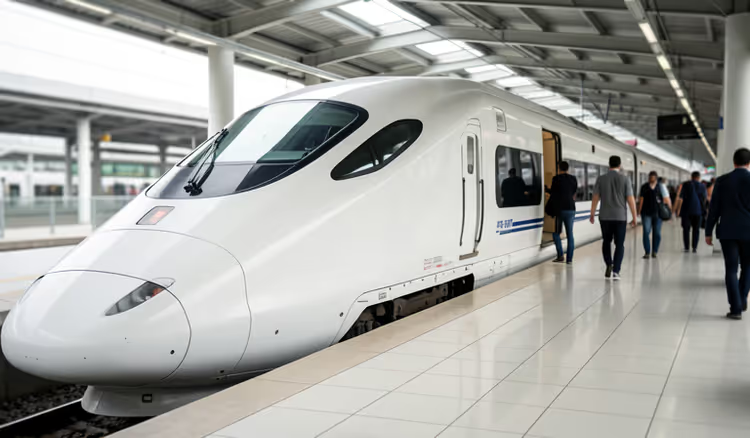
The highest speed belongs to trains with the letter G. Slightly slower are D trains, while Z, T, and K expresses are considered classics of the network. A train with no letter at all turns out to be the oldest: it stops at every pole and carries passengers in basic cars without air conditioning.
Almost every train has a dining car or a buffet. Hot food will be brought right to your seat, but we still recommend taking something for the road. The car usually has a hot water boiler, so you can make tea or instant coffee yourself.
Toilets on Chinese trains are kept clean. You will find both familiar seated toilets and Asian floor-level ones, but there may be no paper. Bring a roll with you. Night cars also have separate washbasins.
High-speed trains: G and D
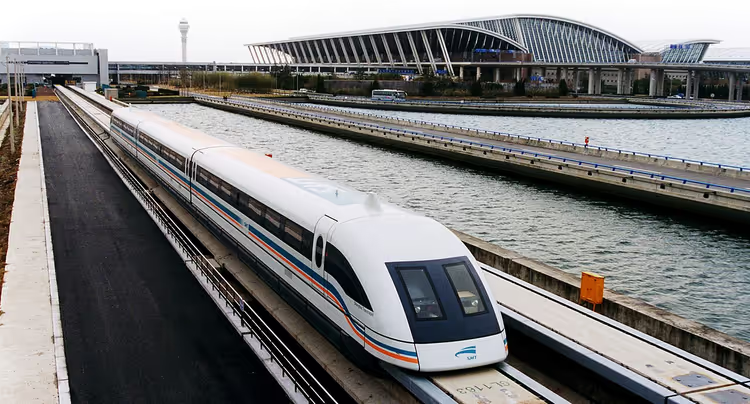
The fastest and most comfortable are trains with the letter G. They accelerate above 300 km/h and run on the country's main routes (as of 09/2026, high-speed trains on 12306). The Shanghai maglev operates on a short section from the airport to the city.
D trains travel up to 250 km/h and connect major cities: Guangzhou, Chengdu, Shanghai, and Beijing. They are slower than G trains, but they cover routes where high-speed lines do not exist yet.
Every high-speed train has three classes. Business Class costs the most: wide seats recline almost like on a plane, three per row. First Class has four seats per row, Second Class has five. These two classes differ mainly in row width and price, not speed. Second Class fills up faster than the others, so during holidays you should book tickets in it in advance.
Regular expresses: Z, T, and K
Z, T, and K expresses reach up to 160 km/h and take the longest routes. They are the ones connecting Beijing with Urumqi and Nanning, and the journey takes up to two days. These trains have seated cars (Hard Seat and Soft Seat) and sleeper cars (Hard Sleeper and Soft Sleeper).
Soft Seat cars are sold by reservation, so your seat is guaranteed and you do not need to rush to the train. This car works well for a trip without an overnight stay.
Hard Seat cars do not guarantee a seat: they are often overcrowded, the air is stuffy, there is no air conditioning, and you have almost nowhere to put your feet. Take Hard Seat only when there is no other option or you are traveling for a couple of hours during the day.
Night trains: hard sleeper and soft sleeper
The night train remains the most pleasant way to cross China. It goes slower than a high-speed train, but you arrive well rested and do not pay for a hotel. Essentially you trade a day on the road and a night in a hostel for one trip in a sleeper car.
Night trains have two classes: Hard Sleeper and Soft Sleeper. They differ in price and comfort. Compare their prices in advance, because the difference between classes depends on the route.
Soft Sleeper
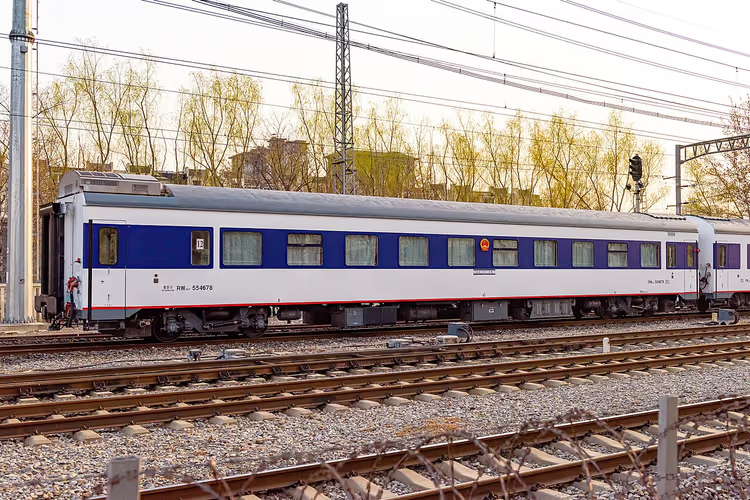
A Soft Sleeper compartment is closest to European sleeping cars. You get a closed cabin with a door and four soft berths, with a table inside for food and tea. Sleeping here is peaceful, because light and noise from the corridor barely bother you.
 © N509FZ · CC BY-SAPhoto: N509FZ, CC BY-SA (https://creativecommons.org/licenses/by-sa/4.0), Wikimedia Commons
On some routes there are Deluxe Soft Sleeper cabins: only two berths and often a private toilet. These compartments cost noticeably more than regular ones and get booked earlier.
Editor's tip: right after boarding, put your food on the table. This way you claim the table spot and get to know your compartment neighbors faster, and over a shared meal conversation starts naturally.
Hard Sleeper
Hard Sleeper is simpler: it is an open car without doors or cabins. At night it is noisier here, because neighbors snore and the light never goes out completely. But you constantly talk with locals and understand the country better than from a tour bus window.
In a Hard Sleeper car, three berths are stacked one above another, and the mattresses are soft enough. The top berth is slightly smaller than the others, but it is quieter to sleep there, and it costs a couple of yuan less than the lower and middle ones. You choose the berth when buying the ticket, and we recommend the top one.
For travelers on a small budget, Hard Sleeper remains the main option. Tickets here are cheaper than a compartment, and a night on the road saves you a whole hotel night.
The letter in the train number is easy to read. G and D mean high-speed lines. Expresses with the letters Z and T stop rarely, K brakes more often, and a train without a letter crawls through every small stop. The more stops, the cheaper the ticket on the same route.
The dining car is more expensive than eating in the city, but portions are large and hot food is brought right to your seat. Next to it there is usually a buffet with water, tea, and snacks. If you are saving money, take instant noodles and make them with hot water from the boiler.
You can stow luggage under the seat or on the upper rack, and large suitcases are left by the car door. Night cars have more space for belongings, so it is more comfortable there with a big backpack. Keep valuables with you.
How to choose a class by task. For a daytime leg of 4 to 6 hours, take Second Class or Soft Seat. For a night alone, Hard Sleeper is enough. With family and heavy luggage, a Soft Sleeper compartment is more convenient. In hot weather, do not take Hard Seat: these cars have no air conditioning.
There are few power outlets on Chinese trains, so a power bank will come in handy. In night cars there is a washbasin nearby, and the stop schedule hangs in the corridor. From it you will know in advance when to get up for your stop.
Price depends not only on class but also on time. During the day a high-speed train is more expensive, but it saves half a day. A night train is cheaper and replaces a hotel, so on long routes it is more cost-effective.
Chinese trains almost always arrive on time. Delays happen in snowstorms or typhoons, but on popular lines the schedule is kept strictly. So plan your transfer with a margin of one to two hours.
Train numbers and departure times change a couple of times a year when a new schedule takes effect. Check your train in the app the evening before, so you do not come to the station for nothing.
High-speed trains have a buffet car with coffee and snacks, but the selection is small. On regular expresses, hot food is cooked in the dining car and delivered through the cars on a cart. Payment is by cash or Chinese apps, and foreign cards are not accepted at the buffet.
Car class | What it is | Who it suits |
|---|---|---|
Second Class | Five seats per row (3+2) on high-speed trains | most passengers |
First Class | Four seats per row (2+2) | those who want more space |
Business Class | Three wide seats per row (2+1) on G and D trains | long and business trips |
Hard Seat | Unreserved seats, often without air conditioning | trips of a couple of hours |
Soft Seat | Four seats per group, reserved seats | trips up to six hours |
Hard Sleeper | Three berths in an open car, toilet in each car | budget overnight trips |
Soft Sleeper | Compartment with four berths, Deluxe option with private toilet | comfortable overnight trips |
Source on car classes: as of 09/2026, car classes on 12306.
How to buy train tickets in China
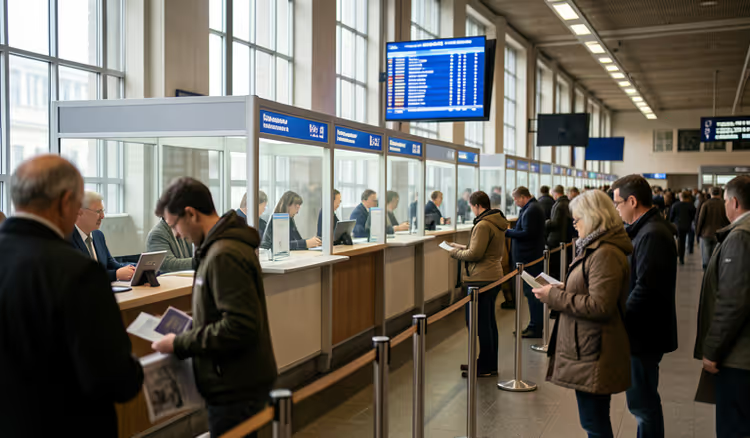
Tickets in China are sold online, at the station, and through travel agencies. For a foreigner, the easiest way is to buy them in advance: either through the official 12306 app or through a partner platform. Keep the station ticket office as a backup option.
 AIIllustrative image: AI-generated
Sales usually open a few weeks before departure. During major holidays, such as Chinese New Year, the window shrinks dramatically and tickets sell out in minutes (as of 09/2026, ticket sales on 12306). Seats in sitting cars remain available even a couple of days before departure, but Hard Sleeper and Soft Sleeper berths are best booked five to ten days ahead.
Buying tickets online
The official 12306 app works in English and accepts a foreign passport. You enter your route and date, and you see all trains with prices and available seats by class (as of 09/2026, prices and available seats on 12306). Payment is by card, and the ticket is linked to your ID.
If the 12306 interface feels complicated, Trip.com also sells tickets: buy train tickets for China on Trip.com.
Enter your first and last name exactly as they appear in your passport. One typo, and you may not be allowed into the car. That is why your details are checked against your ID before payment.
After purchase, the ticket appears in the app. You do not need a paper ticket: at the gate you scan your passport, and the turnstile finds your booking.
For international trains (Kazakhstan, Vietnam, North Korea, Mongolia), the rules are different. These tickets are often sold only at the ticket office or by mail, and you should get them well in advance.
You can change and refund tickets before departure, but the closer to the train, the higher the fee. The strictest rules apply during holidays, when demand exceeds the number of seats. If you are traveling during Chinese New Year or Golden Week, book ahead.
When buying tickets for two or for a group, add each passport to the order separately. The 12306 app stores a list of passengers and fills in the details on your next purchase, so you only enter long numbers once.
Payment works with a Chinese card, WeChat Pay, or Alipay. Foreign cards are accepted more and more often, but payments are sometimes declined. In that case, it is easier to get the ticket on Trip.com and pay with your usual card.
You choose your berth in a sleeper car and your seat in a sitting car directly in the app, if they are available. On popular routes, upper berths and window seats go first, so do not put off buying.
If you are traveling with a child, take a lower berth: climbing down from the upper one at night is inconvenient. A child ticket costs less than an adult one, and for small children a separate seat is often not sold at all.
Arrive at the station with time to spare. At large stations, the walk from the entrance to the platform can be long, and luggage is checked twice. In Beijing and Shanghai, it is better to leave early and not run for the train.
Buying tickets at the station
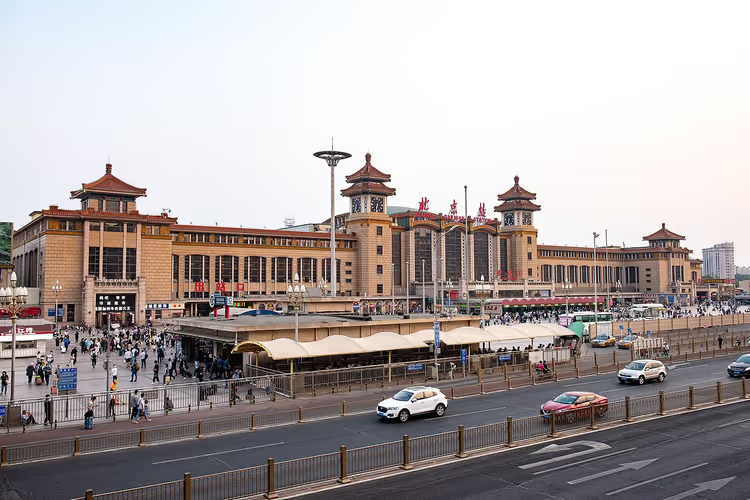
You can also buy a ticket right at the station. In tourist cities (Beijing, Xi'an, Guilin), you will easily find a ticket office with an English-speaking employee, and there is often a separate window for tourists.
 © N509FZ · CC BY-SAPhoto: N509FZ, CC BY-SA (https://creativecommons.org/licenses/by-sa/4.0), Wikimedia Commons
Off the popular routes, communication is harder. In Urumqi, a ticket clerk may know only "no" and "yes." Gestures will help, and sometimes talkative fellow travelers in line will too.
You need a passport to buy a ticket. The document number and name are entered on the ticket, and they are checked again on the train.
Almost every station has luggage storage or a baggage room. You can use them only with a ticket for that day.
Boarding: how to get on the train
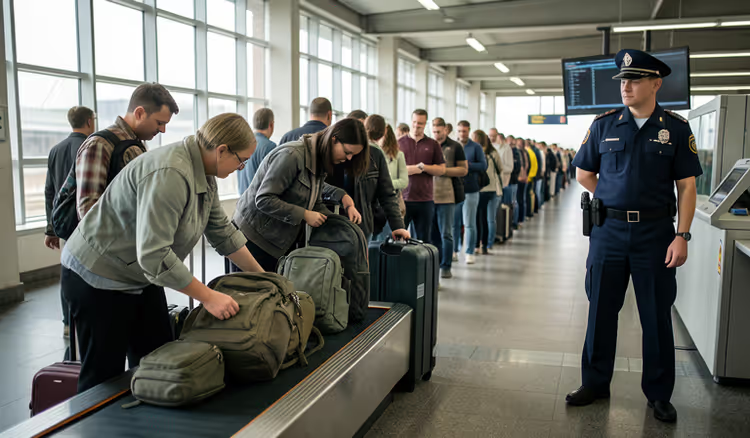
On the day of travel, arrive at the station early, at least an hour before departure. At the entrance, your luggage goes through an X-ray, and you show your ticket or passport for the first time. Sometimes a personal search is added on top of that.
 AIIllustrative image: AI-generated
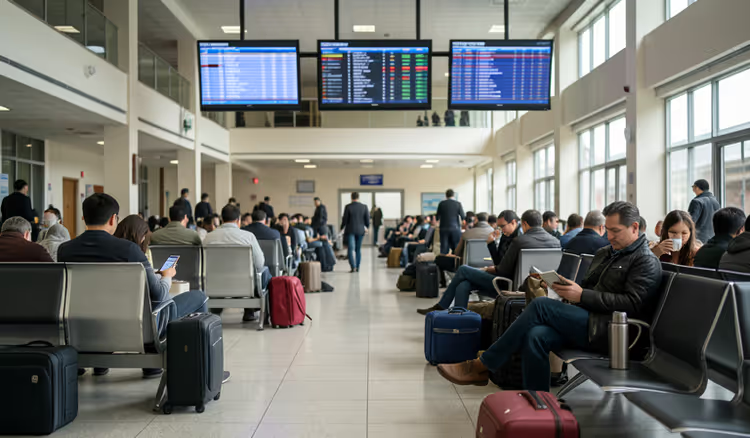
Next, you need to find your waiting hall. At the large stations in Beijing and Xi'an, this is not always easy. Look for the train number shown on the monitors at the hall entrance. VIP passengers often have separate halls.
Before the waiting hall, there is sometimes a second X-ray, and your ticket is checked again. Inside, all you have to do is wait.
 AIIllustrative image: AI-generated
Ten to fifteen minutes before departure, the turnstiles to the platform open. VIP guests and Soft Sleeper passengers usually go first.
When the line reaches the Hard Seat cars, the crush begins. Seats there are not guaranteed, so everyone wants to get on first and sit down. Elbows come out, and you should stay out of the way.
With a Soft Seat, Hard Sleeper, or Soft Sleeper ticket, you board calmly. Your place is reserved, and there is no need to rush, even if the crowd runs past. Each car has a sign with its number.
Inside, all that remains is to find your seat or berth and stow your backpack. After that, the journey through China itself begins.
Routes and schedules across China
In this section we have gathered the country's main rail routes. Almost all long-distance trains start or end in Beijing, so it is convenient to count routes from the capital. Travel times are based on 12306 data as of 09/2026, but check specific trains and exact minutes before buying (as of 09/2026, long-distance train schedules).
 AIIllustrative image: AI-generated
Beijing's three stations
Beijing has three major stations, and your train does not leave from the one that is most convenient for you, it leaves from the one printed on your ticket. West station (Beijing Xi) sends high-speed trains to Xi'an, Guangzhou and Wuhan, and conventional trains to Chongqing, Chengdu and Lhasa. You can get there on metro line 9, but because of its size, arrive at least two hours early.
South station (Beijing Nan) serves the north-south axis and is considered the second largest station in Asia. High-speed trains to Shanghai, Hefei and Tianjin, 140 km from the capital, leave from here. The most convenient way to get there is metro line 4 or buses 381 and 458.
The old main station (Beijing Zhan) handles overnight trains across the country and international trains to Mongolia and North Korea. Its 250,000 sq m site has 14 tracks and several waiting halls. The station is in the center, and all metro lines connect to it.
Beijing and Shanghai
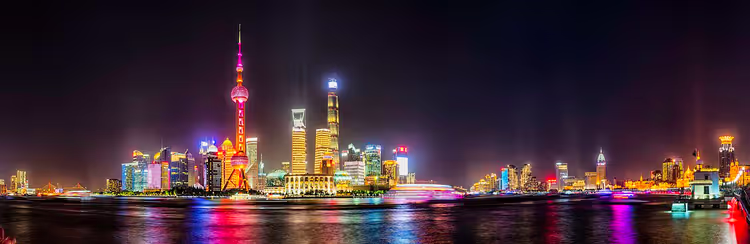
Shanghai has changed more over the past quarter century than any other city in China. Old neighborhoods are giving way to skyscrapers, and today the city lives on business and nightlife. Before leaving, it is worth walking along the Bund and down the main shopping street, Nanjing Lu.
 © David Zhang from Canada · CC BY-SAPhoto: David Zhang from Canada, CC BY-SA (https://creativecommons.org/licenses/by-sa/2.0), Wikimedia Commons
On the new high-speed line you can get from Beijing to Shanghai in under six hours. Besides high-speed trains, conventional express and overnight trains also run between the cities.
Shanghai's main station (Shanghai Hongqiao) is west of the airport and is considered the largest station in Asia. From here trains go to Beijing, Xi'an, Chengdu, Chongqing and the southern provinces. The fastest way to the station is by metro.
Route | Daytime high-speed | Overnight train |
|---|---|---|
Beijing - Shanghai | about 5 hours | 12-15 hours |
Shanghai - Beijing | about 5 hours | 12-15 hours |
Travel time source: 09/2026, official line schedule.
Dozens of high-speed trains run between Beijing and Shanghai every day. Most leave from Beijing South station and arrive at Shanghai Hongqiao, so check the departure station on your ticket. Along the way the train stops in Nanjing, where it is worth getting off for at least a couple of hours.
Overnight trains between the two cities take longer, but they save you a hotel. You go to sleep in Beijing and wake up by the sea. A sleeper ticket costs less than a high-speed seat, so a night on the road is a good deal.
Shanghai lies in the east of the country, and from there you can continue to Hangzhou or Suzhou. Both cities are connected to Shanghai by high-speed lines, and the trip takes under an hour.
The Bund is pleasant to walk along in the evening, when the lights come on. The shops on Nanjing Lu stay open late, and street food is sold in the nearby alleys.
Beijing and Xi'an
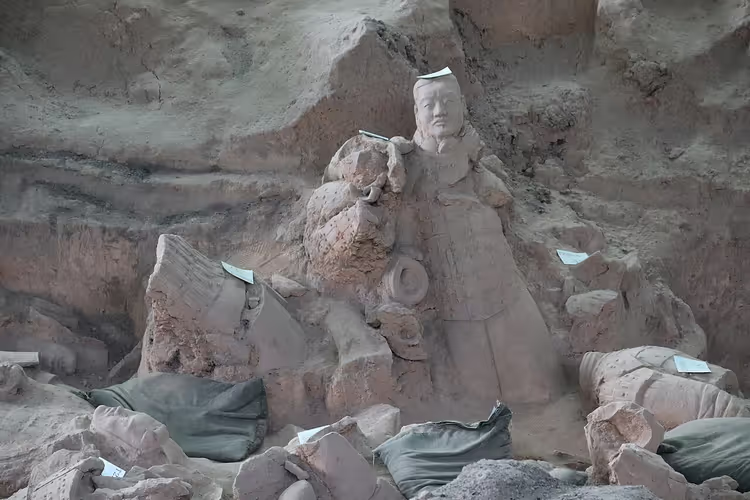
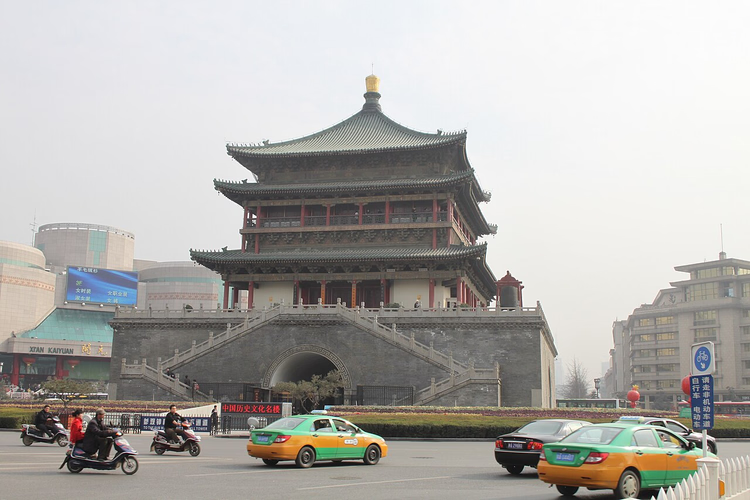
Xi'an lies 1,150 km from Beijing, in Shaanxi province, and almost everyone knows it for the Terracotta Army. Besides the two-thousand-year-old clay warriors, the city is worth seeing for its bell tower and drum tower, the market and the great mosque behind it.
Xi'an is surrounded by a massive city wall. Just beyond it, in the northeast of the center, is the main station (Xi'an Zhan), from which conventional overnight trains leave for all parts of the country.
High-speed trains run between Beijing and Xi'an almost every hour and take about five hours. They arrive at the new North station (Xi'an Bei), 12 km from the center in the Weiyang district. You can get there on metro line 2, and a taxi will not cost much.
You do not need an expensive tour to see the Terracotta Army. From Xi'an's bus station, city bus 5, sometimes numbered 306, goes there, and the ticket costs a few yuan. The ride takes about an hour, and along the way the bus stops at the hot springs.
Beijing and Xi'an are also connected by overnight express trains. They leave in the evening and arrive in the morning, and a sleeper berth costs less than a daytime high-speed seat. If you want to see the city without rushing, take an overnight train there and a daytime one back.
The Terracotta Army takes a full day. Besides the warriors themselves, there is a museum of bronze chariots, and tickets are sold at the entrance or online. Come at opening time: by midday the largest crowds gather at the main pavilion.
In the center of Xi'an stands the bell tower, and nearby begins the Muslim quarter with street food. In the evening they cook lamb, hand-pulled noodles and flatbreads here. The city wall is easy to ride around by bicycle, with rentals at the gates.
Distinguish Xi'an's stations in advance. Overnight trains leave from the main station in the center, while high-speed trains arrive at the North station outside the city. You can get between them on metro line 2 in about half an hour.
If you are short on time, choose two places: the Terracotta Army and the city wall. That is enough to get a sense of the city, and you will not spend an extra day on museums.
Beijing, Guilin and Nanning
Since 2014, a high-speed line has operated between Beijing and Nanning. A daytime train covers it in about 13 hours, while the old overnight trains took ten hours longer. Overnight trains do have a plus: sleeper tickets cost noticeably less.
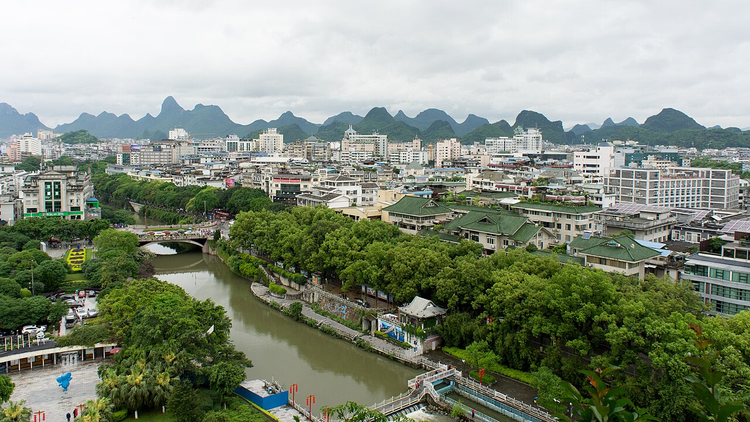
Along the way lies Guilin, ringed by karst mountains. The city has long been a tourist destination, and it is worth stopping here for the rice terraces. Be sure to take a boat ride on the Li River, whose scenery has long appeared on banknotes.
Guilin station (Guilin Zhan) is in the city center, and most trains stop right here. Nearby you will find many inexpensive hotels.
Nanning itself is not especially interesting, but trains to Vietnam leave from here. The city lies in Guangxi province in the far south of China. It is worth visiting Nanhu Park, the botanical garden and the Guangxi Museum, which tells the story of the local peoples. The station (Nanning Zhan) is also in the center, and international tickets to Hanoi are sold at window 16.
Beijing, Chongqing and Chengdu
Chongqing and Chengdu are separated by only about 300 km, so trains between them run almost every hour and take under two hours. From Beijing, both high-speed trains and express trains with sleeping cars come here.
Chongqing: starting point for a Yangtze cruise
Chongqing is often called the largest city in the world, although that is not true. Nevertheless, it is a major economic center on the Yangtze River.
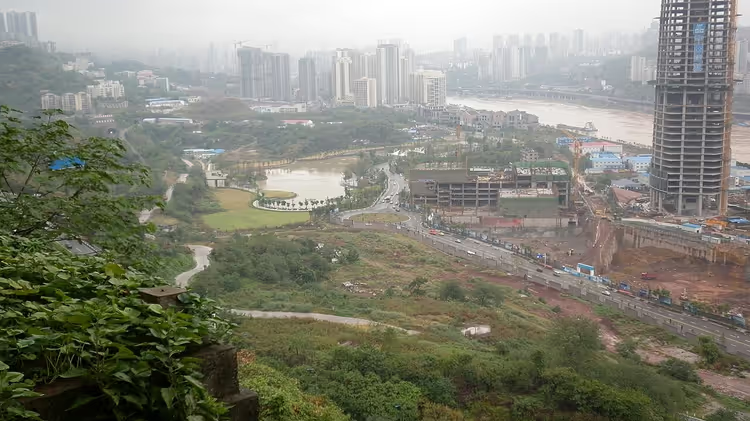
Trains from Beijing arrive at North station (Chongqing bei), opened in 2006 in the Yubei district outside the center. You can get into the city on buses 105, 168, 202 and 41 or on metro line 3. If you take a taxi, leave early: the center has constant traffic jams.
Some trains still leave from the old main station (Chongqing Zhan), which is closer to the center. Metro lines 1 and 3 connect to it.
Many people come to Chongqing for a Yangtze cruise. The ships pass "ghost cities," travel through the Three Gorges and reach the massive Three Gorges Dam near Yichang. We recommend not skipping this trip. From Yichang, trains then go back to Chongqing and Chengdu or on to Wuhan.
 © Dark Shaw · CC BY-SAPhoto: Dark Shaw, CC BY-SA (https://creativecommons.org/licenses/by-sa/3.0), Wikimedia Commons
Tip: Chinese cruise ships are noticeably cheaper than Western tourist ones, and they often include more excursions. You also get closer to the local culture and your fellow passengers.
Chengdu: pandas and spicy hotpot
Chengdu is calmer than Chongqing. The main draw here is pandas: the Panda Breeding Station outside the city is one of the most visited places in China. From the center you can get there on buses 87 and 198. And be sure to try hotpot, a spicy soup with meat and vegetables that was invented in Sichuan province.
High-speed trains to Chongqing and Beijing stop at East station (Chengdu Dong Zhan). It is far from the center, and metro line 2 will help you get there.
Chengdu's main station (Chengdu Huoche Zhan), sometimes called North station, handles overnight trains to Beijing and back. It is located in the north near the second ring road, and metro line 1 is closest to it.
Xi'an, Chengdu and Kunming
The Xi'an-Chengdu-Kunming line connects central China with Yunnan Province. Since late 2016, new high-speed sections have been added, and now you can get from Beijing to Kunming in about 11 hours.
Kunming is called the city of flowers. It sits at an elevation of 1,890 m, so spring lasts all year round here. In the city, you should see Green Lake Park, Yuantong Temple, and the old mosques. For many, Kunming becomes a transit hub before traveling through Yunnan.
Kunming's main station (Kunming Huoche Zhan) lies away from the center, at the end of Beijing Lu. From here, trains depart not only for Xi'an and Chengdu, but also overnight trains to Nanning and Guangzhou.
If you have enough time, choose the overnight train K165. It runs from Xi'an through Chengdu and arrives in Kunming two nights later, and during the day you get a stopover in Chengdu.
Beijing, Shanghai, and Hong Kong
Hong Kong is most convenient to reach by high-speed train across the border. Trains run from Beijing West Railway Station to West Kowloon Station and take about 8.5 hours. There used to be a direct overnight train between the cities, but it was replaced by the high-speed line.
Alternative: take a high-speed train to Shenzhen or Guangzhou and transfer to an express to Hong Kong. In both cities you'll have to change stations, so this option is more convenient for those who wanted to see Guangzhou anyway.
West Kowloon Station is in Kowloon, west of the Tsim Sha Tsui area. You can get there on the MTR.
At West Kowloon Station, passport control takes place right in the building, so you cross the border without a transfer. After control, you go down to the MTR and reach central Hong Kong in half an hour.
If the direct train is sold out, go to Shenzhen, cross the border on foot, and then take the metro to Kowloon. This route is cheaper, and seats are almost always available. Just keep in mind that you'll have to wait in line at the border.
Beijing and Urumqi
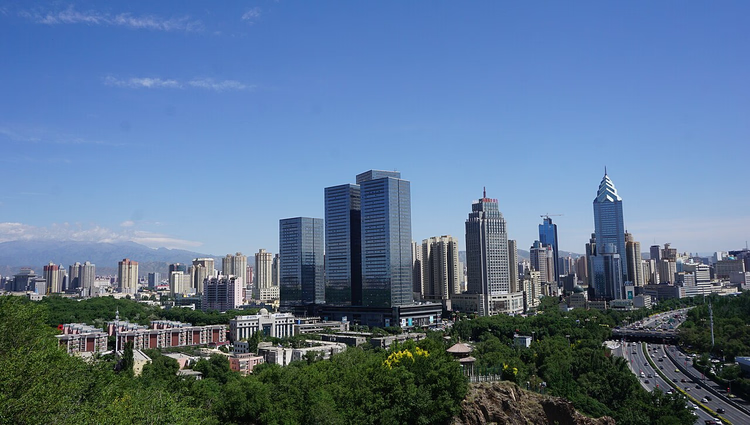
Urumqi lies in the west of the country, in the Xinjiang Uyghur Autonomous Region. For most travelers, it's the last stop before heading to Kazakhstan.
 © Albertaont · CC BY-SAPhoto: Albertaont, CC BY-SA (https://creativecommons.org/licenses/by-sa/4.0), Wikimedia Commons
From Urumqi, trains depart three times a week to Almaty and Astana. And from Beijing to Urumqi, you travel by overnight train for one and a half to two days, but without transfers and with views of deserts and mountains.
Urumqi sits on the edge of the desert and serves as the gateway to Xinjiang. The overnight train from Beijing runs through steppes and mountains, and along the way you'll see wind farms and the foothills of the Tian Shan. In summer it's hot and dry here, in winter cold and windy.
Bring plenty of water on such a train: there's nowhere to buy it en route, and the heat in the carriage feels stronger than in the city. A sleeper car on a long-distance route should be booked in advance, and Soft Sleeper berths sell out first.
How much a train in China costs
Prices depend on class and distance, but the train is almost always cheaper than flying. A seat ticket costs less than a sleeper, and Second Class is cheaper than First Class. On long routes, a sleeper car pays off: you don't pay for a night in a hotel.
High-speed trains are more expensive because you're buying time. If budget matters more than speed, the overnight express remains the best choice. Comparing classes and times is easy in the 12306 app, where prices for all options are shown at once (as of 09/2026, train prices on 12306).
Buy tickets on 12306 directly, and you don't pay an agency fee. On some international routes, a fee is unavoidable because they aren't sold online.
An overnight journey replaces a night in a hotel, so a long route can be split into two legs. During the day you explore a city, in the evening you board the train, and in the morning you arrive in a new place.
Between major Chinese cities, trains run from morning to evening, so adjusting the route to your needs isn't hard. Pay attention to arrival times: arriving in an unfamiliar city after midnight is inconvenient, and the metro is already closed by then.
Trains to neighboring countries
You can leave China by train to four neighboring countries. There are regular services from Nanning to Hanoi, from Urumqi to Almaty, and from Beijing to Ulaanbaatar. Below we break down the routes to Vietnam, Kazakhstan, North Korea, and Mongolia.
Vietnam
An overnight train runs between Nanning and Hanoi every day. It has comfortable Soft Sleeper compartments and a dining car, and the journey takes about twelve hours. Twice a week you can leave Beijing for Vietnam without changing trains in Nanning.
Nanning station is small. Tickets to Hanoi are sold at window 16, but sometimes you will be sent to another window if the staff member does not speak English well. Do not forget your visa for Vietnam: without it, they will not sell you a ticket. If you do not have a visa yet, your hotel can help with the paperwork.
Trains arrive in Hanoi early in the morning at Gia Lam station, outside the center. Taxi drivers waiting in front of the station see new arrivals as easy prey. Do not accept the first price, haggle, or call a car through an app.
Kazakhstan
You can travel by train from China to Kazakhstan along the old Silk Road route. Trains leave Urumqi for Almaty, about 850 km away, and continue on to Astana.
Kazakhstan and China use different track gauges, so at the border the cars are moved onto different bogies. The operation takes two to three hours. You can spend this time in your car or in the station building. There is not much to see here, but sometimes vendors sell tasty food.
North Korea
A trip to North Korea looks even more exotic. Three times a week an overnight train runs from Beijing to Pyongyang.
You need a visa and an organized tour for the trip. There are many agencies in Beijing that run such tours, and the visa can be arranged in advance at the North Korean embassy in Germany. Independent travel within the country does not happen: a guide accompanies you the entire time.
Mongolia
A direct train runs from Beijing to Ulaanbaatar via the border town of Erlian. Mongolia uses a different track gauge, so at the border the cars are moved onto new bogies, and this operation takes several hours. In total you will spend more than a full day in transit.
The ticket price depends heavily on the class of car and the route, so confirm the budget when booking. We recommend taking a berth in a sleeper car: not everyone can endure several days in a seated car.
International tickets are almost never sold online. They are issued at a ticket office or through an agency, and for some routes you need to queue in advance. Arrive at the ticket office with time to spare and bring copies of your visa and passport.
The train crosses the border at night or early in the morning, and documents are checked right in your car. Keep your passport handy and do not bury it deep in your luggage.
On international routes you will spend several days in transit, so bring food, water, and a supply of medicine. Hot food in the dining car is not always available, and there is nowhere to go at stops.
Bring extra money for the road too. There are few exchange offices near the border, ATMs are not everywhere, and the buffet takes cash.
If you are going to Mongolia, do not rush onward. Ulaanbaatar and the steppes around it are worth staying for a day or two. Buy your return tickets in advance.
For a trip to North Korea, book the tour a month or more ahead. The visa is stamped in your passport, and the route is limited to Pyongyang and a few other cities. You will not be able to wander freely around the country; a guide accompanies you the entire time.
English helps little once you cross the border. With conductors and border guards it is easier to communicate with gestures or through a translator app on your phone. Bring a printout of your route with station names.
International trains often make a large number of stops, so check the schedule before buying. Seasonality matters too: there are more seats in summer, and some trains run less frequently in winter.
Entry rules for Kazakhstan for EU citizens change periodically. Check them on the embassy website before departure so you do not get stuck at the border.
⁉️🤔 Frequently asked questions
Can I buy a train ticket in China from abroad?
Yes. The 12306 app works in English, and the ticket is linked to your passport. Foreign cards are accepted there, but payment is sometimes declined. You can buy it well before your trip and avoid looking for a ticket office at the station. If the interface seems complicated, Trip.com will do the same thing. The main thing is to enter your first and last name exactly as they appear in your document.
Do I need cash at the station?
Not necessarily. In major cities, ticket offices and machines accept cards and mobile payments, while food on the train is often sold for cash. Take a little yuan for tea, water, and snacks. In remote cities, cash comes in handy more often than you might think.
How safe are overnight trains in China?
Overnight trains are considered safe. Your berth and belongings stay in the car, and the conductor keeps order. Keep valuables and documents with you. Ordinary precautions solve almost everything, so travelers rarely have serious problems here.
What should I do about food on the road?
The train has a dining car or buffet, and hot meals are sometimes brought through the cars. Still, bring something with you: noodles, fruit, nuts. Hot water for tea and instant noodles is available free in every car. The buffet is usually closed at night.
Can I board the train with an electronic ticket without a printout?
Yes. A paper ticket has not been required for a long time. At the entrance you tap your passport at the turnstile, and the system finds your booking. You board the same way. A printout is needed in rare cases, such as a system failure, so keep your order number handy.
Can I leave China by train to neighboring countries?
Yes. Trains run from Nanning to Hanoi, from Urumqi to Almaty, from Beijing to Ulaanbaatar and Pyongyang. International tickets are usually issued at a ticket office or through an agency, and the price depends on the class of car and the season. You need a visa for every country on your route.
In short: what to book
China is more convenient and cheaper to cover by train than by plane if you choose overnight legs. Build your route from Beijing: high-speed lines connect you to Xi'an, Shanghai, and Guangzhou, while sleeper cars replace hotels on long stretches.
- If you have a week: overnight train Beijing to Xi'an there and a daytime one back.
- If you want karst and water: add Guilin and a trip on the Li River.
- If you are going further: leave Nanning for Hanoi, Urumqi for Almaty.
- If Hong Kong is your goal: take the high-speed train to West Kowloon.
Tickets open in advance, and before holidays they sell out quickly. Check train schedules and buy tickets on Trip.com.

A small editorial team writing guides for independent travel. We travel ourselves, but we haven’t been everywhere, so we check prices, opening hours and how to get there against official sources.