



Euro in Croatia: where cards do not work and how much cash to take in 2026
Croatia switched to the euro on January 1, 2023. The kuna is no longer in circulation, and exchange offices near hotels have lost their purpose. For your trip, you need the same banknotes that are sitting in your wallet at home.
Questions still remain. Does your card work at a market and in a village konoba? How much cash should you bring? How do you avoid overpaying at an ATM and how much should you leave the waiter? We break down payments in Croatia step by step: from exchange rates and ATMs to real prices and tips.
The short answer: you can pay by card almost everywhere, but a small cash reserve will save you from surprises at the market, in a remote konoba, and at a parking meter.
Ad: this article contains affiliate links, we earn a commission if you book through them, at no extra cost to you.
Croatia and the euro: the end of the kuna
💡 In short:
- Croatia adopted the euro on January 1, 2023 and simultaneously joined the Schengen Area.
- The old kuna exchange rate is fixed: 1 euro = 7.53450 kuna.
- Cash euros are accepted everywhere, cards almost everywhere, read about your cash reserve below.
- Exchange rate and payment rules: 09/2026, verified on the official European Central Bank website.
Croatia became the twentieth country in the eurozone. Along with the euro, the country joined Schengen. If you drive from Germany through Austria and Slovenia, there are no more borders or exchange offices, and you barely notice the change of country.
The kuna was replaced at a fixed rate, and the transition period ended long ago (as of 09/2026, European Central Bank). Today, a seller simply won't accept kuna, and old banknotes can only be exchanged at the Croatian National Bank in Zagreb. For an ordinary vacationer, this is no longer relevant.
Few people know: Croatia has its own euro coins. The 1 euro coin features a marten, because "kuna" means "marten" in Croatian. The 2 euro coin has the outline of the country minted on it. These coins circulate all over Europe, and you'll easily come across them in change on the other end of the continent.
Can you pay with euros everywhere in Croatia?
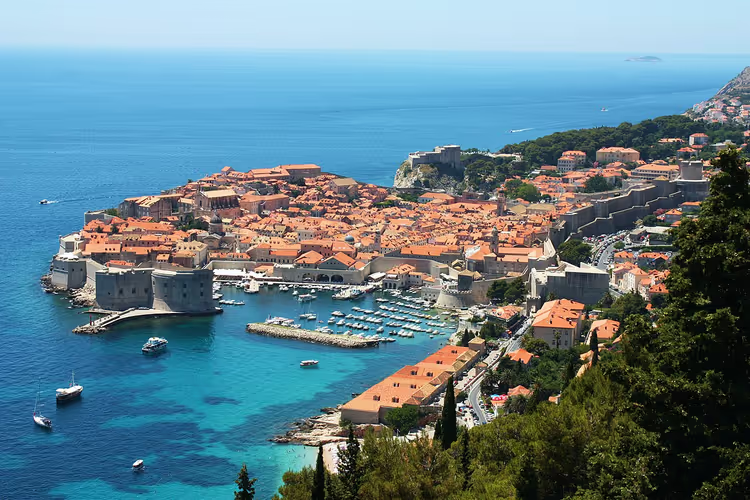 © Bracodbk · CC BY-SAPhoto: Bracodbk, CC BY-SA (https://creativecommons.org/licenses/by-sa/3.0), Wikimedia Commons
There are no problems with cash euros: they are accepted everywhere. With a card it's more complicated, because there are exceptions, and they concern exactly the most pleasant places.
Visa and Mastercard work in hotels, city restaurants, large supermarkets (Konzum, Lidl, Spar, Kaufland, Tommy), at gas stations, in pharmacies, at national park and museum ticket offices. Contactless payment, Apple Pay and Google Pay also work. In Split or Dubrovnik you can easily get by for several days without cash.
The closer you are to the sea and to the tourist flow, the more willingly they take cards. In resort towns, even a small bar has a terminal, while in a village twenty kilometers from the coast they may not have heard of one.
Cash is needed where you least expect it. At markets (Dolac in Zagreb, Pazar in Split, the green market in Zadar), the seller has fruit, cheese and olive oil in front of them, but no card terminal. In family konobas in the villages of Istria, in the interior of Dalmatia and on small islands, they also often take only cash, and there may be no sign at the entrance.
Then come parking meters in Trogir, Primošten or on Murter, mini-markets on Šolta, Prvić and Zlarin, beach lounger rentals and ice cream sellers. Local ferries and taxi boats settle in cash, although Jadrolinija tickets can be bought by card. On large islands like Hvar, Brač and Korčula, cards become the norm again.
This doesn't mean you need suitcases of cash. The problem is solved simply: keep a reserve in your wallet and cover large expenses by card. Then you won't be left without dinner just because the konoba has no terminal.
A simple rule: in the city and in tourist areas, a card is enough. As soon as you leave the main routes, take cash, and better with a reserve.
ATMs in Croatia: what you need to know
An ATM is called "bankomat" in Croatian, and there is one in every city, in every resort village and even in most villages. On small islands you'll find at least one, usually near the ferry dock or in the center.
Which ATMs are good and which are not
ATMs fall into three groups. Bank machines charge fewer fees, while Euronet near tourist spots often adds its own surcharge. Choose carefully, the difference in amount can be noticeable.
ATM type | Fee | Recommendation |
|---|---|---|
Bank ATMs (Erste, PBZ, Raiffeisen, OTP, HPB) | usually no fee for EU cards | first choice |
Euronet with the blue logo | own exchange rate surcharge | better to avoid |
ATMs in hotels and shopping centers | varies, often an operator fee | read the message on the screen |
Your own bank fee hasn't gone anywhere. Some German banks charge several euros per withdrawal, so it's more profitable for you to withdraw a large amount once than small amounts three times.
The daily withdrawal limit depends on the bank and usually allows you to take out several hundred euros. Your bank's app will tell you the exact amount, and on the ATM screen you'll see the available balance.
What is DCC and where does it lurk
If your card is in euros, there is no dynamic currency conversion (DCC) at the ATM. You withdraw euros from a euro account, and no conversion takes place. With a card in another currency, Euronet ATMs may offer DCC. Decline the conversion and choose to be charged in euros.
On terminals in restaurants and shops, DCC sometimes pops up. The terminal asks whether to charge the amount in euros or in your home currency, and shows a rounded intermediary rate. Always choose euros: then your bank will process the card at the European Central Bank rate, and that's cheaper.
Tipping in Croatia: how much, when and why
Tipping (in Croatian "napojnica") in Croatia is not elevated to a cult, as in the USA, but it's not considered unnecessary either. It's not strictly demanded, but in the restaurant industry leaving a tip has long become the norm, and you'll notice it in how you're treated.
In restaurants, the ten percent rule applies. A dinner for two at a good place easily reaches 60-80 €, and ten percent of that amount looks appropriate (as of 09/2026, Bluesun hotel chain). If the evening was excellent, you can leave 15 percent. When paying by card, tell the waiter the total amount including the tip, and many terminals offer this option themselves.
In cafes and bars, rounding up is enough. Coffee usually costs a couple of euros, and a bill of 2.30 € easily becomes 3 €. If you occupied a terrace table for a long time and didn't order a second coffee, rounding up is doubly appropriate.
In taxis, rounding up is also customary: from a 12 € fare you give 14 or 15 €. In Uber and Bolt, tips are added through the app. A private airport transfer driver usually gets 5-10 € on top if they helped you with your luggage. A tour guide gets 5-10 € per person, and hotel staff 1-2 € per day.
Many guides and some waiters work seasonally and receive a noticeable share of their income precisely from tips. Your few euros go where they are really needed.
Cash on the table is still the most convenient, and waiters often prefer exactly that option. If you pay by card, don't forget to state the total amount, otherwise the terminal will charge exactly what is printed on the bill.
How much a vacation in Croatia costs in 2026
Croatia is cheaper than Germany, but not by as much as many people hope. The days when three courses on the Adriatic cost less than a doner in Berlin are over. Dubrovnik, Hvar, and Split have become especially expensive.
Overall, tourist prices are about 10-30 percent lower than in Germany (as of 09/2026, Eurostat). That said, a lot depends on the location and season: the same lunch in Osijek and on the Stradun can differ by several times.
Cafe and restaurant prices (2026)
Countrywide benchmarks as of 09/2026, average level according to Bluesun Hotels.
Item | Range, € | Compared with Germany |
|---|---|---|
Espresso | 1.20-2.50 | cheaper (in Germany 2.50-4.00) |
Cappuccino | 1.80-3.00 | cheaper |
Beer, 0.5 l | 3.00-5.00 | about the same |
Glass of wine | 3.00-7.00 | cheaper |
Pizza | 8.00-14.00 | cheaper |
Main course in a restaurant | 12.00-25.00 | cheaper |
Fish dish | 15.00-40.00 | comparable |
Ćevapi or Pljeskavica | 8.00-12.00 | cheaper |
Taxi across town | 8.00-20.00 | comparable |
Parking downtown, 1 hour | 1.50-3.00 | cheaper |
A separate note about fish. In Croatia it is often priced by weight: the menu says, for example, "Brancin, 7 € per 100 g". A whole sea bass weighs 400-600 g, so one dish comes to 28-42 €. This is not a scam, but you should ask about the weight before ordering. Good restaurants will show you the fish before cooking it.
Supermarket prices (2026)
If you cook for yourself, prices at Lidl, Kaufland, Spar, Konzum, and Tommy are often lower than in Germany.
Product | Price, € |
|---|---|
White bread, 500 g | 0.80-1.50 |
Water, 1.5 l | 0.40-0.80 |
Canned beer, 0.5 l | 0.80-1.30 |
Bottle of good table wine | 4.00-8.00 |
Olive oil, 0.5 l, Istrian | 8.00-15.00 |
Pršut, 100 g | 3.00-5.00 |
Paški sir, 100 g | 3.50-6.00 |
Milk, 1 l | 0.90-1.30 |
Local products are a better deal when you buy them directly from the producer. Istrian olive oil bought on site, at the mill, costs noticeably less than in a German store. Paški sir from the island of Pag costs about half as much as in a German specialty food store.
Accommodation in July and August becomes two to three times more expensive compared with the shoulder season. If you are traveling in peak season, book early and compare hotel prices in Croatia on Trip.com.
Where Croatia is genuinely expensive
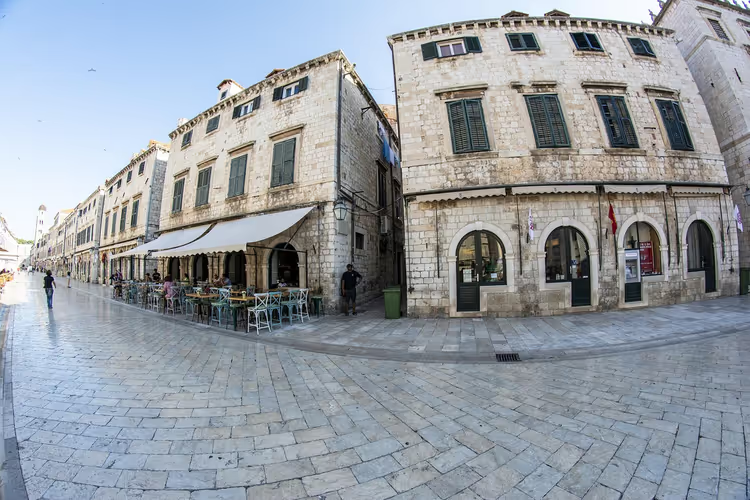
Dubrovnik holds first place for prices, and by a wide margin. Coffee on the Stradun costs 4-5 €, a main course 25-40 €, a cocktail at Buža Bar with a sea view 15 € (as of 09/2026, Bluesun price review). Cruise ships bring in thousands of people every day who are ready to pay.
Hvar is Dubrovnik for party lovers. Cocktails at the harbor bars cost as much as at expensive bars in Germany, and a lounger at a beach club on the Pakleni Islands runs several tens of euros plus a minimum spend. In August, Hvar is among the most expensive places on the entire Adriatic.
High season drives prices up everywhere. In July and August, apartments double and triple in price, restaurants rewrite their menus, and parking fees go up.
If you come in June or September, accommodation will cost 30-50 percent less. The difference between late June and early August can reach half of your trip budget, and this is the easiest way to save.
Where Croatia offers the best value for money
The real bargains are waiting for you away from the coast.
Slavonia in the east is barely touched by tourists, so prices there are lower. In Osijek, a hearty lunch with Čobanac, bread, salad, and half a liter of house wine costs noticeably less than on the coast. A double room in a good guesthouse will cost you significantly less than by the sea; check the price for your travel dates. A tasting of five or six wines with a cheese plate at wineries around Kutjevo is inexpensive; confirm the exact price with the winery.
Istria away from the shore is a separate story. In Rovinj and Poreč, prices are at Dalmatian levels, but twenty kilometers inland, in the villages around Motovun, Grožnjan, and Buzet, you can eat pasta with truffles noticeably cheaper than on the coast.
Shoulder season is the main way to save. Many places in May, June, September, and October offer inexpensive lunch menus (marenda): soup, a main course, sometimes dessert. In August, such offers simply do not exist.
If you want to tour the wineries of Slavonia or inland Istria, a car is more convenient. Compare car rental prices in Croatia in advance so you do not overpay at the airport.
Traps and tricks: what to watch for
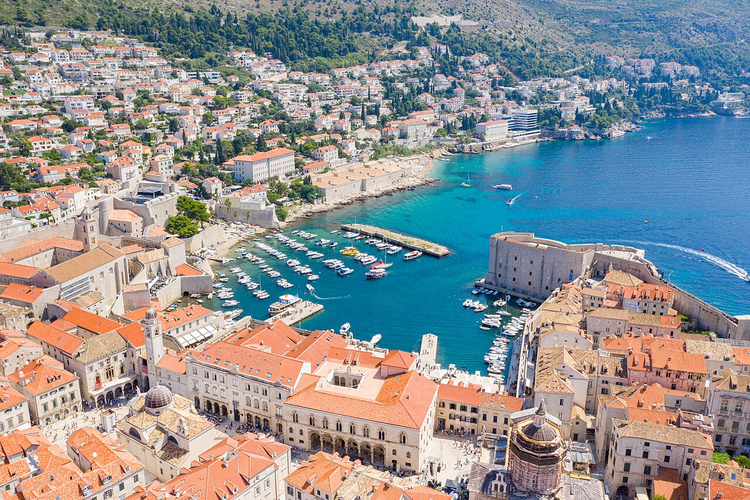 © dronepicr · CC BYPhoto: dronepicr, CC BY (https://creativecommons.org/licenses/by/2.0), Wikimedia Commons
Systematic scamming is not common in Croatia: most waiters, taxi drivers, and shopkeepers are honest. But there are situations where you should be careful, and they repeat year after year.
Menus without prices. In some restaurants in Dubrovnik, Split, and Hvar, you get a menu with no prices, and the waiter recommends "today's fresh fish" without naming the cost. Always ask the price before ordering. An honest place will show you the fish, state the weight, and give the price per kilogram.
Taximeter. In Split and Dubrovnik, it happens that a taxi driver estimates the fare from the airport "by eye" instead of using the meter. Insist that the meter be turned on or agree on a price in advance. Even more reliable is Uber or Bolt: the app shows the price before the ride.
Exchange offices advertising kuna. Even three years after the switch to the euro, tourist areas still have "Change" signs showing kuna rates. You no longer need such exchange offices: there is nothing left to exchange in Croatia.
Beach bar without prices. On some beaches there are improvised bars with no price list. A beer there can suddenly cost twice as much as at a regular bar. It is not illegal, but it is unpleasant, so ask the price in advance.
Couvert. Some restaurants add a few euros per person for tableware, bread, and olives. This is usually written in small print on the menu. Not a scam, but useful to know so the bill does not surprise you.
Mistakes on the bill. These happen more often than deliberate overcharging: in high season, staff work at their limit. Glance over the list of items before paying; an extra line will be removed without argument.
Practical tips: how to handle money in Croatia
Get a card with no foreign transaction fees. Many direct banks (DKB, ING, N26, Comdirect) let you withdraw euros outside Germany with no surcharge. For branch banks, it is better to get a travel card: the annual fee pays for itself after a few withdrawals.
Two cards, two payment networks. Carry Visa and Mastercard at the same time: sometimes a terminal accepts only one network. American Express is almost never accepted in Croatia, so it is better to leave it at home.
30-50 € in cash. This is enough for the market, parking, ice cream for the kids, and entry to a cave that only takes banknotes. You usually do not need more, unless you plan to have dinner at a remote konoba with a handwritten bill.
Split up your cash. Do not keep all your money in one wallet: leave some in the safe at your accommodation. Pickpocketing is rare in Croatia, but in crowded places like Dubrovnik's Old Town or the ferry terminal in Split, a little caution will not hurt.
Parking apps. In Split, Dubrovnik, Zagreb, and Zadar, you can pay for parking through EasyPark or CroParking, without hunting for coins. This saves you when the machine is full or broken.
Check the bill and stay connected. After dinner with a large group, review the bill carefully. Set up an eSIM for your trip to Croatia in advance so maps, parking apps, and finding an ATM work without roaming.
⁉️🤔 Frequently asked questions
Can you pay by card everywhere in Croatia?
Not everywhere. Visa and Mastercard work in hotels, supermarkets, museums, and city restaurants. But at markets, in village konobas, at parking meters, and with beach vendors, you often need cash. Keep a small amount of cash on hand for those situations.
How much cash should you bring to Croatia?
Keep 30-50 € in your wallet as a reserve: enough for a market, parking, ice cream, and entry where there is no terminal. It is more convenient to leave the rest on your card and stash some cash in the safe at your accommodation. In cities and hotels, you can easily get by with just a card.
How much should you tip at a restaurant?
Ten percent of the bill. A lunch for two at 60-80 € rounds up to 66-88 €, which is enough. For a great evening, you can leave 15 percent. When paying by card, tell the waiter the final amount; many terminals offer to add a tip themselves.
What should you do with leftover kuna?
You can only exchange them at the Croatian National Bank in Zagreb. Banks, the post office, and FINA stopped exchanging kuna back in early 2024, so on vacation you simply will not find anywhere to exchange the old banknotes.
How do you avoid overpaying at an ATM?
Withdraw from a bank ATM, not from a Euronet machine with the blue logo. If your card is not in euros and the ATM offers conversion, choose euros. Then your bank does the conversion, and the final amount is lower. If your bank charges a fee, withdraw one large amount instead of three small ones.
Is Croatia cheaper than Germany?
Overall, yes. The price level for tourists is about 10-30 percent lower than in Germany, but Dubrovnik and Hvar are catching up to Germany and sometimes even overtaking it. In Slavonia and inland Istria, the same trip will cost you noticeably less.
In short: what is worth booking
Croatia with the euro has become simpler. You do not exchange currency, you can pay by card almost everywhere, and you see prices in familiar euros. Keep a small cash reserve, bring a card with no fees, and the money side of your vacation will take care of itself.
If you have a short trip to Split or Zagreb, a card and a small cash reserve will be enough. If you are heading to the islands and inland areas, add cash and a rental car. If you are traveling in peak season, book accommodation in advance and choose a hotel in Croatia on Trip.com.

A small editorial team writing guides for independent travel. We travel ourselves, but we haven’t been everywhere, so we check prices, opening hours and how to get there against official sources.