
















How to fall asleep on a plane and not ruin your sleep after landing
Sleeping on a plane is disrupted by engine noise, light, and an uncomfortable seat. After a long-haul flight you feel more exhausted than after a workday at the office.
Four things help: shifting your schedule in advance, a seat away from the sun, a simple sleep kit, and a smart first day after landing. The NHS advises sleeping during the flight if it is nighttime at your destination, drinking water, and not overdoing coffee and alcohol (as of 09/2026, jet lag page).
Below we break down each step.
Step 1: adjust your schedule before departure
💡 In short:
- Shift your bedtime and wake-up time closer to your destination's time.
- Get a good night's sleep before the flight instead of deliberately staying up.
- Bring an eye mask, earplugs, and an inflatable pillow.
- Choose a seat away from the sun.
- On the first day, walk in daylight and avoid napping.
- Rules for sleeping in flight and adjusting: 09/2026, verified on the NHS jet lag page.
One of the most persistent tips from old guides goes like this: deliberately don't sleep the night before departure so that fatigue builds up on its own. It works poorly, and the NHS advises the exact opposite: rest before the trip and shift your schedule toward your destination's time in advance.
Start early: go to bed and wake up a bit earlier or a bit later, depending on where you're flying. When flying west, shift bedtime later; when flying east, shift it earlier. The point is that by the time you land, your internal clock has already moved toward the new time zone, so sleep in your seat comes faster.
If your trip lasts only a few days, the NHS classifies it as short and advises against changing your schedule. Otherwise, you'll have to readjust to home time when you return, which means extra days of fatigue.
Step 2: choose your seat in the cabin
Your seat matters more than the size of your carry-on because you'll spend all the long hours of the flight in it. Start with the seat map. People used to recommend SeatGuru for this, but the service shut down and now redirects visitors to TripAdvisor (according to The Points Guy, 09/2026).
There is a free, active alternative: seatmaps.com shows cabin layouts by flight and aircraft type and highlights seats with better pitch.
After that, simple sun logic applies. On a daytime flight from east to west, the sun shines on the left side of the plane, so you're better off taking a seat on the right. On a daytime flight from west to east, it's the opposite: sit on the left, and bright light won't hit your eyes for half the day.
A nighttime flight from west to east is tricky because dawn comes early, and the sun can appear in the window a couple of hours after takeoff. If you want to sleep longer, keep the shade closed.
Aisle or window depends on your goal. By the window, nobody will disturb you; by the aisle, you can get up and stretch freely, which the NHS explicitly recommends doing during a flight. Take the aisle if getting up and walking around the cabin matters to you during the long hours of the flight.
Step 3: put together a sleep kit
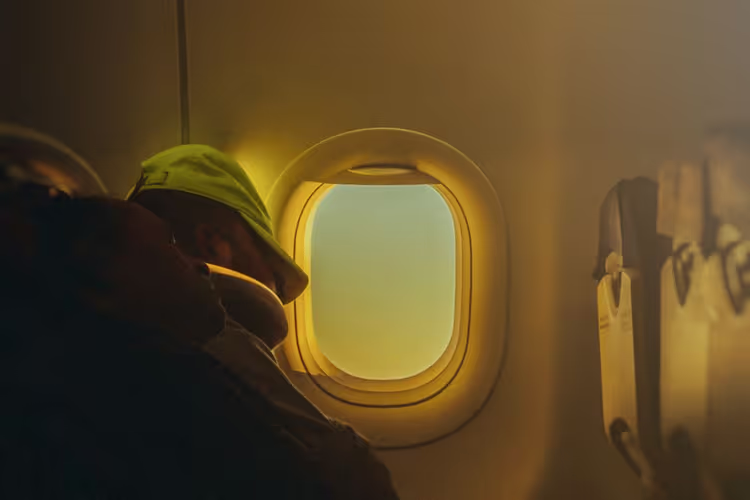
Three items take up minimal space and address the main obstacles. An eye mask blocks light, earplugs muffle some of the noise, and an inflatable pillow supports your neck in the seat. The NHS lists an eye mask and earplugs among the things that help you fall asleep while traveling (as of 09/2026, NHS sleep tips for travel).
Earplugs cost pennies and don't need batteries, but they dampen the steady low hum of engines less effectively than active noise-canceling headphones. Such headphones work specifically with constant background noise, not sudden sounds. Among product lines, Bose QuietComfort and Sennheiser Momentum are recommended more often than others, but models get updated, so before buying, check the current version rather than reviews from past years.
Get an inflatable pillow: it deflates and takes up almost no space in your carry-on, and you can inflate it right in your seat. A thin scarf or light blanket comes in handy if the cabin feels chilly.
Step 4: dress for sleeping in your seat
The cabin is cool even in summer, and it gets colder toward night because the air conditioning runs nonstop. Loose pants made of soft fabric, warm socks, and a hoodie are easier to endure than thick jeans and stiff shoes.
It's better to take your shoes off or choose loose ones so they don't squeeze your feet. On a night flight, a hood replaces an eye mask and also muffles the noise from your neighbors.
Old guides advise women to bring a shawl or poncho, but the rule is universal: a loose layer over a T-shirt keeps you warm and doesn't press at the waist.
What helps during the flight and what hurts
Do | Don't |
|---|---|
Drink water in small amounts | Lots of coffee and alcohol |
Stretch and walk around the cabin | Sit still for the entire flight |
Sleep if it's nighttime at your destination | Sleep during the day after arrival |
Walk in daylight | Sleep in until noon |
The list is compiled entirely from NHS recommendations for long-haul flights (as of 09/2026). The rules are simple, and you can follow them without any special purchases.
Step 5: spend the first day after landing wisely
Sleeping on the plane solves half the problem, and the first day on the ground solves the other half. The key here is not to stretch the transition over a week.
Switch to the new time immediately. During the day, go outside: natural light helps your internal clock adjust to the new time zone (as of 09/2026, NHS recommendations after arrival). Set an alarm for the morning so you don't sleep until noon.
If you feel like taking a nap during the day, it's better to resist. The NHS advises sleeping only at night; otherwise your body stays in the old rhythm and you'll be wide awake again by evening.
A separate note on pills. The NHS does not recommend melatonin for jet lag because there isn't enough evidence of its benefit. A doctor may prescribe sleeping pills for severe insomnia, but only for a short period, since such medications are habit-forming.
⁉️🤔 Frequently asked questions
Can I take melatonin to fall asleep on the plane?
The NHS does not recommend melatonin for jet lag; see step 5 for details. In flight, it's more reliable to rely on an eye mask, earplugs, and a seat with less light and noise.
Does alcohol help you fall asleep faster on a plane?
That's a common mistake. Alcohol makes you drowsy, but the NHS asks you not to drink much alcohol or coffee because it makes jet lag harder to handle. Coffee works in a similar way: it perks you up briefly, but falling asleep afterward is harder. On the plane, it's better to order water and save a glass of wine for the evening at the hotel.
Which side is better to sit on so light doesn't bother you?
On a daytime flight west, take a seat on the right; east, on the left. The detailed sun logic is described in step 2. On a night flight, keeping the window shade closed matters more.
What should I do if the trip is short?
The NHS advises spending a short trip on home time; see step 1 for details. This saves energy for those going away for a weekend.
Is it worth paying extra for an aisle seat?
By the aisle, you can get up and stretch freely, which helps you endure a long flight. By the window, nobody disturbs you; by the aisle, your neighbors will climb over you to get out. If getting up regularly and drinking water matters to you, take the aisle; if you plan to sleep undisturbed, choose the window.
In short: what to book
To make sleep on the plane work, settle three questions in advance, when buying your ticket.
- If peace matters to you: take a window seat on the side away from the sun.
- If you get up often: book an aisle seat so you don't disturb anyone.
- If it's a night flight: check the seat map to make sure your seat isn't near the lavatory or galley.
Check the seat map in advance on seatmaps.com and choose your seat together with your ticket: aisle seats go first.

A small editorial team writing guides for independent travel. We travel ourselves, but we haven’t been everywhere, so we check prices, opening hours and how to get there against official sources.