
















Life in Brazil: reversed climate, safety and transport
Brazil is associated by most people with football, coffee, carnival and soap operas. Behind these clichés lies everyday life, and that is what determines whether you will like the country or not. Alina moved to São Paulo in December with her husband and agreed to share what surprised her, made her wary and made her happy.
Alina's observations and verified data will help you understand daily life, safety and transport in the country from the inside. Below are facts about the climate, entry rules, language, food and getting around Brazil.
Ad: this article contains affiliate links, we earn a commission if you book through them, at no extra cost to you.
What to know before you go
💡 In short:
- The climate here is mirrored: December is the height of summer, July is a cool winter, and apartments have no heating.
- Getting around the city is safer by taxi or Uber than by metro and bus.
- Citizens of Germany and most EU countries do not need a visa for trips of up to 90 days (as of 09/2026, German Federal Foreign Office).
- Major cities have a high crime rate (as of 09/2026, German Embassy in Brazil).
Winter and summer swap places here
Alina's move happened in December. São Paulo lies in the southern hemisphere, so December is the height of summer here. After a European winter, the contrast hits you immediately: you step off the plane and into warmth.
The heat in the south of the country is milder than in the north. On the hottest days, temperatures rise above thirty degrees, but it is easier to bear than a European heatwave. Near the equator, humidity is so high that your shirt gets wet as soon as you step off the plane.
 © Deni Williams from São Paulo, Brasil · CC BYPhoto: Deni Williams from São Paulo, Brasil, CC BY (https://creativecommons.org/licenses/by/2.0), Wikimedia Commons
There is a non-obvious connection between the season and the length of the day. Daylight hours barely change all year round, and in winter it gets dark by six in the evening. Brazilian apartments have no heating. In the evenings you will have to sleep under several blankets, as Alina herself does.
There is no single best month to visit. In December it is warm in both the south and the north. In resort towns, more bars and restaurants are open at this time.
São Paulo: a megacity without outdoor advertising
São Paulo is considered the largest city in Brazil and the business center of all Latin America. Millions of people live here, and the city itself resembles a Brazilian New York: skyscrapers, traffic jams and very good service.
Classic sights are few here. If you want colorful Brazil, choose other states. In São Paulo, people value shopping, restaurants and quality of service.
The city is surprisingly green. The authorities take care of the parks and constantly plant greenery. Before construction, trees are not cut down but carefully dug up and replanted in a new location.
 © ProtoplasmaKid · CC BY-SAPhoto: ProtoplasmaKid, CC BY-SA (https://creativecommons.org/licenses/by-sa/4.0), Wikimedia Commons
There is no outdoor advertising in São Paulo. You will not see billboards or banners. Advertisers have found a workaround: at a red light, they step onto the crosswalk and unfold signs in their hands, then disappear when the light turns green.
Another detail catches the eye. In business districts, a real web of wires hangs overhead. Walking under such cables is not very pleasant, especially if they spark.
If you plan to stay in the city, compare hotels in São Paulo on Trip.com.
Safety, favelas and evening streets
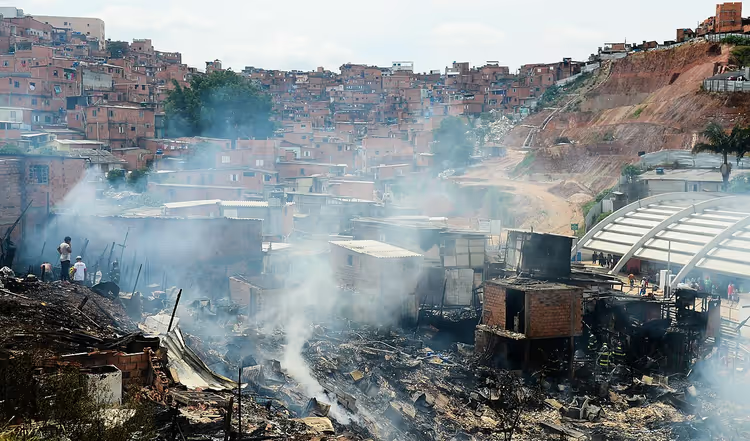
Favelas exist in São Paulo too, although Alina has only seen them in passing. She considers the prejudice that all poor people are dangerous to be wrong. Some residents would indeed never take what belongs to others. Another category makes a living from robbery.
Tourists are better off staying in expensive neighborhoods. This still does not guarantee complete safety, because the streets are not guarded around the clock.
 © Agência Brasil Fotografias · CC BYPhoto: Agência Brasil Fotografias, CC BY (https://creativecommons.org/licenses/by/2.0), Wikimedia Commons
The crime situation in major Brazilian cities remains tense, as warned by the German diplomatic mission. Alina tells of a chase: a robber was riding a motorcycle, with two police officers racing after him. According to her, you do not need to watch local soap operas, because life here is a soap opera.
Alina's family tries not to go out in the evenings and not to use public transport. The metro and buses are comfortable, but robberies happen there too. There are known cases of people boarding a bus with weapons and demanding bags. The most convenient way to get around is by taxi and Uber.
Simply going out and walking down the street is also not an option. A thief on a scooter can snatch your bag at speed. If they want to take a walk, Alina and her husband drive to a park for that.
There is also an unpleasant consequence. Because of robbers, a person who falls ill on the street may not get help. Fraudsters pretended to be victims, and their accomplices attacked those who came over.
How to get there and what about the visa
The flight from Europe to Brazil is long but comfortable. Alina even likes it: on the plane you are fed, given drinks, and you can get a good night's sleep.
A visa is not required for everyone. Citizens of Germany and most EU countries do not need one if the trip is no longer than 90 days (as of 09/2026, German Federal Foreign Office). The stay can be extended for another 90 days. To do this, you need to go through a procedure with the federal police and fill out documents.
Vaccinations are not required for a regular trip. They are only needed if you plan to visit the Amazon.
Why you can't get by without Portuguese
English is difficult in Brazil. Even in hotels and restaurants, staff do not always respond in English, and Alina has to pull out an online translator. Before the trip, learn at least a few phrases.
Alina started learning Portuguese to communicate with locals. She studied Spanish at university, and that helps: the languages are similar. Now she orders coffee herself, makes doctor's appointments, and handles everyday matters. Locals also make mistakes in the language, although Brazilian Portuguese is considered simplified.
What to prepare for on the trip
Mobile internet works everywhere, and fifth-generation coverage is already available in some places. Set up an eSIM for Brazil in advance so you stay connected from day one.
People here are very loud. You will get used to it quickly, but the first few days will feel unusual.
Being fifteen minutes late is considered normal. Alina once waited almost an hour for an appointment at a clinic, and no one even apologized.
Street vendors are treated casually. At a beauty salon, a woman walked in and started offering handmade candies to Alina. For Brazil, this is normal. Don't be afraid to buy something from street sellers.
Locals find a reason to celebrate every day. So you won't be bored.
How to travel within the country
Ground transportation in Brazil is poorly developed. Highways have strict speed limits, so even a short distance will take a long time. The railway is mostly for freight. It is easier and cheaper to travel around the country by plane.
Option | When it works | What to keep in mind |
|---|---|---|
Plane between cities | Medium and long routes | There are low-cost carriers GOL and Azul, a round-trip ticket is cheaper than in Europe |
Helicopter | Short distances along the coast | Fast but expensive; this is what wealthy locals do |
Car and bus | Short trips | Speed limits make the journey long |
Brazil is called the country of helicopters. The road to the ocean, just a few dozen kilometers away, can take half a day, so many people fly. Alina knows a woman who lives near the coast and calls a helicopter for errands. The local Uber even has a motorcycle taxi option.
Alina and her husband spent a month on the ocean shore, in the state of Santa Catarina, in the town of São Francisco do Sul. Colonial Portuguese architecture, quiet, and fresh seafood. Nearby is the city of Joinville. There you can walk in the Atlantic Forest and see monkeys in their natural habitat.
Two hours from São Paulo is the Brazilian Switzerland, the city of Campos do Jordão (Campos do Jordão). Here it is hard to believe you are still in Brazil.
And Alina has many plans. She wants to see Rio, go to a southern resort where football stars vacation, and walk through the Amazon forests.
Alina and her husband also travel around the continent. They recently returned from Buenos Aires. During dinner on one of the capital's most popular streets, a woman came up and simply took meat from the plate. South America is colorful.
What to try from food and drinks
Start with rodízio. That is the name of a gastronomic ritual: waiters bring freshly cooked meat to the tables non-stop. The food here is very tasty.
From seafood, be sure to try octopus and shrimp. And of course, fresh fish.
There is also a coffee peculiarity. Even after a heavy dinner, Brazilians order dessert and espresso. They mostly drink Americano and espresso, but latte and cappuccino are not easy to find in coffee shops. Instead of a latte, Alina was once served hot cocoa, and at a restaurant they brought her espresso with foam.
From drinks, we recommend coconut water. It is sold in regular bottles, and you can also drink it through a straw straight from a coconut.
A few Portuguese words for the trip
Locals greet each other at length. First comes the informal "Olá", then a greeting based on the time of day: "Bom dia" in the morning, "Boa tarde" in the afternoon, "Boa noite" in the evening. At the end, they will ask you "Tudo bem?", the equivalent of the English "What's up?". You do not have to answer it.
Saying goodbye is also long: they will wish you a good week, a good weekend, and all the best. Learn these phrases, and a Brazilian's sympathy is guaranteed.
⁉️🤔 Frequently asked questions
When is the best time to go to Brazil?
There is no single best month. In December it is warm in both the south and the north of the country. If mild weather without exhausting humidity matters to you, choose the southern states.
Do I need a visa to travel to Brazil?
Citizens of Germany and most EU countries do not need a visa for a tourist trip of up to 90 days (as of 09/2026, official website of the German Federal Foreign Office). Vaccinations are only required before traveling to the Amazon.
Is São Paulo safe?
The crime rate in large Brazilian cities is high, as warned by the German Embassy in Brazil. It is safer to get around by taxi or Uber and not carry expensive items with you.
What language is spoken in Brazil?
The country speaks Portuguese, and English is poorly known even in hotels. Learn at least the greetings and the question "Tudo bem?".
How to get around the country?
Within the country, it is more convenient to fly; there are low-cost carriers GOL and Azul. In cities, taxis and Uber are safer.
In short: what is worth booking
If you are going to Brazil for the first time, prepare in advance. Check your passport expiration date and entry rules, compare hotels, and plan flights between cities.
- Want to stay in a megacity: compare hotels in São Paulo on Trip.com.
- Planning domestic flights: check airline tickets on Kiwi.com.

A small editorial team writing guides for independent travel. We travel ourselves, but we haven’t been everywhere, so we check prices, opening hours and how to get there against official sources.