




 AIIllustrative image: AI-generated
Hotels in Europe in November 2027: where prices drop the most
There is a dead zone in the European travel calendar. It is the weeks between the end of fall break and the opening of the Christmas markets. No school holidays, no long weekends, no reason to go. So hotels there cost what they never cost at any other time.
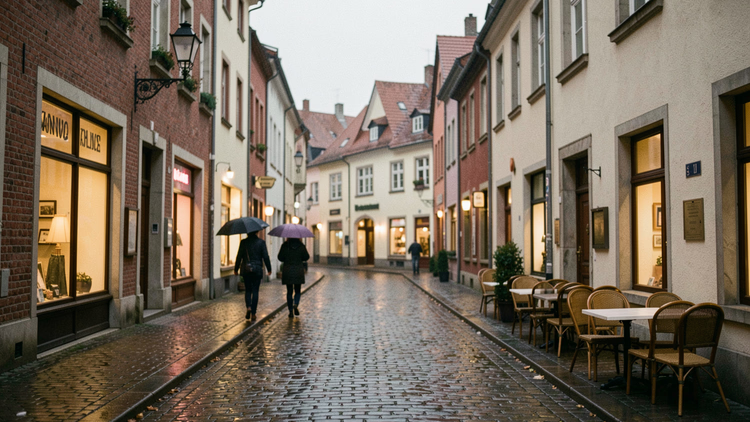
The catch is something else. It is November. The question is not whether the month has downsides, but how much they get in the way in the specific city you choose. In Seville and Malta, November is one of the most pleasant months of the year. In Prague and Krakow, it means eight degrees, early darkness, and a high chance of drizzle.
Below are the exact 2027 window, the real price difference, and eight cities with an honest assessment. We will show which trips November works for and which it does not.
Ad: this article contains affiliate links, we earn a commission if you book through them, at no extra cost to you.
The November 2027 calendar window
💡 In short:
- The cheapest window of the year: November 8 to 21, 2027, with the lowest prices on Tuesday, Wednesday, and Thursday of the week of November 8-12.
- Hotels in the second week of November are often a quarter cheaper than in May.
- Best destinations: Valletta, Seville, Palermo, and Valencia, around 20-21 °C.
- November does not work north of the 55th parallel or in Lisbon.
- Dates and holidays: 09/2026, checked against the 2027 holiday calendar.
The November calendar is more precise than it seems. Year after year, three dates shape prices in this month.
The first date is set by All Saints' Day. In 2027 it falls on Monday, November 1 (German holiday calendar). It is a public holiday in Baden-Württemberg, Bavaria, North Rhine-Westphalia, Rhineland-Palatinate, and Saarland, as well as in Austria and parts of the Swiss cantons. A Monday creates a long weekend. That is why the first weekend of November is expensive and busy.
The second date is the Day of Repentance and Prayer, Buß- und Bettag. In 2027 it falls on Wednesday, November 17, and remains a public holiday only in Saxony (Saxony holidays). In several federal states, schoolchildren have the day off. The day has a moderate effect on prices, but in Dresden and Leipzig you will feel the difference.
The third date is set by the first Advent. In 2027 it falls on Sunday, November 28 (first Advent 2027). Major Christmas markets usually open the previous week, meaning around November 22. From that point on, hotel prices in Nuremberg, Vienna, Dresden, Strasbourg, Prague, and Budapest rise in jumps. Sometimes they climb above summer levels.
The holiday-free stretch is November 8 to 21. The absolute price minimum falls on Tuesday, Wednesday, and Thursday of the week of November 8-12. If you want to catch both weather and price, plan your trip for those dates.
What actually drives the price difference
Hotel prices in European cities follow demand almost directly. The supply of beds does not change in the short term. When occupancy drops, the average room rate gives way, and disproportionately so. The weakest hotels are the first to enter the price war.
In practice, prices in the second week of November are often a quarter or even a third below the May level in the same city. These figures are based on our observations, not on government statistics. The actual spread depends heavily on whether a major trade fair is taking place on your dates. Airfare moves less, but in the same direction. Airlines cut flight frequency in November, and that partially eats into the effect.
Two expense categories get cheaper on top of that, regardless of the hotel. Restaurant tables are available again without a reservation. Timed entry slots at major museums can be booked a couple of days before your visit. In Rome, Florence, or Barcelona in May, you cannot do that. You can check hotels for your dates on Trip.com.
One expense category goes up: cancellation and rebooking flexibility. Weather disruptions are more likely in November, and cheap rates rarely offer refunds.
Eight cities: a comparison
The table shows multi-year average daily highs for November (based on the climate atlas).
City | Average high in November | Rain risk | What November works for |
|---|---|---|---|
Valletta, Malta | around 21 °C | low to medium | The strongest option: warm, dry, museums and coastal trails without the heat |
Seville | around 21 °C | medium | The city becomes walkable, the Alcázar and the cathedral with no lines |
Palermo | around 20 °C | medium | Markets, churches, street food; too late for swimming, but Madonie hikes are excellent |
Valencia | around 20 °C | low | The best price-to-weather ratio in Spain, easy to get around by bike |
Athens | around 19 °C | medium | The Acropolis without midday closures and without crowds |
Rome | around 17 °C | high | Museums and churches carry the whole itinerary, rain probability is high |
Budapest | around 9 °C | medium | Thermal baths, coffeehouses, ruin bars; weather is secondary |
Krakow | around 6 °C | medium | Very cheap, plenty of indoor spaces, short days |
Two cities are missing from the list on purpose. Lisbon appears in every November roundup, but November is exactly when it gets the most precipitation of the year, around 90 mm (Lisbon weather atlas). The sun shines for about six hours a day. The temperature of around 17 °C is accurate, but the brochure pictures are not. If you want Portugal in November, Madeira is a safer bet.
Barcelona didn't make the list because of major conferences. They completely wipe out the price advantage. Lisbon has the same problem in the first week of November during Web Summit, as do Düsseldorf and Frankfurt during the autumn trade fairs. For tours in the cities from the table, it's worth comparing options on GetYourGuide in advance.
Where November doesn't work
North of the 55th parallel, November is not suited to city trips. In Stockholm, Helsinki, Riga, and Edinburgh, the sun sets between 3:30 and 4:00 PM. The holiday lights aren't on yet. The days are gray and lack the saving grace of snow. For these destinations, December will be a better choice despite the higher prices.
The same applies to mountain towns and anything that depends on views. Innsbruck, Bolzano, Bern, and Salzburg get stuck in November between hiking season and ski season. Cable cars are idle, huts are closed, and low fog lingers for days. If you're going to the Alps in November, focus on thermal baths and cities, not on panoramas.
And finally, water. Danube, Rhine, and Douro river cruises run on a limited schedule in November or don't run at all. Coastal villages outside cities shut down. November rewards cities with a dense indoor program and punishes everything else.
An underrated factor: daylight hours and winter opening times
Daylight saving time ends on the last weekend of October. After that, it gets dark around 4:30 PM in Central Europe, around 5:00 PM in Malta, around 5:15 PM in Athens, and around 6:00 to 6:20 PM in southern Spain (sunset in Vienna by month). In November you have noticeably fewer daylight hours than the fourteen you get in May. Anyone who copies their spring itinerary one-to-one won't even manage half of it.
At the same time, many sights switch to winter opening hours. This happens in late October or early November. Archaeological sites in Greece and Italy close between 3:00 and 5:00 PM instead of 8:00 PM. Gardens and viewpoints sometimes close even earlier. Some museums schedule maintenance closures in November because visitor numbers are low.
The practical takeaway is simple. Plan two items per day instead of four. Save the main outdoor sights for before 2:00 PM. Check opening hours on the official website the day before your visit. The evening then belongs to restaurants, thermal baths, and concerts. Theater and opera season is in full swing in November, and tickets cost what you simply never see in summer.

November also forces you to rearrange the rhythm of the day itself. You give the morning to outdoor sights, and after lunch you look for indoor spaces. That way you don't waste daylight on travel between distant points.
How to actually get this discount
Four things separate the theoretical benefit from the real one.
Let's start with the day of the week. A Tuesday check-in and Friday check-out in November is regularly cheaper than a Thursday check-in and Sunday check-out. In business cities like Frankfurt, Zurich, or Milan, the rule is reversed: weekends are cheaper there, and midweek is more expensive.
The second factor concerns the trade fair calendar. Before booking, check the city's event calendar. One major industry trade show doubles the price level across an entire district for four days, and hotel availability drops sharply.
The third point relates to cancellation terms. The risk of bad weather and strikes is higher in November. A rate with free cancellation costs slightly more than a non-refundable one, and in November that premium usually pays off. With a better offer, you can simply move your trip two weeks later and lose nothing. The risk of a trip falling through is additionally covered by insurance, so compare insurance terms in advance.
The fourth point concerns the hotel category. Upper mid-range hotels and four-star properties see the biggest price drops. In November, they are no longer filled with business travelers. Hostels and simple guesthouses discount less. If you usually book three stars, in November you often get four stars at your usual price.
That is exactly why the same trip should be checked with two date options. The price changes not because of the season as a whole, but because of the specific week and the specific event in the city.
⁉️🤔 Frequently asked questions
When is the cheapest time in November 2027?
The price minimum falls on the period from November 8 to 21, 2027. The best time is Tuesday, Wednesday, and Thursday of the week of November 8 to 12. The window after November 1 is closed by the All Saints' Day long weekend. After November 22, Christmas markets open, and Vienna, Prague, Nuremberg, and Budapest rise to summer levels or higher.
Why is Lisbon not on the list?
November in Lisbon is the rainiest month of the year, with about 90 mm of precipitation. For Portugal in November, Madeira is a more reliable choice.
Is November a good time for Rome and Athens?
Yes, but you will have to shift your itinerary indoors. In Rome, the average high is around 17 °C with a high chance of rain, so museums, churches, and galleries carry the entire load. In Athens, it is around 19 °C, and in November you can see the Acropolis without the midday closure and without the crowds.
Where is it still warm in November?
Malta, Seville, Palermo, and Valencia hold at around 20-21 °C. The most reliable option remains Valletta in Malta.
How much daylight is there in November?
In Central Europe it gets dark around 4:30 PM, in Malta around 5:00 PM, in southern Spain around 6:00-6:20 PM. So schedule outdoor sights for the first half of the day.
Do I need a refundable rate?
Yes, in November the risk of bad weather and strikes is higher, and the premium for free cancellation usually pays off. Just check the deadline by which cancellation remains free.
In short: what to book
November offers real savings if you choose the middle of the month and the right city. Here is a quick matrix for your trip.
- If you want warmth and the sea in the frame: choose Valletta or Seville.
- If you are traveling for culture: choose Rome, Athens, or Budapest.
- If budget matters more than weather: choose Krakow and Budapest.
- If you are going to a business city: check the trade fair calendar before booking a hotel.
Find hotels for your date window on Trip.com, and book train tickets through the Trip.com train service.
Compare flights on Kiwi.com.

A small editorial team writing guides for independent travel. We travel ourselves, but we haven’t been everywhere, so we check prices, opening hours and how to get there against official sources.